




Help Us Bypass Censorship. Share This.
Sign up to receive Our Weekly Briefing Newsletter
Begin your journey with weekly insights designed to expand awareness and ground you in truth. Our free tier gives you a powerful introduction without any commitment.
“The words were never gone. For two thousand years, they were simply waiting for us to learn how to see them.”
After 2,000 Years, the Unreadable Scrolls of Herculaneum Are Beginning to Speak
When Mount Vesuvius erupted in A.D. 79, the Roman cities of Pompeii and Herculaneum were overwhelmed by one of history’s most famous volcanic disasters. Buildings vanished beneath volcanic material, lives ended in moments, and an entire world was effectively frozen in time.
Inside one luxurious villa near Herculaneum was something especially remarkable: a private library filled with papyrus scrolls.
The eruption subjected those scrolls to extraordinary heat, carbonizing them into fragile blackened objects that today look more like pieces of charcoal than books. Ordinarily, such destruction would have erased their contents forever. Instead, Vesuvius created an extraordinary historical paradox.
The catastrophe that destroyed the library also helped preserve it.
When excavators began recovering the scrolls in the 18th century from what became known as the Villa of the Papyri, they discovered that many could not safely be opened. The words were still physically present, but attempting to unroll the carbonized papyrus could fracture or destroy it.
Humanity had recovered an ancient library.
We simply couldn’t read much of it.
Until now.
A LIBRARY SEALED FOR NEARLY 2,000 YEARS
The Herculaneum papyri represent something exceptionally rare: the remains of an ancient library surviving directly from the classical world.
Yet survival and accessibility are very different things.
Many ancient works known today endured because generations of scribes repeatedly copied them. Others disappeared entirely. In some cases, modern scholars know that a work once existed only because another ancient writer mentioned it or quoted a small fragment.
The Herculaneum scrolls followed a different path. Their physical destruction prevented them from being read—but also contributed to their preservation.
More than 600 scrolls remain unopened today.
For generations, that created an almost impossible dilemma. Opening a scroll might reveal its contents, but the physical act could also destroy the object and the writing researchers hoped to recover.
The solution would eventually require something radically different:
Don’t open the scroll at all.
Instead, look inside it.
READING A BOOK WITHOUT OPENING IT
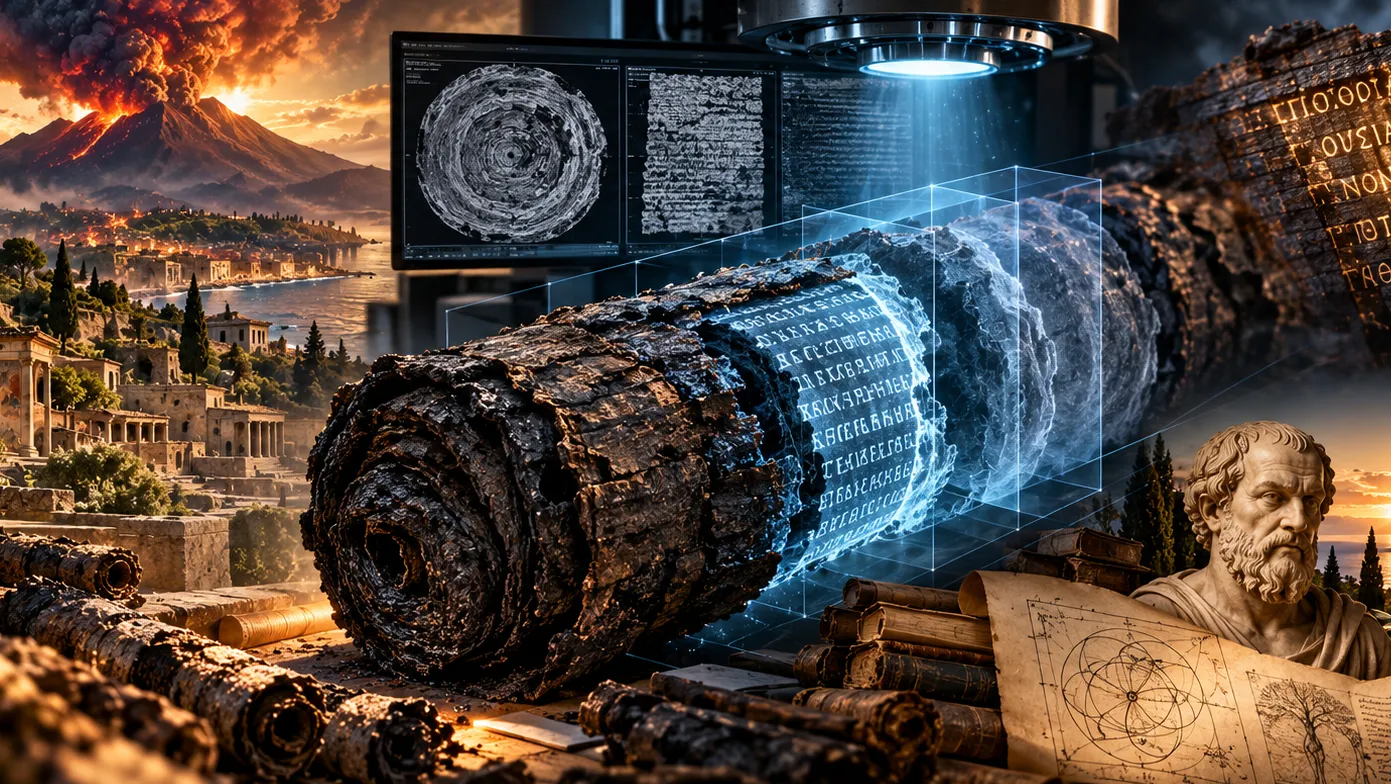
Researchers involved with the Vesuvius Challenge are combining advanced X-ray imaging, computer vision, machine learning and classical scholarship to virtually reconstruct the carbonized scrolls.
Powerful X-rays create three-dimensional maps of their internal structures. Computer systems help identify and trace individual layers of crumpled papyrus. Those layers can then be digitally flattened, while computational techniques help researchers detect traces of ink.
The scale is enormous. Individual scans can generate hundreds of terabytes of data. Once possible writing is identified, papyrologists and classicists still have to perform the painstaking work of recognizing ancient Greek letters, assembling words and reconstructing meaning. Pasted markdown
This isn’t simply a case of artificial intelligence “reading” ancient books.
It is a collaboration between technology and human expertise—physics, chemistry, imaging science, computer science, archaeology and classical scholarship working together on a problem that none of those disciplines could easily solve alone.
In June 2026, that effort reached a major milestone.
Researchers announced that the surviving portion of a carbonized scroll known as PHerc. 1667 had been virtually unwrapped, producing nearly 1.5 meters of continuous text across approximately 20 columns. Another scroll yielded more than 70 columns, while additional work identified previously unknown books by the Epicurean philosopher Philodemus, including On Vices, Book 1 and On Gods, Book 8. Pasted markdown
Instead of isolated letters and fragments, scholars can increasingly begin following arguments across multiple columns.
Ancient books are becoming books again.
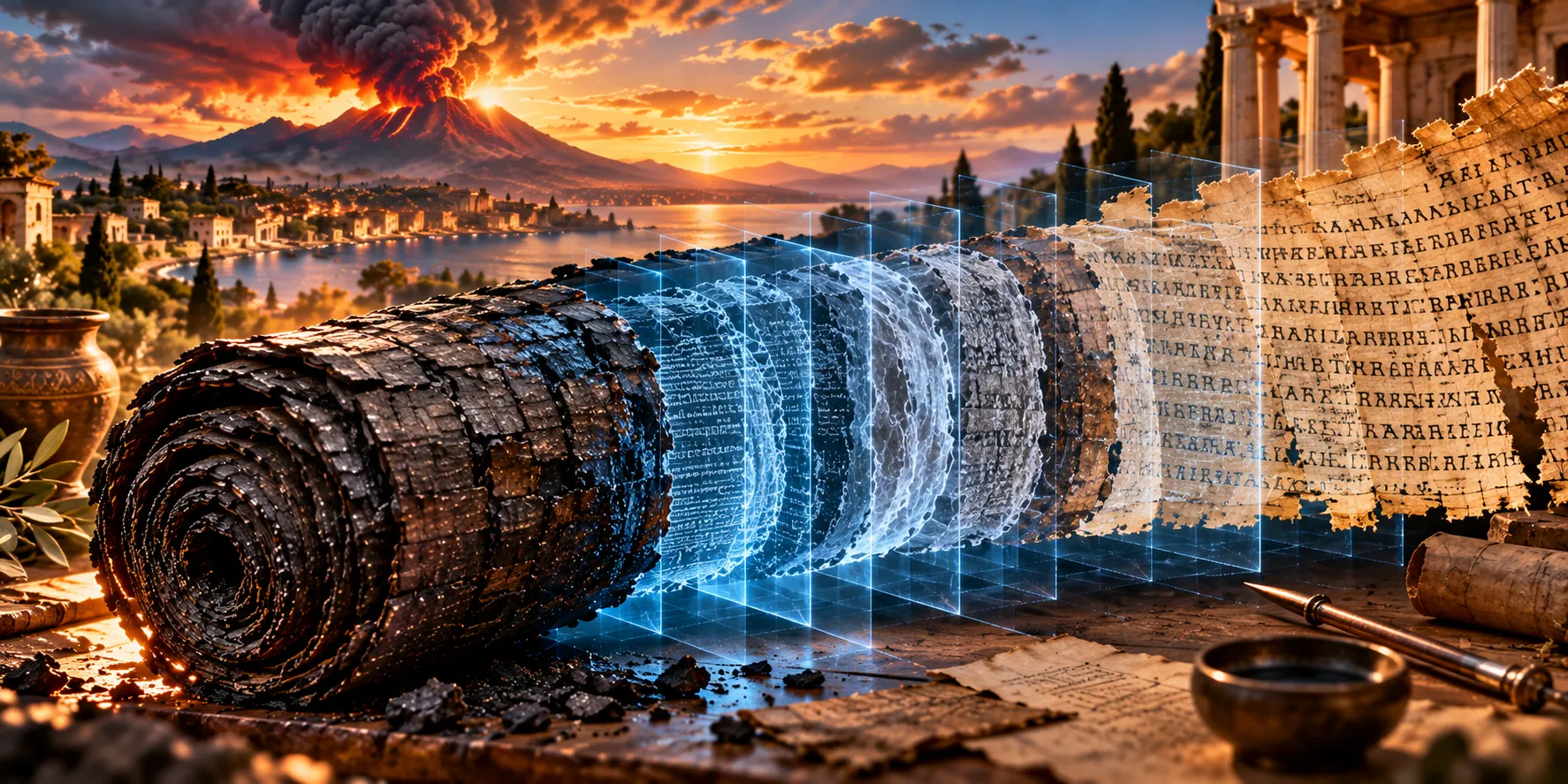
WHAT THE SCROLLS ARE BEGINNING TO SAY
Perhaps the most fascinating part of the story is what is actually emerging from the darkness.
PHerc. 1667 appears to contain a philosophical work examining ethics, human behavior, reason, the arts and the impulses that drive human action. Its author has not been established, although researchers believe the material may reflect Stoic thought. One possibility under consideration is Chrysippus, one of the foundational figures of Stoicism whose writings have been largely lost. Pasted markdown
Among the concepts appearing in the text is phronēsis—practical wisdom and the discernment involved in choosing between virtue and vice. Another is hormē, the impulse or drive toward action and what can happen when impulse overwhelms reason.
One recovered passage is particularly striking:
“We will inquire into something, but we will not grasp it, if in some way we depart from ourselves and from our own nature.”
Another scroll, PHerc. 139, has revealed something entirely different.
Researchers discovered an identifying title at the end of the work: Philodemus, On Gods, Book 8. Until its discovery, only the first book of On Gods had been known.
Early readings include concepts translated as “providence,” “god,” “invisible entities,” “according to nature,” “living beings,” “future things” and an “intellective principle.” Scholars believe the material represents part of an extended Epicurean exploration of theology, including questions concerning the gods, providence and the structure of the universe. Pasted markdown
That does not mean researchers have uncovered some hidden ancient spiritual doctrine.
It means something arguably more fascinating:
Our surviving picture of ancient thought is incomplete.
Entire philosophical works disappeared from history. Some thinkers survive only in fragments. Others may have vanished completely.
And some of those missing voices may still exist inside Herculaneum’s unopened scrolls.
SCIENTISTS ARE NOW BURNING SCROLLS TO READ THEM
Then the story took an unexpected turn.
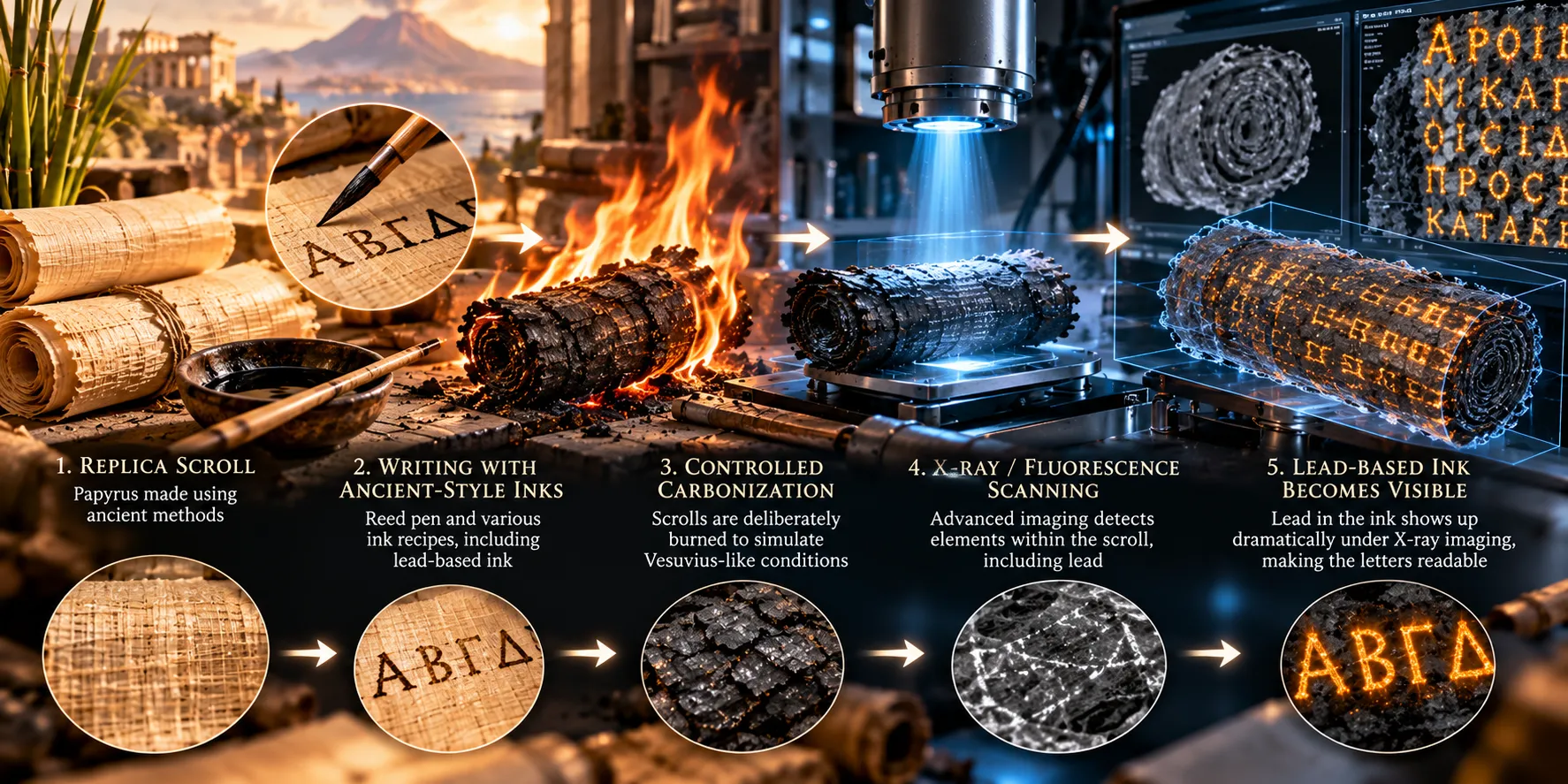
Researchers recently began creating their own ancient-style scrolls using Egyptian papyrus, reed writing instruments and different types of ink.
And then they deliberately burned them.
The goal was to recreate aspects of the carbonization process and determine how various ancient inks respond to modern imaging techniques. One experiment proved particularly interesting: ink containing lead remained dramatically more visible under X-ray imaging because lead absorbs X-rays much more strongly than the carbonized papyrus surrounding it.
One researcher described the resulting letters as lighting up “like a Christmas tree.” Pasted markdown
Researchers also found that handheld X-ray fluorescence equipment could detect lead inside a scroll. If the technique proves useful with authentic Herculaneum material, it could provide a relatively efficient way of screening unopened scrolls and identifying particularly promising candidates for more sophisticated scanning.
There are limitations. Not every ancient ink contained lead, and artificially carbonized papyrus cannot perfectly reproduce what happened beneath Vesuvius nearly two thousand years ago. Researchers are therefore treating the method as another potential tool rather than a universal solution. Pasted markdown
But the experiment captures something extraordinary about this entire project:
Nearly 2,000 years after Vesuvius accidentally burned a library, scientists are intentionally burning scrolls to learn how to read the originals.
THE PAST IS BEGINNING TO SPEAK
Perhaps the most remarkable thing about Herculaneum is that this knowledge was never truly lost. For nearly two thousand years, the words remained exactly where their authors had left them, preserved inside layers of carbonized papyrus that no one could safely open. The people who wrote them disappeared, as did the readers who once held these scrolls in their hands. Empires rose and fell, religions spread across continents, languages evolved, and civilizations transformed. Through all of it, the scrolls remained silent—not because the words were gone, but because we had not yet developed the ability to see them.
That is what is changing now. Researchers can peer inside a scroll without physically opening it, digitally separate layers that have not moved since antiquity, and gradually reconstruct writing from something that appears to the naked eye to be little more than charcoal. What begins as an almost imperceptible mark becomes a recognizable letter, then a word, a sentence and eventually an argument. Suddenly, a philosopher who lived two thousand years ago can enter the human conversation again. Pasted markdown
And there is still an enormous amount we do not know. More than 600 Herculaneum scrolls remain unopened, and no one can say with certainty what is waiting inside them. They may contain additional works by philosophers we already know, histories, poetry, scientific observations or writings by people whose names disappeared completely from the historical record. Some discoveries may reshape scholarly understanding of the ancient world; others may simply fill in missing pieces. Either way, each recovered passage restores something that history had effectively removed from human reach. Pasted markdown
There is also a remarkable symmetry in how that recovery is happening. Ancient hands made the ink and rolled the papyrus. Vesuvius brought the world around them to an end while unintentionally preserving what remained. Archaeologists recovered the scrolls centuries later but could not safely reach the words inside. Another few hundred years then passed before X-ray imaging, chemistry, computer vision, machine learning and classical scholarship finally converged to make the invisible visible. Two civilizations separated by nearly two millennia are now meeting on a screen—one left the message, and the other finally developed the tools to receive it. Pasted markdown
We live in an age increasingly focused on what comes next—artificial intelligence, emerging technologies and discoveries that may reshape how we understand ourselves and the world around us. Yet one of the most extraordinary capabilities of those technologies may be their ability to recover what humanity left behind. Somewhere inside these fragile blackened rolls, a philosopher may still be midway through an argument, a sentence may be waiting for its ending, or an idea abandoned by history may be only a few layers of papyrus away from entering human consciousness again.
The library was never truly empty. We simply could not hear it.
Now, slowly—letter by letter, line by line, scroll by scroll—the past is beginning to speak again.
Sign up to receive Our Weekly Briefing Newsletter
Begin your journey with weekly insights designed to expand awareness and ground you in truth. Our free tier gives you a powerful introduction without any commitment.
STOP DROWNING IN THE NOISE. START SEEING THE TRUTH. Join over 99,000 truth seekers. Get the essential intelligence, alternative news, and disclosure updates that the mainstream media won’t touch.
Latest Reports
 Monthly ReportConscious Practices · October 2026 EditionOctober 5, 2026
 Weekly ReportAwakening The Sleeping Giant · October 5th EditionOctober 5, 2026
 Weekly ReportAwakening The Sleeping Giant · September 28th EditionSeptember 28, 2026
 Weekly ReportAwakening The Sleeping Giant · September 21st EditionSeptember 21, 2026View all weekly reports
Special Reports
 Special ReportTHE AWAKENING JOURNEY: Hero’s Journey Part II · Week 1October 3, 2026
 Special ReportGlobal Everything Collapse · Economic Chaos · Part IOctober 1, 2026
 Special ReportCreating A Conscious Culture · Part ISeptember 3, 2026
 Special ReportThe Great Healing: Detox, Defense & Sovereignty In an Engineered World · Part ISeptember 1, 2026View all special reports
Help Us Bypass Censorship. Share This.
Join the Discussion
Related Posts


Have questions?
At Great Awakening Report, we are dedicated to supporting your journey toward truth and enlightenment through our specialized Coaching and Consulting services.
Coaching Services: Our coaching programs are designed to guide you through personal awakening and transformation. We offer personalized sessions that focus on expanding consciousness, uncovering hidden truths, and fostering spiritual growth. Our experienced coaches provide the tools and insights necessary to navigate your path with clarity and confidence.
Consulting Services: For organizations and individuals seeking deeper understanding and strategic guidance, our consulting services offer expert analysis and solutions. We delve into areas such as global transitions, alternative news insights, and consciousness studies to provide comprehensive strategies tailored to your unique objectives.
Embark on a transformative journey with our Coaching and Consulting services, and unlock your highest potential. To learn more and schedule a session, visit our Coaching and Consulting pages.
Thank you
Thank you to our subscribers and readers for your continued support and dedication to truth and awakening. Your encouragement, engagement, and belief in our mission make everything we do possible. Together, we are expanding awareness and helping illuminate the path forward.
If you would like to further support the Great Awakening team and our ongoing efforts to share insight, knowledge, and truth, you can DONATE HERE.
With deep gratitude,
– Great Awakening Team
About the Author: Great Awakening Team

We are a community. We are cultural creatives and like minded people seeking the truth and focusing on disclosure, awakening and consciousness. Our focus is real news as researchers, reporters and truth seekers. We are here to teach, to spread the word, to serve and to help. We are a collective, a movement, free from all programing, not closed minded and not discriminatory. We are not political. We are not religious but we are spiritual. We study, research, and report on a wide range of subjects and topics, from the current geopolitical climate to health and wellness, from earth’s history to spiritual practices. We are forward thinkers and visionaries, we are guides for the transition as we usher in The Great Awakening.
THIS WEBSITE DOES NOT PROVIDE MEDICAL ADVICE: The information, including but not limited to text, graphics, images, and other material contained on this website, are for informational purposes only. No material on this site is intended to be a substitute for professional medical advice, diagnosis, or treatment. Always seek the advice of your physician or other qualified health care provider with any questions you may have regarding a medical condition or treatment and before undertaking a new health care regimen, and never disregard professional medical advice or delay in seeking it because of something you have read on this website.
DISCLAIMER: All statements, claims, views and opinions that appear anywhere on this site, whether stated as theories or absolute facts, are always presented by The Great Awakening Report (GAR) as unverified—and should be personally fact checked and discerned by you, the reader.Any opinions or statements herein presented are not necessarily promoted, endorsed, or agreed to by GAR, those who work with GAR, or those who read or subscribe to GAR.Any belief or conclusion gleaned from content on this site is solely the responsibility of you the reader to substantiate.Any actions taken by those who read material on this site are solely the responsibility of the acting party.You are encouraged to think for yourself and do your own research.Nothing on this site is meant to be believed without question or personal appraisal.
COPYRIGHT DISCLAIMER: Citation of articles and authors in this report does not imply ownership. Works and images presented here fall under Fair Use Section 107 and are used for commentary on globally significant newsworthy events. Under Section 107 of the Copyright Act 1976, allowance is made for fair use for purposes such as criticism, comment, news reporting, teaching, scholarship, and research.
COMMUNITY GUIDELINES DISCLAIMER: The points of view and purpose of this video is not to bully or harass anybody, but rather share that opinion and thoughts with other like-minded individuals curious about the subject.