







Published Date: November 13th, 2026
WEEKLY REPORT
TRUTH///AWAKENING///DISCLOSURE
TRUTH SEEKERS WEEKLY BRIEFINGS, MASTER CLASS CONNECTING THE DOTS
CROSSING THE THRESHOLD | A WORLD IN TRANSFORMATION
November 13, 2026 | Fourteen Investigations • Seven Global Developments • Five Defining Questions
“As political uncertainty, economic pressures, geopolitical conflicts, technological acceleration, and scientific discoveries converge, humanity faces a defining challenge: navigating the transformation of established systems with discernment, resilience, and conscious leadership while creating the foundations for a better world.”
Global Convergence • Political & Institutional Transformation • Economic Compression • Geopolitical Realignment • AI & Technological Revolution • Scientific Discovery & Consciousness • Connecting the Dots • Crossing the Threshold • Subscribers Q&A
Call to The Awakened
“Let these days be etched in history as the moment we rose to reclaim our Republic from the grip of those who have long exploited its people for their own gain. Stand strong, fight with honor, and let justice prevail. Together, we restore the nation to its true greatness.”
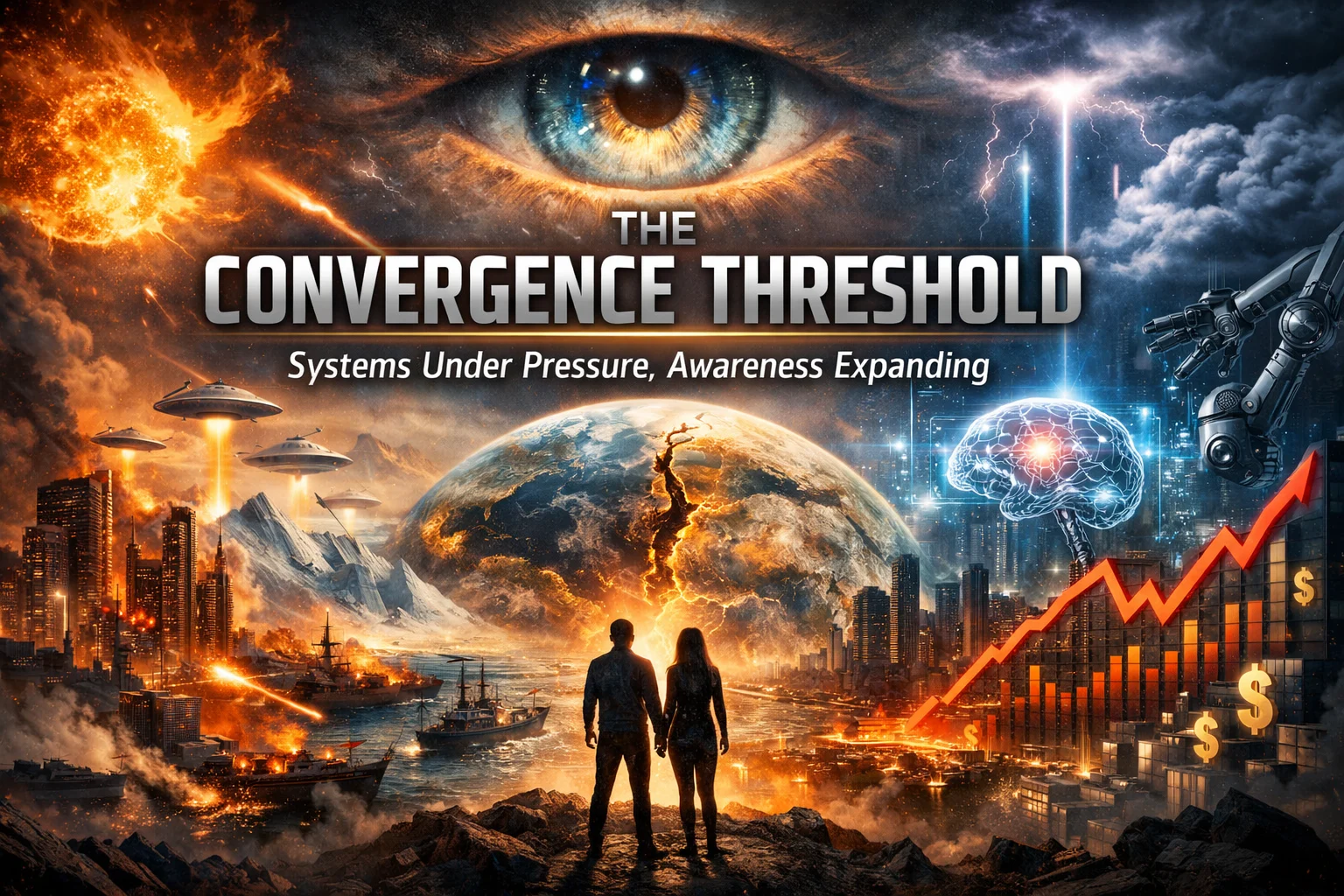
Civilizations Journey to The Precipice of Convergence Threshold
“Be Strong Enough to Stand Alone / Be Yourself Enough to Stand Apart / And When the Time Comes, Be Wise Enough to Stand Together”
The Great Reset | Roll Back Pricing of Everything
We are living through a period of profound global disruption. Institutions once viewed as stable pillars—government, finance, media, technology, and healthcare—are facing growing scrutiny as geopolitical conflict, economic instability, and political tension expose deeper systemic pressures.
Rather than isolated crises, these events point to a broader restructuring of global systems. Power structures, economic frameworks, and long-standing narratives are all being tested simultaneously, creating what many observers describe as a period of accelerated change.
This Weekly Report compiles insights from 57 independent sources, many highlighting overlapping signals across geopolitics, economics, and societal trends. By organizing these developments along a timeline of emerging events, we aim to provide a clearer view of the forces shaping this moment.
As always, we encourage readers to approach the information with discernment and calm awareness. Preparation in uncertain times is largely mental—understanding the landscape helps us remain grounded as events continue to unfold.
“We The People”
If we the people, as a nation, do not work together to restore our founding father’s visions for our Constitutional Republic, our children could be lost and our nation will be destroyed. We all have a part to play in this peaceful, faithful, informed, prayer-filled participation and with forgiveness in our hearts for the corruption of this nation that we have been a party to, either knowingly or unknowingly.

Truth Seekers Weekly Briefing | Master Class Series | Published Every Friday
Last Warning: Prepare for something that you never expected to see in your lifetime. The Media will never let you know! The things around us could change very fast. – QAnon Telegram
“Ye shall hear of wars and rumors of wars. See that ye be not troubled, for all these things must come to pass, but the end is not yet.” – Matthew 24:6
Methodology Behind the Master Class on Connecting the Dots
The Master Class on Connecting the Dots is built on a structured, multi-layered methodology designed to help individuals develop discernment, signal awareness, and pattern recognition in a world shaped by information saturation, narrative volatility, and declining institutional trust. Rather than offering conclusions, this approach trains participants to detect meaningful signals, place them in context, and orient themselves within complexity with clarity and composure.
At its core, the methodology integrates three foundational disciplines:
Analytical and Critical Reasoning – evaluating headlines, timelines, data points, and official narratives by separating signal from noise, testing claims against evidence, and identifying inconsistencies, incentives, and omissions.
Signal and Pattern Recognition – tracking weak signals, repeated motifs, coordinated messaging, symbolic cues, institutional overlap, and timing alignments that, when viewed collectively, reveal larger structural patterns or converging trajectories.
Discernment and Observer Awareness – cultivating emotional neutrality, recognizing narrative framing and psychological influence, and learning to observe unfolding events without premature conclusions or reactive interpretation.
The process begins with broad-spectrum signal intake—comparing mainstream reporting, independent analysis, historical precedent, and direct accounts. Participants are then guided to map the who, what, when, where, why, and how of events, while monitoring incentives, power dynamics, escalation markers, and cross-domain convergence across politics, finance, technology, culture, and belief systems.
Ultimately, Connecting the Dots is not about arriving at a fixed interpretation—it is about strengthening one’s capacity to track signals over time, recognize emerging patterns, and navigate uncertainty with coherence, resilience, and sovereignty. The Master Class functions as both a practical framework and an orientation lens, supporting the shift from passive information consumption to informed, self-directed understanding.
Great Awakening Featured Reports
The Great Awakening Featured Reports offer a comprehensive and multi-dimensional guide to understanding the rapidly unfolding events shaping our world. Designed for awakened minds and discerning truth seekers, these reports synthesize hard-to-find data, suppressed knowledge, and spiritual insight to help you navigate global transformation with clarity and confidence. Each report series serves a unique purpose—from decoding mainstream and alternative narratives to tracking the spiritual evolution of humanity and exposing hidden truths withheld from public view. Together, they form a powerful resource for those seeking not just information, but illumination, discernment, and alignment in the midst of chaos.
Great Awakening Featured Reports include:
📌 Monthly Reports – Covering the latest geopolitical, geoweather, economic, health, true history, suppressed technologies, ET disclosures, and seismic global shifts.
📌 Truth Seekers Weekly Briefings – Master Class in Connecting the Dots, Top 5 MSM News explained, Top 5 Alternative News reviewed, and Subscriber Q&A Top 5 most asked questions.
📌 Awakening Sleeping Giant Weekly Reports – Tracking global intelligence news and key events effecting a mass global awakening.
📌 Spiritual Practice Reports – Tools and techniques for maintaining alignment and higher heart consciousness coherence.
📌 Special Reports; New & Updated – Breaking revelations and disclosures you won’t hear or read anywhere else.
Get ready to expand your awareness, sharpen your discernment, and step fully into your sovereignty. The dots are there—it’s time to connect them.

Truth Seeker Report Audio Reviews
“When truth emerges, illusions shatter. As the old world crumbles, a new one rises—built on sovereignty, wisdom, and the unbreakable power of unity.”
At Truth Seekers Weekly Briefing, our research process begins with a comprehensive review of both Mainstream Media (MSM) and Alternative News sources. Our team tracks major stories, emerging patterns, and overlooked developments to identify the most relevant signals shaping the week’s events.
Using our “Connecting the Dots” approach, we analyze these developments through rational, critical, and logical thinking to reveal broader patterns often missed in surface-level reporting. The goal is not just to report the news, but to provide context that helps readers better understand the forces shaping the world around them.
To support this process, each section of the report includes a short audio review (approximately 12 minutes) summarizing the key findings of the week. These concise segments are designed for quick listening and help subscribers stay informed while developing their own discernment.
Our purpose is simple: not to tell you what to think—but to help you connect the dots and think for yourself.
“In a world clouded by distraction and deception, true power lies in seeing the bigger picture. When we sharpen our discernment, align with heart consciousness, and embrace the truth, we reclaim our sovereignty. The dots are there—it’s time to connect them.”
Truth Seekers Mainstream Media Audio Recap & Review, November 13th, 2026
Truth Seekers Alternative News Audio Recap & Review, November 13th, 2026
Truth Seekers Subscriber Q&A Audio Recap & Review, November 13th, 2026
Welcome, Truth Seekers Weekly Briefing — November 13th, 2026
“In a world clouded by distraction and deception, true power lies in seeing the bigger picture. When we sharpen our discernment, align with heart consciousness, and embrace the truth, we reclaim our sovereignty. The dots are there—it’s time to connect them.”
Welcome to your Master Class in Connecting the Dots.
In an era defined by information overload, narrative volatility, and engineered distraction, clarity no longer comes from consuming more content—it comes from learning how to recognize signals. Individual events rarely tell the full story on their own. But when signals repeat across different domains—politics, economics, media, and technology—they begin to form threads that reveal deeper forces shaping the world around us.
This process begins with grounded, rational thinking and the ability to separate meaningful signals from background noise. As signals accumulate, they form threads that stretch across institutions, policies, markets, and narratives. When multiple threads converge, patterns emerge—offering a clearer view of direction, momentum, and the structural shifts unfolding beneath the surface.
Discernment allows us to step into the observer position—recognizing how fear-based messaging, psychological pressure, and narrative framing are often used to keep populations reactive and divided. By focusing on signals rather than headlines, and patterns rather than personalities, we regain the clarity needed to navigate complexity without becoming overwhelmed by it.
Each week in the Truth Seekers Weekly Briefing, we track developments across geopolitics, economics, technology, and broader societal shifts—identifying signals, following threads, and revealing patterns of convergence as they emerge.
Our mission is simple:
to help you recognize signals early, follow threads intelligently, and understand patterns clearly—so you remain grounded, aware, and sovereign in a rapidly changing world.
Let’s dive in.
The following content is a compilation from various sources.
TRUTH SEEKERS WEEKLY BRIEFING | THE TOP SEVEN MAINSTREAM NEWS STORIES
November 13, 2026 | Global Developments • Economic Pressures • Political Accountability • Emerging Technologies • Institutional Transformation
Introduction | A World in Transition
This week’s Truth Seekers Weekly Briefing examines seven major news stories that reflect the growing complexity of America’s political, economic, and institutional landscape, alongside an increasingly interconnected global environment. From the 2026 midterm elections and renewed questions surrounding election integrity to congressional investigations, household affordability, migrant caravans, and shifting international relationships, the headlines reveal a world confronting simultaneous pressures across multiple systems. Meanwhile, China’s expanding technological competition, the acceleration of artificial intelligence infrastructure, and ongoing geopolitical conflicts are introducing new challenges involving national sovereignty, economic security, and international cooperation. Although mainstream news coverage often presents these developments as separate events, their broader implications deserve examination within the changing political, financial, and technological conditions shaping the future.
Throughout this week’s seven topics, we will examine how mainstream news organizations are reporting these developments, which perspectives dominate public discussion, and what important questions remain unresolved. The continuing debate over election administration raises concerns about transparency and public confidence, while congressional investigations bring renewed attention to government accountability, constitutional authority, and institutional credibility. Persistent affordability pressures highlight the distinction between official economic measurements and the financial realities experienced by American households. At the same time, migration disputes, geopolitical tensions, and competition over strategic technologies demonstrate how domestic political decisions increasingly influence international trade, security relationships, energy infrastructure, and global financial stability. Our objective is to distinguish documented developments from political interpretations, competing narratives, and emerging uncertainties, providing a clearer understanding of the forces influencing today’s headlines.
As we explore these stories, the larger question is whether the world’s established institutions can successfully adapt to accelerating technological change, economic uncertainty, shifting geopolitical relationships, and growing demands for transparency and accountability. Artificial intelligence is transforming expectations for industrial productivity and financial investment, while international competition is challenging long-standing assumptions about globalization and economic interdependence. Within the United States, political polarization and financial pressures continue to test public confidence in government and economic institutions. These developments do not necessarily point toward a single predetermined outcome, but they do suggest an increasingly consequential period of institutional adjustment, strategic realignment, and systemic transformation. Through independent thinking, critical examination, and informed discernment, this week’s briefing seeks to move beyond individual headlines and provide readers with the context needed to understand the challenges, opportunities, and decisions emerging across our rapidly changing world.
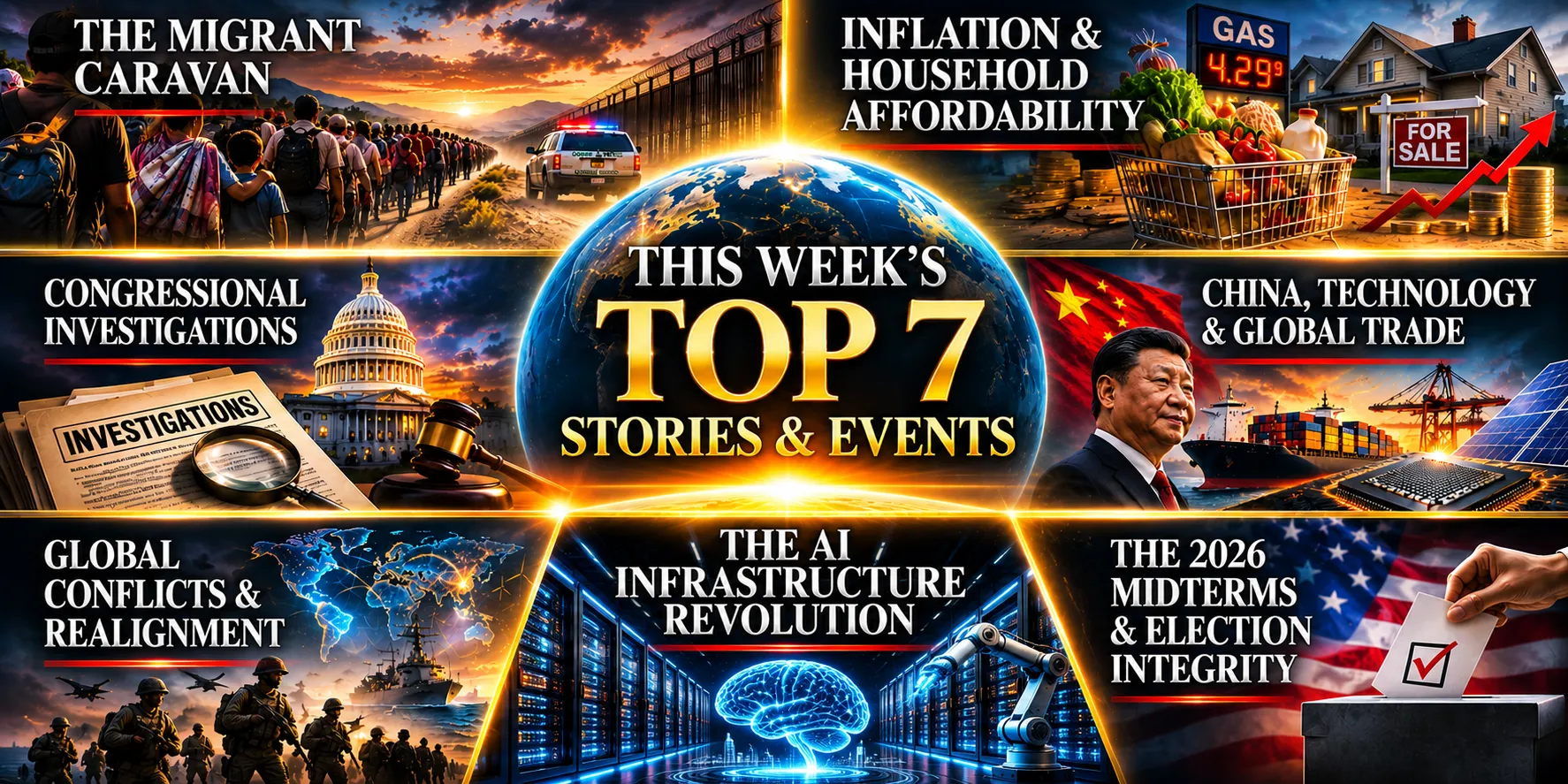
Truth Seekers Weekly Briefing | A Guide to Reviewing This Week’s Top Seven Stories
As you review this week’s seven leading news stories and events, approach each topic with an open mind, independent judgment, and a commitment to distinguishing verified facts, competing narratives, informed analysis, and unsubstantiated claims. Begin by understanding what actually happened, identifying the principal individuals and institutions involved, and examining how mainstream and alternative news sources interpret the same developments. Look beyond the headlines to consider the historical context, political motivations, economic consequences, and institutional interests that may influence both the events and their coverage. Pay particular attention to what is documented, what remains uncertain, and which important questions have not been adequately addressed. The objective is not simply to determine which narrative is most persuasive, but to develop a more complete understanding through critical thinking, source comparison, independent research, and personal discernment.
As you move through the seven stories, consider how individual developments may relate to broader changes in government accountability, economic stability, geopolitical relationships, technological transformation, and public confidence in established institutions. Reflect on the potential short-term consequences while remaining attentive to longer-term implications for individuals, communities, businesses, and national sovereignty. Avoid assuming that events are connected simply because they occur simultaneously; instead, look for documented relationships, recurring institutional behavior, measurable economic pressures, and meaningful changes in policy or public sentiment. Use the questions accompanying each topic to challenge assumptions, explore alternative explanations, and identify areas deserving further investigation. Ultimately, the purpose of the Truth Seekers Weekly Briefing is to move beyond passive news consumption toward greater awareness, informed decision-making, personal responsibility, and a clearer understanding of the forces shaping our changing world.
1. ELECTION INTEGRITY & THE CRISIS OF PUBLIC TRUST
The 2026 Midterm Elections | Transparency, Accountability & the Future of American Democracy
The November 3, 2026, midterm elections have once again brought election integrity, transparency, and public confidence into the national spotlight. More than a week after Election Day, unresolved congressional races, recounts, provisional ballots, mail-in ballot deadlines, and complex tabulation procedures have contributed to uncertainty surrounding final results. While extended counting periods do not inherently indicate fraud or misconduct, they expose a growing challenge within America’s electoral system: the widening gap between the technical administration of elections and the public’s ability to independently understand and verify the outcomes. In an era of advanced technology, instantaneous communication, and sophisticated data systems, many Americans question why election results can remain uncertain for extended periods and why consistent, transparent verification standards are not more widely established.
Beyond partisan victories and defeats lies a more consequential question: Can an electoral system maintain democratic legitimacy when substantial portions of the population no longer trust the process? Election administration remains largely decentralized across states and local jurisdictions, creating variations in voting technology, ballot processing, recount procedures, voter identification requirements, and post-election auditing. These differences can generate confusion and political disputes, particularly in closely contested battleground states. Electronic voting systems, mail-in ballots, voter registration accuracy, chain-of-custody documentation, and independent audits all deserve rigorous examination. However, allegations of manipulation must be distinguished from documented irregularities and verified misconduct. Genuine accountability requires more than assurances from election officials or political representatives; it requires accessible evidence, enforceable safeguards, transparent procedures, and meaningful opportunities for independent verification.
Looking toward future elections, restoring public confidence will require moving beyond the familiar cycle of partisan accusations, institutional defensiveness, and competing media narratives. A genuinely transparent election system would incorporate voter-verifiable paper records, secure ballot handling, publicly documented reconciliation procedures, rigorous risk-limiting audits, independent oversight, and clear reporting standards that allow citizens to understand how results were determined. Equally important, these standards must be established before elections occur rather than negotiated after politically inconvenient outcomes. The larger challenge is not simply technological but institutional and cultural: rebuilding confidence through procedures that remain credible regardless of which political party benefits. The ultimate measure of election integrity is not how quickly a winner is declared, but whether the outcome can withstand impartial examination, independent verification, and legitimate public scrutiny.
Signals • Threads • Patterns | Election Integrity
Signals emerge through delayed election results, recount disputes, legal challenges, inconsistent administrative procedures, and continuing public skepticism about electoral institutions. Threads connect these developments to broader concerns involving technological accountability, federal versus state authority, election security, media influence, institutional credibility, and the growing demand for independently verifiable public systems. Patterns reveal a recurring cycle in which closely contested elections generate competing allegations, political polarization intensifies, and confidence becomes increasingly dependent on partisan outcomes rather than shared verification standards. Taken together, these developments suggest that the deeper issue extends beyond the 2026 midterms toward a fundamental question about democratic governance: whether America’s electoral institutions can evolve toward greater transparency, accountability, and public participation before another contested election further weakens institutional trust.


2. WASHINGTON’S GOVERNANCE CRISIS | FEDERAL SPENDING, WAR POWERS & THE LIMITS OF CONGRESSIONAL OVERSIGHT
Government Funding Deadlines • Fiscal Accountability • Military Spending • Executive Authority • Constitutional Checks and Balances
Washington faces another consequential test of its governing institutions as Congress approaches the December 11 federal funding deadline amid disagreements over spending priorities, military commitments, and the exercise of executive authority. The recurring reliance on temporary funding measures raises a fundamental question about whether America’s political institutions can establish sustainable fiscal priorities while managing competing domestic and international obligations. Federal expenditures, rising debt-service costs, defense appropriations, entitlement commitments, and political disagreements place significant pressure on the annual budget process. Although short-term continuing resolutions provide a lawful mechanism for maintaining government operations, repeated dependence on them can delay long-term planning and create uncertainty for federal agencies, contractors, and public services. The broader concern is whether temporary crisis management is gradually becoming an accepted operating model rather than an exception to normal governance.
The debate over military spending and the reported Iran conflict introduces another dimension: the constitutional division of authority between Congress and the presidency. Under the Constitution, Congress possesses the power to declare war, authorize appropriations, and oversee federal expenditures, while the president serves as commander in chief of the armed forces. Decades of military operations conducted under varying statutory authorizations and executive interpretations have generated continuing disagreements over the practical boundaries of these responsibilities. Any expansion of American military commitments raises questions about congressional authorization, operational objectives, financial transparency, regional consequences, and the human costs of prolonged engagement. Defense contractors, intelligence agencies, diplomatic institutions, and congressional committees all operate within this complex decision-making environment. Effective oversight requires examining not only the justification for military action but also its legal foundation, measurable objectives, financial obligations, and mechanisms for accountability.
The larger issue confronting Washington is whether existing political and financial structures can reconcile expanding commitments with the constitutional responsibilities of representative government. Fiscal negotiations, military appropriations, and executive decision-making are often treated as separate political disputes, yet each involves fundamental questions about who authorizes public commitments, who controls the resources, and who is accountable for the results. Repeated funding deadlines can expose weaknesses in long-term budgeting, while disputes over military authority highlight the importance of clearly defined constitutional responsibilities. Restoring institutional confidence would require more predictable budgeting, transparent accounting of military expenditures, meaningful congressional scrutiny, and clearly established standards for authorizing and evaluating federal commitments. The defining question is whether Washington can move beyond recurring emergency negotiations toward a governing framework built on fiscal sustainability, constitutional accountability, and durable public trust.
Signals • Threads • Patterns | Washington’s Governance Crisis
Signals are emerging through recurring government funding deadlines, escalating federal debt obligations, expanding military expenditures, renewed congressional disputes over executive war powers, and growing concerns about fiscal accountability. Threads connect these developments to deeper structural challenges involving Washington’s dependence on temporary spending agreements, the expanding financial demands of international military commitments, the influence of defense industry interests, and the continuing debate over the constitutional balance of power between Congress and the presidency. Patterns reveal a recurring cycle of crisis-driven governance in which short-term political negotiations repeatedly substitute for comprehensive fiscal planning, while military and financial obligations extend beyond individual administrations and election cycles. Together, these developments raise a larger question about America’s institutional sustainability: whether recurring political and fiscal confrontations reflect temporary dysfunction or a deeper structural challenge requiring fundamental reforms in governance, financial accountability, and constitutional oversight.

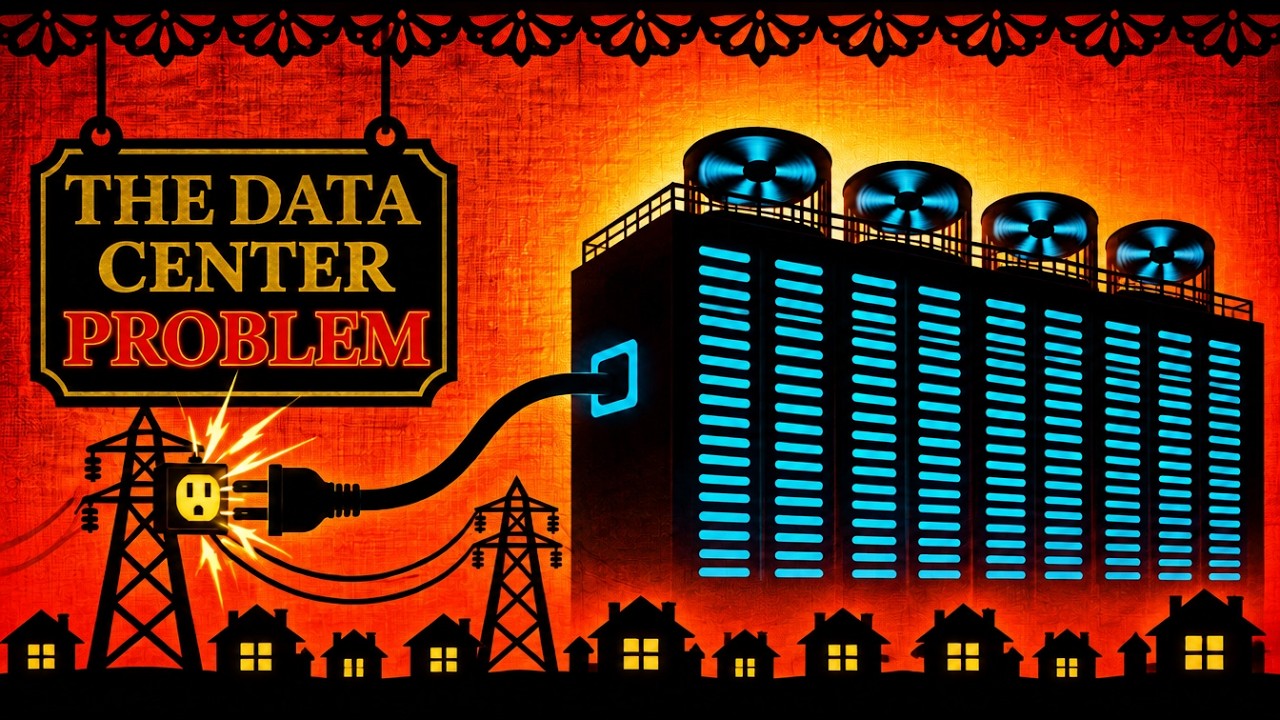
3. THE AI INFRASTRUCTURE REVOLUTION | MARKET DEPENDENCY, ENERGY DEMANDS & THE NEXT TECHNOLOGY THRESHOLD
Artificial Intelligence • Nvidia • Semiconductor Supply Chains • Global Capital Markets • Energy Infrastructure • Economic Transformation
Artificial intelligence has rapidly evolved from an emerging technological innovation into one of the most influential forces shaping global investment, industrial development, and economic expectations. The reported November 12 leadership developments involving Nvidia, which require independent confirmation, bring renewed attention to the extraordinary concentration of financial and technological influence within a relatively small group of companies. Nvidia’s position in advanced semiconductor design, AI computing infrastructure, and accelerated processing has made the company central to an investment cycle involving hyperscale data centers, cloud computing, advanced manufacturing, and national technology strategies. As governments and corporations commit substantial resources to AI development, a fundamental question is emerging: Has the artificial intelligence industry become so economically interconnected that uncertainty surrounding a single major technology company could produce consequences across financial markets, infrastructure development, and national economies? The issue extends beyond corporate leadership to the sustainability of an economic transformation increasingly dependent on continuous technological advancement and capital investment.
Beneath the excitement surrounding AI innovation lies a rapidly expanding physical and financial infrastructure requiring enormous quantities of electricity, advanced semiconductors, cooling systems, transmission capacity, specialized equipment, and long-term financing. Major technology companies are investing heavily in data centers and computing networks, while energy providers, utilities, construction firms, and semiconductor manufacturers face increasing pressure to expand capacity. These investments introduce important questions about whether electricity generation, grid modernization, equipment availability, and financial returns can develop at comparable rates. The concentration of AI-related market valuations also raises concerns about investor expectations, particularly when projected productivity improvements have yet to translate consistently into measurable economic returns across industries. If infrastructure costs rise faster than anticipated, energy constraints intensify, or commercial adoption develops more slowly than projected, the consequences could extend beyond individual technology companies into credit markets, capital expenditures, regional energy systems, and broader economic growth.
Looking toward the next phase of artificial intelligence, the central challenge is whether technological capability, financial investment, and physical infrastructure can remain aligned through an increasingly complex global transformation. Competition among the United States, China, Europe, and other major economies is accelerating efforts to secure semiconductor production, computing capacity, energy resources, and technological independence. At the same time, automation, robotics, advanced research, and AI-driven business applications offer significant opportunities for productivity improvements and entirely new industries. However, realizing those benefits requires sustainable financing, reliable infrastructure, effective governance, and practical economic applications capable of supporting long-term investment. The emerging question is no longer simply how powerful artificial intelligence can become, but whether the financial and industrial systems supporting its expansion can adapt quickly enough to sustain it. The next major threshold for artificial intelligence may be determined not by breakthroughs in computing alone, but by the ability of energy systems, global capital markets, and economic institutions to support the scale of transformation already underway.
Signals • Threads • Patterns | AI Infrastructure
Signals are emerging through heightened sensitivity to semiconductor industry leadership, concentrated AI-related stock valuations, accelerating data center investment, expanding electricity requirements, and intensifying international competition for advanced computing resources. Threads connect these developments to the broader interdependence of technology companies, financial markets, semiconductor supply chains, energy infrastructure, national security strategies, and expectations for future productivity growth. Patterns suggest an investment cycle in which anticipated technological breakthroughs encourage increasingly large capital commitments, while the physical infrastructure and commercial returns needed to justify those commitments may develop at different speeds. Together, these dynamics reveal a critical challenge for the emerging AI economy: whether continued technological advancement can translate into sustainable productivity and financial returns without creating excessive dependence on concentrated corporate leadership, speculative valuations, constrained energy resources, or increasingly interconnected infrastructure systems.

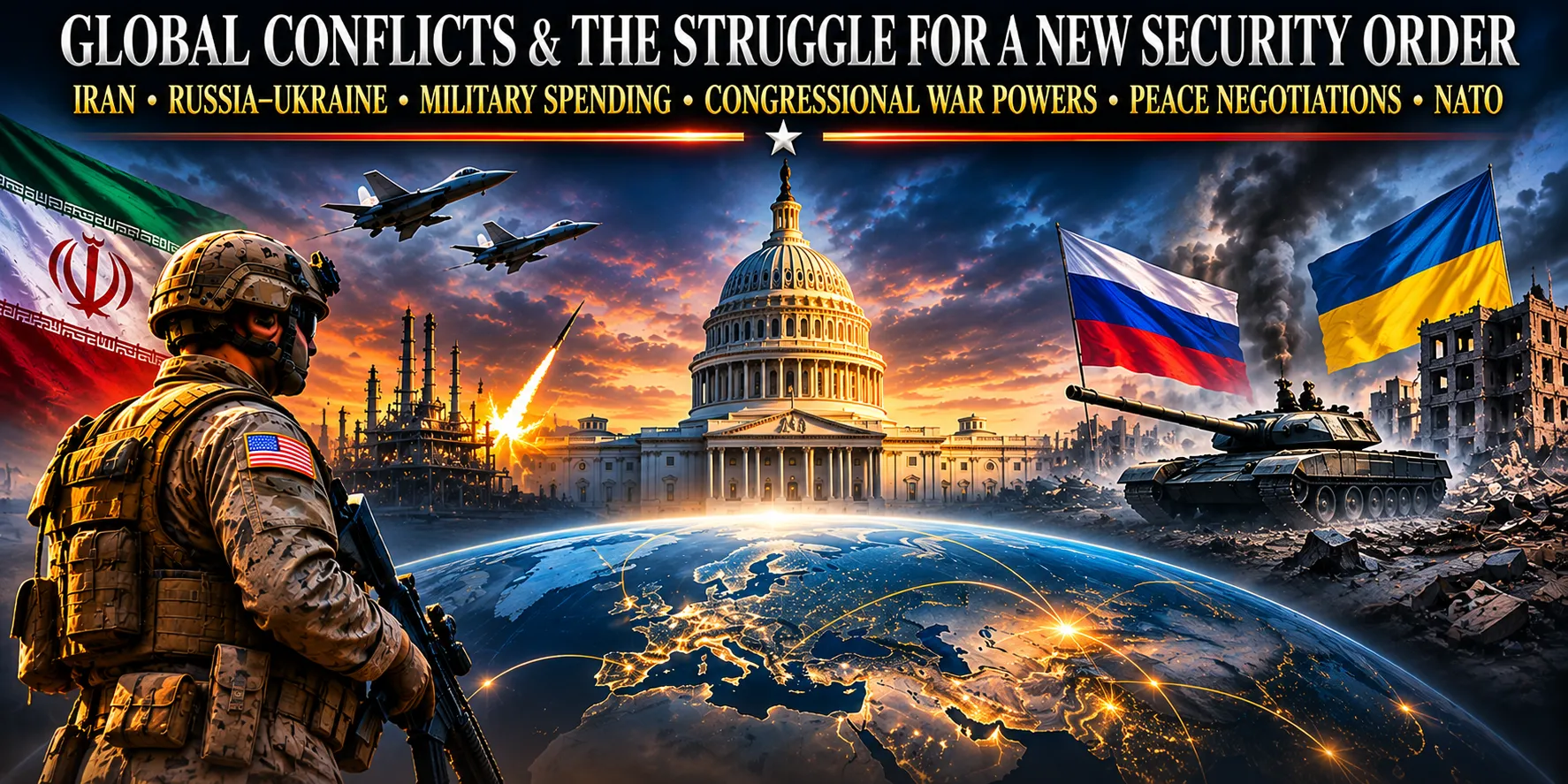
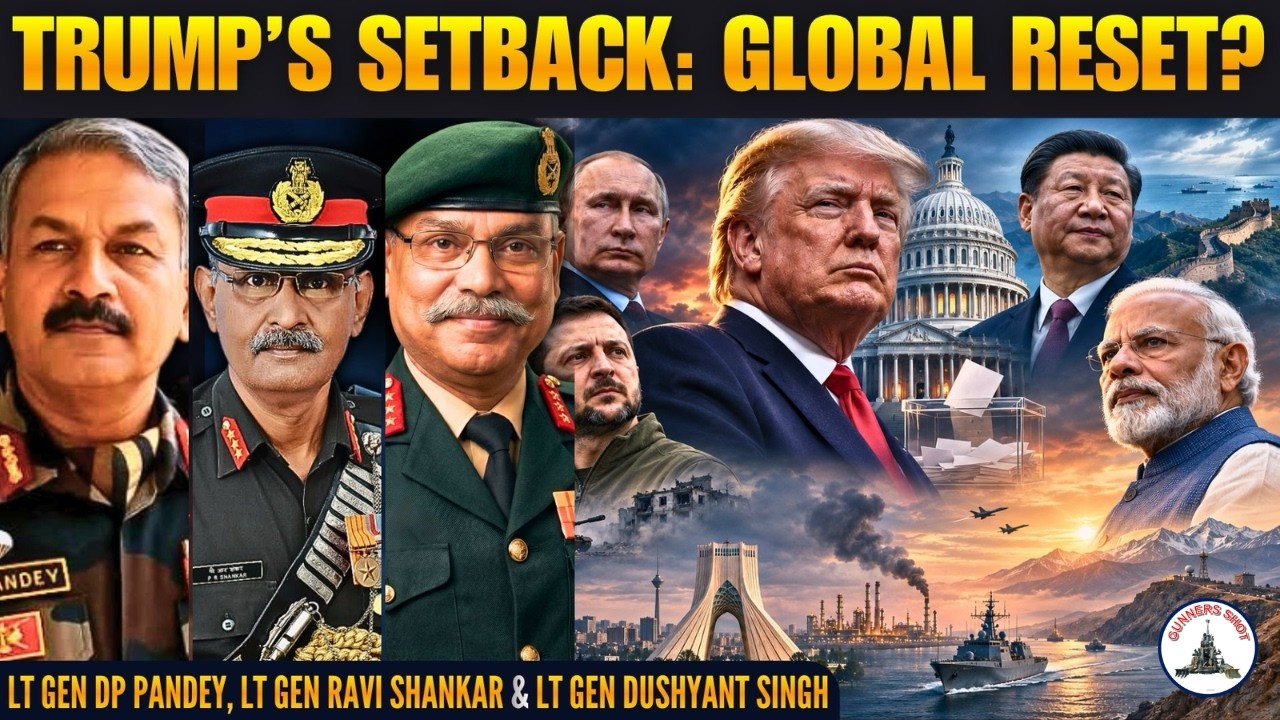
4. GLOBAL CONFLICTS & THE STRUGGLE FOR A NEW SECURITY ORDER
Iran • Russia–Ukraine • Military Spending • Congressional War Powers • Peace Negotiations • NATO • Global Geopolitical Realignment
The international security landscape is entering another period of heightened geopolitical uncertainty, as American military involvement in the Middle East and renewed diplomatic efforts surrounding the Russia–Ukraine conflict raise fundamental questions about war powers, national sovereignty, military spending, and international accountability. In Washington, debate over the Iran conflict has brought renewed attention to the constitutional division of authority between Congress and the presidency. While the president serves as commander in chief, Congress retains essential responsibilities involving war authorization, military appropriations, and oversight of executive actions. The financial and human consequences of extended military commitments make these constitutional distinctions increasingly consequential. Defense expenditures, regional security arrangements, intelligence operations, and the economic interests surrounding military procurement all deserve examination. The central question is whether Congress can exercise meaningful oversight when military operations expand without clearly defined objectives, transparent financial accounting, or an established endpoint. Beyond the immediate conflict lies a broader concern about the gradual concentration of military decision-making authority within the executive branch and the ability of elected representatives to maintain accountability for decisions involving war and peace.
Meanwhile, the Russia–Ukraine conflict continues to influence the future of European security, with renewed diplomatic initiatives confronting difficult disagreements over territorial sovereignty, NATO arrangements, security guarantees, economic sanctions, and Europe’s participation in negotiations. The challenge extends well beyond establishing a temporary ceasefire. Any durable settlement must address Ukraine’s sovereignty and security, Russia’s stated security concerns, European defense commitments, and the credibility of international agreements. Years of warfare have accelerated changes in European energy policy, military procurement, defense spending, and relationships with Washington and Moscow. Attacks on energy infrastructure and the economic costs of prolonged confrontation have reinforced the connection between military security, energy independence, industrial capacity, and financial stability. Negotiations therefore represent more than an attempt to stop the fighting; they also concern the structure of Europe’s future security relationships. The defining challenge is whether competing national security objectives can be reconciled through enforceable agreements that protect sovereignty, reduce the risk of renewed conflict, and establish a credible foundation for lasting peace.
Taken together, the Iran and Russia–Ukraine conflicts illustrate the increasingly interconnected nature of global military commitments, diplomatic negotiations, economic pressures, and shifting international power relationships. American decisions concerning military funding and executive authority influence international alliances, while developments in Eastern Europe and the Middle East affect energy markets, defense industries, supply chains, and global investment priorities. These pressures are unfolding alongside growing debates over the sustainability of government expenditures and the capacity of existing international institutions to resolve prolonged conflicts. The United States, European governments, Russia, Iran, and other regional powers are pursuing different strategic objectives within an international environment characterized by security competition, economic interdependence, and contested spheres of influence. The broader question is whether diplomacy can produce durable security arrangements or whether unresolved disputes will continue generating cycles of military escalation and temporary agreements. The next phase of global realignment may depend on whether governments can move beyond open-ended military commitments toward clearly defined security objectives, accountable decision-making, and negotiated frameworks capable of reducing long-term instability.
Signals • Threads • Patterns | Global Conflicts
Signals are emerging through intensified debate over American military involvement in Iran, congressional oversight of executive war powers, expanding defense expenditures, renewed Russia–Ukraine diplomatic initiatives, and continuing disputes over NATO security arrangements. Threads connect these developments to the deeper relationships among constitutional authority, military-industrial interests, energy security, European defense independence, national sovereignty, and international diplomatic influence. The financial burden of prolonged military commitments also connects regional conflicts to broader concerns about government debt, fiscal priorities, and economic sustainability. Patterns reveal recurring tensions between military escalation and diplomatic negotiation, executive decision-making and legislative accountability, national security objectives and economic constraints, and the competing interests of established and emerging geopolitical powers. Together, these developments raise a defining question for the coming years: Can the international system establish a more stable security framework through diplomacy and enforceable agreements, or will unresolved geopolitical rivalries continue reinforcing military expansion, economic pressure, and recurring regional conflicts?

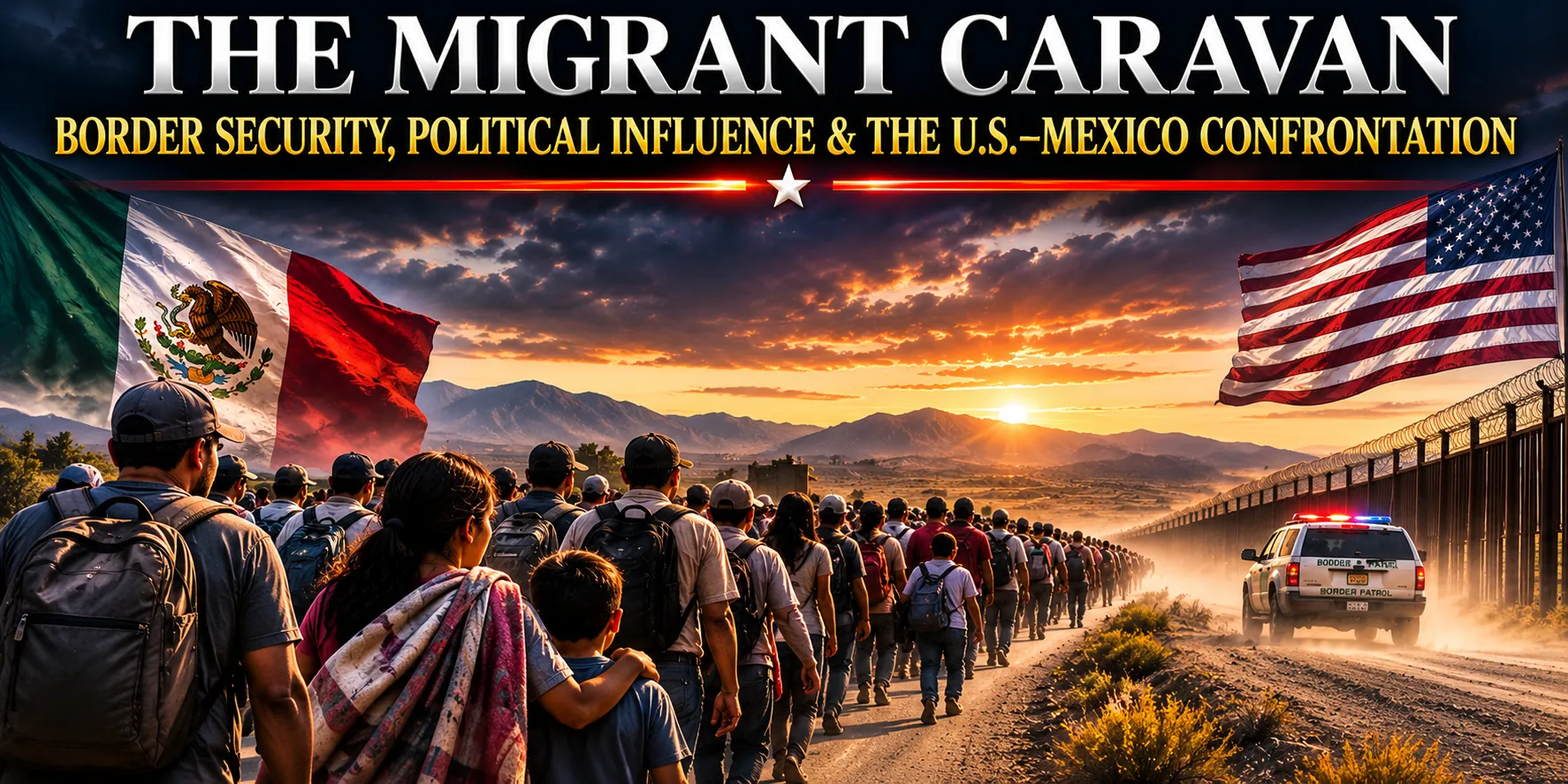
5. THE MIGRANT CARAVAN | BORDER SECURITY, POLITICAL INFLUENCE & THE U.S.–MEXICO CONFRONTATION
2026 Midterm Elections • Migration Networks • Mexican Sovereignty • Humanitarian Organizations • Border Enforcement • Economic Leverage
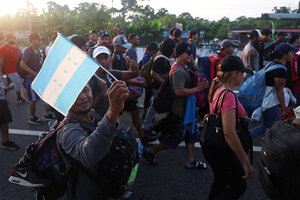
The emergence of new migrant caravans in southern Mexico following the November 3, 2026, midterm elections has renewed debate over American border security, immigration enforcement, and the political forces influencing migration throughout Central America and Mexico. Reports describe a caravan of approximately 1,500 migrants departing Tapachula on November 10–11, following earlier movements organized before Election Day. Some participants reportedly expressed optimism that the election results might eventually produce changes in American immigration policies, illustrating how political expectations can influence migration decisions even before laws or enforcement practices change. The developments have also reportedly intensified tensions between Washington and Mexico, with President Donald Trump threatening additional tariffs on Mexican imports and President Claudia Sheinbaum challenging the characterization of the caravans as an immediate border threat. Importantly, the formation of a caravan in southern Mexico does not establish that its participants have reached or crossed the United States border. The larger question extends beyond the movement of migrants themselves: Are immigration patterns increasingly influenced by political messaging, election outcomes, and expectations about future enforcement policies rather than changes in the law?
Beyond the immediate political confrontation, alternative and independent reporting has raised questions about the organization, financing, and logistical support behind migrant caravans. Reports from Zero Hedge, Breitbart, The Gateway Pundit, and independent border journalists have examined allegations involving caravan organizers, Mexican police escorts, temporary accommodations, humanitarian organizations, and possible financial incentives. Separate reporting describes U.S. visa restrictions against individuals accused of organizing or promoting migrant movements, while other accounts raise questions about the involvement of nongovernmental organizations providing food, shelter, transportation assistance, or other services. These claims require careful distinctions between legitimate humanitarian assistance, public safety operations, organized migration coordination, and unlawful human smuggling. Police escorts or emergency accommodations do not independently demonstrate government efforts to facilitate unauthorized entry into the United States, and allegations concerning specific organizations require documented evidence of their activities, funding, and intentions. Nevertheless, understanding who organizes migrant movements, how logistical networks operate, and whether financial or political interests influence their activities remains a legitimate subject for independent investigation and public accountability.
The broader implications extend into U.S.–Mexico diplomatic relations, international trade, border enforcement, national sovereignty, and the economic consequences of immigration policy. Washington’s reported consideration of tariffs as leverage against Mexico illustrates how migration disputes can become intertwined with trade negotiations, manufacturing supply chains, consumer prices, and regional economic stability. Mexico faces competing responsibilities involving humanitarian protections, domestic security, international migration agreements, and the preservation of its own sovereignty, while the United States continues to confront disagreements over border enforcement and immigration reform. Political rhetoric surrounding elections can further complicate these relationships when migrants, governments, advocacy organizations, and enforcement agencies interpret changing political conditions differently. A sustainable approach would require transparent migration data, independent examination of organizational networks, consistent enforcement of immigration laws, accountability for unlawful exploitation, and coordinated diplomatic engagement. The defining question is whether the United States and Mexico can establish a credible, enforceable migration framework that addresses security concerns and humanitarian obligations without turning immigration into a recurring instrument of political and economic confrontation.
Signals • Threads • Patterns | Midterm Elections
Signals are emerging through new migrant caravan formations, reported election-related migration expectations, heightened U.S.–Mexico diplomatic tensions, threatened trade tariffs, and allegations concerning caravan organizers and logistical assistance. Threads connect these developments to broader relationships among American election messaging, immigration enforcement, Mexican sovereignty, humanitarian assistance networks, international trade, and the financial interests that may surround organized migration. Questions about police escorts, temporary accommodations, NGO involvement, and alleged organizers highlight the importance of distinguishing documented coordination from unverified claims of political or financial orchestration. Patterns suggest that migration pressures can intensify when political uncertainty, economic hardship, security concerns, and expectations of changing immigration policies intersect, producing recurring cycles of migrant movement, border enforcement disputes, diplomatic confrontation, and competing media narratives. Together, these developments raise a larger question: Are migration policies being shaped primarily through sustainable bilateral agreements and transparent enforcement, or are political expectations, economic leverage, and unresolved regional conditions perpetuating recurring border crises?

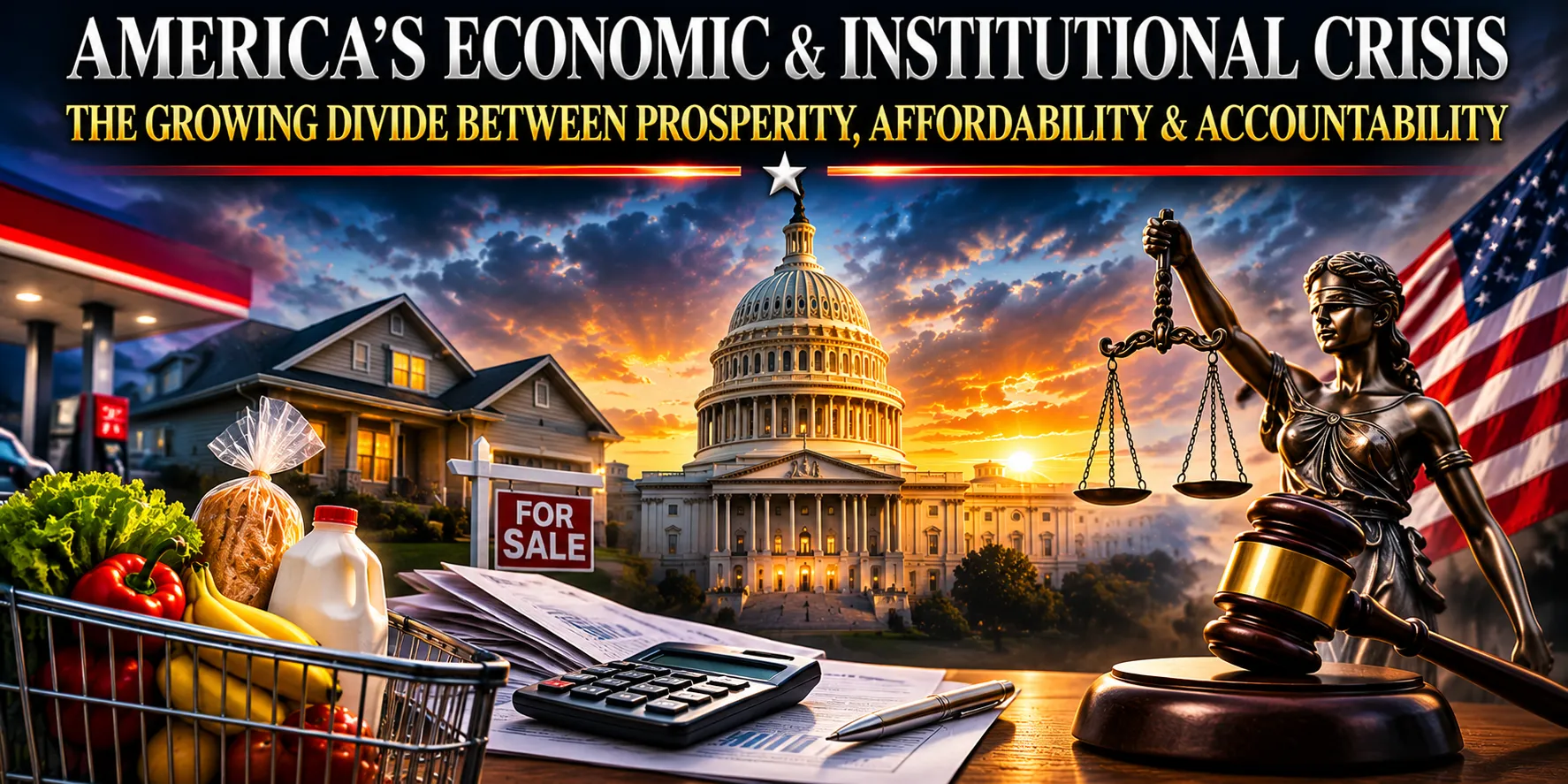
6. AMERICA’S ECONOMIC & INSTITUTIONAL CRISIS | THE GROWING DIVIDE BETWEEN PROSPERITY, AFFORDABILITY & ACCOUNTABILITY
Inflation • Household Purchasing Power • Cost of Living • Consumer Debt • Congressional Investigations • Government Accountability • Institutional Trust
The American economy continues to face a fundamental contradiction between official measures of economic stability and the financial realities experienced by millions of households. October’s reported inflation developments have renewed attention to the persistent pressures surrounding housing affordability, food prices, insurance premiums, utility costs, consumer debt, and elevated borrowing expenses. While conventional economic indicators emphasize inflation rates, employment statistics, GDP growth, and financial market performance, these measurements do not always capture the cumulative financial strain experienced by working families, retirees, and small businesses. A declining inflation rate means prices are generally increasing more slowly, not that the substantial price increases accumulated over previous years have disappeared. Meanwhile, higher interest rates can increase the cost of mortgages, automobile financing, credit cards, and business borrowing, further reducing disposable income. The central question is whether America’s traditional economic measurements adequately reflect household purchasing power, financial security, and the actual cost of maintaining a reasonable standard of living. The growing distinction between economic performance on paper and economic security in everyday life deserves greater attention in national policy discussions.
At the same time, the post-election political environment is bringing renewed scrutiny to congressional investigations, federal agency oversight, military policy, immigration enforcement, and the accountability of government institutions. Congressional oversight is an essential constitutional responsibility, providing elected representatives with mechanisms to investigate federal expenditures, examine executive actions, identify misconduct, and recommend institutional reforms. However, investigations can also become entangled in partisan competition, selective enforcement, political messaging, and competing interpretations of government conduct. The critical distinction lies in whether investigations produce verifiable evidence, transparent findings, consistent legal standards, and meaningful corrective action, or primarily generate public accusations without lasting institutional improvements. Genuine accountability must apply regardless of which political party controls Congress or the White House. When standards of oversight appear to change with political leadership, public confidence in the impartiality and credibility of government institutions can deteriorate. The larger challenge is ensuring that congressional investigations strengthen constitutional governance rather than becoming another recurring instrument of political confrontation.
Together, these economic and institutional pressures raise broader questions about the relationship between financial stability, effective governance, and public trust in America’s political and economic systems. Households experiencing persistent affordability challenges may become increasingly skeptical of official economic narratives, particularly when financial markets perform well while essential living expenses consume a growing share of personal income. Similarly, recurring congressional investigations that fail to produce clear findings or durable reforms can reinforce perceptions that political institutions are more focused on partisan conflict than addressing structural problems. The connection between these developments is significant: economic insecurity can weaken institutional confidence, while ineffective governance can undermine the public’s belief that financial and political systems operate in their interests. Addressing these challenges requires more comprehensive measurements of household financial conditions, transparent government spending, consistent oversight standards, and policies that connect economic growth with measurable improvements in living standards. The defining question is whether America’s institutions can move beyond favorable statistical indicators and recurring political investigations toward genuine economic resilience, measurable accountability, and renewed public confidence.
Signals • Threads • Patterns | American’s Economic & Institutional Crisis
Signals are emerging through persistent household affordability pressures, accumulated consumer price increases, elevated borrowing costs, growing debt-service obligations, renewed congressional investigations, and public skepticism toward economic and political institutions. Threads connect these developments to the broader relationships among monetary policy, household purchasing power, federal spending priorities, political accountability, institutional transparency, and public confidence in government. The distinction between official economic performance and household financial security parallels concerns about the difference between congressional investigations and meaningful institutional reform. Patterns suggest a recurring cycle in which economic statistics can indicate stability while households experience financial pressure, and political institutions repeatedly promise accountability without necessarily delivering durable structural improvements. Together, these developments raise a fundamental question about America’s future: Can economic and political institutions restore public confidence through measurable improvements in household prosperity, transparent governance, and consistent accountability, or will the divide between institutional performance and everyday experience continue to widen?


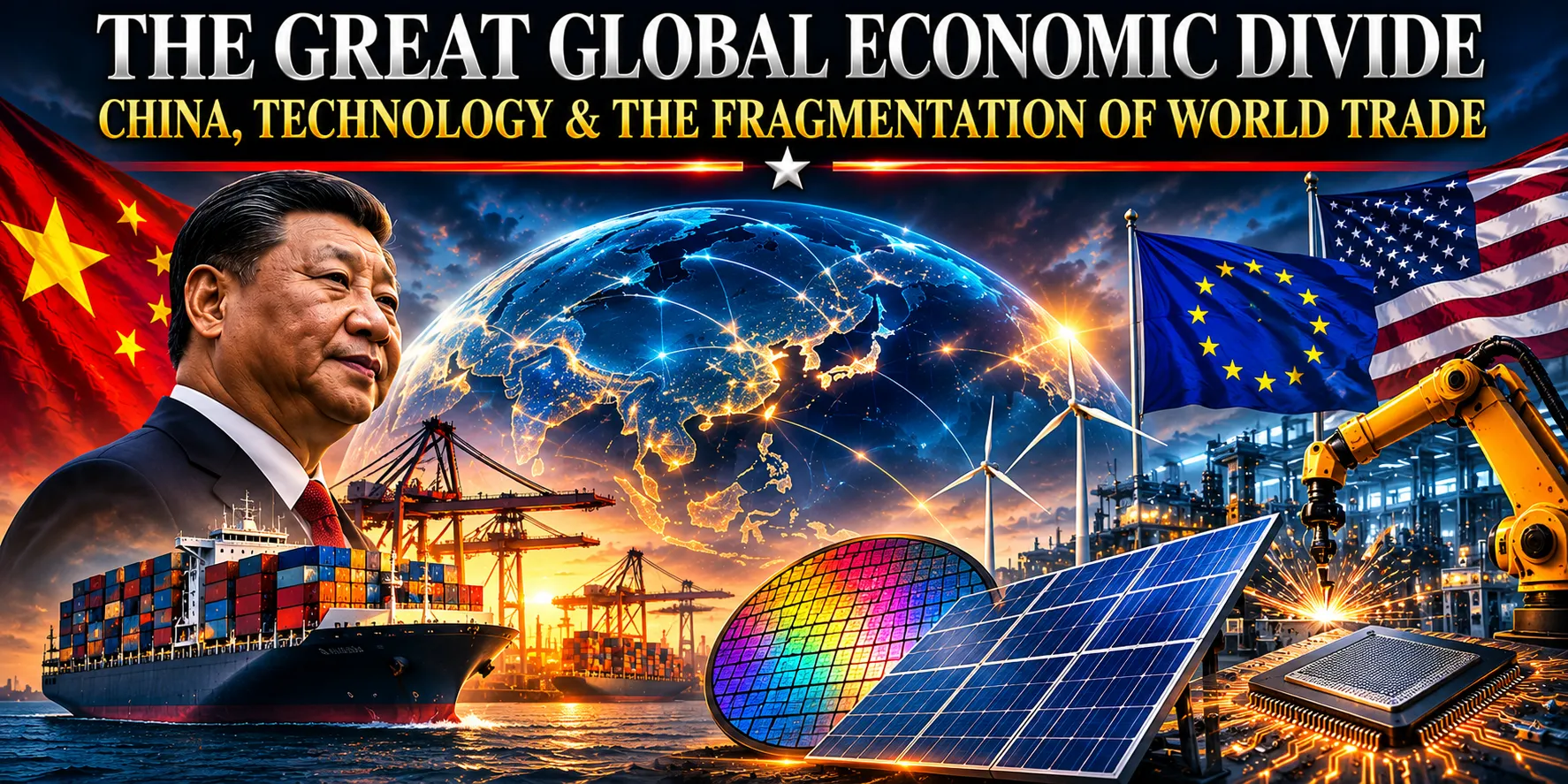
7. THE GREAT GLOBAL ECONOMIC DIVIDE | CHINA, TECHNOLOGY & THE FRAGMENTATION OF WORLD TRADE
China • Technology Restrictions • Global Trade Realignment • Economic Sovereignty • Strategic Industries • Supply Chain Security • Emerging Economic Blocs
The global economic landscape is undergoing a fundamental transformation as international trade, technological innovation, and national security become increasingly interconnected. China’s reported technology-transfer restrictions, particularly those affecting strategic industries such as solar manufacturing, advanced industrial equipment, and clean-energy technologies, are bringing renewed attention to growing tensions between Beijing and European industrial policymakers. For decades, globalization encouraged the international movement of capital, technology, manufacturing, and resources through interconnected supply chains designed to maximize efficiency and reduce production costs. Today, governments are increasingly reconsidering those relationships as technological independence, industrial competitiveness, and control over critical resources become central national-security priorities. China’s position in several advanced manufacturing and renewable-energy supply chains gives Beijing considerable influence over international production networks, while European governments face pressure to strengthen domestic industries and reduce strategic dependencies. The central question is whether globalization is gradually evolving from an integrated international marketplace into a fragmented economic system organized around competing national interests, technological restrictions, and regional alliances.
Beneath these developments lies an expanding competition for semiconductor technology, artificial intelligence, critical minerals, renewable-energy manufacturing, advanced robotics, and next-generation industrial infrastructure. Governments increasingly view these capabilities not simply as commercial products but as essential foundations of economic sovereignty, military readiness, energy independence, and long-term geopolitical influence. China, the United States, and the European Union are pursuing different combinations of export controls, industrial subsidies, domestic manufacturing incentives, investment restrictions, and strategic partnerships to protect their technological advantages. While these policies may strengthen domestic production capacity and reduce exposure to foreign supply disruptions, they can also produce higher manufacturing costs, duplicated infrastructure investments, restricted market access, and greater uncertainty throughout global supply chains. Businesses operating across international markets must navigate competing regulatory systems, shifting trade agreements, and increasingly complex sourcing requirements. The deeper concern is that policies intended to protect national economic security could simultaneously weaken the efficiencies, affordability, and international cooperation that supported decades of global economic expansion.
Looking toward the next phase of international economic development, the emerging challenge is whether major economies can maintain productive trade relationships while competing for technological leadership, resource security, manufacturing independence, and strategic economic influence. The possibility of increasingly distinct economic blocs raises important questions about the future of multinational corporations, global financial markets, international investment, and consumer affordability. Countries with access to critical minerals, advanced manufacturing capabilities, reliable energy supplies, and technological expertise may gain greater negotiating leverage, while nations dependent on imported technologies or concentrated supply chains could face increased economic vulnerability. For ordinary consumers, the consequences may appear through higher prices, reduced product availability, shifting employment opportunities, and the rising costs of energy and technological infrastructure. Yet economic separation is not inevitable; selective cooperation, diversified supply chains, and negotiated trade arrangements may preserve important areas of international exchange. The defining question is whether the world’s major economic powers can establish a sustainable balance between national economic sovereignty and international cooperation, or whether escalating technological restrictions will accelerate the emergence of competing economic systems that reshape global trade for decades to come.
Signals • Threads • Patterns | The Great Global Economic Divide
Signals are emerging through China’s technology-transfer restrictions, European industrial policy responses, expanding export controls, strategic manufacturing investments, and intensifying competition for critical minerals and advanced technologies. Threads connect these developments to broader relationships among national security, energy independence, semiconductor production, artificial intelligence, industrial subsidies, international trade agreements, and the restructuring of global supply chains. Governments are increasingly linking economic competitiveness with strategic autonomy, creating new pressures on corporations, investors, and international trading partners. Patterns suggest a gradual movement away from unrestricted globalization toward selective economic integration, regional manufacturing networks, strategic resource alliances, and competing technological ecosystems. Together, these developments raise a fundamental question about the future global economy: Will international trade evolve into a more resilient system of diversified partnerships, or will expanding technological restrictions and geopolitical competition produce increasingly separated economic blocs, higher costs, and greater financial uncertainty for businesses and consumers worldwide?

CONNECTING THE DOTS | THE CONVERGENCE OF SEVEN GLOBAL DEVELOPMENTS
November 13, 2026 | Political Transformation • Economic Pressures • Geopolitical Realignment • Technological Acceleration • Institutional Change
Introduction | From Individual Events to Global Convergence
The seven major stories examined in this week’s Truth Seekers Weekly Briefing represent more than a collection of political, economic, and geopolitical developments. Together, they reveal an increasingly interconnected global landscape in which political institutions, financial markets, international security, technological infrastructure, and economic systems are experiencing simultaneous pressures that intersect, reinforce one another, and influence the direction of future change. Having examined the individual Signals, Threads, and Patterns surrounding each topic, we now move into a deeper exploration of their convergence—the point where separate developments begin producing shared consequences, exposing structural vulnerabilities, and potentially accelerating broader institutional and economic transformation. From the 2026 midterm elections and Washington’s governance challenges to global conflicts, migration pressures, household affordability, China’s economic competition, and the artificial intelligence revolution, these developments illustrate how changes within one system can influence conditions across several others. Understanding this convergence provides a broader perspective on the forces shaping America’s future and the evolving international order.
The purpose of Connecting the Dots is to move beyond fragmented headlines and examine the underlying relationships, institutional dependencies, and economic forces connecting major global developments. Political uncertainty can influence investor confidence, government spending decisions affect national security and household economic conditions, and international conflicts can reshape energy markets, industrial production, and global trade relationships. Meanwhile, technological acceleration, artificial intelligence investment, and strategic competition over semiconductors, critical minerals, and energy infrastructure are creating new pressures on financial markets, national economies, and international supply chains. These developments do not necessarily share a common origin, yet their combined consequences can produce compounding economic pressures, shifting geopolitical relationships, changing institutional priorities, and emerging opportunities for structural reform. By examining where these forces intersect, we can better recognize how individual events contribute to broader changes in economic stability, national sovereignty, institutional credibility, and the balance of global influence. The essential objective is to distinguish meaningful relationships from coincidental developments while identifying the conditions that could shape future turning points.
As we look toward the remainder of 2026 and into 2027, the convergence of these seven developments raises a fundamental question: Are we witnessing a temporary period of overlapping challenges, or the early stages of a more substantial transformation in how political, economic, technological, and international systems operate? The answer will depend on how governments, financial institutions, industries, and communities respond to increasing demands for fiscal responsibility, economic resilience, technological adaptation, energy security, transparent governance, and international cooperation. Some pressures may intensify existing vulnerabilities, while others may encourage innovation, institutional reform, diversified supply chains, and new approaches to economic development. Our responsibility as Truth Seekers is not to assume a predetermined outcome, but to examine where multiple forces converge, which relationships are supported by evidence, what consequences may emerge, and how these developments could influence the next phase of global realignment. Through this broader perspective, Connecting the Dots becomes a framework for transforming information into understanding, recognizing potential turning points, and navigating an increasingly complex world with greater discernment, clarity, and informed awareness.
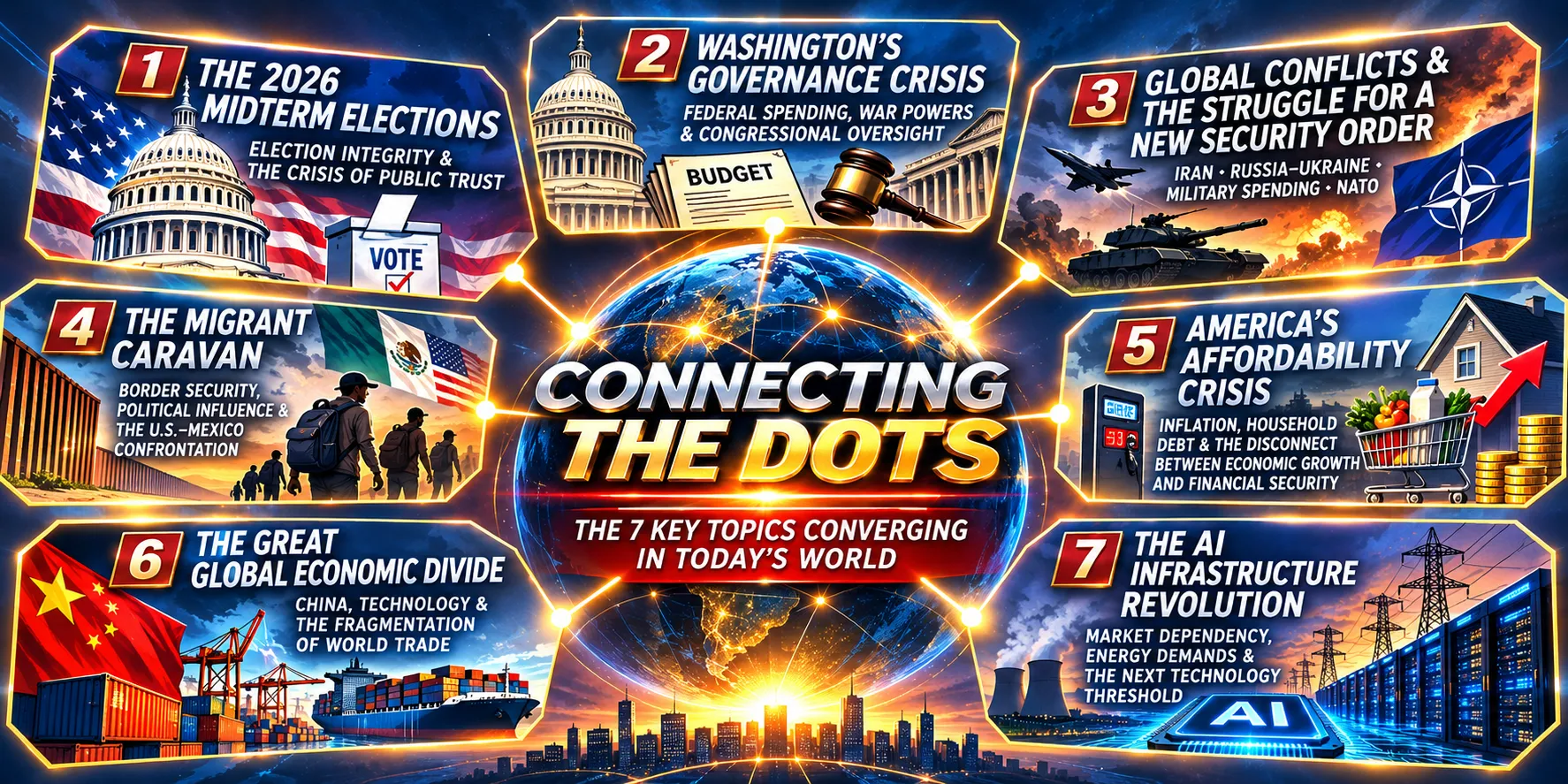
CONNECTING THE DOTS | A GUIDE TO UNDERSTANDING THE CONVERGENCE OF GLOBAL EVENTS
To effectively navigate Connecting the Dots, begin by looking beyond individual headlines and examining how current news stories and events intersect across political, economic, geopolitical, technological, and institutional systems. Rather than viewing each development as an isolated occurrence, consider how the convergence of Signals, Threads, and Patterns reveals relationships that may not be immediately apparent. Identify the underlying forces influencing each event, including government policies, financial pressures, international conflicts, technological advancements, and shifting public expectations. Ask yourself how one development might influence another, whether multiple events share common causes, and which connections are supported by verifiable evidence. Pay particular attention to timing, cause-and-effect relationships, institutional dependencies, and recurring developments that may indicate broader structural changes. The objective is to move beyond fragmented news coverage toward a more comprehensive understanding of how interconnected systems influence one another and contribute to an evolving global landscape.
As you explore these connections, focus on understanding where multiple pressures converge, how their combined effects may accelerate change, and what emerging consequences could develop over time. Consider how economic uncertainty influences political decisions, geopolitical conflicts reshape energy and trade relationships, technological innovation transforms financial and industrial systems, and institutional challenges affect public confidence. Distinguish between established connections, reasonable interpretations, and speculative possibilities, recognizing that simultaneous events do not necessarily share a common cause. Use this broader perspective to evaluate potential turning points, emerging opportunities, systemic vulnerabilities, and alternative future scenarios without assuming that any particular outcome is inevitable. Ultimately, Connecting the Dots is about transforming information into understanding, understanding into discernment, and discernment into informed action. By recognizing meaningful convergence across current events, you can develop greater clarity, strengthen independent judgment, and navigate the challenges and opportunities of our changing world with awareness, perspective, and personal sovereignty.
1. THE 2026 MIDTERM ELECTIONS | ELECTION INTEGRITY & THE CRISIS OF PUBLIC TRUST
The 2026 midterm elections represent an important intersection of political legitimacy, institutional accountability, and national policy direction. Questions surrounding election administration, ballot verification, recount procedures, and public confidence extend beyond determining which political party controls Congress. Election outcomes influence the legislative priorities governing federal spending, immigration enforcement, military appropriations, technological regulation, and congressional oversight. When public confidence in electoral procedures becomes fragile, the consequences can extend into broader perceptions of government legitimacy and the credibility of future policy decisions. This creates a connection between the administration of elections and the ability of political institutions to respond effectively to economic and geopolitical challenges.
The convergence becomes more significant when election uncertainty intersects with household affordability, government funding disputes, and international security commitments. Citizens experiencing financial pressure may evaluate political institutions through their ability to improve economic conditions, while disagreements over election outcomes can complicate efforts to establish legislative priorities. Congressional investigations, spending negotiations, and debates over executive authority may become more politically contentious when the legitimacy of elected officials is questioned. International governments and financial markets also monitor American elections because changes in congressional leadership can influence trade policy, military funding, diplomatic relationships, and economic regulation. The broader connection demonstrates how political confidence can affect institutional effectiveness, which in turn influences economic and international stability.
Looking forward, the deeper issue is whether America’s democratic institutions can maintain credibility while managing increasingly complex economic, technological, and geopolitical responsibilities. Transparent election procedures, independently verifiable results, consistent oversight standards, and clear public communication can strengthen confidence regardless of political outcomes. Conversely, recurring disputes that remain unresolved in the public’s understanding may reinforce polarization and weaken cooperation on other national priorities. The convergence of electoral legitimacy, economic insecurity, political accountability, and institutional trust therefore represents an important challenge for representative government. The defining question is whether Americans can establish shared standards of transparency and accountability that remain credible regardless of which political party wins, allowing government institutions to address larger national challenges with greater public confidence.
2. WASHINGTON’S GOVERNANCE CRISIS | FEDERAL SPENDING, WAR POWERS & CONGRESSIONAL OVERSIGHT
Washington’s recurring funding confrontations illustrate the growing intersection of fiscal sustainability, constitutional authority, military commitments, and political accountability. Federal budget negotiations are not simply disputes over annual appropriations; they determine how national resources are distributed among domestic programs, debt obligations, defense requirements, infrastructure investment, and international commitments. As these responsibilities expand, policymakers face increasingly difficult choices involving government borrowing, spending priorities, economic growth, and long-term financial obligations. The convergence becomes especially visible when military spending debates overlap with government funding deadlines and disagreements over executive war powers. Decisions made in Washington can influence not only federal operations but also financial markets, defense industries, household economic conditions, and America’s relationships with international partners.
The deeper connection emerges when government borrowing, interest rates, military expenditures, and household affordability interact within the same financial system. Federal spending decisions influence fiscal conditions, while borrowing costs affect the government’s capacity to finance existing commitments. Military operations can create additional financial obligations, and international conflicts may influence energy markets, supply chains, and economic expectations. At the same time, congressional oversight determines whether these commitments receive adequate scrutiny and whether executive agencies remain accountable for their decisions. These relationships connect Washington’s governance challenges to several other developments in this briefing, including global military conflicts, inflation pressures, technological investment, and growing public skepticism toward political institutions. The central issue is whether government can reconcile expanding responsibilities with the financial and constitutional mechanisms intended to regulate them.
The longer-term implications involve the possibility that repeated crisis management could increasingly replace durable fiscal planning and institutional cooperation. Temporary funding agreements may preserve government operations, but they do not necessarily resolve structural disagreements over spending, taxation, debt, and national priorities. Similarly, military commitments without clearly defined objectives or consistent congressional authorization can complicate long-term accountability. As economic and geopolitical pressures intensify, these institutional weaknesses may become more consequential. The convergence of fiscal uncertainty, executive authority, military obligations, and public confidence raises an essential question about America’s governing capacity. Can Washington transition from recurring emergency negotiations toward a more sustainable framework of financial responsibility, constitutional accountability, and long-term strategic planning, or will temporary crisis management continue shaping the nation’s political and economic future?
3. GLOBAL CONFLICTS & THE STRUGGLE FOR A NEW SECURITY ORDER
The conflicts involving Iran and Russia–Ukraine illustrate how regional military confrontations can influence the structure of international security, economic relationships, and geopolitical power. Although these conflicts involve different histories, participants, and strategic objectives, their consequences intersect through American foreign policy, military expenditures, diplomatic alliances, energy markets, and international trade. European security arrangements remain closely connected to developments in Ukraine, while tensions involving Iran can affect Middle Eastern stability, maritime transportation, and global energy expectations. Together, these pressures create a more complex environment in which governments must balance military deterrence, diplomatic negotiations, economic sustainability, and domestic political accountability. The convergence becomes visible when decisions made in one region influence strategic calculations and resource commitments in another.
The relationship between military conflict, energy security, industrial production, and financial stability is particularly important. Prolonged military confrontations can increase demand for defense equipment, redirect government spending, disrupt commercial transportation, and encourage countries to strengthen domestic manufacturing capabilities. European efforts to diversify energy supplies and increase defense readiness intersect with broader international competition over critical resources, advanced technologies, and strategic infrastructure. Meanwhile, the United States must consider how overseas commitments influence federal spending priorities and congressional oversight responsibilities. These developments connect geopolitical conflict directly to Washington’s fiscal challenges, China’s technological competition, global trade realignment, and household affordability. The resulting economic pressures can extend far beyond the countries directly involved in military operations.
Looking ahead, the convergence of regional conflicts, strategic alliances, energy dependencies, defense spending, and economic competition may influence the development of a changing international security order. Governments seeking greater independence may expand domestic defense industries, diversify energy sources, and strengthen regional partnerships. These decisions could improve resilience while also increasing costs and contributing to competing spheres of strategic influence. Diplomatic agreements remain essential because prolonged confrontation can generate financial and humanitarian consequences that extend across generations. The defining question is whether international security arrangements can evolve through enforceable diplomatic agreements and cooperative economic relationships, or whether unresolved conflicts will continue reinforcing military expansion, strategic fragmentation, and geopolitical instability. The outcome will depend on political decisions, negotiation, and the willingness of competing powers to establish credible arrangements for reducing conflict.
4. THE MIGRANT CARAVAN | BORDER SECURITY, POLITICAL INFLUENCE & THE U.S.–MEXICO CONFRONTATION
The renewed discussion surrounding migrant caravans in southern Mexico demonstrates how migration can become a convergence point for electoral politics, border enforcement, economic conditions, and international diplomacy. Reports of migrant movements surrounding the November midterm elections have raised questions about whether expectations of political change influence decisions to travel, even when immigration laws remain unchanged. These developments connect American political messaging to the calculations of individuals and families confronting economic hardship, insecurity, or uncertain opportunities in their home countries. At the same time, disputes between Washington and Mexico introduce questions involving national sovereignty, immigration enforcement responsibilities, humanitarian obligations, and bilateral cooperation. The broader issue is how perceptions of changing political conditions can influence migration pressures and government responses across international borders.
The economic dimension becomes more significant when migration enforcement intersects with trade policy, manufacturing supply chains, and regional financial relationships. Reported threats involving tariffs against Mexican imports illustrate how governments may attempt to use economic leverage to influence migration cooperation. However, tariffs can also affect businesses, consumers, cross-border manufacturing, and investment relationships that depend on integrated North American trade. Questions surrounding migrant assistance networks introduce another layer involving humanitarian organizations, government agencies, transportation logistics, financial transparency, and the prevention of criminal exploitation. These relationships require distinguishing lawful assistance from documented unlawful conduct rather than assuming that coordination or humanitarian support establishes wrongdoing. The convergence reveals that migration is not an isolated border-security issue but a complex interaction among economic incentives, political expectations, legal responsibilities, and international relationships.
The larger implications concern whether the United States and Mexico can develop consistent migration policies capable of balancing national security, humanitarian protections, economic stability, and regional cooperation. Temporary enforcement actions or diplomatic confrontations may influence immediate migration patterns, but they do not necessarily resolve the conditions motivating people to leave their countries. Political messaging can alter expectations, while economic pressures and insecurity may continue influencing migration decisions regardless of election outcomes. The convergence of migration, electoral politics, economic leverage, and national sovereignty demonstrates how one policy challenge can generate consequences across several interconnected systems. The defining question is whether North American governments can establish transparent, enforceable, and sustainable migration arrangements—or whether recurring political disputes and economic pressures will continue producing cycles of migration uncertainty and bilateral confrontation.
5. AMERICA’S AFFORDABILITY CRISIS | INFLATION, HOUSEHOLD DEBT & THE DISCONNECT BETWEEN ECONOMIC GROWTH AND FINANCIAL SECURITY
America’s continuing affordability challenges illustrate the convergence of monetary policy, household purchasing power, housing costs, consumer debt, and broader economic expectations. Official inflation statistics, employment reports, and GDP measurements provide important information about national economic performance, but they do not fully describe the cumulative financial pressures experienced by individual households. Rising housing expenses, insurance premiums, food prices, utilities, and borrowing costs can continue limiting financial flexibility even when inflation moderates. The connection becomes particularly important when economic growth and financial market performance appear stronger than the everyday financial conditions experienced by many families. This divergence can influence consumer confidence, spending decisions, household savings, and perceptions of whether existing economic policies are producing broadly shared prosperity.
The deeper convergence connects household affordability to federal fiscal policy, international conflicts, global trade restrictions, energy infrastructure, and technological investment. Government borrowing and monetary conditions can influence interest rates and credit availability, while geopolitical disruptions may affect energy costs and transportation expenses. Trade restrictions and changes in international manufacturing networks can alter the prices and availability of consumer products. Meanwhile, the expansion of artificial intelligence infrastructure creates new demands for electricity, industrial equipment, construction resources, and investment capital. These pressures may affect regional development and energy pricing, depending on how costs are allocated and infrastructure is financed. Together, these relationships demonstrate that household financial security is influenced by decisions made across government, financial markets, international trade, and emerging industries. Affordability is therefore not simply a matter of inflation statistics, but an outcome shaped by multiple interconnected economic systems.
Looking toward the next phase of economic development, the central challenge is whether technological productivity, national economic growth, and industrial investment can translate into measurable improvements in household financial security. Artificial intelligence and advanced manufacturing may create opportunities for efficiency and economic expansion, but their benefits will depend on adoption, competition, employment effects, and the distribution of financial gains. Similarly, stronger domestic supply chains may improve economic resilience while introducing higher costs during periods of industrial transition. The convergence of consumer debt, essential living expenses, fiscal pressures, and technological transformation raises questions about how future prosperity will be measured and distributed. The defining issue is whether America’s economic institutions can move beyond aggregate growth indicators toward policies and investments that improve purchasing power, strengthen household resilience, and expand genuine economic opportunity across the population.
6. THE GREAT GLOBAL ECONOMIC DIVIDE | CHINA, TECHNOLOGY & THE FRAGMENTATION OF WORLD TRADE
The growing competition involving China, the United States, and the European Union reflects a convergence of technological leadership, national security, industrial policy, and global economic interdependence. China’s reported restrictions on strategic technology transfers, alongside Western efforts to strengthen domestic manufacturing, illustrate how governments are reconsidering the economic relationships that supported decades of globalization. Advanced semiconductors, renewable-energy equipment, critical minerals, industrial robotics, and specialized manufacturing technologies are increasingly viewed as strategic resources. As countries pursue greater economic sovereignty, decisions involving export controls, investment restrictions, and domestic subsidies can influence international production networks. The larger transformation involves a shift from prioritizing global manufacturing efficiency toward balancing economic competitiveness, supply-chain resilience, technological independence, and geopolitical security.
The convergence becomes especially significant when strategic trade restrictions intersect with artificial intelligence development, energy infrastructure, and international financial markets. AI systems require advanced semiconductor technology, specialized equipment, reliable electricity, and access to globally distributed resources. Renewable-energy development similarly depends on complex manufacturing networks and critical materials that are concentrated in particular countries. When governments restrict access to these technologies or resources, businesses may respond by relocating production, diversifying suppliers, or investing in alternative industrial capabilities. These adjustments can improve resilience but may also increase capital requirements, production expenses, and consumer costs. The consequences connect directly to household affordability, industrial employment, investment decisions, and the competitive position of national economies. What begins as a technology-transfer dispute can therefore influence industries and markets far removed from the original policy decision.
The emerging challenge is whether global economic integration can evolve into a more resilient system of strategic cooperation or become increasingly divided among competing technological and industrial blocs. Governments seeking to protect domestic industries must weigh the advantages of strategic independence against the economic benefits of international specialization and trade. Multinational corporations face difficult decisions concerning manufacturing locations, investment commitments, technology access, and compliance with competing regulatory frameworks. Countries with abundant energy, critical minerals, advanced research capabilities, and manufacturing expertise may gain greater strategic influence, while more dependent economies could face increased vulnerability. The convergence of technology restrictions, national-security priorities, supply-chain restructuring, and economic competition may reshape international trade relationships for decades. The defining question is whether nations can preserve the benefits of international cooperation while strengthening strategic resilience, or whether escalating economic separation will produce higher costs, reduced efficiency, and greater geopolitical fragmentation.
7. THE AI INFRASTRUCTURE REVOLUTION | MARKET DEPENDENCY, ENERGY DEMANDS & THE NEXT TECHNOLOGY THRESHOLD
The rapid expansion of artificial intelligence represents a convergence of technological innovation, financial investment, energy infrastructure, industrial development, and national economic strategy. What began as advances in machine learning and computational capability has evolved into a major investment cycle involving semiconductor manufacturers, cloud computing companies, data center developers, energy providers, and financial institutions. Nvidia’s central position in advanced AI computing illustrates how the technological capabilities of a relatively small number of companies can influence broader investment expectations and infrastructure planning. Meanwhile, governments increasingly view AI development as essential to economic competitiveness, national security, industrial productivity, and technological sovereignty. The larger issue is whether the financial and physical systems supporting this expansion can develop at a pace consistent with the industry’s technological ambitions.
The deeper convergence emerges through the interaction of AI capital expenditures, electricity demand, semiconductor supply chains, global trade restrictions, and financial market valuations. Large-scale data centers require reliable power generation, transmission infrastructure, cooling systems, advanced computing equipment, and substantial long-term financing. These requirements connect AI development directly to national energy policies, industrial manufacturing, construction markets, and access to critical resources. International competition over advanced semiconductors further links the industry to strategic trade restrictions and geopolitical relationships. At the same time, expectations of future AI profitability influence corporate investment decisions and financial market valuations. If energy infrastructure, equipment availability, or commercial adoption develops more slowly than anticipated, investment returns may face pressure. Conversely, successful deployment could generate significant productivity gains and support new industries. The central connection is that AI’s economic future depends on the coordinated development of technology, energy, manufacturing capacity, financial resources, and practical commercial applications.
Looking forward, artificial intelligence may become one of the most consequential forces influencing employment, industrial productivity, scientific research, financial markets, and the international distribution of economic power. However, the pace and scale of transformation will depend on more than advances in computing capability. Sustainable development requires reliable infrastructure, commercially viable applications, effective competition, workforce adaptation, and financial returns capable of supporting continued investment. The convergence of technological acceleration, capital concentration, energy requirements, and geopolitical competition creates opportunities for innovation alongside risks involving infrastructure constraints, market volatility, and unequal access to technological benefits. The defining question is whether the AI revolution can generate broad-based economic productivity and sustainable industrial development, or whether the gap between investment expectations and infrastructure realities will create a period of financial adjustment before its long-term benefits are fully realized.
THE GREAT CONVERGENCE | SEVEN STORIES, ONE INTERCONNECTED GLOBAL LANDSCAPE
When viewed collectively, these seven developments reveal an international environment in which political institutions, economic systems, military commitments, technological infrastructure, and global trade relationships are becoming increasingly interdependent. Election outcomes influence government priorities, while fiscal decisions affect military commitments and economic conditions. Geopolitical conflicts influence energy markets and industrial investment, while international trade restrictions reshape technological supply chains. Artificial intelligence creates new demands for electricity, capital, and manufacturing capacity, while household affordability remains a central measure of whether economic transformation produces meaningful improvements in everyday life. These relationships demonstrate how pressures originating in one system can influence the stability, performance, and future direction of several others.
The most consequential feature of this convergence is the potential for interacting pressures to accelerate change across multiple institutions simultaneously. Financial constraints may influence government decisions just as technological investment increases demand for infrastructure and capital. Trade restrictions may encourage domestic manufacturing while creating additional costs for businesses and consumers. Political polarization can complicate the development of durable policy agreements precisely when economic and geopolitical challenges require coordinated responses. Yet these same pressures may also encourage institutional reform, technological innovation, diversified supply chains, improved infrastructure, and more resilient economic relationships. The direction of change is not predetermined; it will depend on how governments, industries, communities, and individuals respond to the challenges and opportunities emerging across these interconnected systems.
As we look toward the remainder of 2026 and into 2027, the central question is whether the world’s existing institutions can adapt to the combined demands of economic uncertainty, technological acceleration, geopolitical competition, and changing public expectations. Some systems may experience prolonged strain, while others may evolve through reform, innovation, and strategic realignment. Understanding this process requires examining not only the immediate events but also the relationships that influence their consequences over time. The Great Convergence is best understood as a period of interacting structural pressures and emerging opportunities, rather than a single event or inevitable outcome. For Truth Seekers, the objective remains clear: recognize meaningful connections, distinguish evidence from speculation, anticipate potential consequences, and make informed decisions within a rapidly changing world.
ALTERNATIVE NEWS | THE SEVEN DEVELOPMENTS SHAPING OUR CHANGING WORLD
Truth Seekers Weekly Briefing | November 13, 2026
Introduction | Beyond the Headlines: Exploring the Forces Reshaping Our Reality
This week’s Truth Seekers Weekly Briefing explores seven compelling developments emerging across global weather and Earth changes, ancient history and archaeology, UAP disclosure, solar activity, food safety and agricultural reform, human consciousness, and the convergence of economic and institutional pressures. While mainstream news coverage often concentrates on political confrontations, financial markets, and international conflicts, alternative and independent researchers are investigating additional questions about the natural world, humanity’s ancient past, scientific discoveries, government transparency, and the evolving relationship between consciousness and physical reality. These investigations invite us to examine the boundaries of established knowledge, question incomplete explanations, and consider evidence and perspectives that may receive limited public attention. From unusual atmospheric disturbances and emerging archaeological discoveries to advances in neuroscience and continuing demands for UAP transparency, these stories highlight areas where new information, unresolved questions, and scientific developments may expand our understanding of the world. The objective is not simply to challenge conventional narratives, but to approach each investigation with curiosity, independent research, critical thinking, and a commitment to distinguishing verified evidence from emerging interpretations and speculation.
A central theme connecting these seven investigations is the growing intersection of scientific advancement, technological vulnerability, institutional accountability, and humanity’s search for a deeper understanding of its history and existence. Advanced satellite imaging and archaeological technologies are revealing previously undocumented features of ancient civilizations, while modern neuroscience is developing new methods for investigating hidden awareness and the nature of human consciousness. Meanwhile, solar activity and extreme weather events remind us of the vulnerabilities facing electrical grids, communications networks, agriculture, water resources, and other essential infrastructure. Questions surrounding agricultural chemicals, corporate lobbying, public-health reform, and government UAP disclosure introduce another dimension involving institutional transparency, scientific integrity, and the public’s ability to evaluate information independently. Although these developments arise from different scientific, environmental, and political circumstances, they share an important characteristic: each challenges us to examine how knowledge is produced, how institutions communicate uncertainty, and how new discoveries or emerging risks influence public understanding and preparedness. Through our framework of Signals, Threads, and Patterns, we begin identifying meaningful developments, tracing their relationships, and examining whether broader changes are emerging across these interconnected fields.
As we move through the final months of 2026 and toward 2027, these seven topics also introduce the broader theme of Crossing the Threshold—a period of potential transformation in which established institutions, emerging technologies, changing economic conditions, and evolving human perspectives intersect. Financial pressures, geopolitical uncertainty, technological acceleration, and declining confidence in certain institutions may contribute to a challenging environment, while scientific discoveries and new approaches to health, energy, communication, and community resilience create opportunities for constructive change. Within the Great Awakening Report’s broader transition framework, this period invites reflection on how humanity responds when familiar assumptions are questioned and existing systems face increasing demands for adaptation. Yet meaningful transformation should not be confused with predetermined predictions of collapse or extraordinary events; the future remains shaped by evidence, human decisions, institutional responses, and developments that cannot always be anticipated. Our purpose is to explore these stories without surrendering to fear, sensationalism, or unquestioned authority, and instead cultivate discernment, practical preparedness, intellectual independence, and conscious participation in the changes unfolding around us. By examining the evidence, asking deeper questions, and remaining open to new discoveries, we strengthen our ability to navigate uncertainty with clarity, recognize emerging opportunities, and contribute thoughtfully to the world we are helping to create.
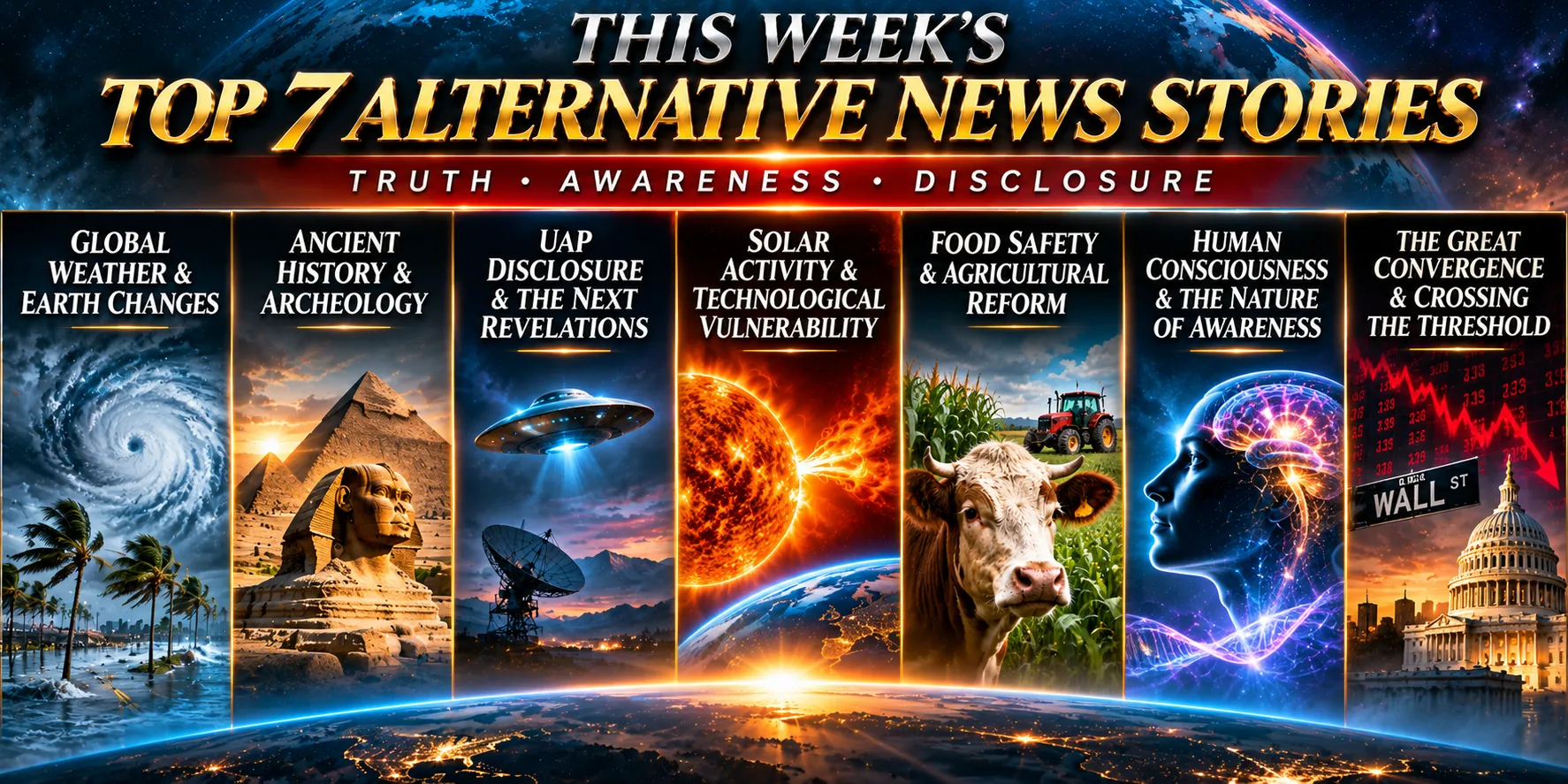
ALTERNATIVE NEWS | YOUR GUIDE TO THIS WEEK’S TOP SEVEN STORIES
Truth Seekers Weekly Briefing | November 13, 2026
As you review this week’s Top Seven Alternative News Stories & Events, approach each topic with an open mind, independent judgment, and a commitment to discernment. These investigations explore developments across global weather and Earth changes, ancient history and archaeology, UAP disclosure, solar activity and technological vulnerability, food safety and agricultural reform, human consciousness, and the convergence of economic and institutional pressures. Begin by examining the central event, available evidence, alternative interpretations, and unanswered questions surrounding each story. Pay particular attention to information that may receive limited attention in mainstream reporting, while distinguishing documented discoveries, scientific findings, credible allegations, emerging theories, and speculation. Our objective is not simply to challenge conventional narratives, but to expand our understanding through Signals, Threads, and Patterns—recognizing significant developments, identifying meaningful relationships, and observing recurring trends that may reveal broader changes in our world.
As you move through these seven investigations, consider how the developments may intersect and what their combined implications could mean for humanity’s future. Examine how advances in scientific technology are expanding our understanding of ancient civilizations and human consciousness, how solar activity and extreme weather expose vulnerabilities in modern infrastructure, and how questions surrounding government transparency, public health, and institutional accountability influence public confidence. Finally, consider the broader theme of Crossing the Threshold, where economic uncertainty, technological transformation, geopolitical realignment, and changing social expectations may create both significant challenges and opportunities for renewal. Avoid assuming that events occurring simultaneously are necessarily connected; instead, look for verifiable relationships, emerging dependencies, and potential consequences. The purpose of this weekly review is to move beyond headlines and fear-driven interpretations toward greater awareness, practical preparedness, personal sovereignty, and informed action. By approaching each story with curiosity, critical thinking, and a willingness to reconsider established assumptions, we strengthen our ability to recognize meaningful change, navigate uncertainty, and participate consciously in shaping the future.
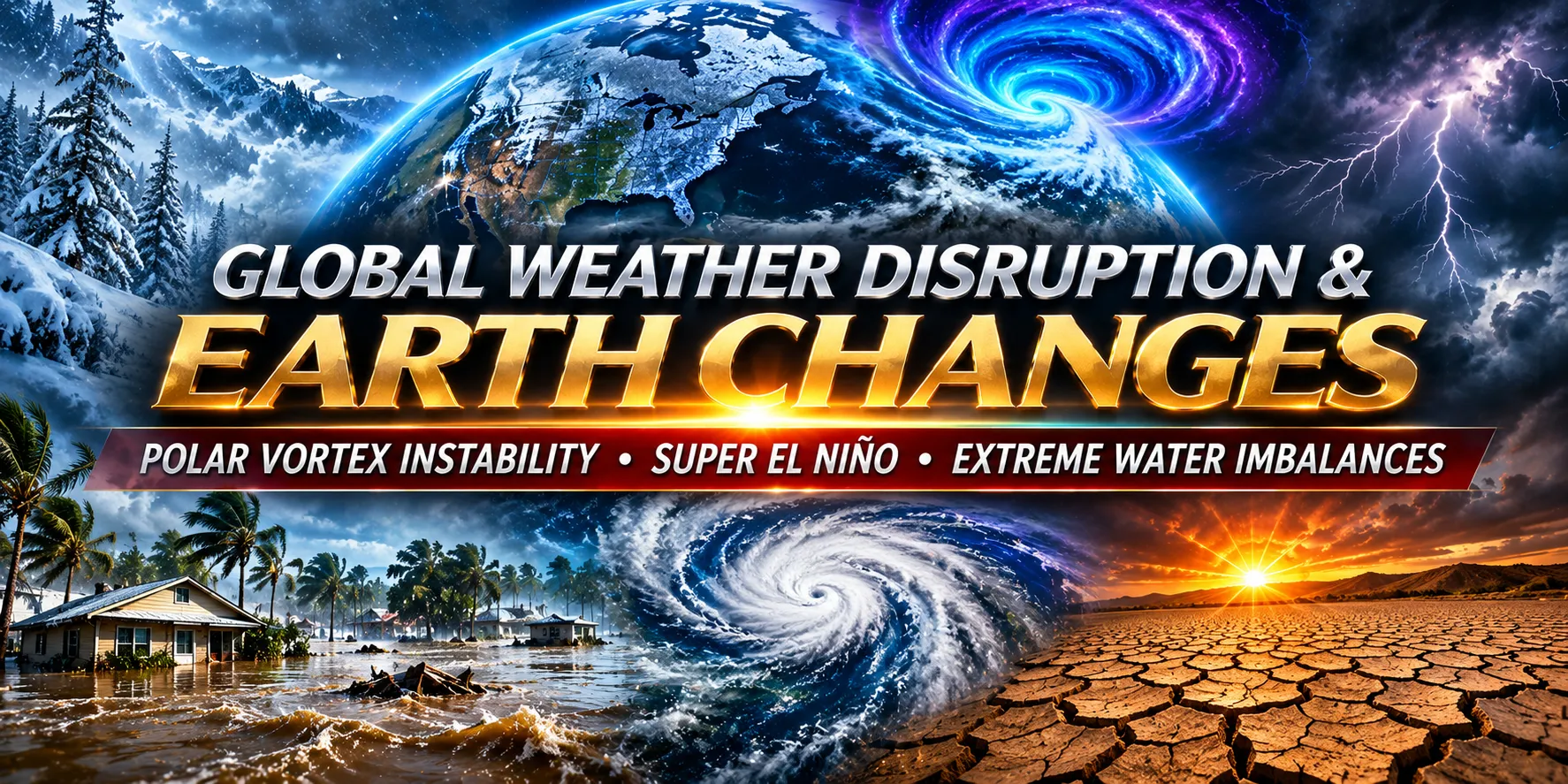
1. GLOBAL WEATHER DISRUPTION & EARTH CHANGES | POLAR VORTEX INSTABILITY, SUPER EL NIÑO & EXTREME WATER IMBALANCES
Atmospheric Circulation • Polar Vortex • El Niño • Extreme Rainfall • Atmospheric Rivers • Flooding • Drought • Global Weather Patterns
The global weather system is entering a period of heightened atmospheric variability and increasingly complex seasonal forecasting challenges, as reports of an unusually early polar vortex disruption coincide with concerns about changing Pacific Ocean temperatures, jet-stream behavior, and extreme weather events across multiple continents. A disruption of the stratospheric polar vortex, particularly one involving the reversal of upper-atmospheric winds, can influence the circulation patterns that help determine winter conditions across North America, Europe, and Asia. However, these atmospheric changes do not automatically produce widespread surface-level cold outbreaks, and their consequences depend on how disturbances propagate through the atmosphere. At the same time, El Niño–Southern Oscillation (ENSO) conditions, ocean temperature anomalies, and shifting atmospheric pressure systems can influence precipitation patterns, storm tracks, and regional temperature variability. The interaction of these forces raises important questions about the reliability of traditional seasonal outlooks when multiple atmospheric and oceanic influences operate simultaneously. The central issue is whether forecasting models can adequately capture these complex interactions and provide communities with sufficient warning of potentially disruptive winter weather.
Beyond the polar regions, reports of extraordinary rainfall, destructive flooding, severe storms, and prolonged drought illustrate the challenges associated with uneven water distribution across the planet. During early November, parts of central Vietnam reportedly experienced exceptional rainfall, including a mountain station recording approximately 760 millimeters, while southern Brazil experienced damaging tornado activity and portions of the Mediterranean faced deadly flash flooding. Meanwhile, Bolivia’s continuing drought emergency highlights the opposite extreme: inadequate precipitation, declining water availability, and growing pressure on agriculture and communities. These developments raise questions about the relationship between atmospheric circulation, ocean temperatures, regional storm systems, land-use changes, and the capacity of existing water-management infrastructure. Atmospheric rivers can deliver substantial moisture to particular regions, while persistent high-pressure systems can suppress rainfall elsewhere, contributing to extended dry conditions. Although simultaneous weather extremes do not necessarily share a single cause, their combined effects highlight the importance of examining regional meteorological mechanisms alongside larger-scale climate variability. The broader concern is whether communities and governments are adequately prepared for periods of intense precipitation, flooding, drought, and rapidly changing weather conditions.
Looking toward the 2026–2027 winter season and beyond, the convergence of polar atmospheric disturbances, ENSO variability, shifting jet streams, extreme precipitation, and regional water shortages presents important challenges for infrastructure planning, agriculture, energy security, transportation, and disaster preparedness. Severe winter storms can disrupt electricity distribution and supply chains, while extreme rainfall can overwhelm drainage systems, damage transportation networks, and threaten communities in flood-prone regions. Prolonged drought can reduce agricultural production, strain reservoirs, and increase pressure on water-dependent industries. These risks become more consequential when weather-sensitive infrastructure has not been designed to withstand unusually severe or persistent conditions. The priority should therefore extend beyond debating individual climate explanations toward improving atmospheric monitoring, strengthening early-warning systems, modernizing water infrastructure, and developing more effective regional resilience strategies. The defining question is whether governments and communities can move from reactive disaster management toward proactive preparation for an increasingly complex range of weather hazards, while using credible scientific evidence to distinguish short-term variability from longer-term climate trends.
Signals • Threads • Patterns | Global Weather Disruptions
Signals include reports of an early polar vortex disruption, changing stratospheric wind circulation, evolving ENSO conditions, exceptional rainfall in Vietnam, severe storms in Brazil, Mediterranean flash flooding, and persistent drought in Bolivia. Threads connect these developments through the relationships among ocean temperatures, atmospheric circulation, jet-stream positioning, moisture transport, regional pressure systems, land-use conditions, and water infrastructure, while recognizing that different events may have distinct meteorological causes. Patterns involve the recurring vulnerability of communities to extreme precipitation, prolonged drought, seasonal weather variability, and infrastructure limitations, particularly when multiple hazards affect agriculture, transportation, energy systems, and water supplies. Together, these developments emphasize the need to examine how atmospheric and oceanic variability interact with local environmental conditions and human preparedness, rather than assuming that simultaneous weather extremes establish a single global mechanism. The larger question is whether advances in forecasting, environmental monitoring, infrastructure investment, and disaster resilience can keep pace with the challenges posed by increasingly complex weather risks.

2. ANCIENT EGYPT’S BURIED CIVILIZATIONS | SATELLITE DISCOVERIES & THE REDISCOVERY OF LOST HISTORY
Ancient Egypt • Buto Archaeological Site • Satellite Radar • Underground Structures • Ancient Engineering • Hidden Civilizations • Historical Rediscovery
The continuing exploration of ancient Egypt’s buried archaeological landscape is opening new possibilities for understanding the engineering capabilities, cultural sophistication, and architectural achievements of early civilizations. Researchers have reportedly identified a large underground structure near the ancient Egyptian city of Buto, using advanced satellite-based remote sensing and subsurface imaging technologies. The reported complex measures approximately 128 meters by 62 meters and has been provisionally associated with Egypt’s Late Period, approximately 688–525 BCE, although its original purpose remains uncertain. Possible interpretations include religious, ceremonial, administrative, or funerary functions, reflecting the importance of Buto as an ancient religious and political center in the Nile Delta. If the reported findings are confirmed through additional archaeological investigation, they could provide valuable insights into the organization of ancient Egyptian settlements and the extent of monumental construction beneath modern landscapes. The larger significance lies not simply in discovering another buried structure, but in recognizing how much archaeological evidence may remain concealed beneath centuries of sediment, agricultural development, changing waterways, and expanding human settlements.
The emergence of satellite radar, ground-penetrating radar, geophysical surveying, and advanced digital mapping is transforming the methods archaeologists use to investigate ancient civilizations. These technologies can help researchers identify buried architectural patterns, settlement boundaries, possible foundations, ancient transportation routes, and previously undocumented archaeological features without immediately undertaking extensive excavation. In regions such as the Nile Delta, where groundwater, agricultural activity, and accumulated sediment complicate traditional archaeological work, remote-sensing techniques offer important opportunities to investigate areas that have remained difficult to access. However, subsurface imaging identifies physical anomalies and potential structures; it does not independently establish their age, function, or cultural significance. Those interpretations require corroborating evidence from archaeological excavation, material analysis, historical records, and scientific dating methods. Nevertheless, the expanding use of these technologies raises compelling questions about the scale of ancient urban development, the sophistication of early engineering systems, and the possibility that important elements of Egyptian history remain undocumented. The convergence of modern technology and ancient archaeology may ultimately reveal a more extensive and complex picture of early societies than existing archaeological records currently provide.
Looking toward the future of archaeological discovery, the integration of artificial intelligence, satellite observation, advanced geophysical instruments, and digital reconstruction could significantly expand humanity’s ability to investigate its ancient past. Large areas of Egypt, the Middle East, the Mediterranean, and other historically significant regions remain incompletely surveyed, creating opportunities for discoveries that could refine established historical timelines and interpretations. New evidence may illuminate ancient construction techniques, religious institutions, trade relationships, settlement organization, water-management systems, and the development of early political structures. Such discoveries do not automatically overturn conventional historical understanding, but they can challenge incomplete assumptions and reveal dimensions of ancient societies that previous generations lacked the technology to investigate. The defining question is whether the next generation of archaeological discoveries will substantially expand our understanding of ancient civilizations, revealing previously undocumented achievements in engineering, architecture, cultural organization, and environmental adaptation. As increasingly sophisticated investigative tools become available, the boundaries of what we know about humanity’s ancient history may continue to expand, reminding us that the archaeological record represents only a portion of the civilizations that once existed.
Signals • Threads • Patterns | Ancient Egypt’s Buried Civilizations
Signals are emerging through reports of large buried architectural features at Buto, the expanding use of satellite and subsurface imaging, advances in archaeological mapping, and the identification of previously undocumented settlement structures. Threads connect these developments to broader relationships among ancient Egyptian engineering, religious institutions, urban planning, Nile Delta environmental changes, sediment accumulation, and the application of modern scientific technologies to historical investigation. The ability to examine archaeological landscapes without extensive excavation also connects historical research to advances in artificial intelligence, geospatial analysis, remote sensing, and digital reconstruction. Patterns suggest that improvements in investigative technology are progressively expanding the archaeological record, revealing how ancient settlements, infrastructure networks, and cultural institutions may have been more extensive or differently organized than surviving surface evidence alone suggests. Together, these developments raise a compelling question: How much of humanity’s ancient architectural, technological, and cultural history remains undiscovered, and how might future archaeological evidence refine our understanding of the capabilities and achievements of early civilizations?

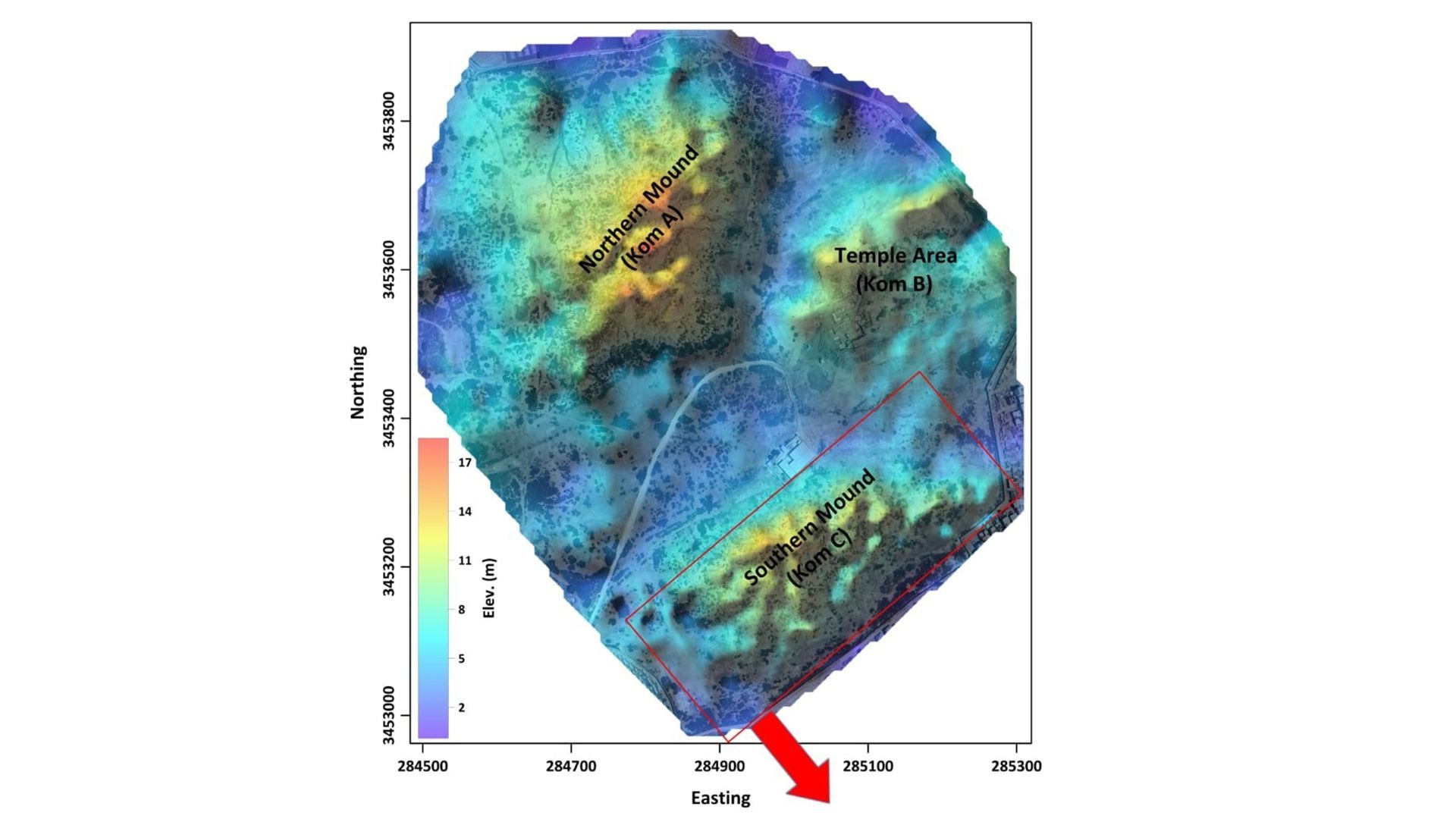
3. THE UAP DISCLOSURE THRESHOLD | PENTAGON REVELATIONS, CONGRESSIONAL OVERSIGHT & THE SEARCH FOR TRANSPARENCY
Unidentified Anomalous Phenomena • Pentagon UAP Files • UAP Disclosure Act • Whistleblower Protections • National Security • Congressional Accountability • Government Transparency
The continuing debate surrounding Unidentified Anomalous Phenomena (UAP) disclosure is entering an important period of institutional scrutiny as Pentagon records, congressional legislative initiatives, and new reporting pathways for government personnel raise questions about the transparency and completeness of information available to the American public. According to the supplied reporting, an October 23, 2026, Pentagon records release included documentation of a reported June 2026 sighting involving a silent triangular object near a national-security installation. While such reports warrant examination, the existence of an official sighting record does not independently establish the object’s origin, technological capabilities, or extraterrestrial nature. The larger issue concerns what information accompanies government disclosures, how incidents are investigated, and whether sufficient evidence is made available for independent scientific evaluation. Witness statements and incident summaries can provide valuable investigative leads, but meaningful verification may require radar records, infrared imagery, calibrated sensor measurements, flight data, environmental conditions, and documented investigative procedures. The central question is whether the government’s disclosure process is evolving toward genuine evidentiary transparency or continuing to release limited information that leaves the most consequential questions unresolved.
A second important development involves the reported establishment of additional pathways for government personnel and defense contractors to provide UAP-related information through authorized national-security channels. September reporting by The Debrief described a Pentagon waiver associated with the PURSUE initiative, intended to facilitate the submission of certain UAP-related defense information while maintaining applicable security-review requirements. Such mechanisms could help address concerns that individuals possessing relevant information may face uncertainty about classification restrictions, professional consequences, or the appropriate procedures for reporting sensitive material. However, authorization to provide information through a protected government process is not equivalent to public declassification, and information submitted through these channels may remain inaccessible to independent researchers or the general public. This distinction becomes particularly important when evaluating the effectiveness of whistleblower protections and government accountability. A credible disclosure framework must balance legitimate national-security protections, meaningful congressional access, independent investigative oversight, and the public interest in understanding unexplained incidents. The deeper question is whether these reporting mechanisms will produce substantive investigative findings, verifiable evidence, and greater institutional accountability, rather than simply increasing the volume of classified information held within existing government systems.
Meanwhile, the continuing debate over the UAP Disclosure Act and its relationship to fiscal year 2027 defense legislation highlights the constitutional and political challenges surrounding the release of potentially sensitive government records. Congressional proposals addressing record preservation, disclosure procedures, classification review, historical investigations, and oversight responsibilities reflect growing interest in establishing a more systematic framework for examining UAP-related information. The effectiveness of any eventual legislation will depend on its final language, implementation, enforcement mechanisms, and the degree of independence granted to the institutions responsible for reviewing records. Discussions surrounding additional congressional hearings may increase public attention, but hearings, proposed legislation, and official statements should not be confused with completed disclosures or independently verified discoveries. The larger implications extend beyond the possibility of unconventional aerospace technologies to questions involving government secrecy, intelligence accountability, scientific investigation, public trust, and the appropriate limits of national-security classification. The defining question is whether the United States can establish a transparent, independently accountable disclosure process that protects legitimate security interests while allowing credible evidence to be evaluated openly—or whether UAP investigations will remain constrained by fragmented records, selective releases, and unresolved institutional barriers.
Signals • Threads • Patterns | UAP Disclosure Threshold
Signals include the reported release of additional Pentagon UAP records, documentation of unexplained aerial sightings, the development of authorized reporting pathways for government personnel, continued congressional interest in UAP legislation, and proposals for additional public hearings. Threads connect these developments through the relationships among national-security classification, intelligence oversight, whistleblower protections, scientific verification, congressional authority, defense contracting, and public access to government information. The distinction between submitting classified information to authorized investigators and releasing evidence publicly is particularly important in evaluating whether institutional transparency is actually improving. Patterns suggest a gradual movement toward more formalized UAP reporting and oversight mechanisms, while longstanding tensions between government secrecy, national-security responsibilities, public accountability, and independent scientific investigation remain unresolved. Together, these developments raise a central question: Are Pentagon disclosures and congressional initiatives establishing the foundations for meaningful, evidence-based transparency, or will the public continue receiving incomplete records that generate additional questions without resolving the underlying phenomena?


4. THE SOLAR THRESHOLD | SPACE WEATHER, SOLAR FLARES & THE VULNERABILITY OF MODERN CIVILIZATION
Solar Maximum • Solar Flares • Coronal Mass Ejections • Geomagnetic Storms • Electromagnetic Disruptions • Central Sun Theories • Global Infrastructure • Technological Resilience
As the Sun continues through the active phase of Solar Cycle 25, growing attention is being directed toward solar flares, coronal mass ejections (CMEs), geomagnetic storms, and the potential consequences of extreme space-weather events. A November 10, 2026, space-weather outlook reportedly identified elevated probabilities of radio blackouts for November 11–12, including a 15% forecast probability of strong-to-extreme radio blackout conditions. These figures represent anticipated risks rather than confirmation that such events occurred. Solar flares can produce intense bursts of electromagnetic radiation capable of disrupting high-frequency radio communications, while Earth-directed CMEs can interact with the planet’s magnetic field and generate geomagnetic disturbances. These interactions may affect satellite operations, GPS accuracy, aviation communications, electrical transmission systems, and other technologies dependent on reliable electromagnetic conditions. The broader issue is not simply whether the Sun produces another spectacular aurora display, but whether modern civilization adequately understands its growing exposure to space-weather hazards capable of disrupting essential technological infrastructure. Although discussions within alternative research communities sometimes reference a Central Sun, galactic energy cycles, or larger cosmic influences, these concepts should be distinguished from the established scientific understanding of solar activity and its measurable effects on Earth’s near-space environment.
The deeper concern involves the extraordinary degree to which modern civilization depends on interconnected electrical grids, satellites, telecommunications networks, digital financial systems, transportation infrastructure, and automated industrial operations. A sufficiently intense geomagnetic storm could induce electrical currents in long-distance transmission systems, potentially damaging vulnerable equipment or causing localized or regional power disruptions. Solar radiation events can also create hazards for spacecraft electronics and astronauts, while ionospheric disturbances may interfere with navigation and radio communication. These vulnerabilities become more consequential when disruptions propagate through interdependent systems involving energy distribution, water treatment, emergency services, transportation, supply chains, banking, and digital communications. Historical events, including the 1859 Carrington Event and the March 1989 Quebec geomagnetic storm, demonstrate that severe solar disturbances can affect technological systems, although the consequences of a future event would depend on its characteristics and the effectiveness of protective measures. Importantly, solar flares, geomagnetic storms, and human-generated electromagnetic pulses (EMPs) are not identical phenomena, even though discussions about technological resilience sometimes group them together. The central question is whether society has become so dependent on continuous electrical and digital connectivity that a relatively brief but severe space-weather disturbance could generate cascading consequences across multiple essential services.
Looking toward the coming years, the interaction between solar activity, technological expansion, infrastructure dependence, and emergency preparedness deserves greater attention from governments, utility operators, telecommunications providers, businesses, and households. The continued development of artificial intelligence data centers, satellite constellations, advanced telecommunications, and increasingly automated infrastructure adds new dimensions to the challenge of maintaining operational resilience during major disruptions. Practical preparation involves improved solar monitoring, early-warning systems, electrical grid protection, satellite safeguards, backup communications, emergency power capabilities, and coordinated continuity planning. Space-weather forecasting agencies can provide advance notice of some hazards, but the precise timing, intensity, and infrastructure consequences of individual events remain uncertain. While catastrophic scenarios often dominate public discussion, effective preparation should be based on credible risk assessments, engineering safeguards, and realistic contingency planning rather than speculative predictions of inevitable global failure. The defining question is whether humanity can strengthen the resilience of its rapidly expanding technological civilization before a major solar event exposes critical weaknesses in the systems supporting modern life. Understanding solar activity therefore becomes more than an exercise in astronomical observation; it is an essential component of national security, economic continuity, infrastructure planning, and long-term societal preparedness.
Signals • Threads • Patterns | The Solar Threshold
Signals include elevated space-weather forecasts, solar flare activity, Earth-directed CME monitoring, geomagnetic storm alerts, radio blackout probabilities, and increasing attention to the vulnerability of satellites and electrical infrastructure. Threads connect these developments through the relationships among solar magnetic activity, Earth’s magnetosphere, ionospheric disturbances, electrical transmission networks, satellite navigation, telecommunications, aviation systems, and emergency preparedness. These connections demonstrate how disturbances originating at the Sun can produce measurable effects across multiple technological systems, depending on the intensity and characteristics of the event. Patterns reflect the approximately 11-year solar activity cycle, recurring periods of increased flare and CME activity, and the expanding dependence of modern society on infrastructure potentially exposed to space-weather disruptions. Together, these developments raise a fundamental question: As technological systems become more interconnected and essential to daily life, are investments in monitoring, infrastructure protection, and emergency resilience keeping pace with the risks posed by extreme solar activity?



5. AMERICA’S FOOD SAFETY CROSSROADS | CATTLE GROWTH DRUGS, AGRICULTURAL LOBBYING & THE BATTLE FOR PUBLIC HEALTH REFORM
Food Safety • Cattle Growth Drugs • Agricultural Chemicals • MAHA Movement • Corporate Influence • Regulatory Accountability • Public Health • Food Sovereignty
America’s food production and agricultural regulatory systems are facing renewed scrutiny as questions emerge about cattle growth-promoting drugs, chemical residues, international food safety standards, and the influence of agricultural industries on public-health policy. November reporting from Children’s Health Defense raises concerns about substances used in American livestock production that face restrictions in numerous other countries. However, the specific drug, the number of countries restricting it, and the scientific basis for those restrictions require verification before definitive conclusions can be drawn. Different countries may reach different regulatory decisions because of varying scientific assessments, permissible residue limits, precautionary policies, agricultural economics, and trade considerations. These differences do not automatically establish that a substance approved in one country is unsafe, but they raise legitimate questions about how regulatory authorities evaluate long-term exposure, cumulative chemical residues, vulnerable populations, and potential public-health consequences. The broader issue extends beyond any single livestock drug to the transparency of the systems responsible for determining which substances enter the food supply, what evidence supports their approval, and whether consumers receive sufficient information to make informed decisions about the products they purchase.
The controversy becomes more significant when connected to the Make America Healthy Again (MAHA) movement, agricultural lobbying, and the political challenges of reforming established food-production practices. Additional reporting from Children’s Health Defense has questioned whether pesticide manufacturers, agricultural trade organizations, and other corporate interests are influencing the direction of proposed health reforms. Statements attributed to MAHA advocate Calley Means have further intensified debate over whether industry pressure has weakened or redirected certain initiatives. These allegations deserve examination through lobbying disclosures, campaign contributions, regulatory meeting records, proposed legislation, agency decisions, and documented policy changes, rather than relying solely on political statements. Agricultural corporations and industry associations have legitimate opportunities to participate in regulatory proceedings, but their involvement also creates questions about conflicts of interest, regulatory independence, transparency, and the relative influence of public-health researchers, farmers, consumers, and corporate stakeholders. The central challenge is whether policymakers can balance agricultural productivity, economic competitiveness, affordable food, environmental protection, and long-term public health while maintaining a regulatory process that is scientifically credible and accountable to the public.
Looking toward the future, the convergence of food safety controversies, international regulatory differences, agricultural lobbying, and the MAHA reform agenda raises broader questions about the direction of America’s food and health systems. Meaningful reform requires more than public declarations or political branding; it requires transparent scientific reviews, independent research, measurable regulatory changes, consistent enforcement, and clear public reporting of outcomes. Policymakers must also consider how restrictions on agricultural chemicals or livestock treatments could affect farm operating costs, food prices, animal welfare, domestic production, and international trade, while evaluating whether safer or more effective alternatives are available. Consumer confidence ultimately depends on whether government agencies can demonstrate that regulatory decisions are based on credible evidence, transparent risk assessments, and clearly defined public-health objectives. The defining question is whether America can develop a food-production system that protects public health while supporting sustainable agriculture and economic stability—or whether competing political, commercial, and institutional interests will continue complicating meaningful regulatory reform. The success of any reform movement should therefore be measured by verifiable policy outcomes, improved oversight, and demonstrated health protections, rather than the strength of its political messaging.
Signals • Threads • Patterns | America’s Food Safety Crossroads
Signals include renewed reporting about livestock growth-promoting drugs, differences between American and international agricultural safety standards, concerns about chemical residues, MAHA policy debates, and allegations of pesticide-industry influence over regulatory reform. Threads connect these developments through the relationships among food production, agricultural economics, scientific risk assessment, corporate lobbying, government oversight, international trade, and consumer health. The regulatory treatment of livestock drugs and pesticides illustrates how scientific evidence, economic interests, and public policy intersect within the broader food system, even though each substance requires its own safety assessment. Patterns involve recurring debates over regulatory transparency, industry participation in policymaking, conflicts of interest, the precautionary principle, and the challenge of translating public-health reform proposals into enforceable standards. Together, these developments raise an essential question: Can America’s agricultural and public-health institutions establish consistent, evidence-based protections that maintain consumer confidence while ensuring that regulatory decisions remain transparent, independent, and accountable to the people they are intended to serve?


6. THE CONSCIOUSNESS FRONTIER | BRAIN IMAGING, HIDDEN AWARENESS & THE MYSTERY OF HUMAN EXPERIENCE
Neuroscience • Human Consciousness • Functional MRI • Hidden Awareness • Brain Activity • Disorders of Consciousness • Mind–Brain Relationship • Scientific Discovery
The scientific investigation of human consciousness is entering a fascinating new phase as advances in brain imaging, neurological research, and artificial intelligence expand our ability to study awareness in individuals who cannot reliably communicate with the outside world. An October 29, 2026, research review reported in Neurology examines the relationship between resting-state functional magnetic resonance imaging (fMRI) and clinical outcomes among patients experiencing acute disorders of consciousness. These conditions can arise following traumatic brain injuries, strokes, oxygen deprivation, and other severe neurological events, leaving patients unable to demonstrate awareness through conventional behavioral responses. Yet the absence of observable movement, speech, or communication does not necessarily establish the absence of conscious experience. Researchers increasingly recognize the importance of distinguishing wakefulness, behavioral responsiveness, neural activity, and subjective awareness, because these characteristics do not always correspond in predictable ways. Advanced imaging techniques can reveal patterns of brain connectivity and activity that conventional bedside examinations may not detect, raising important questions about how consciousness should be assessed and whether some patients retain forms of awareness that remain hidden from ordinary observation. The central question is whether our traditional understanding of consciousness has been constrained by the limitations of the tools used to measure it.
The deeper implications extend beyond neurological diagnosis into the longstanding scientific and philosophical debate surrounding the relationship between the brain, awareness, and subjective human experience. Functional MRI measures changes associated with blood oxygenation, allowing researchers to investigate brain networks involved in attention, sensory processing, memory, and other cognitive functions. In some studies, patients who appear behaviorally unresponsive have demonstrated brain activity consistent with preserved cognitive processing, while specialized experimental tasks have identified cases of covert consciousness or cognitive motor dissociation, in which individuals may understand instructions despite being unable to produce visible responses. Importantly, resting-state connectivity findings alone cannot establish that a particular patient is consciously aware, and not every pattern of neural activity indicates subjective experience. Nevertheless, these discoveries challenge the assumption that an inability to communicate necessarily reflects an inability to perceive, understand, or experience. They also introduce profound ethical questions involving medical decision-making, rehabilitation opportunities, patient dignity, and the interpretation of neurological prognosis. Beyond clinical applications, the research invites a broader examination of whether neuroscience is approaching a comprehensive explanation of consciousness or primarily improving its ability to identify the measurable biological processes associated with conscious states.
Looking toward the future, the convergence of advanced neuroimaging, artificial intelligence, brain-computer interfaces, and consciousness research could transform how scientists investigate the boundaries of human awareness. Emerging technologies may improve the detection of preserved cognitive function, support more individualized rehabilitation strategies, and eventually create new communication possibilities for patients who cannot speak or move. These developments also raise fundamental questions about the nature of self-awareness, the relationship between subjective experience and physical brain processes, and the limits of conventional scientific observation. Researchers continue debating whether consciousness can ultimately be explained through neural activity alone or whether existing theoretical frameworks remain incomplete. Some philosophical and contemplative traditions propose broader interpretations of consciousness, but these perspectives should be distinguished from conclusions established through clinical neuroscience. The defining question is whether humanity is approaching a deeper understanding of consciousness itself, or whether increasingly sophisticated technologies are revealing how much remains unknown about the relationship between physical brain activity and the experience of being aware. As scientific investigation advances, the study of consciousness may become one of the most consequential frontiers connecting medicine, neuroscience, philosophy, technology, and the fundamental questions of human existence.
Signals • Threads • Patterns | The Conscious Frontier
Signals include emerging research involving resting-state fMRI, functional brain connectivity, covert consciousness, cognitive motor dissociation, and improved neurological assessment techniques for patients who cannot reliably communicate. Threads connect these developments through the relationships among neural activity, behavioral responsiveness, subjective awareness, advanced imaging technologies, artificial intelligence, clinical diagnosis, and medical ethics. These connections are particularly important because observable behavior and underlying cognitive function may differ, requiring researchers to examine consciousness through multiple complementary methods rather than relying on a single measurement. Patterns suggest a gradual shift toward more sophisticated, multimodal approaches to studying consciousness, in which behavioral examinations are increasingly supplemented by brain imaging, electrophysiology, computational analysis, and experimental cognitive testing. Together, these developments raise a profound question: As science becomes more capable of detecting hidden cognitive activity, will it also move closer to explaining the fundamental nature of conscious experience—or will the distinction between measuring brain function and understanding subjective awareness remain one of neuroscience’s greatest unresolved challenges?


7. CROSSING THE THRESHOLD | THE GREAT CONVERGENCE & THE UNRAVELING OF THE OLD WORLD ORDER
2026 Election Certification • Financial Market Instability • Institutional Breakdown • Economic Compression • Global Realignment • Crisis of Confidence • Humanity’s Great Transition
The world appears to be approaching a critical threshold where mounting pressures across financial markets, major industries, political institutions, and geopolitical systems are converging into an increasingly complex period of uncertainty. What once appeared to be separate challenges—government dysfunction, unsustainable debt burdens, economic inequality, technological disruption, geopolitical confrontation, and declining institutional trust—now interact through deeply interconnected systems. The approaching certification of the 2026 U.S. midterm election results introduces another potential point of political tension, particularly if contested outcomes, legal challenges, or competing narratives intensify public distrust. Yet election certification is a decentralized legal process, and there is no established evidence that it will trigger a global financial collapse or coordinated disruption. The more consequential concern is whether an unexpected political confrontation could amplify existing economic vulnerabilities and accelerate a broader crisis of confidence. History demonstrates that financial instability often becomes most dangerous when uncertainty spreads beyond individual markets into the institutions responsible for maintaining public confidence, credit availability, and economic continuity. The defining question is whether humanity is approaching a temporary period of heightened instability or a more consequential structural transition in which established systems must fundamentally adapt to changing global realities.
The deeper significance lies in the convergence of economic compression, institutional fragility, technological transformation, and geopolitical realignment. Financial markets depend on confidence, liquidity, and predictable institutional behavior, while industries rely on functioning supply chains, affordable energy, accessible credit, and stable consumer demand. When several of these conditions deteriorate simultaneously, pressures can reinforce one another, potentially affecting banking institutions, commercial real estate, government finances, employment, international trade, and essential infrastructure. Artificial intelligence is accelerating changes in employment, capital investment, and industrial organization, while international conflicts and strategic competition are reshaping energy security and manufacturing relationships. These developments create genuine vulnerabilities, but they also present opportunities for innovation, institutional reform, and economic restructuring. The possibility of widespread fear emerges when financial insecurity, political uncertainty, and disruptive information narratives interact, particularly in environments where public confidence is already weakened. However, a period of economic or political turbulence should not automatically be interpreted as an inevitable descent into global darkness. The central challenge is whether governments, businesses, communities, and individuals can maintain stability and constructive decision-making while navigating simultaneous pressures that may require substantial institutional and economic adaptation.
Looking toward 2027 and the years beyond, the concept of Crossing the Threshold offers a framework for understanding a possible transition between established structures and emerging economic, technological, and social arrangements. Within this framework, 2026–2028 represents a potential period of intensifying structural pressure, followed by a longer process of adjustment, innovation, and institutional realignment. This is an interpretive scenario rather than a scientifically established timetable, and its usefulness depends on evaluating actual developments rather than assuming predetermined outcomes. Major transitions throughout history have involved uncertainty, institutional resistance, financial disruption, changing social expectations, and the emergence of new systems of organization. Such periods can be difficult, particularly for individuals and communities lacking financial flexibility, reliable information, or strong support networks. Yet transitions also create opportunities to strengthen local resilience, independent thinking, responsible leadership, technological innovation, and community cooperation. Humanity’s greatest challenge may not be the disruption of familiar institutions, but the ability to navigate change without allowing fear, polarization, and uncertainty to determine collective decisions. Crossing the Threshold, therefore, is not necessarily the end of an established world, but a potential period in which the choices made by individuals, institutions, and societies influence what emerges next.
Signals • Threads • Patterns | Crossing The Threshold
Signals include political disputes surrounding election administration, financial market volatility, elevated debt burdens, pressure on vulnerable industries, geopolitical confrontation, technological disruption, and declining confidence in major institutions. Threads connect these developments through the interdependence of government legitimacy, financial liquidity, credit markets, industrial supply chains, energy infrastructure, public sentiment, and international economic relationships. Political uncertainty can influence market expectations, financial instability can constrain business investment, and geopolitical disruptions can affect energy prices and trade flows, creating pathways through which pressures may spread across multiple systems. Patterns involve recurring periods of economic adjustment, institutional stress, political polarization, technological displacement, and subsequent adaptation, although their timing and severity cannot be reliably determined from broad historical comparisons alone. Together, these developments raise a defining question: Are we approaching a period in which multiple structural pressures reinforce one another and accelerate global realignment—and, if so, can humanity navigate this threshold through preparation, discernment, cooperation, and responsible leadership rather than allowing uncertainty and fear to dominate the transition?


CONNECTING THE DOTS | THE GREAT CONVERGENCE OF SEVEN ALTERNATIVE NEWS DEVELOPMENTS
Truth Seekers Weekly Briefing | November 13, 2026
Introduction | Understanding the Convergence of a Changing World
As we move beyond the individual investigations presented in this week’s Alternative News Stories & Events, our focus shifts toward Connecting the Dots—understanding how seemingly unrelated developments may intersect, influence one another, and contribute to a larger transformation of our global landscape. The seven topics explored—Global Weather & Earth Changes, Ancient Civilizations, UAP Disclosure, Solar Activity, Food Safety, Human Consciousness, and Crossing the Threshold—represent different dimensions of a world experiencing accelerating technological advancement, environmental pressures, scientific discovery, and institutional uncertainty. Having examined the Signals, Threads, and Patterns within each investigation, we now bring those observations together to identify where meaningful relationships emerge, where existing pressures may reinforce one another, and where new opportunities for understanding and adaptation are developing. The objective is to move beyond isolated headlines and recognize how the convergence of multiple developments can reveal vulnerabilities, dependencies, and possibilities that are less visible when each event is examined independently.
The deeper significance of this convergence emerges through the relationships among natural systems, technological infrastructure, scientific discovery, public-health policy, and institutional accountability. Extreme weather and solar activity demonstrate how environmental disturbances can affect energy networks, communications systems, agriculture, transportation, and economic stability, while advances in satellite imaging and neuroscience are expanding humanity’s ability to investigate ancient civilizations and the nature of human consciousness. Meanwhile, continuing questions surrounding UAP disclosure, agricultural regulation, and government transparency reveal the importance of credible evidence, independent verification, and public confidence in established institutions. These developments do not necessarily originate from a common cause, but they intersect through broader questions involving the reliability of essential systems, the boundaries of scientific knowledge, the management of emerging risks, and society’s capacity to respond to new information. By examining these relationships collectively, we begin to recognize how environmental vulnerability, technological dependence, institutional trust, and scientific advancement can influence the direction and resilience of modern civilization.
As we look toward 2027 and the broader period described within Great Awakening Report as Crossing the Threshold, these seven investigations provide a framework for considering how humanity may navigate a period of economic realignment, technological transformation, environmental uncertainty, and evolving perspectives on human history and consciousness. Some developments may introduce significant challenges, including infrastructure disruptions, financial pressures, and institutional resistance to change, while others may create opportunities for scientific breakthroughs, stronger communities, improved public accountability, and innovative approaches to health, energy, and economic resilience. The essential task is to distinguish verified connections from speculation, emerging trends from isolated events, and constructive opportunities from fear-driven predictions. Connecting the Dots is ultimately about developing the awareness to recognize meaningful change without assuming that every development points toward a predetermined outcome. Through discernment, independent research, practical preparedness, and conscious leadership, we can approach this convergence with greater clarity, understand the forces influencing our evolving world, and participate more thoughtfully in shaping what emerges beyond the threshold.
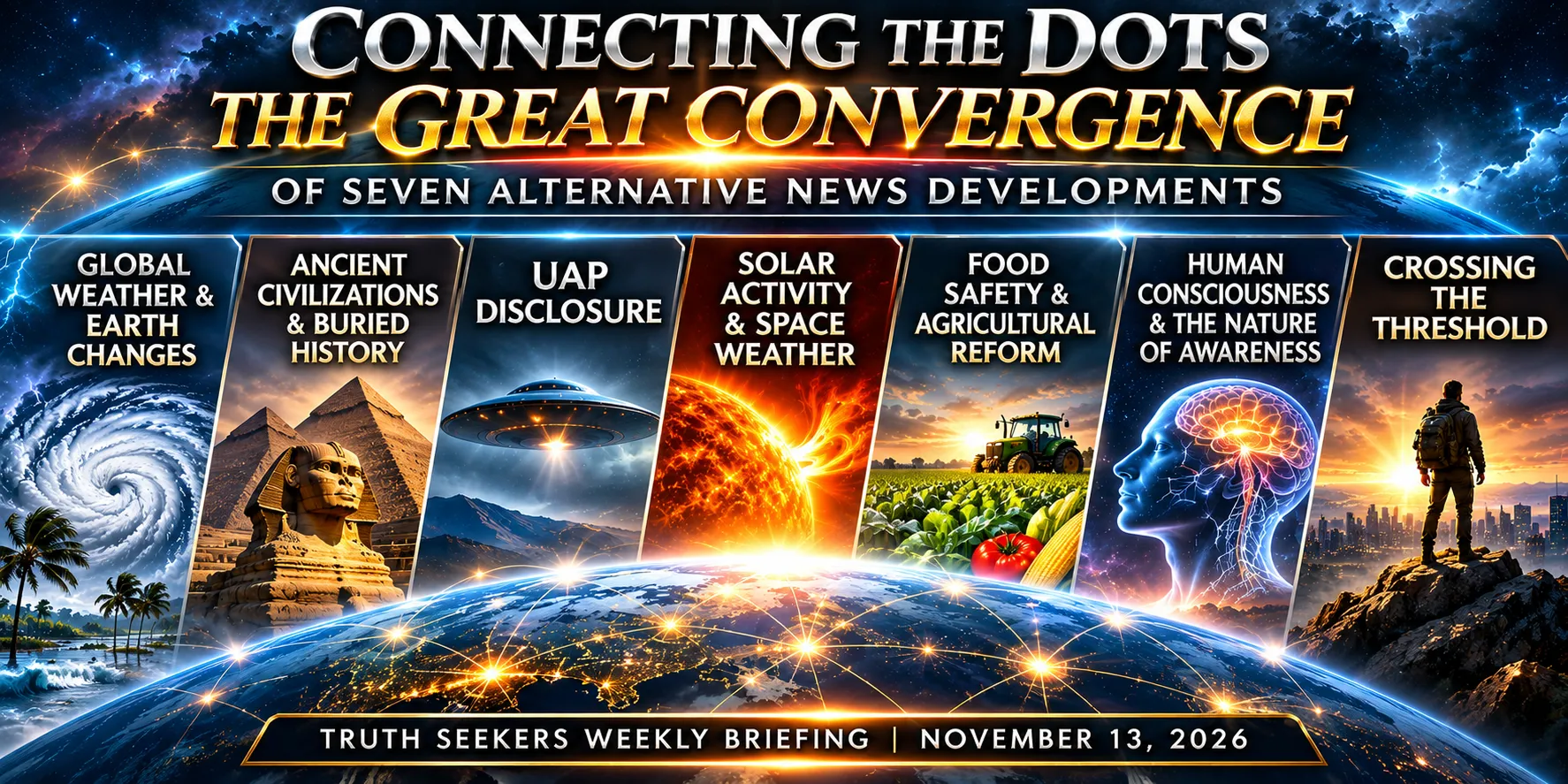
HOW TO NAVIGATE CONNECTING THE DOTS | UNDERSTANDING THE GREAT CONVERGENCE
As you review this week’s seven alternative news investigations, shift your perspective from examining individual events to recognizing how separate developments may intersect, influence one another, and contribute to broader patterns of global transformation. Having already identified the Signals, Threads, and Patterns within each topic, the next step is to understand their convergence—the point where multiple developments interact, reinforce existing pressures, and potentially accelerate systemic change. Begin by examining the relationships among global weather and Earth changes, ancient archaeological discoveries, UAP disclosure, solar activity, food safety, human consciousness, and institutional transformation. Consider how environmental disturbances and solar activity expose vulnerabilities in modern infrastructure, how technological advances expand our understanding of ancient civilizations and consciousness, and how questions surrounding government transparency and public-health policy influence institutional trust. Look beyond the immediate headlines to identify shared vulnerabilities, technological dependencies, institutional challenges, and emerging opportunities, while distinguishing meaningful connections from events that simply happen to occur during the same period.
As you move deeper into Connecting the Dots, focus on understanding how the convergence of these developments may influence humanity’s direction through 2027 and the broader period we describe as Crossing the Threshold. Ask three essential questions: What is changing? How are these changes connected? What could emerge from their combined effects? Consider both the immediate consequences and the longer-term implications for economic stability, technological resilience, scientific discovery, public confidence, personal sovereignty, and community preparedness. Not every development shares a common cause, and convergence does not mean that every event is moving toward a predetermined outcome. Instead, the objective is to recognize where pressures are accumulating, where systems are becoming increasingly interdependent, and where new possibilities for adaptation and transformation are emerging. By approaching these investigations through discernment, critical thinking, and a broader systems perspective, we move beyond isolated news stories toward a more comprehensive understanding of the forces shaping our evolving global landscape—and how to navigate uncertainty with greater awareness, clarity, and conscious intention.
1. GLOBAL WEATHER DISRUPTION & EARTH CHANGES | POLAR VORTEX INSTABILITY, SUPER EL NIÑO & EXTREME WATER IMBALANCES
The convergence of atmospheric instability, ocean temperature variability, extreme precipitation, and regional drought conditions reveals the complex relationship between Earth’s natural systems and humanity’s growing dependence on predictable environmental conditions. Reports of unusual polar vortex behavior, shifting atmospheric circulation, severe flooding, and prolonged drought raise questions about how oceanic influences, jet streams, atmospheric moisture, and regional weather systems interact. Although these events do not necessarily share a single cause, their combined consequences can expose vulnerabilities across agriculture, energy production, transportation, water management, and essential infrastructure. The deeper connection is that environmental disruptions become economic and institutional challenges when governments, industries, and communities lack sufficient resilience to absorb their effects.
These relationships become particularly significant when weather extremes intersect with global food production, financial pressures, and infrastructure limitations. Severe flooding can damage transportation networks, disrupt agricultural production, and overwhelm water-management systems, while prolonged drought can reduce crop yields, threaten livestock, and increase competition for limited water resources. Winter storms and atmospheric disturbances may affect energy demand, electrical transmission systems, and regional supply chains. When several of these conditions develop across different regions, their economic consequences can accumulate through commodity markets, food prices, insurance costs, government disaster spending, and international trade. This convergence demonstrates how natural environmental variability can amplify existing economic vulnerabilities, particularly in communities already experiencing financial pressure or inadequate infrastructure investment.
Looking toward 2027 and beyond, the larger question is whether humanity can transition from reactive disaster response toward proactive environmental resilience and long-term infrastructure planning. Advances in satellite observation, atmospheric modeling, early-warning systems, and water-management technologies provide opportunities to improve preparedness, but their effectiveness depends on coordinated investment and implementation. The convergence of weather variability, agricultural vulnerability, energy security, and economic uncertainty suggests that environmental resilience will become an increasingly important component of national security and economic stability. The defining challenge is not simply predicting the next extreme weather event, but understanding how environmental pressures can interact with existing systemic weaknesses and preparing communities to withstand their combined consequences.
2. ANCIENT EGYPT’S BURIED CIVILIZATIONS | SATELLITE DISCOVERIES & THE REDISCOVERY OF LOST HISTORY
The reported discovery of a substantial buried structure near Buto in Egypt’s Nile Delta illustrates a convergence between advanced technology, archaeological investigation, and humanity’s evolving understanding of ancient civilizations. Modern satellite observation, geophysical surveying, and underground imaging are expanding researchers’ ability to identify archaeological features that may have remained concealed beneath sediment, agricultural development, and modern settlements. The deeper connection extends beyond any individual discovery to the relationship between technological innovation and historical interpretation. As investigative instruments become more sophisticated, researchers can examine locations and architectural features previously inaccessible through conventional excavation. These developments suggest that portions of the archaeological record may remain undocumented, potentially limiting our understanding of the scale, organization, and achievements of ancient societies.
The convergence becomes particularly compelling when archaeological research intersects with artificial intelligence, digital reconstruction, environmental science, and historical analysis. Technologies originally developed for modern applications—including satellite mapping, advanced imaging, and computational analysis—are increasingly being adapted to investigate ancient landscapes. Researchers can compare buried structural anomalies with historical records, settlement patterns, ancient waterways, and known architectural traditions to develop more informed interpretations of how civilizations organized their communities. These discoveries may reveal additional evidence concerning urban planning, religious institutions, agricultural engineering, transportation networks, and regional trade relationships. However, remote-sensing anomalies require archaeological confirmation before their age, purpose, or significance can be established. The larger connection is that modern scientific innovation can expand historical knowledge without requiring the assumption that established historical timelines are necessarily incorrect.
As humanity develops increasingly powerful investigative technologies, the potential exists for significant discoveries that refine our understanding of ancient engineering, cultural development, and the historical evolution of civilization. These findings may challenge incomplete assumptions, identify previously undocumented settlements, and illuminate how earlier societies adapted to environmental and political change. There is also a broader philosophical connection: the more capable humanity becomes at investigating its past, the more clearly we recognize the limitations of what has survived in the historical record. Within the larger convergence of scientific discovery and technological transformation, archaeology reminds us that progress involves not only creating new knowledge but also reconsidering earlier interpretations when credible evidence emerges. The defining question is how much of humanity’s historical development remains undiscovered, and whether the technologies transforming our future will also fundamentally expand our understanding of our past.
3. THE UAP DISCLOSURE THRESHOLD | PENTAGON REVELATIONS, CONGRESSIONAL OVERSIGHT & THE SEARCH FOR TRANSPARENCY
The continuing debate surrounding Unidentified Anomalous Phenomena (UAP) represents a convergence of national security, government transparency, scientific investigation, congressional oversight, and public confidence in established institutions. Reported Pentagon records releases, proposed legislative measures, and developing pathways for government personnel to provide sensitive information demonstrate growing institutional attention to unexplained aerial incidents. Yet the existence of official reports does not independently establish extraordinary technological capabilities or nonhuman origins. The deeper connection concerns the relationship between information control, classification procedures, independent verification, and the public’s ability to evaluate government findings. When information is released without sufficient supporting evidence, uncertainty may persist even as official disclosure activity increases.
The convergence becomes more significant when UAP investigations intersect with advanced aerospace technologies, military surveillance systems, intelligence gathering, and scientific research. Governments possess legitimate reasons to protect sensitive defense capabilities, yet excessive or inconsistent classification can complicate independent evaluation and weaken public confidence. Congressional oversight may provide a mechanism for reviewing classified information, preserving records, and determining whether agencies have complied with applicable reporting requirements. At the same time, emerging sensor technologies, artificial intelligence, and improved data-analysis methods could strengthen the investigation of unexplained incidents by distinguishing instrument errors, atmospheric phenomena, conventional aircraft, unidentified objects, and genuinely unresolved observations. The larger issue is whether these investigative systems can evolve into a transparent framework that balances national-security responsibilities with scientific credibility and institutional accountability.
Looking toward the next phase of disclosure, the defining challenge is whether government initiatives can move beyond fragmented reporting toward systematic evidence preservation, independent analysis, and meaningful public transparency. A credible process would require clear investigative standards, appropriate access to relevant sensor information, consistent classification reviews, and safeguards for authorized reporting. The broader convergence connects UAP disclosure to questions also emerging in archaeology, neuroscience, and technological research: How does humanity investigate phenomena that remain incompletely understood, and how should institutions respond when existing explanations are insufficient? New discoveries may emerge, but their significance must be determined through verifiable evidence rather than anticipation alone. The central question is whether UAP disclosure will strengthen public understanding and scientific investigation—or remain an unresolved example of the tensions between institutional secrecy, emerging knowledge, and public trust.
4. THE SOLAR THRESHOLD | SPACE WEATHER, SOLAR FLARES & THE VULNERABILITY OF MODERN CIVILIZATION
The convergence of solar activity, technological expansion, electrical infrastructure dependence, and global communications networks reveals a significant vulnerability within modern civilization. Solar flares, coronal mass ejections, and geomagnetic storms are natural phenomena, but their potential consequences have become increasingly important as societies depend on satellites, GPS navigation, telecommunications, electrical grids, and automated infrastructure. The deeper connection is that humanity’s technological sophistication has created extraordinary capabilities while simultaneously increasing exposure to disruptions originating beyond Earth’s atmosphere. Solar activity does not need to produce a civilization-ending event to create meaningful economic consequences. Even localized disruptions involving electrical transmission, satellite operations, or communications systems can affect multiple industries and essential services.
These vulnerabilities become more consequential when space-weather hazards intersect with artificial intelligence infrastructure, financial systems, transportation networks, and emergency preparedness. Data centers require reliable electricity, commercial aviation depends on communications and navigation systems, and modern banking relies on continuously operating digital infrastructure. A sufficiently severe geomagnetic disturbance could affect some of these systems, depending on the event’s characteristics and the protections already in place. The consequences could spread through supply chains, payment systems, transportation schedules, industrial operations, and emergency services. This creates a meaningful connection between solar activity and the broader economic and institutional pressures examined throughout the briefing. While natural geomagnetic disturbances differ from human-generated electromagnetic pulses, both discussions highlight the importance of protecting critical electronics and maintaining operational continuity during disruptive events.
As technological civilization continues expanding, infrastructure resilience may become as important as technological innovation itself. Investments in space-weather monitoring, electrical grid protection, satellite safeguards, backup power systems, and emergency communications can reduce the consequences of severe disturbances. The broader convergence raises questions about whether the pace of infrastructure protection is keeping up with the expansion of interconnected digital systems. Within the framework of Crossing the Threshold, solar activity represents a reminder that civilization’s future depends not only on economic and political decisions but also on the ability to adapt to natural environmental hazards. The defining challenge is whether humanity can strengthen the systems supporting modern life before a major disruption exposes vulnerabilities that could have been addressed through preparation, engineering, and coordinated planning.

5. AMERICA’S FOOD SAFETY CROSSROADS | CATTLE GROWTH DRUGS, AGRICULTURAL LOBBYING & THE BATTLE FOR PUBLIC HEALTH REFORM
The debate surrounding livestock growth-promoting drugs, agricultural chemicals, international food safety standards, and the MAHA reform movement reveals a convergence of public health, corporate influence, agricultural economics, and government regulatory accountability. Questions about why countries establish different restrictions on certain agricultural substances raise broader concerns about how scientific evidence, permissible exposure levels, precautionary policies, and economic priorities influence regulatory decisions. These differences do not automatically demonstrate that one country’s policies are unsafe, but they highlight the importance of transparent scientific review and independent evaluation. The deeper connection is that food safety policy operates within a larger economic and institutional system, where decisions affecting farmers, manufacturers, consumers, and public-health agencies can produce consequences across the entire food supply chain.
The convergence becomes particularly important when agricultural regulation intersects with climate variability, food production costs, corporate lobbying, and household affordability. Restrictions on certain livestock treatments or agricultural chemicals may affect production practices and operating expenses, while environmental pressures such as drought, flooding, and changing growing conditions can create additional challenges for farmers. At the same time, large agricultural corporations and trade organizations participate in regulatory discussions that can influence public policy. Their involvement raises legitimate questions about transparency, conflicts of interest, independent scientific oversight, and the balance between commercial interests and consumer protection. The MAHA movement provides an opportunity to evaluate whether public-health reform proposals produce measurable changes in regulatory standards, research independence, and food-system accountability. The broader connection is that food safety, economic stability, environmental resilience, and institutional credibility cannot be examined entirely independently of one another.
Looking ahead, the central challenge is whether America can strengthen public-health protections while maintaining a productive, economically sustainable, and resilient agricultural system. Meaningful reform requires credible scientific evidence, transparent regulatory decisions, enforceable standards, and realistic consideration of the consequences for farmers and consumers. These developments also connect to a larger discussion of food sovereignty, local agricultural resilience, supply-chain diversification, and public confidence in regulatory institutions. Within the broader convergence, food safety represents one of the most immediate ways institutional decisions affect everyday life. The defining question is whether reform efforts can move beyond political messaging and competing commercial interests toward measurable improvements in food safety, regulatory accountability, and the long-term health and resilience of American communities.
6. THE CONSCIOUSNESS FRONTIER | BRAIN IMAGING, HIDDEN AWARENESS & THE MYSTERY OF HUMAN EXPERIENCE
The expanding scientific investigation of human consciousness represents a convergence of neuroscience, advanced brain imaging, artificial intelligence, medical ethics, and philosophical inquiry into the nature of subjective experience. Research involving patients with disorders of consciousness is revealing important distinctions between observable behavior, measurable neural activity, and the possibility of preserved awareness. Some individuals who cannot reliably communicate may demonstrate patterns of brain activity consistent with cognitive processing, challenging the assumption that an absence of behavioral response necessarily establishes an absence of consciousness. The deeper connection is that advances in scientific instrumentation are allowing researchers to investigate aspects of human experience that conventional observation cannot reliably detect. This development parallels broader changes occurring in archaeology and other scientific fields, where new technologies expand the boundaries of what researchers can examine.
The convergence becomes especially significant when neuroscience intersects with machine learning, brain-computer interfaces, rehabilitation medicine, and emerging theories of consciousness. Advanced imaging and computational methods can help researchers identify patterns of neural connectivity, evaluate possible cognitive function, and improve neurological assessments. These developments may eventually create additional opportunities for communication and rehabilitation among patients with severe neurological injuries. At the same time, they raise profound questions about patient dignity, medical decision-making, the interpretation of awareness, and the relationship between physical brain activity and subjective experience. While some philosophical and spiritual traditions propose broader understandings of consciousness, clinical findings concerning neural activity do not independently establish those interpretations. The important connection is that scientific advances are expanding our ability to investigate consciousness while also revealing the limitations of existing methods for explaining the experience of being aware.
Looking toward the future, the study of consciousness may become one of the most consequential fields connecting medicine, technology, philosophy, artificial intelligence, and humanity’s understanding of itself. As research progresses, improved diagnostic tools could influence medical treatment, rehabilitation strategies, and ethical standards for individuals unable to communicate. At the same time, the development of increasingly sophisticated artificial intelligence systems may intensify philosophical discussions about the relationship between information processing, intelligence, and subjective awareness. These questions remain scientifically and philosophically unresolved, but they illustrate how technological progress can create new challenges for established definitions of mind and experience. Within the broader theme of Crossing the Threshold, consciousness research represents a frontier of expanding knowledge rather than proof of a predetermined transformation in human awareness. The defining question is whether humanity’s growing ability to measure the physical processes associated with consciousness will ultimately lead to a deeper explanation of subjective experience—or reveal fundamental questions that existing scientific frameworks have yet to resolve.
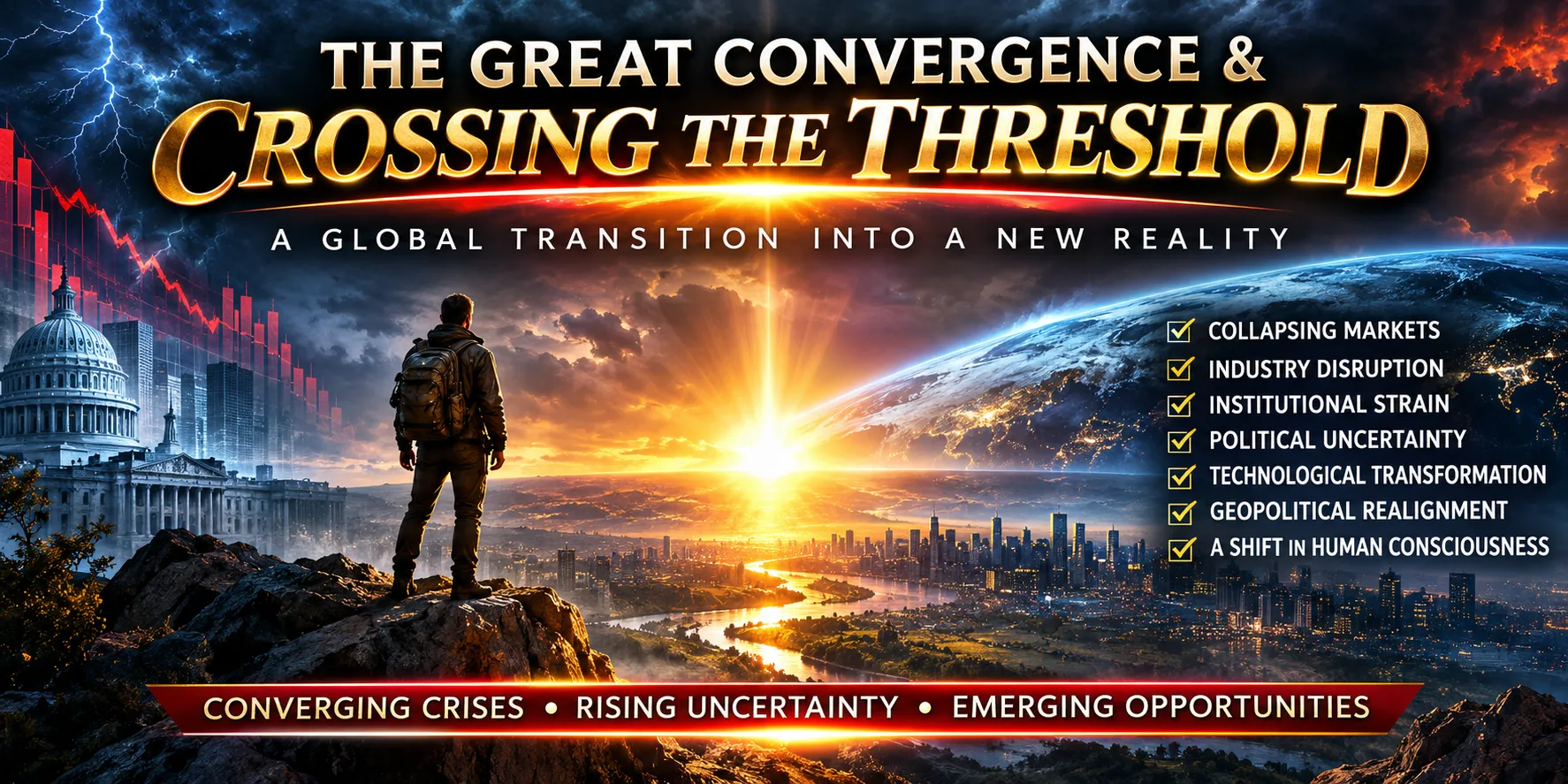
7. CROSSING THE THRESHOLD | THE GREAT CONVERGENCE & THE UNRAVELING OF THE OLD WORLD ORDER
The seventh investigation brings the preceding developments into a broader examination of economic compression, institutional fragility, technological acceleration, geopolitical realignment, and changing public expectations. Financial markets, governments, industries, and international institutions operate through interconnected systems of credit, energy, information, trade, and public confidence. When pressures develop simultaneously across several of these areas, their consequences can become more difficult to manage. Questions surrounding the 2026 midterm election certification process introduce an additional dimension of political uncertainty, particularly where contested outcomes or legal disputes affect public confidence. However, there is no established evidence that election certification will trigger a global collapse. The more meaningful connection is that political instability can amplify existing financial and institutional vulnerabilities when confidence is already weakened. The convergence therefore concerns not a single predetermined event, but the possibility that multiple structural pressures could reinforce one another during a period of significant economic and technological change.
The deeper relationship emerges when financial instability intersects with technological transformation, infrastructure dependence, environmental hazards, and declining institutional trust. Markets depend on liquidity and confidence, industries rely on functioning supply chains and affordable energy, and governments require sufficient institutional credibility to implement difficult policy decisions. Extreme weather or severe solar activity can create additional disruptions, while technological advances reshape employment, capital investment, and economic competition. Questions surrounding food safety, government transparency, UAP investigations, and scientific discovery contribute to a broader public debate about whether established institutions are adequately responding to emerging information and changing social expectations. These developments do not necessarily share a common origin or coordinated purpose, but their interaction can influence how individuals perceive the stability and legitimacy of existing systems. The defining feature of convergence is that pressures affecting one institution or industry can influence others, potentially accelerating adaptation, restructuring, or periods of instability.
As we move through 2027 and the broader transition period described by Great Awakening Report as Crossing the Threshold, the central challenge is understanding how societies respond when established systems face simultaneous demands for change. Economic restructuring, technological innovation, scientific discovery, and institutional reform can create uncertainty, particularly when their benefits and costs are distributed unevenly. Some industries may experience contraction, while others expand through new technologies, changing consumer demands, and emerging business models. Governments may struggle to reconcile financial obligations with public expectations, while communities seek greater resilience, independence, and stability. Yet none of these developments makes global darkness, institutional collapse, or a particular future inevitable. Crossing the Threshold is best understood as a framework for examining a potentially consequential period of transformation, in which humanity’s response to uncertainty may be as important as the pressures themselves. The defining question is whether individuals, institutions, and communities can navigate economic and social change through preparation, discernment, cooperation, and constructive leadership—or whether fear, polarization, and institutional rigidity will make an already difficult transition more disruptive than necessary.
THE GREAT CONVERGENCE | FROM SEVEN DEVELOPMENTS TO ONE EVOLVING GLOBAL LANDSCAPE
Across these seven investigations, the central theme is the interaction between emerging knowledge, technological dependence, environmental vulnerability, economic uncertainty, and institutional adaptation. Some connections are direct and measurable, such as the effects of extreme weather on agriculture or solar disturbances on electrical infrastructure. Others are broader relationships involving public confidence, scientific discovery, and changing expectations about institutions. Understanding the difference is essential to meaningful analysis.
The purpose of Connecting the Dots is not to assume that every development points toward a single inevitable outcome, but to recognize where independent pressures may converge, where discoveries may challenge existing assumptions, and where opportunities for resilience and constructive transformation are emerging. The seven topics collectively invite us to examine both the vulnerabilities and possibilities of an increasingly interconnected civilization.
The larger question for 2027 and beyond is not simply what may change, but how prepared humanity will be to navigate that change. Through discernment, credible research, practical preparedness, and independent thinking, the challenges of convergence can become opportunities for greater understanding, stronger communities, and more responsible leadership.
QUESTIONS EXAMINING THE GREAT CONVERGENCE | UNDERSTANDING THE FORCES SHAPING OUR FUTURE
Truth Seekers Weekly Briefing | November 13, 2026
Political Transformation • Economic Compression • Global Realignment • Technological Acceleration • Scientific Discovery • Institutional Accountability • Crossing the Threshold
Introduction | From Connecting the Dots to Understanding the Bigger Picture
As we enter the Five Questions & Answers section of this week’s Truth Seekers Weekly Briefing, our investigation moves beyond individual news stories and the connections between them to examine the larger forces shaping our rapidly changing world. Throughout this week’s 14 mainstream and alternative news investigations, we have explored developments involving election integrity, government accountability, economic instability, geopolitical conflicts, artificial intelligence, extreme weather, solar activity, scientific discoveries, and human consciousness. Through our examination of Signals, Threads, and Patterns, followed by Connecting the Dots, we have identified how these developments may interact, reinforce existing pressures, and contribute to broader structural changes. The five questions now bring these investigations together, challenging us to consider whether the convergence of political uncertainty, economic compression, technological acceleration, and institutional transformation represents a significant turning point in the evolution of modern civilization. Rather than viewing these developments as isolated events, we examine their combined implications for global stability, public confidence, economic resilience, and humanity’s future direction.
The deeper purpose of these five discussions is to explore the consequences of convergence and the critical decisions facing governments, industries, institutions, communities, and individuals. Our questions examine whether established political systems can maintain legitimacy and public trust, whether the global economy has become increasingly vulnerable to interconnected disruptions, and whether technological progress is creating new dependencies faster than societies can develop the infrastructure needed to support them. We also investigate how scientific discoveries, emerging research into consciousness, archaeological revelations, and continuing demands for government transparency may expand humanity’s understanding of its history, capabilities, and relationship with the physical world. These subjects introduce important distinctions between verified developments, emerging trends, unresolved questions, and possible future scenarios. The objective is not to assume that every event shares a common cause or points toward an inevitable outcome, but to examine where meaningful relationships exist, where systemic pressures are accumulating, and where opportunities for innovation, institutional reform, and constructive transformation may emerge. Together, these questions encourage us to look beyond conventional political divisions and consider the broader responsibilities associated with navigating an increasingly interconnected civilization.
As we look toward 2027 and the unfolding period described within Great Awakening Report as Crossing the Threshold, these five questions invite us to consider how humanity may respond to a convergence of economic, political, technological, environmental, and social challenges. Within our broader Three-Phase Transition framework—Crossing the Threshold, The Great Transition, and Global Emergence—we examine the possibility that established systems will face increasing demands for adaptation while new technologies, economic models, scientific discoveries, and forms of community organization continue developing. This framework provides a perspective for exploring potential changes rather than a predetermined forecast of collapse or global transformation. The central question is whether fear, polarization, financial insecurity, and institutional resistance will dominate the response to uncertainty, or whether greater awareness, independent thinking, practical preparedness, personal sovereignty, and conscious leadership can help guide a more constructive transition. These five discussions are designed to challenge assumptions, encourage deeper reflection, and strengthen our ability to recognize both the risks and opportunities emerging from global convergence. The future is not simply something that happens to humanity; it is also shaped by the choices, values, decisions, and collective actions we bring to the challenges ahead.
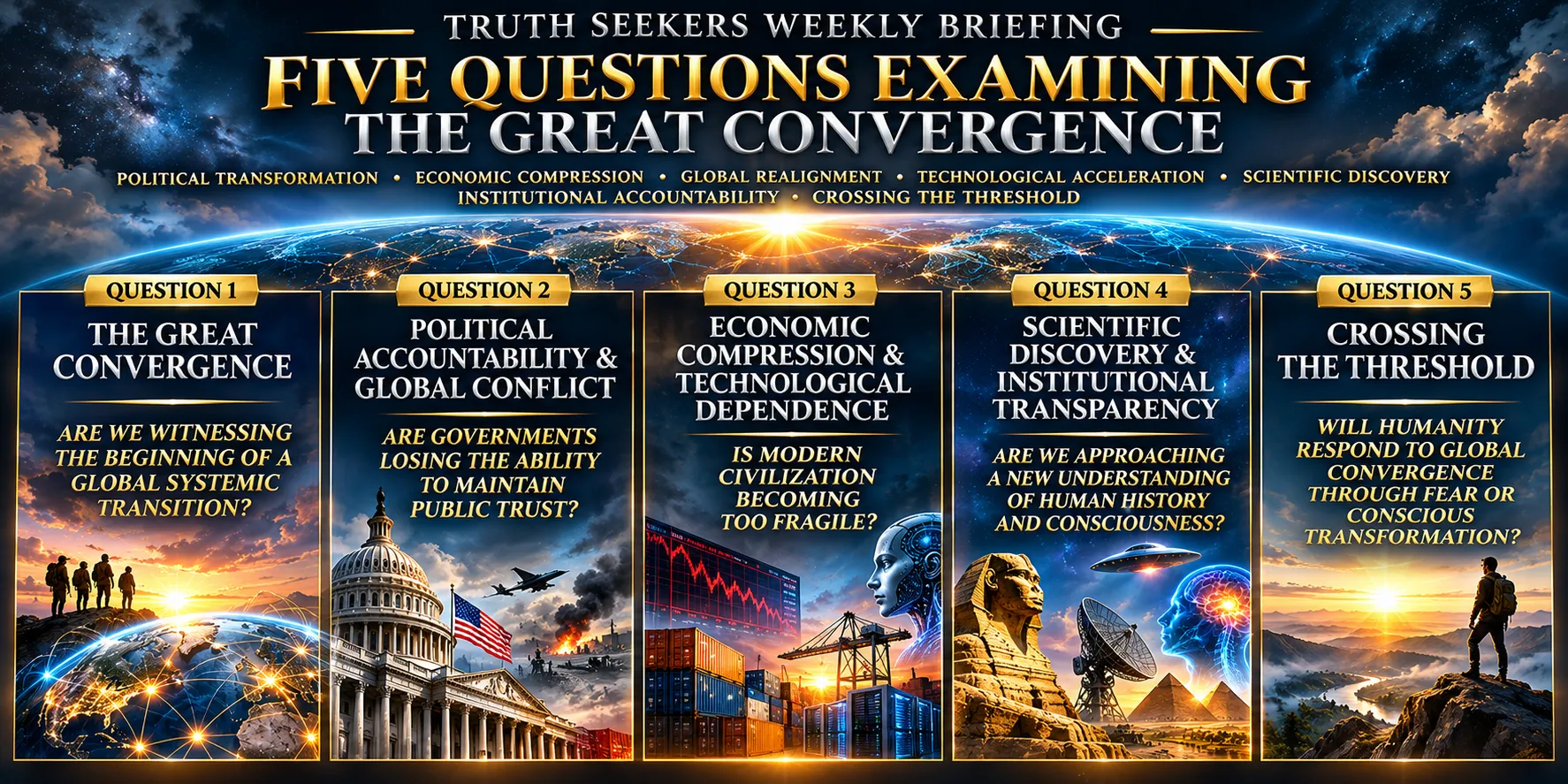
TRUTH SEEKERS WEEKLY BRIEFING | FIVE QUESTIONS EXAMINING THE GREAT CONVERGENCE
NAVIGATING THE QUESTIONS | UNDERSTANDING THE GREAT CONVERGENCE
As you review the five questions in this week’s Truth Seekers Weekly Briefing, move beyond the individual headlines and examine how the 14 mainstream and alternative news investigations converge into a larger picture of global transformation. Each question explores a different dimension of this convergence, including political accountability, economic compression, geopolitical realignment, technological dependence, scientific discovery, institutional transparency, and Crossing the Threshold. Having already examined the Signals, Threads, and Patterns and explored their relationships through Connecting the Dots, this section invites you to consider the broader implications of these interconnected developments. Focus on what is changing, how these changes influence one another, where pressures are accumulating, and what consequences may emerge as multiple systems experience simultaneous challenges. Distinguish documented developments from emerging possibilities, recognizing that events occurring together do not necessarily share a common cause. The objective is to strengthen your understanding of the forces reshaping our world and the vulnerabilities, opportunities, and structural changes that may define the years ahead.
As you progress through the five discussions, consider how their combined insights relate to your personal circumstances, financial security, community resilience, independent thinking, and preparedness for an uncertain future. Each question encourages you to examine the relationship between institutional stability and public confidence, economic growth and technological vulnerability, scientific advancement and human consciousness, and the choices humanity faces during periods of profound change. Within Great Awakening Report’s broader framework of Crossing the Threshold, these discussions offer an opportunity to evaluate potential developments without assuming that disruption, collapse, or transformation is inevitable. Ask yourself three essential questions: What do we know? What meaningful connections are emerging? How can this understanding guide our decisions and actions? The purpose is not simply to anticipate future events, but to develop discernment, personal sovereignty, practical preparedness, and conscious leadership. By integrating the insights from all five questions, we can move beyond fear and speculation toward greater clarity, informed decision-making, and a more comprehensive understanding of the global convergence shaping our collective future.
QUESTION 1 | THE GREAT CONVERGENCE: ARE WE WITNESSING THE BEGINNING OF A GLOBAL SYSTEMIC TRANSITION?
Question: Across this week’s 14 mainstream and alternative news investigations, we are seeing mounting pressures involving election integrity, government dysfunction, financial instability, geopolitical conflicts, extreme weather, technological disruption, and declining institutional confidence. Are these separate challenges simply occurring simultaneously, or are their combined effects pushing established economic, political, and social systems toward a significant structural transition? Could 2026–2027 represent a critical threshold in how our civilization operates?
ANSWER: When we examine these developments collectively, the most important observation is that the world’s major systems are increasingly interconnected, making it difficult for any significant disruption to remain isolated. Political uncertainty influences financial confidence, government spending decisions affect economic stability, and geopolitical conflicts reshape energy markets, international trade, and national security priorities. At the same time, artificial intelligence, expanding technological infrastructure, and changing global supply chains are introducing new demands on capital, electricity, manufacturing, and employment. These pressures do not necessarily originate from the same source, but their interaction can amplify existing vulnerabilities. The real significance of convergence is that problems affecting one institution or industry can create consequences across several others, potentially accelerating economic adjustments and institutional change.
What makes this period particularly challenging is the combination of financial pressure, political polarization, institutional distrust, and technological acceleration. Governments are attempting to reconcile growing financial obligations with competing political priorities, while households continue facing the cumulative effects of higher living expenses, borrowing costs, and economic uncertainty. International conflicts and trade restrictions are changing relationships among major economic powers, while environmental hazards and infrastructure vulnerabilities introduce additional challenges. Within this environment, the certification of the 2026 midterm elections could become another source of political tension if disputes intensify, although there is no established evidence that the process will trigger a broader systemic crisis. The important question is whether institutions can manage these pressures through adaptation and reform or whether repeated short-term interventions will become an increasingly inadequate response to deeper structural problems.
Within the Great Awakening Report’s Crossing the Threshold framework, the years 2026–2028 represent a period for examining how established systems may respond to accelerating economic, technological, and institutional change. This is an interpretive framework rather than a predetermined timetable of collapse. Historical transitions have often involved periods of uncertainty, institutional resistance, economic restructuring, and the emergence of new forms of organization. What ultimately determines their consequences is not simply the severity of the pressures, but the decisions made by governments, businesses, communities, and individuals in response. I believe the most constructive approach is to recognize emerging vulnerabilities without surrendering to fear, strengthen personal and community resilience, and remain attentive to opportunities for innovation and renewal. Crossing the Threshold is fundamentally about understanding change, maintaining discernment, and preparing to participate in what comes next.
QUESTION 2 | POLITICAL ACCOUNTABILITY & GLOBAL CONFLICT: ARE GOVERNMENTS LOSING THE ABILITY TO MAINTAIN PUBLIC TRUST?
Question: The 2026 midterm elections, recurring federal funding disputes, congressional investigations, military commitments involving Iran, and Russia–Ukraine negotiations all raise questions about government accountability and institutional effectiveness. Are political leaders becoming increasingly dependent on crisis management rather than long-term solutions? And can democratic institutions maintain public confidence when election disputes, military decisions, and financial obligations appear increasingly disconnected from meaningful public oversight?
ANSWER: One of the most significant developments across these stories is the growing tension between government authority, institutional accountability, and public confidence. Elections are intended to establish legitimate representation, but confidence depends on whether citizens believe the process is transparent, accurately administered, and independently verifiable. Extended ballot counting, recounts, and legal challenges are not themselves evidence of misconduct, yet inconsistent communication and political accusations can weaken public understanding. Similarly, congressional investigations serve an essential constitutional purpose, but their credibility depends on consistent standards, credible evidence, procedural fairness, and measurable outcomes. When accountability appears to change depending on which political party controls Congress, citizens may begin questioning whether institutions are functioning in the public interest or primarily serving political competition.
The same concerns extend into federal spending, military commitments, and international diplomacy. Repeated government-funding confrontations highlight the difficulty of reconciling financial obligations with competing political priorities, while debates over military operations raise fundamental questions about the division of authority between Congress and the executive branch. The Iran conflict and Russia–Ukraine negotiations introduce additional challenges involving national security, international alliances, regional stability, energy markets, and long-term financial commitments. Military decisions can produce consequences extending far beyond the battlefield, influencing government budgets, global trade, humanitarian conditions, and diplomatic relationships. The central issue is not simply whether a particular military policy is popular, but whether the objectives, legal authority, financial costs, and mechanisms of accountability are clearly established and subject to meaningful oversight.
Looking ahead, the defining challenge for democratic institutions is whether they can restore confidence through transparency, responsible leadership, constitutional accountability, and consistent application of the law. Governments cannot eliminate disagreement, but they can strengthen public trust by providing clear evidence, explaining decisions, respecting institutional boundaries, and demonstrating measurable results. International negotiations likewise require realistic objectives and recognition that competing nations often have fundamentally different security interests. Within the larger convergence, political legitimacy becomes an essential component of economic and social stability, because institutions facing declining confidence may find it more difficult to respond effectively during periods of crisis. The opportunity is to move beyond political theater toward governance that emphasizes long-term responsibility, independent oversight, and accountability that applies regardless of who holds power.
 QUESTION 3 | ECONOMIC COMPRESSION & TECHNOLOGICAL DEPENDENCE: IS MODERN CIVILIZATION BECOMING TOO FRAGILE?
Question: This week’s investigations connect household affordability, China’s technology restrictions, the AI infrastructure revolution, extreme weather, solar activity, and vulnerabilities in electrical and communications networks. Have we created an economic and technological system so interconnected that disruptions involving energy, finance, trade, or digital infrastructure could spread rapidly across multiple industries? And are governments and corporations investing enough in resilience, or primarily assuming that technological expansion and economic growth will continue uninterrupted?
ANSWER: The extraordinary technological advancement of recent decades has created an economic system that is more productive, globally connected, and dependent on continuous infrastructure operation than at almost any previous point in history. Artificial intelligence is accelerating investment in data centers, semiconductor manufacturing, electrical generation, and advanced communications, while governments increasingly view critical technologies and industrial supply chains as national-security assets. China’s technology-transfer restrictions and the broader movement toward competing economic blocs illustrate how geopolitical competition can influence manufacturing capacity, energy investment, international trade, and consumer costs. Meanwhile, households continue experiencing financial pressures involving housing, food, insurance, utilities, and debt servicing. The connection is that economic expansion does not automatically translate into improved household financial security, particularly when the costs of essential goods and services increase faster than disposable income.
These vulnerabilities become more apparent when technological dependence intersects with environmental hazards and infrastructure limitations. Severe storms, flooding, drought, and other weather disruptions can damage transportation systems, agricultural production, electrical networks, and regional supply chains. Solar flares and geomagnetic storms introduce additional risks to satellites, navigation systems, radio communications, and vulnerable electrical infrastructure. Although extreme solar events and catastrophic infrastructure failures are relatively uncommon, their potential consequences deserve serious preparation. A disruption affecting electricity or communications can influence banking operations, healthcare delivery, emergency services, transportation, industrial production, and digital commerce. The broader concern is whether infrastructure protection, backup capabilities, and emergency planning are keeping pace with the rapid expansion of interconnected technologies.
The future challenge is to balance technological innovation with economic sustainability and operational resilience. Artificial intelligence and advanced automation offer substantial opportunities for productivity improvements, scientific research, and new industries, but their long-term benefits depend on realistic infrastructure costs, reliable energy supplies, and economically sustainable investment. Governments and businesses must also consider the risks of excessive supply-chain concentration, vulnerable electrical networks, and dependence on a limited number of critical technology providers. At the household and community level, resilience involves practical measures such as financial flexibility, emergency power, reliable communications, diversified resources, and local preparedness. The defining lesson is that a technologically advanced civilization is not necessarily a resilient civilization. True progress requires building systems capable of maintaining essential functions when unexpected disruptions occur.
QUESTION 4 | SCIENTIFIC DISCOVERY & INSTITUTIONAL TRANSPARENCY: ARE WE APPROACHING A NEW UNDERSTANDING OF HUMAN HISTORY AND CONSCIOUSNESS?
Question: Advances in satellite archaeology, brain imaging, artificial intelligence, and UAP investigations are expanding our ability to examine phenomena that previously remained inaccessible or poorly understood. At the same time, debates over government disclosure, scientific interpretation, and agricultural regulatory transparency raise questions about who controls information and how new evidence reaches the public. Are we approaching a period of significant scientific discovery, and can established institutions adapt when emerging evidence challenges existing assumptions?
ANSWER: One of the most fascinating developments across these investigations is the convergence of advanced scientific instrumentation, computational technology, and the exploration of previously inaccessible areas of knowledge. Satellite imaging and geophysical surveying are helping archaeologists identify buried structures and investigate ancient settlements without immediately undertaking extensive excavation. Reported discoveries near the ancient Egyptian city of Buto illustrate how technology may expand our understanding of historical architecture, settlement organization, and cultural development, provided that preliminary findings receive archaeological confirmation. Meanwhile, neuroscience is developing increasingly sophisticated methods for examining brain activity among patients who cannot reliably communicate. Research involving resting-state functional MRI, cognitive motor dissociation, and hidden awareness is challenging assumptions about the relationship between behavioral responsiveness and conscious experience. These discoveries demonstrate that limitations in our ability to observe a phenomenon should not automatically be mistaken for limitations in the phenomenon itself.
The connection to UAP disclosure and institutional transparency involves the question of how evidence is collected, interpreted, protected, and independently evaluated. Government records documenting unexplained aerial incidents may provide legitimate investigative leads, but they do not independently establish extraordinary origins or capabilities. Similarly, emerging neurological findings do not automatically prove broader philosophical theories about consciousness, and remote-sensing discoveries do not necessarily overturn established historical timelines. What these investigations share is the need for credible evidence, methodological transparency, independent verification, and a willingness to reconsider interpretations when new information becomes available. The same principles apply to controversies surrounding food safety and agricultural regulation, where public confidence depends on understanding the scientific basis for regulatory decisions and the role of commercial interests. Scientific progress requires both openness to unexpected discoveries and discipline in distinguishing evidence from speculation.
Looking toward the future, the integration of artificial intelligence, advanced imaging, scientific computing, and increasingly sophisticated research instruments could produce important breakthroughs across archaeology, medicine, aerospace investigation, and consciousness studies. Some discoveries may refine existing knowledge, while others may reveal previously undocumented aspects of human history or biological function. Yet the broader transformation may involve how society evaluates knowledge itself. Institutions that communicate uncertainty clearly, provide access to appropriate evidence, and welcome rigorous independent investigation are more likely to maintain public confidence than those relying primarily on authority or selective information releases. Within the Crossing the Threshold framework, this represents an opportunity for greater intellectual independence, scientific collaboration, and responsible exploration of unanswered questions. The defining challenge is to remain open to discoveries without abandoning the standards necessary to determine what those discoveries actually demonstrate.
 QUESTION 5 | CROSSING THE THRESHOLD: WILL HUMANITY RESPOND TO GLOBAL CONVERGENCE THROUGH FEAR OR CONSCIOUS TRANSFORMATION?
Question: When we connect all 14 stories—from election uncertainty, financial pressure, geopolitical conflict, and technological disruption to extreme weather, food safety, ancient discoveries, UAP disclosure, and human consciousness—we see a civilization confronting change across many dimensions simultaneously. Could the convergence of these developments represent a broader transition in how humanity understands itself and organizes society? And as we move toward 2027, will fear and institutional resistance dominate the response, or can greater awareness, resilience, and conscious leadership help shape a more constructive future?
ANSWER: The most important lesson from these investigations is that humanity is confronting a period in which multiple forms of change are occurring simultaneously, often faster than established institutions and social expectations can comfortably accommodate. Economic systems are adjusting to technological innovation and financial pressures, political institutions are facing demands for greater accountability, and international relationships are being reshaped by strategic competition and geopolitical conflict. At the same time, environmental hazards reveal infrastructure vulnerabilities, while scientific advances continue expanding our understanding of the physical world, ancient history, and human consciousness. These developments are not necessarily components of a single coordinated process, but their convergence creates an environment in which uncertainty, opportunity, disruption, and adaptation coexist. The central question is whether society can distinguish genuine structural change from fear-driven narratives and respond to emerging challenges with informed judgment.
Within the Great Awakening Report’s Three-Phase Transition framework, Crossing the Threshold from 2026–2028 represents the first stage of a possible longer period of economic, institutional, and social transformation. The subsequent phases—The Great Transition and Global Emergence—provide a conceptual structure for examining how new systems, technologies, communities, and forms of organization might develop over time. These phases are interpretive scenarios, not guaranteed future events. What makes the framework useful is its emphasis on examining the relationships among institutional pressure, technological innovation, social adaptation, and emerging opportunities for constructive change. History demonstrates that periods of major transformation can involve financial disruption, political uncertainty, and resistance from established interests, but they can also encourage innovation, reform, cooperation, and new approaches to economic and community development. The future is not determined solely by the pressures we experience, but also by the choices we make in responding to them.
As we move toward 2027 and beyond, I believe the most constructive response is to strengthen discernment, personal sovereignty, community resilience, responsible leadership, and the ability to navigate uncertainty without becoming overwhelmed by fear. This means developing practical financial and emergency preparedness, maintaining reliable sources of information, strengthening local relationships, and remaining open to new scientific and technological possibilities. It also means recognizing that meaningful change requires more than awareness; it requires thoughtful decisions, consistent action, and institutions willing to adapt to changing realities. Crossing the Threshold should not be understood as an inevitable descent into darkness or a predetermined global awakening, but as an invitation to examine how humanity might navigate an increasingly complex transition. The defining question is not whether the old world will disappear overnight, but whether we can recognize what is changing, preserve what remains valuable, and consciously participate in building systems that are more resilient, transparent, and responsive to human needs.
Closing Reflection | The Great Convergence
Across these five questions, the recurring theme is that political stability, economic resilience, technological progress, scientific discovery, and institutional accountability are increasingly interconnected. Understanding their convergence requires more than identifying individual events; it requires recognizing how developments interact, where pressures may accumulate, and which responses can create more constructive outcomes.

THE BIG PICTURE | CONNECTING THE DOTS THROUGH THE GREAT CONVERGENCE
Truth Seekers Weekly Briefing | November 13, 2026
Fourteen Investigations • Seven Global Systems • Five Defining Questions • One Interconnected World
This week’s Truth Seekers Weekly Briefing brings together 14 mainstream and alternative news investigations to reveal a broader picture of the forces influencing our rapidly changing world. What begins as individual stories involving political uncertainty, financial instability, geopolitical conflict, technological acceleration, extreme weather, scientific discovery, and institutional accountability becomes more meaningful when examined through the lens of Signals, Threads, and Patterns. Each investigation provides a different perspective on the pressures, discoveries, and transformations occurring across modern civilization. By identifying the significant signals, tracing the threads connecting related developments, and recognizing recurring patterns, we begin moving beyond fragmented headlines toward a more comprehensive understanding of how political, economic, environmental, technological, and social systems interact. The Big Picture emerges when we recognize that developments affecting one system can influence the stability, performance, and direction of others. Our objective is not simply to understand what is happening, but to recognize why these developments matter collectively and what their convergence may reveal about the future.
The next stage of our investigation, Connecting the Dots, examines how these relationships converge into broader pressures and opportunities. Election uncertainty and government dysfunction can influence public confidence and economic expectations, while financial pressures, military commitments, and geopolitical realignment affect government budgets, energy markets, international trade, and household affordability. Meanwhile, artificial intelligence, global technology competition, and expanding digital infrastructure are transforming industries while increasing dependence on electricity, communications networks, and critical supply chains. Our alternative news investigations introduce additional dimensions, including solar activity, extreme weather, agricultural regulation, archaeological discoveries, UAP disclosure, and emerging research into human consciousness. Some of these connections are direct and measurable, while others involve broader questions about scientific knowledge, institutional transparency, and humanity’s capacity to adapt. Their convergence does not establish a single underlying cause, but it does reveal a civilization becoming increasingly interconnected, technologically dependent, and challenged to balance innovation with resilience. Understanding these relationships allows us to recognize where economic compression, institutional fragility, environmental vulnerability, and technological transformation may reinforce one another.
Our Five Questions Examining the Great Convergence bring these investigations into sharper focus by asking what their combined consequences could mean for governments, industries, communities, and individuals. Are we witnessing the beginning of a significant systemic transition? Can political institutions maintain public trust while confronting growing financial obligations and geopolitical uncertainty? Has modern civilization become so dependent on interconnected technologies that disruptions could produce cascading economic consequences? Are scientific discoveries and demands for transparency changing how humanity understands its history, consciousness, and established institutions? And ultimately, will humanity respond to this convergence through fear and resistance, or through greater awareness, resilience, innovation, and conscious leadership? These questions transform our weekly news review into a broader examination of systemic dependencies, emerging vulnerabilities, institutional adaptation, and the choices shaping our collective future. Rather than predicting inevitable outcomes, we examine the evidence, consider possible scenarios, and identify where informed decisions and practical preparation may help reduce uncertainty. The Big Picture is not a single event or prediction; it is the evolving relationship between multiple developments and the consequences that may emerge from their interaction.
As we look toward 2027 and the broader period described within Great Awakening Report as Crossing the Threshold, this week’s investigations offer a framework for understanding a potentially consequential period of economic realignment, institutional transformation, scientific advancement, and changing human expectations. Within our Three-Phase Transition—Crossing the Threshold, The Great Transition, and Global Emergence—we explore how established systems may encounter increasing demands for adaptation while new technologies, business models, scientific discoveries, and community structures continue developing. This framework is an interpretive guide rather than a predetermined timetable, and the future remains dependent on events, decisions, and circumstances that cannot be known with certainty. The essential lesson from this week’s briefing is that awareness must lead to understanding, understanding must lead to discernment, and discernment must lead to informed action. By bringing together 14 investigations, the Signals–Threads–Patterns framework, Connecting the Dots, and five defining questions, we develop a more integrated perspective on the challenges and opportunities ahead. Crossing the Threshold is ultimately about recognizing meaningful change without surrendering to fear, strengthening our capacity to navigate uncertainty, and consciously participating in the decisions that will shape what emerges next.

Truth Seekers Weekly Wrap-Up
The Journey from the Matrix to Higher Frequency Living
As we close out this week’s Truth Seekers Weekly Briefing, let’s take a moment to reflect on the essential keys to rising above the noise, breaking free from the matrix, and aligning with a higher vibrational state of being.
🔑 Key Pillars for Awakening:
- Let Go of Fear: Fear is the master key of control. Releasing it is the first act of sovereignty—and the doorway to true freedom.
- Practice Forgiveness & Emotional Clearing: Unshackle yourself from the past. Forgiveness dissolves energetic residue, restores clarity, and reclaims your power.
- Meditation & Transformational Breathing: Harness the breath as a tool for inner alignment, expanded awareness, and conscious presence in each moment.
- Live with the Heart of a Volunteer: Lead with authenticity, service, and unconditional love. Embody the values of integrity and compassion in all you do.
As we often say: “You’re either outside acting in the movie… or going within to watch it consciously.”
So, which role are you playing right now?
Are you being pulled by fear—or grounded in peace?
Caught in the chaos—or anchored in presence?
Your Personal Code of Mindset:
✅ Kindness & Respect
✅ Accountability & Responsibility
Ask yourself honestly:
- Are you observing your thoughts—or are they running the show?
- Is your mental atmosphere vibrationally aligned, at 50%+ or higher?
- Can you feel the resonance of your higher self?
- Are you responding with awareness—or reacting on autopilot?
Remember: The path out of the matrix and into higher consciousness isn’t a one-time decision—it’s a daily choice. A moment-by-moment commitment to awareness, sovereignty, and alignment.
Until next time, Truth Seekers: Stay awake. Stay empowered. And keep connecting the dots.
In Love & Light ❤️
The Great Awakening Team

The 3 C’s of Life: “Choices, Chances, and Changes”,
You must make a choice to take a chance or your life will never change. – Zig Ziglar
Share This Report
Join the Discussion
Related Reports


Have questions?
At Great Awakening Report, we are dedicated to supporting your journey toward truth and enlightenment through our specialized Coaching and Consulting services.
Coaching Services: Our coaching programs are designed to guide you through personal awakening and transformation. We offer personalized sessions that focus on expanding consciousness, uncovering hidden truths, and fostering spiritual growth. Our experienced coaches provide the tools and insights necessary to navigate your path with clarity and confidence.
Consulting Services: For organizations and individuals seeking deeper understanding and strategic guidance, our consulting services offer expert analysis and solutions. We delve into areas such as global transitions, alternative news insights, and consciousness studies to provide comprehensive strategies tailored to your unique objectives.
Embark on a transformative journey with our Coaching and Consulting services, and unlock your highest potential. To learn more and schedule a session, visit our Coaching and Consulting pages.
Thank you
Thank you to our subscribers and readers for your continued support and dedication to truth and awakening. Your encouragement, engagement, and belief in our mission make everything we do possible. Together, we are expanding awareness and helping illuminate the path forward.
If you would like to further support the Great Awakening team and our ongoing efforts to share insight, knowledge, and truth, you can DONATE HERE.
With deep gratitude,
– Great Awakening Team
About the Author: Great Awakening Team

We are a community. We are cultural creatives and like minded people seeking the truth and focusing on disclosure, awakening and consciousness. Our focus is real news as researchers, reporters and truth seekers. We are here to teach, to spread the word, to serve and to help. We are a collective, a movement, free from all programing, not closed minded and not discriminatory. We are not political. We are not religious but we are spiritual. We study, research, and report on a wide range of subjects and topics, from the current geopolitical climate to health and wellness, from earth’s history to spiritual practices. We are forward thinkers and visionaries, we are guides for the transition as we usher in The Great Awakening.
THIS WEBSITE DOES NOT PROVIDE MEDICAL ADVICE: The information, including but not limited to text, graphics, images, and other material contained on this website, are for informational purposes only. No material on this site is intended to be a substitute for professional medical advice, diagnosis, or treatment. Always seek the advice of your physician or other qualified health care provider with any questions you may have regarding a medical condition or treatment and before undertaking a new health care regimen, and never disregard professional medical advice or delay in seeking it because of something you have read on this website.
DISCLAIMER: All statements, claims, views and opinions that appear anywhere on this site, whether stated as theories or absolute facts, are always presented by The Great Awakening Report (GAR) as unverified—and should be personally fact checked and discerned by you, the reader.Any opinions or statements herein presented are not necessarily promoted, endorsed, or agreed to by GAR, those who work with GAR, or those who read or subscribe to GAR.Any belief or conclusion gleaned from content on this site is solely the responsibility of you the reader to substantiate.Any actions taken by those who read material on this site are solely the responsibility of the acting party.You are encouraged to think for yourself and do your own research.Nothing on this site is meant to be believed without question or personal appraisal.
COPYRIGHT DISCLAIMER: Citation of articles and authors in this report does not imply ownership. Works and images presented here fall under Fair Use Section 107 and are used for commentary on globally significant newsworthy events. Under Section 107 of the Copyright Act 1976, allowance is made for fair use for purposes such as criticism, comment, news reporting, teaching, scholarship, and research.
COMMUNITY GUIDELINES DISCLAIMER: The points of view and purpose of this video is not to bully or harass anybody, but rather share that opinion and thoughts with other like-minded individuals curious about the subject.