






The Cult of Baal Map Explained
Tracing an alternative history of power, religion and secret societies. Dylan Louis Monroe's Cult of Baal Map connects ancient civilizations, ruling dynasties, secret societies, banking and modern politics in one dense timeline. This guide shows Truth Seekers how to read it, layer by layer, and how to investigate what it proposes.
What Is the Cult of Baal Map?
- Creator
- Dylan Louis Monroe, Deep State Mapping Project
- Structure
- Timeline in three sections, read top to bottom
- Layers
- Central spine, margin annotations, deity comparison chart
- Span
- Ancient Near East to the founding of the United States
- Current edition
- High-resolution two-sided PDF, version 3.10.25
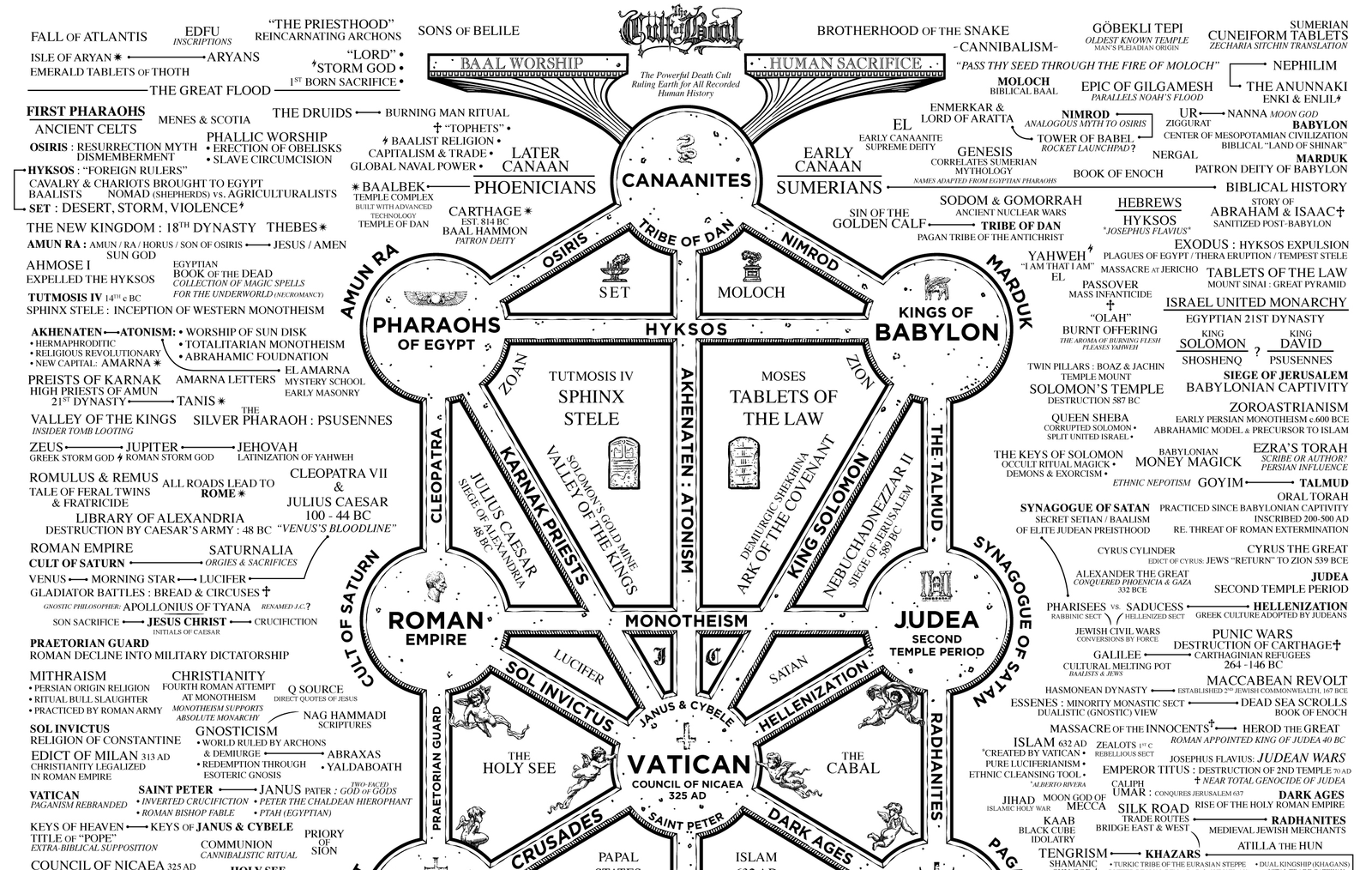
The Cult of Baal Map is a dense alternative-history timeline that attempts to trace connections among ancient civilizations, religious traditions, ruling dynasties, secret societies, financial institutions, political movements, symbolism and systems of power across thousands of years.
Beginning with ancient Near Eastern cultures, including the Canaanites, Phoenicians, Sumerians, Babylon and Egypt, the map moves through Rome, Judea, early Christianity, the Knights Templar, medieval Europe, the Jesuits, Freemasonry, the Illuminati, banking dynasties and eventually the formation and development of the United States. Its central theme is the proposition that certain beliefs, symbols, institutions and power structures may have been transmitted, transformed or reinterpreted across successive civilizations.
For the Truth Seeker, the Cult of Baal Map is most valuable when approached as an investigative hypothesis map, not as a verified historical record. It combines documented people, civilizations, organizations and events with disputed interpretations, religious traditions, symbolic associations, allegations and speculative connections. The lines connecting two subjects should therefore be treated as questions to investigate rather than proof of a relationship. Some connections can be examined through archaeology, primary historical documents and established scholarship. Others originate in esoteric literature, alternative-history research or modern conspiracy narratives.
The best way to explore the map is to choose one branch at a time and work both forward and backward through history. Ask: Who or what is being connected? What is the claimed relationship? When did each actually exist? What primary evidence supports the connection? Is the relationship historical, religious, symbolic, genealogical or merely interpretive? By separating documented history from historical interpretation, religious tradition, allegation and speculation, the map becomes far more useful. Its real value is not a predetermined conclusion about who secretly controls history. It is hundreds of individual research leads that can be independently examined, verified, challenged or rejected.
Observe. Identify the connection. Trace the source. Verify the history. Compare interpretations. Connect the evidence. Reassess.
That framing matters for this particular map. It lets GAR feature provocative alternative research while making clear that the map represents a thesis to investigate, not evidence that every connection shown is historically established.
Learn to Read the Cult of Baal Map with Dylan Louis Monroe
Hear the creator explain the Cult of Baal Map in his own words before you work through the eight reading layers below.
How to Read the Cult of Baal Map
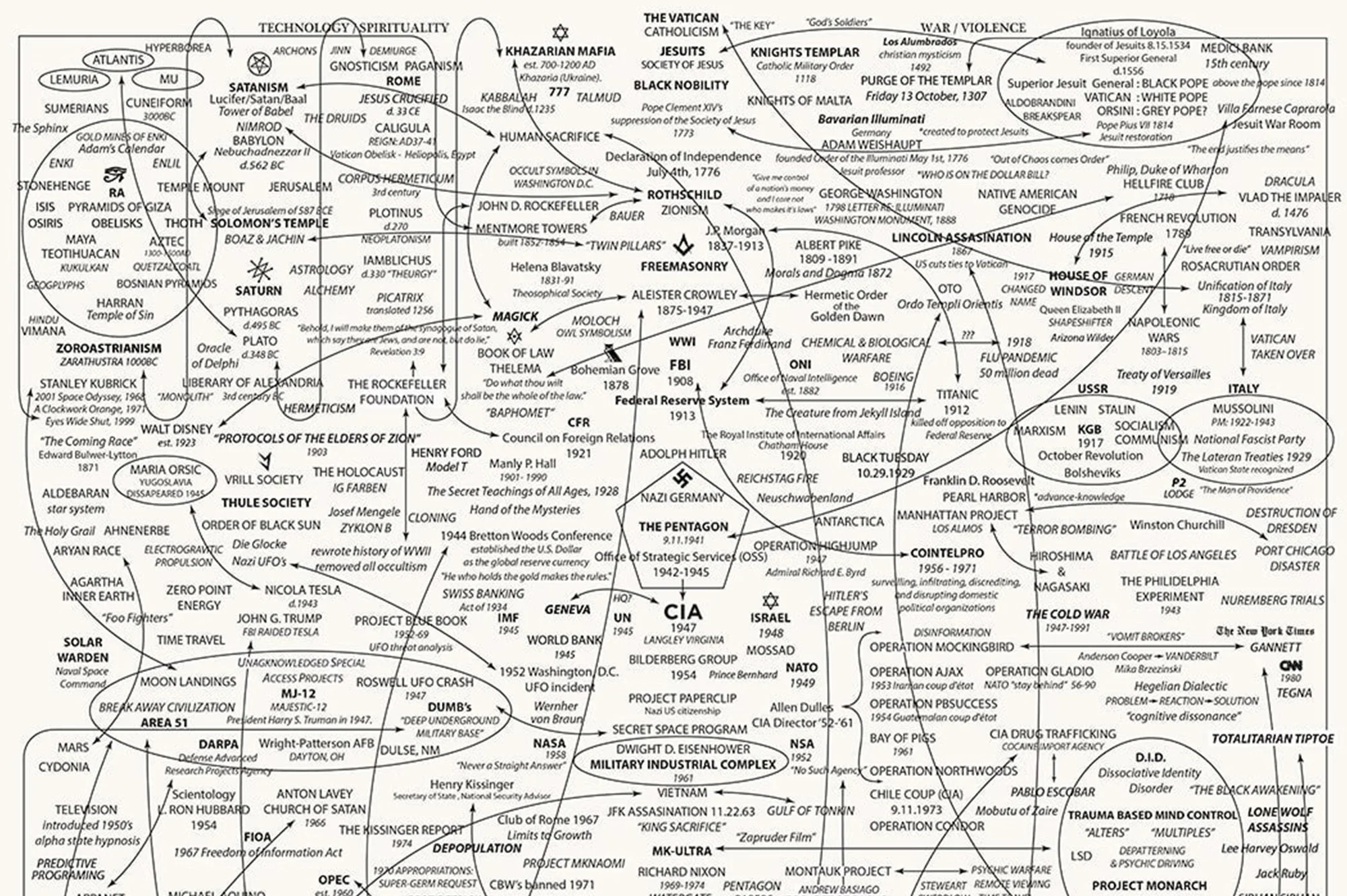
The Cult of Baal Map, created by Dylan Louis Monroe of the Deep State Mapping Project, is deliberately dense. According to Monroe's own instructions, the timeline is divided into three major sections and proceeds from top to bottom. The large terms inside the central structure provide the main route through the diagram, while bold terms in the outside margins correspond to those central subjects and supply additional names, events, dates, references and proposed connections. A separate deity comparison appears at the bottom.
The most useful way to understand it is not to read every word from left to right. Start with the central structure, follow one historical branch downward, and only then move into the surrounding annotations. Work through the eight layers below with the full-size map open.
- 01
The Top: Ancient Civilizations and Religious Origins
Begin at the top of the map. This is the ancient-world layer, where Monroe places Canaanites, Sumerians, Pharaohs of Egypt, Kings of Babylon, Rome and Judea into interconnected branches.
Around those central civilizations are references to Baal worship, Moloch, ancient Canaan, Phoenicians, Sumerian religion, Genesis, the Hebrew Bible, Egyptian religion, Hyksos, Akhenaten, Osiris, Set, Babylon, Solomon, the First and Second Temples and other ancient subjects.
This is where the map establishes its central thesis: that certain religious concepts, symbols, rituals, ruling structures and ideas about power may have migrated between civilizations. That is the mapmaker's interpretation, not something the diagram itself proves. Cultural exchange among ancient Near Eastern civilizations is well established. The map's broader claim of a continuous hidden cult requires separate evidence for each proposed connection. Monroe himself describes the work as tracing what he considers a continuous occult belief system.
- 02
Follow the Central Spine: Ancient World to Rome to Medieval Europe
Move downward through the large central shapes rather than immediately reading the margins. The visual progression takes you broadly through the Ancient Near East, then Egypt, Babylon and Judea, then Rome, early Christianity, medieval Europe, the Knights Templar, papal and European institutions, Renaissance and Reformation-era organizations, Freemasonry, the Jesuits and the Illuminati, European finance and political institutions, and finally the United States.
The diagram uses this structure to suggest continuity through transformation: civilizations disappear, but Monroe proposes that certain ideas, networks, symbols, bloodlines, religious concepts or institutional structures continue under different names.
Keep this distinctionA chronological sequence is not automatically evidence of organizational continuity. - 03
The Center: Rome, Christianity and the Council of Nicaea
Near the middle of the upper map, Vatican / Council of Nicaea / 325 AD becomes an important visual junction. The surrounding branches reference Rome, early Christianity, the Holy See, Kabbalah, the Cabal, Islam, the Crusades and other religious and political developments.
Here the map is attempting to show the transformation from ancient religious and imperial systems into medieval religious and political institutions. When researching this section, separate documented events such as the Council of Nicaea, the development of the papacy, the Crusades and the emergence of Islam from claims that these institutions formed part of one continuous hidden organization.
- 04
The Medieval Layer: Templars, Khazars and European Power
Moving farther downward brings you into subjects including the Knights Templar, Khazars, Papal States, canon law, Sharia law, Venice, Switzerland, Acre and European aristocratic or religious networks. This is where the map increasingly shifts from conventional chronology into alternative interpretations of institutional continuity.
Rather than asking whether this proves that Group A became Group B, ask: What exactly is the proposed connection? Is Monroe claiming migration? Religious influence? Financial influence? Genealogy? Membership continuity? Symbolic similarity? Political alliance? Those are very different propositions requiring different evidence.
- 05
The Early-Modern Layer: Jesuits, Freemasonry and Illuminati
The next major section contains three highly visible nodes: Jesuits (1534), Freemasons (1717) and Illuminati (1776). The surrounding annotations connect these organizations to European religious conflicts, banking, aristocracy, political revolutions, secret societies, the Reformation and other historical developments.
Many of the organizations and dates are historical. The controversial part is the relationship the diagram proposes between them. Establishing that two organizations existed during overlapping periods does not establish that one secretly controlled the other. Membership records, correspondence, institutional archives, financial records or credible contemporary documentation would be needed to demonstrate such relationships.
- 06
The Lower Center: Banking, Revolution and the United States
As the diagram approaches the modern period, its emphasis shifts toward central banking, European financial institutions, political revolutions, Freemasonry, the Federal Reserve, American political history and international finance. The map culminates visually in USA 1776, and from there the margins contain numerous references extending into later American history.
Read this portion as Monroe's attempt to connect the earlier religious and esoteric narrative with the development of modern political and financial power structures. Break the large thesis into small questions. Instead of researching whether America was secretly created by an ancient cult, investigate specific propositions about particular individuals, organizations, documents, dates, memberships, financial relationships and historical events.
- 07
The Side Margins: Where Most of the Research Leads Live
The enormous amount of small text surrounding the central diagram is not secondary decoration. It functions like the map's research notebook. Monroe specifically says that bold terms in the margins correspond to major terms in the central structure, with additional information positioned around them.
So when you encounter a central node, for example Pharaohs of Egypt, move horizontally into the adjacent margin and examine the related names, dates and claims. Then return to the central structure and continue downward.
The loopCentral node. Side notes. Research. Return to node. Move down. That makes an otherwise overwhelming map manageable. - 08
The Bottom: The Deity Comparison
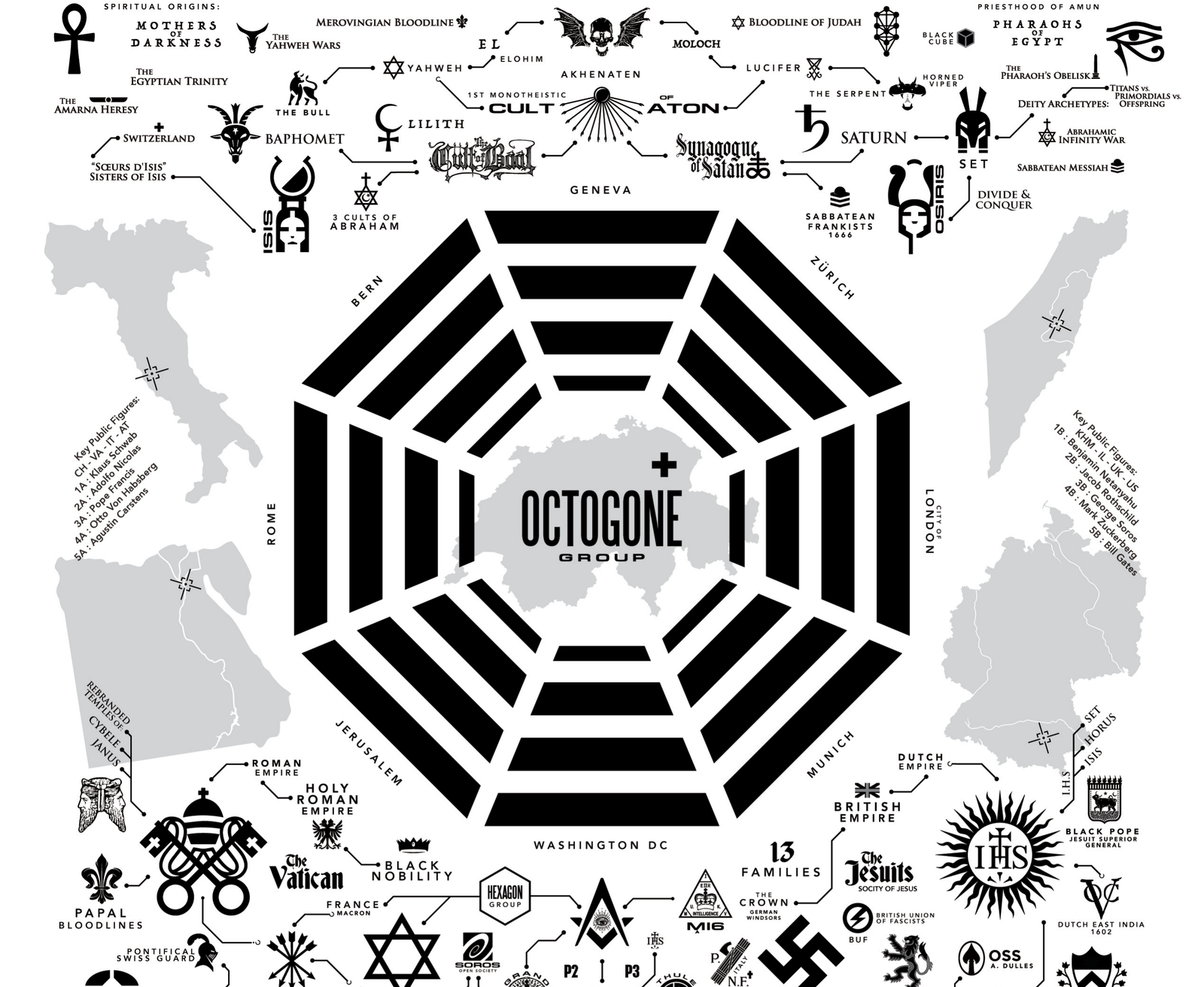
At the bottom, the map shifts from chronology to comparative mythology. Monroe describes this as a separate Deity Chart, intended to compare analogous deities and deity attributes across Western cultures.
Handle this section especially carefully. Similar attributes such as sun imagery, fertility, death and rebirth, storms, kingship and motherhood can provide interesting comparative mythology, but similarity does not establish that two gods are historically identical or that worship of one secretly continued as worship of another. Use these correspondences as research prompts rather than equivalence statements.
Get the High-Resolution Cult of Baal Map
The margin annotations and deity chart are unreadable in small previews. Enter your email and we will send the high-resolution PDF of the map straight to your inbox, along with the free Great Awakening Report weekly newsletter.
- High-resolution PDF, zoomable to the smallest margin note
- Study each of the three timeline sections one at a time
- Free weekly insights from the Great Awakening Report; unsubscribe any time
Send me the map
Delivered by email within a minute.
By requesting the map you agree to receive the free Great Awakening Report newsletter. We never share your email. Map artwork © Dylan Louis Monroe / Deep State Mapping Project, shared with attribution.
Who Was Baal? Historical Context for the Map
Baal appears in the religious history of the ancient Near East. The Louvre's account of a stela found at Ugarit identifies Baal as a storm god associated with thunder and rain. This provides a material, archaeological starting point for investigating the name.
Ancient worship and modern claims about hidden organizations are separate subjects. Evidence that a deity was worshipped in antiquity does not establish the survival of a single organization into the present.
"The Cult of Baal: Philosophy of the Ancient Death Cult," companion artwork.
The Best Way for a Truth Seeker to Use the Cult of Baal Map
The map becomes far more useful when you stop treating the lines as answers and start treating them as questions. Choose one connection. Identify exactly what Monroe is proposing. Establish whether the people and institutions actually existed at the same time. Find the earliest available source for the claim. Look for primary documents and archaeological or historical scholarship. Then compare those sources with Monroe's interpretation.
GAR uses five classifications when evaluating individual claims on the map.
Documented
Supported by strong historical evidence.
Plausible
Evidence exists, but the interpretation remains uncertain.
Disputed
Credible sources disagree.
Speculative
The proposed connection lacks adequate supporting evidence.
Symbolic
The relationship is primarily mythological, religious or interpretive.
This matters because the creator presents very strong conclusions about a continuous "death cult" controlling human history. Those conclusions go considerably beyond what can be established from the historical names and dates appearing on the diagram.
GAR Research Method
That turns the Cult of Baal Map from something to simply believe or reject into something much more valuable: a roadmap containing hundreds of individual historical claims that Truth Seekers can investigate for themselves.
Explore the Deep State Mapping Project
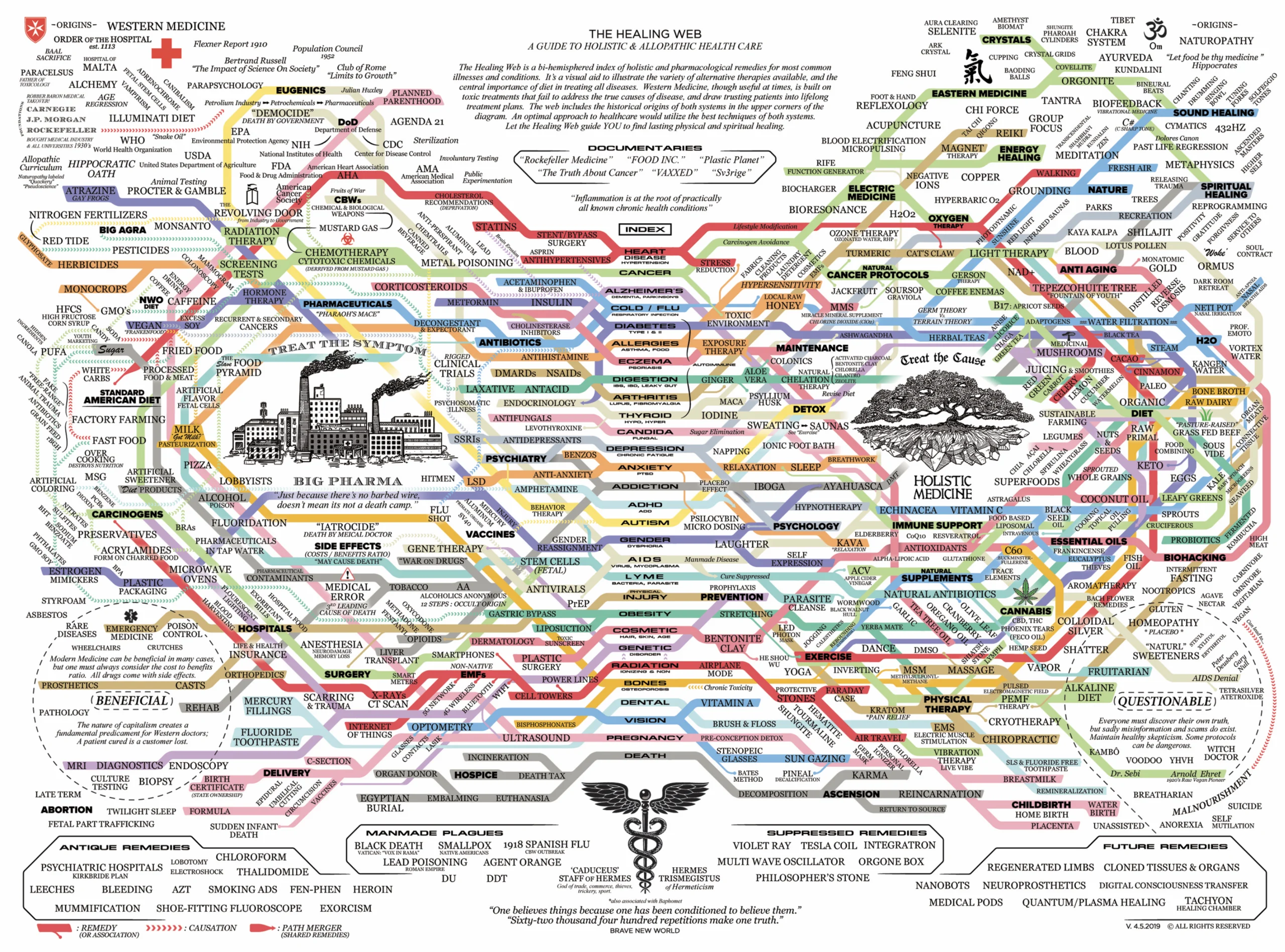
Comparing the maps can help you understand the creator's broader visual approach, although related artworks are not independent corroborating sources.
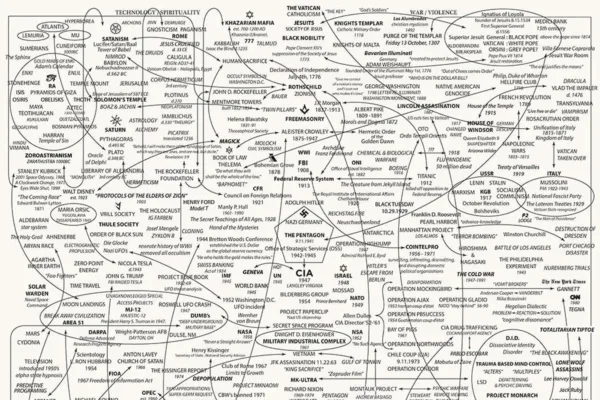
The network
Interconnected people, institutions, organizations, intelligence agencies, secret societies, and historical events that Monroe associates with the "Deep State."
Explore the Deep State Map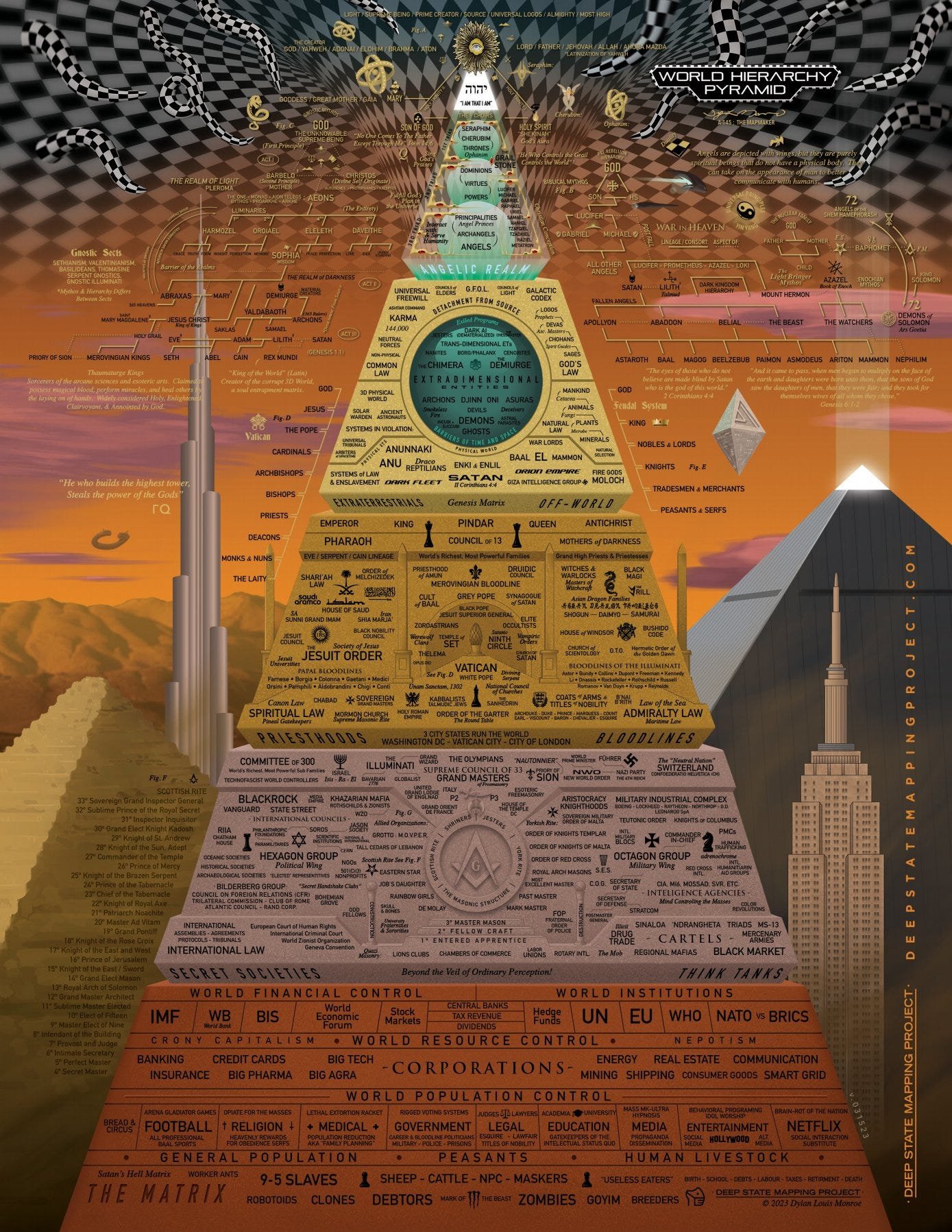
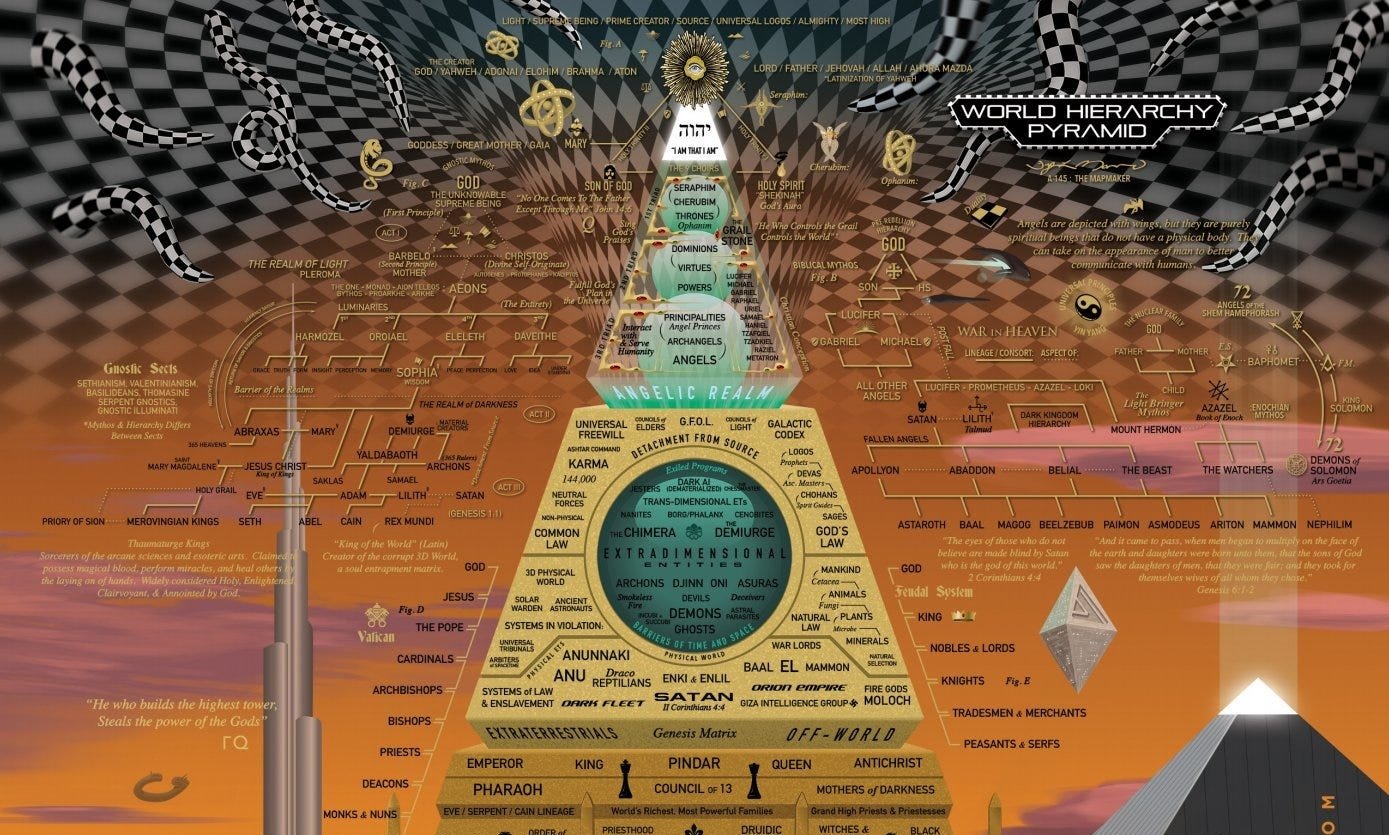
The hierarchy
Five tiers from the general population to the angelic realm, placing power structures inside a broader spiritual and metaphysical worldview.
Explore the PyramidCult of Baal Map: Frequently Asked Questions
What is the Cult of Baal Map?
It is a dense alternative-history timeline by Dylan Louis Monroe of the Deep State Mapping Project that attempts to trace connections among ancient civilizations, religious traditions, ruling dynasties, secret societies, financial institutions and political movements, from the ancient Near East to the founding of the United States.
Who created the Cult of Baal Map?
Dylan Louis Monroe, the artist behind the Deep State Mapping Project, which also produced the Deep State Map and the World Hierarchy Pyramid. He currently offers the map as a high-resolution, two-sided PDF (version 3.10.25).
How is the map organized?
It is a timeline divided into three major sections, read from top to bottom. The large terms in the central structure provide the main route. Bold terms in the outside margins correspond to those central subjects and supply additional names, dates and proposed connections. A separate deity comparison chart sits at the bottom.
Where should I start reading?
Start at the top with the ancient civilizations, follow one branch of the central spine downward, and only then move into the margin annotations for that branch. Do not try to read every word from left to right.
Is the Cult of Baal Map historically accurate?
It mixes documented people, civilizations and events with disputed interpretations, symbolic associations, allegations and speculation. Treat it as an investigative hypothesis map. Each line is a question to investigate, not proof of a relationship. GAR classifies individual claims as Documented, Plausible, Disputed, Speculative or Symbolic.
Does the map prove a continuous "death cult" runs history?
No. A chronological sequence is not evidence of organizational continuity, and two organizations existing in overlapping periods does not show that one controlled the other. Monroe's conclusions go beyond what the names and dates on the diagram can establish on their own.
Who was Baal?
Baal appears in the religious history of the ancient Near East. The Louvre's account of a stela found at Ugarit identifies Baal as a storm god associated with thunder and rain. Ancient worship and modern claims about hidden organizations are separate subjects.
Why is the small text so hard to read?
The margins are packed with annotations that blur in small previews. Use the full-size viewer on this page, or request the free high-resolution Cult of Baal Map PDF and zoom into one section at a time.
Where can I get the original artwork?
Visit Dylan Louis Monroe's official Cult of Baal page for the creator's explanation, current download and print options. Check the terms attached to the edition you obtain before reproducing it.
Who Made the Cult of Baal Map? Dylan Louis Monroe & the Deep State Mapping Project
All credit for the Cult of Baal artwork belongs to Dylan Louis Monroe and the Deep State Mapping Project, a collection of highly detailed diagrams and information-art projects exploring alternative interpretations of politics, history, secret societies, technology, spirituality, geopolitics, and power structures.
For readers who want the original creator's version, Monroe currently offers a high-resolution, two-sided PDF (version 3.10.25) through the Deep State Mapping Project. Visit his official Cult of Baal page for his explanation, interviews, bibliography and links to available editions. Check the terms attached to the edition you obtain before reproducing it.
Keep going
You've explored the Cult of Baal Map. Now get the whole picture.
The map shows the structure. Our reports show what is moving inside it right now, drawn from 1,133+ independent sources and delivered to you every week.
Premium, free for 30 days
$0today
Then $19.95/month. Cancel anytime from your account.
- Every Weekly Report and Monthly Deep Dive
- Special Reports and in depth investigations
- The full archive of 872+ published reports
- Podcasts, documentaries and the Truth Seekers community
- All courses, including The Awakening Journey
Prefer the essentials? Standard is $11.95/month · Compare plans
Not ready yet?
Get the free Weekly Briefing
New maps, fresh reports and the headlines worth your time, in your inbox every week. Free forever.
No spam. Unsubscribe anytime.
You're on the list
Your free Weekly Briefing is on the way.
Want the full reports behind the headlines? Premium is free for your first 30 days.
Try Premium Free →- Independent since 2018
- 872+ reports published
- No ads. No algorithms.
- Reader supported