

















Help Us Bypass Censorship. Share This.
Sign up to receive Our Weekly Briefing Newsletter

Begin your journey with weekly insights designed to expand awareness and ground you in truth. Our free tier gives you a powerful introduction without any commitment.

Rediscovering the Inner Knowing We Were Never Meant to Lose

“At the center of your being you have the answer; you know who you are and you know what you want.” — Lao Tzu

BEFORE THE MIND HAS AN ANSWER

Before we learned to analyze every decision, seek outside validation, or ask the world what it thought we should do, there was another way of knowing.

Most of us have experienced it. You suddenly think of someone you have not spoken with in months, only to hear from them later that day. You enter a room and sense immediately that something is wrong, even though no one has said a word. An answer to a problem arrives unexpectedly while walking, showering, meditating, or drifting toward sleep. You feel inexplicably drawn toward a person, place, idea, or opportunity—or receive an equally unmistakable feeling that something is not right.

Sometimes the message is barely more than a whisper: wait. Go. Call her. Don’t do this yet. Pay attention.

And often, the most curious part is that the knowing arrives before the explanation.

We call it intuition, inner knowing, instinct, divine guidance, the still small voice, higher consciousness, or simply a feeling we cannot quite explain. Different traditions have given it different names, but the underlying human experience appears remarkably persistent: information seems to enter our awareness without traveling through the deliberate, analytical process we normally associate with thinking.

Modern psychology offers explanations for some of this, and undoubtedly many intuitive impressions arise from experiences and patterns our minds have absorbed without our conscious awareness. Yet the larger phenomenon raises a fascinating question—particularly as humanity begins reconsidering the nature of consciousness itself.

What if intuition is one of the quiet ways consciousness communicates with us?

Perhaps the answer is less important than our willingness to explore the question.

THE INNER KNOWING WE HAVE ALWAYS CARRIED

Intuition is hardly a modern spiritual invention. Humanity has been describing forms of inner guidance for thousands of years.

Ancient philosophers contemplated knowledge that seemed to arise beyond ordinary reasoning. Eastern traditions developed meditation and contemplative practices intended to quiet mental activity and deepen awareness. Indigenous cultures often placed tremendous value on dreams, observation, relationship with nature, and knowledge carried through generations. Christian contemplative traditions speak of discernment, prayer, revelation, and the quiet guidance of Spirit. Mystics across cultures have described moments when understanding seemed to arrive not through deliberate thought, but through profound states of stillness and connection.

The language varies because the worldviews vary.

One person may describe an intuitive experience as guidance from God. Another may call it communication with the higher self or Source. Someone else may understand it as expanded consciousness, while a psychologist may describe the same experience as subconscious pattern recognition.

Perhaps we do not need to force these interpretations into competition.

What matters is that humans have repeatedly recognized a form of knowing that feels different from ordinary thought. And somewhere along the path toward modernity, many of us may have become less comfortable trusting it.

We live in a civilization extraordinarily skilled at externalizing knowledge. We search. We research. We consult experts. We compare reviews. We measure, calculate, analyze, poll, model, and increasingly ask algorithms what they recommend.

There is enormous value in all of this. But in becoming so proficient at looking outward, have we become less practiced at looking within?

WHERE DOES INTUITION COME FROM?

There is a perfectly reasonable scientific explanation for much of what we call intuition. The human mind is continuously processing far more information than reaches conscious awareness. Experiences accumulate. Patterns are learned. Subtle changes in expression, tone, environment, and behavior can register without our deliberately noticing them. Sometimes the conclusion surfaces before the conscious mind has reconstructed the path that produced it.

That alone makes intuition remarkable.

But it does not necessarily settle every question surrounding it.

There are experiences that people find more difficult to place neatly inside that explanation: a vivid dream that appears strangely connected to something that happens later; thinking intensely about someone immediately before they contact you; an unexpected insight during meditation or prayer; a sequence of coincidences that seems almost improbably meaningful; or a creative idea that arrives with such completeness that the person experiencing it feels less as though they invented it than received it.

None of these experiences proves that consciousness exists independently of the brain. Coincidence remains coincidence sometimes. Memory is imperfect. Human beings are natural pattern seekers, and we can find meaning where none was intended.

Discernment requires acknowledging all of that.

Yet consciousness itself remains one of humanity’s deepest mysteries. We can observe extraordinarily detailed relationships between brain activity and conscious experience, but fundamental questions about why subjective awareness exists and what consciousness ultimately is remain unsettled.

That leaves room for inquiry.

Some philosophical and spiritual traditions have long proposed that consciousness may be more fundamental than our conventional understanding suggests—that the brain might participate in, filter, or interact with consciousness rather than solely manufacture it.

If that possibility were ever demonstrated to contain truth, intuition would become an even more interesting phenomenon.

Could some forms of inner knowing represent information entering ordinary awareness from a deeper level of consciousness?

We don’t know.

But not knowing is precisely where genuine exploration begins.

WHEN SOMETHING WANTS TO COME THROUGH YOU

Perhaps nowhere is intuition easier to recognize than in creativity.

Writers frequently describe stories that seem to arrive before they understand them. Musicians hear melodies before they know where they will lead. Artists see an image internally and then attempt to bring it into physical form. Entrepreneurs sometimes become consumed by an idea that did not emerge from a carefully constructed business plan. People change careers because of a persistent inner pull they cannot entirely explain.

Spiritual teacher Eckhart Tolle has described the creative process in terms of form and formlessness. Something may initially exist only as an unformed inspiration—a sense that there is something wanting to be expressed. The human mind then performs the essential work of giving that inspiration structure and bringing it into the world.

That distinction also offers an interesting way of examining the difference between intuition and ego.

There is a difference between wanting to be a writer because we like the identity associated with being one and feeling that there is something within us that genuinely needs to be written. There is a difference between pursuing something because of the recognition we imagine receiving and being repeatedly drawn toward something even when recognition is unlikely.

Sometimes the deeper impulse is inconvenient.

It may require effort. It may disrupt comfortable routines. It may frighten us. We may resist it repeatedly and still discover that it refuses to disappear.

That is important because intuition is sometimes portrayed as though genuine alignment should always feel effortless. Human experience suggests otherwise. Resistance does not necessarily mean the deeper impulse is wrong. Sometimes resistance belongs to the part of us that recognizes how much change following that impulse may require.

An idea can arrive in an instant. Giving it form can take years.

And perhaps one of the quiet arts of conscious living is learning to recognize when something isn’t merely occupying our thoughts, but is asking to be expressed through our lives.
THE SIGNAL BENEATH THE NOISE

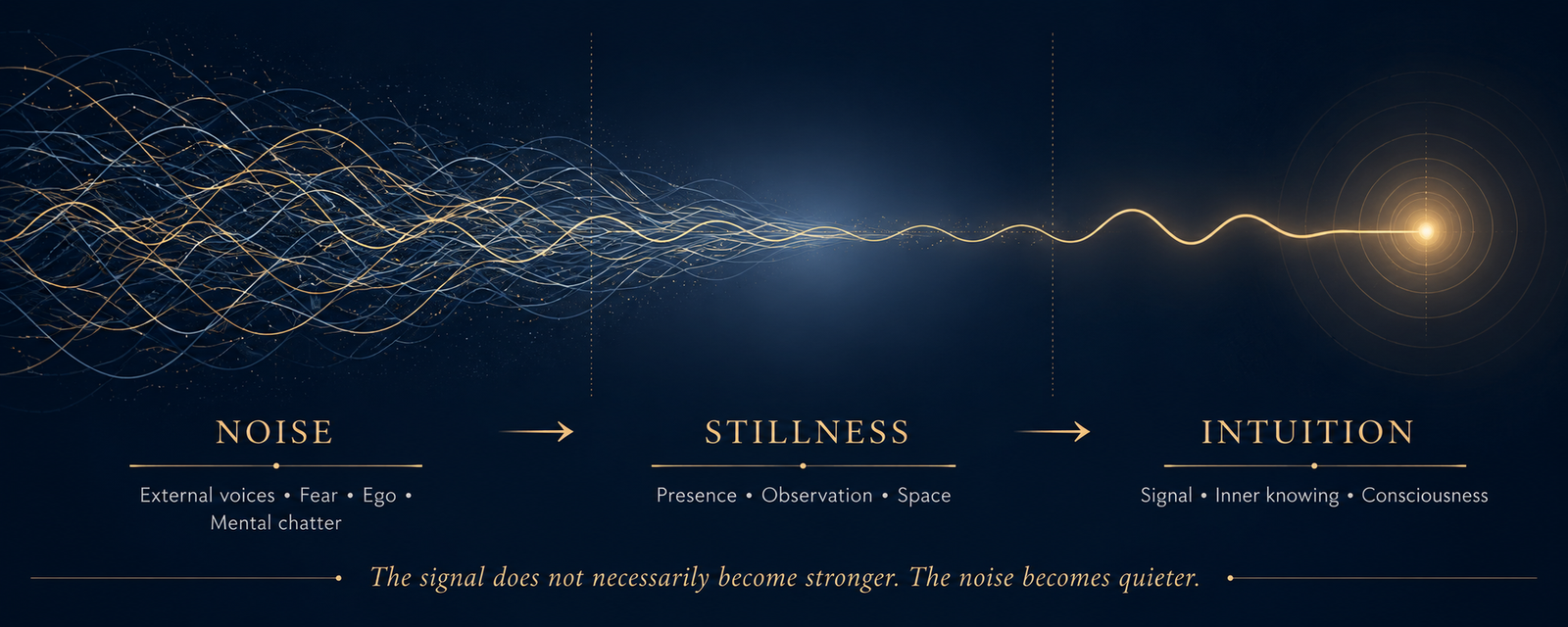
Perhaps intuition has not become weaker. Perhaps the world around us has simply become louder.

There was a time when quiet arrived naturally. A walk meant walking. Waiting meant waiting. Driving somewhere left us alone with our thoughts. The first moments of morning belonged to us before they belonged to the outside world. Today, many of those empty spaces have disappeared. Before our feet touch the floor, messages are waiting. News alerts tell us what deserves our attention. Algorithms anticipate what might hold it. Podcasts accompany our walks, screens fill our pauses, and even the few moments when nothing is happening can create an almost instinctive urge to reach for a phone.

None of these things is inherently harmful. They have given us extraordinary access to information, ideas, people, and knowledge. But they have also created something previous generations rarely experienced at this scale: a nearly continuous stream of other people’s thoughts entering our consciousness.

And intuition seems to operate very differently.

It rarely competes for our attention. It does not usually arrive with a notification or make an elaborate argument for why we should listen. More often, it appears in the spaces between everything else—during a quiet morning, a long walk, a moment in nature, meditation, prayer, journaling, or those strange minutes just before sleep when the thinking mind finally loosens its grip.

This may help explain why stillness appears so consistently across contemplative and spiritual traditions. Meditation, prayer, solitude, time in nature, breathwork, and reflection may not create intuition at all. Their deeper value may be that they create enough space for us to notice what was already trying to reach our awareness.

There is something beautiful in Tolle’s observation about the creative process that applies here as well. When something wants to emerge, we have to make room for it. A writer may sit quietly for an hour and produce only a sentence, yet the hour has not necessarily been wasted. The space itself has been honored. Something that previously existed only as an impulse has been given an opportunity to take form.

Perhaps inner guidance asks the same of us.

We often say that we are searching for an answer, yet searching itself can become another form of noise. We ask friends. We read another article. We watch another video. We search for another opinion. We continue gathering information until eventually we have so many voices in the room that we can no longer distinguish our own.

Sometimes the answer may require more information.

But sometimes it may require less.

There are moments when the most conscious thing we can do is stop searching, sit with the question, and allow ourselves not to know for a while. That uncomfortable space between the question and the answer may be precisely where intuition begins to become audible.

And perhaps that is why some of our clearest realizations arrive when we are no longer deliberately looking for them. The answer appears on the morning walk. In the shower. While staring out a window. During meditation. Somewhere in the middle of the night. The conscious mind has stopped demanding an answer, and something quieter finally has room to emerge.

The signal may have been there all along. We simply had to become quiet enough to hear it.

SYNCHRONICITY | WHEN THE OUTER WORLD SEEMS TO ANSWER

And then, every so often, something even stranger happens.

The answer we have been quietly sensing within seems to appear somewhere outside us.

A book falls into our hands at precisely the moment its message is needed. Someone we have been thinking about unexpectedly calls. A conversation with a stranger answers a question we have been carrying privately. The same symbol, phrase, or idea begins appearing in places that seem entirely unrelated. Individually, each occurrence can easily be dismissed as coincidence. Sometimes that is exactly what it is.

But occasionally the timing is so precise, the sequence so unexpected, or the meaning so personally relevant that we stop and wonder whether something more may be taking place.

Carl Jung gave these experiences a name: synchronicity. He used the term to describe meaningful coincidences that appear connected not through an obvious chain of cause and effect, but through the significance they hold for the person experiencing them. Jung was deeply interested in the possibility that the boundary between our inner and outer worlds might be less absolute than we assume, and synchronicity became one way of exploring that mystery.

Perhaps this is why these moments can feel so different from ordinary coincidence. They often seem to occur when our attention is already turned inward—during periods of transition, contemplation, grief, creativity, spiritual exploration, or when we are wrestling with an important decision. Something is moving within us, and suddenly the external world seems to reflect it back.

There are, of course, perfectly reasonable explanations for much of this. Human beings are extraordinary pattern seekers. Once something becomes meaningful to us, we notice it more readily. We remember the remarkable coincidences and forget the hundreds of ordinary moments when nothing happened. Our minds naturally connect events and create meaning from them.

Recognizing those possibilities does not diminish the experience. Nor does it require us to conclude that every synchronicity is a message from the universe.

Perhaps the more conscious response lies somewhere between those extremes.

We can notice without immediately interpreting. We can remain curious without needing to declare what something means. We can allow an experience to matter personally without turning it into proof of a larger cosmic mechanism.

And sometimes, simply paying attention changes us.

A synchronicity may encourage us to reconsider something we had dismissed. It may bring a person or possibility into our awareness. It may affirm an inner movement already taking place. Or it may do nothing more than interrupt the ordinary flow of life long enough for us to become completely present.

For a moment, we notice.

And perhaps that act of noticing is itself important.

The more attentive we become to these quieter movements of life, however, the more difficult question inevitably arrives. If intuition can appear as a feeling, an inner voice, an unexpected insight, or even a meaningful coincidence, how do we know what we are actually listening to?

Because there is another voice within us that can be every bit as persuasive.

INTUITION, EGO & FEAR

Anyone who has spent time trying to follow intuition eventually encounters this problem.

We feel strongly that we should do something—but is that intuition? Or is it simply what we want to happen? We feel uneasy about a person or situation—but are we perceiving something important, or has an old fear been activated? We become convinced that a particular path is meant for us—but is something deeper calling us forward, or does the identity associated with that path appeal to the ego?

The distinction is rarely as obvious as we might like.

Eckhart Tolle offers a useful way of thinking about this through the creative process. When someone feels compelled to write a book, for example, there can be a profound difference between wanting the identity of being a writer and sensing that something within is genuinely asking to be written. One is attracted to what the accomplishment might mean for the self; the other begins with something less formed—a persistent impulse that seems to want expression.

That idea reaches far beyond writing.

Many of life’s most consequential decisions begin in precisely that uncertain territory. A relationship no longer feels right even though nothing obviously terrible has happened. A career that once made sense begins to feel complete. A place we have never visited inexplicably calls to us. An idea keeps returning despite every practical reason to ignore it. Something within us seems to know that change is approaching before the rational mind has caught up.

Yet even genuine inner guidance does not necessarily arrive wrapped in peace.

Sometimes following it is frightening.

This is where the familiar advice to simply “follow what feels good” becomes inadequate. A deeply aligned decision can require leaving something comfortable. Creative work can bring enormous resistance. Growth can ask us to step into uncertainty. Speaking truth can make us nervous. Beginning again can be terrifying even when some deeper part of us knows it is time.

Fear, therefore, does not automatically mean no.

Nor does excitement automatically mean yes.

The more useful question may be what remains beneath the first emotional reaction.

Fear often creates a story around itself. The mind begins racing ahead, constructing scenarios, defending positions, replaying old experiences, and demanding certainty about an unknowable future. Ego can be equally elaborate, imagining recognition, status, validation, control, or the satisfaction of finally proving something to someone else.

Intuition often seems to require less explanation.

There may simply be a persistent sense of this way. Something continues returning after the emotional intensity has passed. We can argue with it, rationalize around it, distract ourselves from it, and sometimes ignore it for years, yet somehow it remains.

That does not make the feeling infallible. Human beings are remarkably capable of mistaking conditioning, desire, fear, and projection for inner guidance. Even the strongest feeling deserves examination.

But perhaps this is where consciousness itself becomes the practice.

Rather than immediately obeying or dismissing what arises within us, we learn to observe it. We give it space. We notice what happens when fear settles and desire quiets. We ask whether the feeling remains when there is no audience, no recognition, and no particular outcome attached to it.

Sometimes the answer becomes clearer.

Sometimes it does not.

And that uncertainty may be important, because learning to hear intuition was never meant to mean believing every voice inside our own heads.

It asks something more difficult of us.

It asks us to become discerning listeners.

INTUITION REQUIRES DISCERNMENT

Learning to listen inward does not mean believing everything we hear.

In fact, the deeper we move into intuition, synchronicity, inner guidance, and consciousness, the more important discernment becomes. Openness without discernment can easily become another form of certainty—the assumption that because something feels meaningful, it must be true. But intuition was never meant to replace our ability to question, observe, investigate, and reconsider. If anything, becoming more conscious asks us to do those things more carefully.

A dream can feel profound without necessarily being prophetic. A synchronicity can capture our attention without becoming an instruction. An intuitive feeling about another person may contain valuable information, but it can also be colored by previous experiences, expectations, or fears. Even an inner knowing that feels unmistakably clear deserves the humility of allowing life to reveal whether we understood it correctly.

Perhaps this is why discernment has been such an important part of spiritual traditions throughout history. The challenge has never simply been learning how to receive guidance. It has also been learning how to recognize what deserves our trust.

That recognition rarely happens in a single moment. It develops through experience. We follow an intuition and later discover that it led somewhere meaningful. Another time, we are certain we are receiving guidance only to realize that desire had been shaping what we wanted to hear. We mistake fear for warning, excitement for alignment, or coincidence for confirmation. Each experience teaches us something about the particular language of our own inner world.

Over time, we may begin asking different questions. Does this feeling remain when the emotion surrounding it settles? Am I sensing something, or am I hoping for a particular outcome? Does the message become clearer in stillness, or does it grow louder only when I am anxious? Am I willing to investigate what I am sensing rather than simply searching for evidence that confirms it? And perhaps most importantly, am I willing to discover that my interpretation was wrong?

That last question may be one of the clearest expressions of discernment.

There is a profound difference between trusting ourselves and believing ourselves incapable of being mistaken. Genuine inner trust does not require certainty. It allows us to say, Something about this feels important. I am going to pay attention,without immediately needing to declare exactly what it means.

Reason has a place here as well. Intuition and intellect are often treated as though we must choose between them, but perhaps they were never intended to be adversaries. Intuition can draw our attention toward something the analytical mind has overlooked. Reason can then examine what intuition has noticed. Evidence can challenge an impression, while an impression can inspire us to look more closely at the evidence.

Perhaps wisdom emerges when intellect and intuition stop competing and begin informing one another.

This becomes especially important in a world overflowing with information, competing narratives, predictions, experts, algorithms, spiritual teachers, commentators, and increasingly sophisticated technologies capable of telling us what to think about almost anything. We can learn from all of them, but none can assume the responsibility that ultimately belongs to us.

Discernment cannot be entirely outsourced.

Not to an institution. Not to an expert. Not to a spiritual teacher. Not to an algorithm. Not to a media organization. And not even to the Great Awakening Report.

Others can offer information, experience, research, wisdom, and perspective. But each of us must ultimately decide what we accept, what we question, what we investigate further, and what we leave unresolved. That process requires both an open mind and a grounded one—the willingness to consider possibilities without becoming attached to them simply because they reinforce what we already believe.

Perhaps that is the deeper relationship between intuition and discernment. Intuition asks us to listen. Discernment asks us to remain conscious of how we are listening.

And somewhere between those two practices, something important begins to happen.

We start learning how to trust ourselves again.

LEARNING TO TRUST YOURSELF AGAIN

Perhaps one of the quiet consequences of modern life is how accustomed we have become to looking outside ourselves for answers. We consult experts, search the internet, compare opinions, follow recommendations, and increasingly rely on algorithms to anticipate what we might want or need. These resources can be enormously valuable, but somewhere along the way, it becomes easy to forget that another source of guidance has been traveling with us all along.

Learning to trust ourselves does not mean rejecting outside knowledge or assuming that our instincts are always correct. It means developing a relationship with our own inner world strong enough that we can hear another person’s perspective without immediately abandoning our own. We begin noticing how fear feels, when ego is seeking validation, when emotion is clouding our judgment, and when something quieter continues to remain after all of those voices have settled.

That kind of trust develops slowly. It is strengthened each time we listen to an inner nudge and later understand why it mattered. It also grows through the times we misread a feeling, follow the wrong impulse, or discover that something we were certain about was simply not true. Even those experiences teach us the language of our own consciousness.

Perhaps that is why presence matters so much. The more present we become, the more clearly we can observe what is happening both around us and within us. We no longer need every answer immediately. We can listen, gather information, sit with uncertainty, and allow clarity to emerge in its own time.

Eventually, trusting ourselves becomes less about achieving certainty and more about developing a quiet confidence that we can meet what comes with awareness, curiosity, and discernment.

And perhaps that is when intuition begins to feel less like something mysterious happening to us and more like a relationship with consciousness that we have slowly learned to recognize.

REMEMBERING HOW TO LISTEN

Perhaps intuition was never meant to feel extraordinary. It may simply be one of the quieter dimensions of being human—an inner intelligence that has accompanied us throughout our lives, even during the years when we were too busy, distracted, skeptical, or externally focused to notice it.

The deeper we explore consciousness, the more we encounter the limits of what we can confidently explain. There are experiences we understand reasonably well and others that remain mysterious. Intuition seems to live somewhere along that boundary, where experience, awareness, creativity, synchronicity, and inner knowing occasionally meet.

We do not need to solve that mystery in order to become more attentive to it.

We can listen without automatically believing. We can notice synchronicities without assigning meaning to every coincidence. We can honor an inner knowing while still asking questions. We can remain open to possibilities that stretch our understanding while allowing discernment to keep us grounded.

Perhaps that balance is part of becoming more conscious.

The world will continue offering us opinions, explanations, predictions, and increasingly sophisticated ways of capturing our attention. There will always be another voice telling us where to look, what to fear, what to believe, and what should matter.

But beneath all of that activity, there remains a quieter space. It is the space we encounter in stillness, in nature, in prayer or meditation, in creativity, and sometimes in the unexpected moments when an answer simply arrives before we have finished asking the question.

Maybe intuition is subconscious intelligence. Maybe it is communication with a deeper level of consciousness. Maybe some experience it as the Creator God, Spirit, the Divine, Source, or the higher self. Perhaps our understanding will continue evolving as we learn more about consciousness itself.

For now, we do not have to know. We only have to become quiet enough to notice. and then strength to trust it.

The question may not be whether intuition exists. The more interesting question may be how much of it we have stopped hearing.

Sign up to receive Our Weekly Briefing Newsletter

Begin your journey with weekly insights designed to expand awareness and ground you in truth. Our free tier gives you a powerful introduction without any commitment.

STOP DROWNING IN THE NOISE. START SEEING THE TRUTH. Join over 99,000 truth seekers. Get the essential intelligence, alternative news, and disclosure updates that the mainstream media won’t touch.

Recently published Reports

🔔 SPECIAL REPORTS

Help Us Bypass Censorship. Share This.

Have questions?

At Great Awakening Report, we are dedicated to supporting your journey toward truth and enlightenment through our specialized Coaching and Consulting services.​

Coaching Services: Our coaching programs are designed to guide you through personal awakening and transformation. We offer personalized sessions that focus on expanding consciousness, uncovering hidden truths, and fostering spiritual growth. Our experienced coaches provide the tools and insights necessary to navigate your path with clarity and confidence.​

Consulting Services: For organizations and individuals seeking deeper understanding and strategic guidance, our consulting services offer expert analysis and solutions. We delve into areas such as global transitions, alternative news insights, and consciousness studies to provide comprehensive strategies tailored to your unique objectives.​

Embark on a transformative journey with our Coaching and Consulting services, and unlock your highest potential. To learn more and schedule a session, visit our Coaching and Consulting pages.​

Thank you

Thank you to our subscribers and readers for your continued support and dedication to truth and awakening. Your encouragement, engagement, and belief in our mission make everything we do possible. Together, we are expanding awareness and helping illuminate the path forward.

If you would like to further support the Great Awakening team and our ongoing efforts to share insight, knowledge, and truth, you can DONATE HERE.

With deep gratitude,

– Great Awakening Team

About the Author: Great Awakening Team

Great Awakening Team

DISCLAIMER: All statements, claims, views and opinions that appear anywhere on this site, whether stated as theories or absolute facts, are always presented by The Great Awakening Report (GAR) as unverified—and should be personally fact checked and discerned by you, the reader.Any opinions or statements herein presented are not necessarily promoted, endorsed, or agreed to by GAR, those who work with GAR, or those who read or subscribe to GAR.Any belief or conclusion gleaned from content on this site is solely the responsibility of you the reader to substantiate.Any actions taken by those who read material on this site are solely the responsibility of the acting party.You are encouraged to think for yourself and do your own research.Nothing on this site is meant to be believed without question or personal appraisal.

COPYRIGHT DISCLAIMER: Citation of articles and authors in this report does not imply ownership. Works and images presented here fall under Fair Use Section 107 and are used for commentary on globally significant newsworthy events. Under Section 107 of the Copyright Act 1976, allowance is made for fair use for purposes such as criticism, comment, news reporting, teaching, scholarship, and research.

COMMUNITY GUIDELINES DISCLAIMER: The points of view and purpose of this video is not to bully or harass anybody, but rather share that opinion and thoughts with other like-minded individuals curious about the subject.