













Help Us Bypass Censorship. Share This.
Sign up to receive Our Weekly Briefing Newsletter
Begin your journey with weekly insights designed to expand awareness and ground you in truth. Our free tier gives you a powerful introduction without any commitment.
EXPLORING MENTALISM, CORRESPONDENCE, VIBRATION & THE TIMELESS SEARCH FOR UNIVERSAL UNDERSTANDING
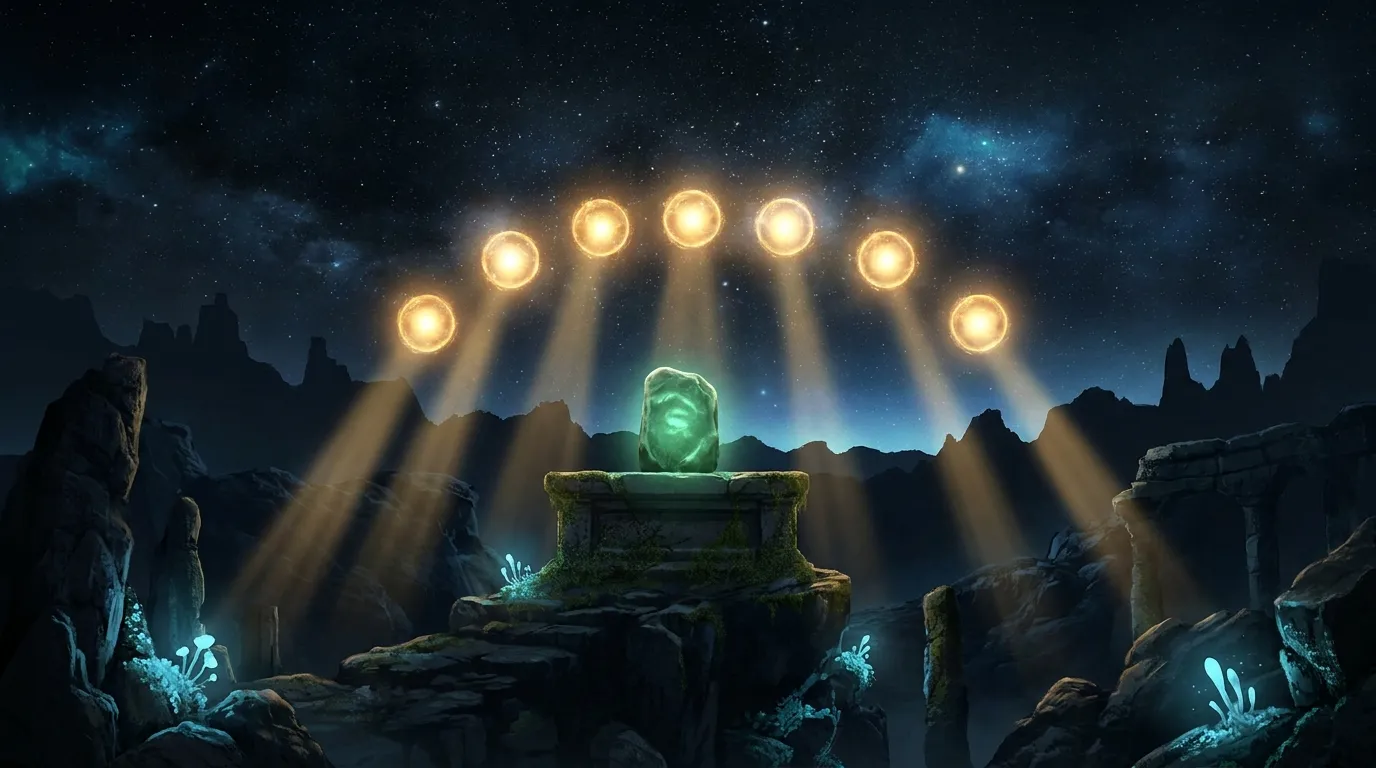
Featured image: Seven golden orbs above an ancient altar and a glowing green tablet
“The universe is not separate from the mind that seeks to understand it. Wisdom begins when we recognize the patterns connecting our inner and outer worlds.” — Great Awakening Report
What if the patterns shaping our thoughts, relationships, and experiences reflect deeper principles woven throughout existence? For centuries, Hermetic philosophy has explored the relationship between mind, nature, and the cosmos, inviting seekers to look beyond appearances and consider the underlying connections that give life its structure and meaning.
In 1908, a mysterious book titled The Kybalion, published under the name Three Initiates, introduced seven Hermetic principles: Mentalism, Correspondence, Vibration, Polarity, Rhythm, Cause and Effect, and Gender. Drawing inspiration from the broader Hermetic tradition while reflecting the New Thought philosophy of its era, the book presented a framework for understanding consciousness, change, and the relationship between our inner and outer worlds.
More than a century later, these principles continue to influence conversations about spiritual development, manifestation, energy, and personal transformation. Whether approached as metaphysical teachings or practical tools for self-reflection, they offer an opportunity to examine how our thoughts, choices, and perceptions influence the way we navigate life. Their greatest value may lie not in promising control over reality, but in encouraging a more conscious relationship with it.
WHERE DO THE 7 HERMETIC PRINCIPLES COME FROM?
The seven principles were presented together in The Kybalion, published in Chicago in 1908 by the Yogi Publication Society. Its authors identified themselves only as the Three Initiates, claiming to preserve teachings associated with Hermes Trismegistus, the legendary sage whose name has long been connected with the philosophical and spiritual traditions of ancient Egypt and Greece.
Hermes Trismegistus, meaning Hermes the Thrice-Great, is a legendary figure combining attributes of the Greek god Hermes and the Egyptian god Thoth, both associated with knowledge and communication. During the early centuries of the Common Era, writings attributed to Hermes emerged in Greco-Roman Egypt, including the Corpus Hermeticum, which explores divine mind, the nature of the cosmos, spiritual rebirth, and the soul’s relationship with the divine.
These writings gained renewed influence during the Renaissance, particularly after Marsilio Ficino translated the Corpus Hermeticum into Latin in the fifteenth century. Their ideas helped shape Western esotericism, alchemy, and mystical philosophy. The historical Emerald Tablet, associated with the Hermetic-alchemical tradition, also contributed to this legacy, although it is distinct from the much later writings commonly known as the Emerald Tablets of Thoth the Atlantean, explored in our article on the Emerald Tablets of Thoth.
While The Kybalion draws upon themes associated with Hermetic thought, its particular seven-principle system is not documented as such in the surviving ancient Hermetic texts. Understanding that distinction allows readers to appreciate the book’s philosophy without confusing its modern presentation with the historical origins of Hermeticism.
PRINCIPLE ONE: MENTALISM
The first principle declares, “THE ALL is MIND; The Universe is Mental.” Within The Kybalion, The All represents the infinite, underlying reality from which existence emerges. The book proposes that the universe is a mental creation within this infinite consciousness, rather than something entirely separate from its source.
This is a metaphysical claim about the nature of existence, extending well beyond the familiar idea that positive thinking influences personal experience. Mentalism suggests that mind is fundamental to reality itself, while individual consciousness participates within a greater universal mind. Although this interpretation cannot be established through conventional scientific methods, it raises enduring philosophical questions about the relationship between consciousness and the material world.
On a personal level, the principle also encourages greater awareness of how thoughts, beliefs, and interpretations influence our experiences. Our perceptions may not determine every circumstance we encounter, but they can profoundly affect how we respond. Recognizing this distinction creates space between an event and the meaning we assign to it.
A practical way to explore Mentalism is to observe your internal dialogue throughout the day. When a fearful or limiting thought appears, consider whether it reflects the situation accurately or simply represents an established pattern of interpretation. The objective is not forced positivity, but greater freedom to choose how we engage with our experiences.
PRINCIPLE TWO: CORRESPONDENCE, AS ABOVE, SO BELOW
The second principle is expressed through the familiar phrase “As above, so below; as below, so above.” In The Kybalion, Correspondence describes the proposed relationship between different planes of existence, suggesting that underlying principles may operate across physical, mental, and spiritual levels even when their expressions appear different.
The idea has roots in the historical Emerald Tablet, whose language describes a correspondence between what is above and what is below. Over time, this concept became central to many forms of Hermetic and esoteric thought, encouraging seekers to explore relationships between the individual and the cosmos, the visible and invisible, and the inner and outer dimensions of experience.
Nature provides compelling visual parallels, from branching trees and rivers to the repeating structures of certain biological systems. These similarities can inspire reflection, although they do not independently demonstrate the metaphysical correspondences described in the book. The principle is best understood within its philosophical context rather than as a universal scientific explanation for recurring patterns.
In everyday life, Correspondence offers a useful invitation to examine how our inner attitudes may influence our relationships, habits, and surroundings. Our article As Above, So Within explores related ideas connecting solar activity, Earth’s environment, and human awareness.

PRINCIPLE THREE: VIBRATION
The third principle states, “Nothing rests; everything moves; everything vibrates.” According to The Kybalion, differences between matter, energy, mind, and spirit arise through varying degrees or rates of vibration. Within this framework, vibration is presented as a fundamental characteristic of existence across physical, mental, and spiritual planes.
Modern physics recognizes many forms of motion, oscillation, and wave behavior, which makes the language of vibration particularly appealing. However, the scientific description of vibrating physical systems does not establish the book’s broader claims about spiritual frequencies, mental transmutation, or the relationship between matter and consciousness. These remain distinct metaphysical interpretations.
The principle has also influenced contemporary language surrounding raising one’s vibration, often associated with gratitude, meditation, music, and emotional well-being. While such practices may support relaxation and improve one’s state of mind, their benefits should not automatically be attributed to measurable changes in a person’s spiritual frequency. Our exploration of 528 Hz examines one popular sound frequency and the evidence surrounding its proposed effects.
A grounded way to approach Vibration is to become more attentive to changes in your own emotional and physical state. Notice how breathing, music, time in nature, or meaningful connection can influence your experience. Whether understood energetically or psychologically, greater awareness of our internal state can help us respond more intentionally to the world around us.
PRINCIPLES FOUR AND FIVE: POLARITY AND RHYTHM
The fourth principle, Polarity, teaches that everything possesses opposing poles and that apparent opposites may represent different degrees of the same underlying quality. Hot and cold, for example, describe variations in temperature rather than entirely unrelated phenomena. The Kybalion extends this concept into mental and emotional experience, suggesting that certain states can be transformed by moving along a continuum.
Within the book, this process is associated with mental transmutation, the deliberate effort to change one’s mental condition through attention and will. The teaching encourages individuals to recognize that fear, discouragement, and other difficult states need not remain permanent. Although not every emotion can be reduced to a single scale, the broader practice of consciously shifting perspective can support greater emotional flexibility.
The fifth principle, Rhythm, describes the recurring movement of existence through cycles of expansion and contraction, rising and falling, action and rest. The book uses the image of a pendulum to illustrate this movement and introduces the concept of neutralization, through which a person seeks to lessen the influence of emotional swings by developing greater mental steadiness.
Together, Polarity and Rhythm offer a perspective on navigating change. Seasons, tides, and many biological processes follow recognizable cycles, while human experience also moves through periods of growth, uncertainty, activity, and renewal. Our article on cycles within cycles explores recurring patterns across history and astronomy.
Rather than attempting to eliminate every difficult experience, these principles invite us to recognize change without becoming completely defined by it. We may not control every circumstance or cycle, but we can cultivate greater awareness of how we respond as conditions shift.

PRINCIPLES SIX AND SEVEN: CAUSE AND EFFECT, AND GENDER
The sixth principle, Cause and Effect, teaches that events arise through causes rather than occurring without explanation. The Kybalion presents chance as a term applied when underlying causes are not understood, and encourages individuals to become more conscious participants in the chain of influences shaping their experiences.
On a practical level, this principle emphasizes responsibility, intentional action, and awareness of consequences. Our choices can influence future circumstances, even though outcomes are also shaped by factors beyond our control. This perspective shares philosophical similarities with teachings about karma, explored in our guide to the 12 laws of karma.
The seventh principle, Gender, describes masculine and feminine aspects as complementary creative principles operating across physical, mental, and spiritual planes. In The Kybalion, Gender is associated with generation, regeneration, and creation, extending beyond biological reproduction into the book’s broader metaphysical understanding of existence.
The text distinguishes these creative principles from biological sex alone, although it also interprets physical reproduction through the same framework. Contemporary readers may find it helpful to consider the principle symbolically through the interaction of active and receptive qualities, initiative and reflection, or expression and integration. These are modern interpretive applications rather than scientific categories or fixed characteristics assigned to men and women.
Together, Cause and Effect and Gender invite reflection on how conscious choices and complementary processes contribute to creation and change. The emphasis is not simply on understanding how life unfolds, but on becoming more intentional about what we contribute to it.
HOW TO READ THE KYBALION WITH DISCERNMENT
Although The Kybalion presents itself as a transmission of ancient Hermetic wisdom, the book belongs to the early twentieth century. Researchers of Western esotericism have noted that its seven-principle structure does not appear in the surviving ancient Hermetic writings and that its emphasis on mental mastery reflects the influence of the New Thought movement.
The identity of the Three Initiates remains formally anonymous, although William Walker Atkinson, a prolific writer associated with New Thought and occult philosophy, is widely regarded as the most likely principal or sole author. Recognizing this historical background does not diminish the book’s potential value; it simply provides a more accurate understanding of how its teachings emerged and developed.
The most constructive way to engage with the principles may be to approach them as invitations to reflection rather than unquestionable laws. What assumptions shape our perceptions? Which patterns continue repeating in our lives? How do our choices influence the experiences we create for ourselves and others? Such questions encourage personal awareness without requiring absolute certainty about the metaphysical explanations behind them.
At the same time, discernment matters when spiritual principles are presented as guarantees of wealth, healing, or complete control over circumstances. Not every hardship results from negative thinking, and not every outcome can be changed through intention alone. Personal sovereignty includes recognizing both the influence of our choices and the realities beyond our immediate control.
Our 12 Universal Laws documentary offers another opportunity to compare spiritual frameworks and explore how these ideas have developed within contemporary consciousness teachings.
More than a century after its publication, The Kybalion continues to invite readers to consider the relationship between mind, creation, and the patterns of existence. Its lasting relevance may be found not in proving that seven universal laws govern every aspect of reality, but in encouraging greater awareness of how we think, act, respond, and participate in the world.
Perhaps the deepest wisdom is not the ability to control every movement of life’s pendulum, but the capacity to remain conscious, centered, and intentional as it swings.



Frequently Asked Questions
What are the 7 Hermetic principles?
The seven Hermetic principles are Mentalism, Correspondence, Vibration, Polarity, Rhythm, Cause and Effect, and Gender. They are presented in The Kybalion, a book published in 1908 that attributes its teachings to the philosophical tradition of Hermes Trismegistus. Together, they offer a metaphysical framework for exploring consciousness, creation, change, and the relationship between mind and the universe.
Who wrote The Kybalion?
The Kybalion was published anonymously in 1908 by the Yogi Publication Society in Chicago under the name Three Initiates. Although its authorship has never been conclusively established, William Walker Atkinson, a prolific New Thought writer and occult philosopher, is widely considered its most likely principal or sole author.
Are the Hermetic principles ancient?
Hermetic philosophy traces its origins to writings produced in Greco-Roman Egypt, particularly during the early centuries of the Common Era. However, the specific seven-principle framework appears in The Kybalion, published in 1908, rather than in the surviving ancient Hermetic texts. Researchers generally regard the book as a modern synthesis of Hermetic themes and New Thought philosophy.
What does “as above, so below” mean?
The phrase expresses the Principle of Correspondence, which proposes that relationships and underlying principles connect different planes of existence, including the physical, mental, and spiritual. A related formulation appears in the historical Emerald Tablet. In practical terms, it encourages reflection on the connections between our inner experiences and the larger world, although these proposed metaphysical correspondences are not established scientific laws.
How can I use the Hermetic principles in daily life?
The Hermetic principles can serve as tools for greater self-awareness and intentional living. Mentalism encourages examining your thoughts and perceptions, Rhythm offers perspective during life’s changing cycles, Polarity invites conscious shifts in attitude, and Cause and Effect emphasizes the consequences of our choices. Approached with discernment, these teachings can support reflection, personal responsibility, and a more balanced relationship with everyday experiences.
Where to Go From Here
If these teachings speak to you, start with our free Truth Seekers Weekly Briefing. It arrives once a week with recently published reports, conscious practices and the threads we are following. The free Great Awakening Map PDF is a good companion, and you can browse the full collection of GAR maps any time.
Premium members get our Special Reports on consciousness and spiritual practice, every Weekly and Monthly Report, and the full Truth Seeker archive. To see exactly what each membership includes, compare the Standard and Premium plans and pick the one that fits how you like to read.
Sign up to receive Our Weekly Briefing Newsletter
Begin your journey with weekly insights designed to expand awareness and ground you in truth. Our free tier gives you a powerful introduction without any commitment.
STOP DROWNING IN THE NOISE. START SEEING THE TRUTH. Join thousands of truth seekers. Get the essential intelligence, alternative news, and disclosure updates that the mainstream media won’t touch.
Latest Reports
 Weekly ReportAwakening The Sleeping Giant · November 23rd EditionNovember 23, 2026
 Weekly ReportAwakening The Sleeping Giant · November 16th EditionNovember 16, 2026
 Weekly ReportTruth Seekers Weekly Briefings · Master Class Connecting The Dots · November 13th EditionNovember 14, 2026
 Weekly ReportAwakening The Sleeping Giant · November 9th EditionNovember 9, 2026View all weekly reports
Special Reports
 Special Report2026 THANKSGIVING EDITION · A SEASON OF GRATITUDE, Light & LoveNovember 19, 2026
 Special ReportGlobal Everything Collapse · Crossing The Threshold · Part IIINovember 6, 2026
 Special ReportThe Next Plandemic, The Bird Flu VirusNovember 5, 2026
 Special ReportThe Great Exodus, California On The ThresholdOctober 20, 2026View all special reports
Help Us Bypass Censorship. Share This.
Join the Discussion
Related Posts


Have questions?
At Great Awakening Report, we are dedicated to supporting your journey toward truth and enlightenment through our specialized Coaching and Consulting services.
Coaching Services: Our coaching programs are designed to guide you through personal awakening and transformation. We offer personalized sessions that focus on expanding consciousness, uncovering hidden truths, and fostering spiritual growth. Our experienced coaches provide the tools and insights necessary to navigate your path with clarity and confidence.
Consulting Services: For organizations and individuals seeking deeper understanding and strategic guidance, our consulting services offer expert analysis and solutions. We delve into areas such as global transitions, alternative news insights, and consciousness studies to provide comprehensive strategies tailored to your unique objectives.
Embark on a transformative journey with our Coaching and Consulting services, and unlock your highest potential. To learn more and schedule a session, visit our Coaching and Consulting pages.
Thank you
Thank you to our subscribers and readers for your continued support and dedication to truth and awakening. Your encouragement, engagement, and belief in our mission make everything we do possible. Together, we are expanding awareness and helping illuminate the path forward.
If you would like to further support the Great Awakening team and our ongoing efforts to share insight, knowledge, and truth, you can DONATE HERE.
With deep gratitude,
– Great Awakening Team
About the Author: Great Awakening Team

DISCLAIMER: All statements, claims, views and opinions that appear anywhere on this site, whether stated as theories or absolute facts, are always presented by The Great Awakening Report (GAR) as unverified—and should be personally fact checked and discerned by you, the reader.Any opinions or statements herein presented are not necessarily promoted, endorsed, or agreed to by GAR, those who work with GAR, or those who read or subscribe to GAR.Any belief or conclusion gleaned from content on this site is solely the responsibility of you the reader to substantiate.Any actions taken by those who read material on this site are solely the responsibility of the acting party.You are encouraged to think for yourself and do your own research.Nothing on this site is meant to be believed without question or personal appraisal.
COPYRIGHT DISCLAIMER: Citation of articles and authors in this report does not imply ownership. Works and images presented here fall under Fair Use Section 107 and are used for commentary on globally significant newsworthy events. Under Section 107 of the Copyright Act 1976, allowance is made for fair use for purposes such as criticism, comment, news reporting, teaching, scholarship, and research.
COMMUNITY GUIDELINES DISCLAIMER: The points of view and purpose of this video is not to bully or harass anybody, but rather share that opinion and thoughts with other like-minded individuals curious about the subject.