




















Help Us Bypass Censorship. Share This.
Sign up to receive Our Weekly Briefing Newsletter
Begin your journey with weekly insights designed to expand awareness and ground you in truth. Our free tier gives you a powerful introduction without any commitment.
EXPLORING GROUP THOUGHT FORMS, COLLECTIVE ENERGY & THE PATH TO CONSCIOUS SOVEREIGNTY
“The most powerful collective structures may not be those built of stone and steel, but those sustained by the thoughts, emotions, and beliefs of humanity.” — Great Awakening Report
Have you ever entered a gathering and immediately sensed an atmosphere that seemed larger than the individuals present? Perhaps you have experienced the extraordinary unity of a meditation gathering, the emotional intensity of a stadium filled with thousands of people, or the unsettling pressure of a group in which independent thinking gradually gives way to collective belief.
What if these experiences represent something more than shared emotion?
Within esoteric traditions, an egregore is understood as a collective thought form brought into existence through the combined thoughts, emotions, intentions, and energetic participation of a group. Sustained through attention, repetition, belief, and emotional investment, it is believed to develop a degree of autonomy, influencing the very individuals whose consciousness helped create it.
Although the term has roots in ancient religious texts and Western esoteric teachings, its relevance extends far beyond occult philosophy. From institutions, cultural traditions, and belief systems to digital communities and global movements, humanity continually participates in collective patterns that shape how we perceive, interpret, and experience reality.
The study of egregores ultimately brings us to one of the most important questions on the path of conscious awakening: How much of what we think, feel, and believe originates within our own awareness, and how much have we absorbed from the collective?
Recognizing these influences is not about withdrawing from humanity. It is about becoming a conscious participant in the reality we are collectively creating.
WHAT IS AN EGREGORE?
Within many metaphysical traditions, consciousness is understood not simply as a means of observing reality, but as a creative force capable of influencing our experience of it. Thoughts, emotions, intentions, and beliefs are regarded as expressions of energy that contribute to the world we experience and collectively shape.
An egregore extends this principle from the individual to the collective. When numerous individuals repeatedly direct their thoughts, emotions, and intentions toward a shared idea, esoteric teachings suggest that their combined energy can generate a collective thought form.
Over time, this thought form is believed to develop characteristics of its own, reflecting the qualities of consciousness that sustain it. A collective united through compassion, creativity, and service may cultivate a very different energetic environment from one sustained through fear, hostility, or division.
One of the most intriguing aspects of an egregore is its proposed ability to influence the individuals who created it. As members continue to reinforce shared beliefs, symbols, and emotional patterns, the collective structure may increasingly shape their perceptions and behavior. It can even outlast its original creators, sustained by successive generations who inherit its traditions and beliefs.
The creation begins to influence its creators.
This concept also connects to broader esoteric teachings concerning unseen influences, including the Gnostic understanding of archons. Although archons and egregores originate from different traditions and should not be considered interchangeable, both invite exploration into the relationship between consciousness, unseen influences, and individual sovereignty.
The independent existence of egregores as energetic entities has not been scientifically established. Nevertheless, their study offers a compelling framework for examining the relationship between individual consciousness and the collective environments we inhabit.

WHERE DOES THE WORD EGREGORE COME FROM?
The word egregore traces its origins to the Greek egrēgoros, meaning wakeful or watchful. Related Greek terminology appears in the ancient traditions surrounding the Book of Enoch, where the Watchers are described as celestial beings who descended to Earth and interacted with humanity.
The Watchers of Enoch, however, are not described as collective thought forms in the modern esoteric sense. That interpretation developed much later through Western occult philosophy.
During the nineteenth century, French occultist Éliphas Lévi incorporated the concept of egregores into his writings concerning spiritual beings and unseen influences. Subsequent European esoteric thinkers expanded the term to describe entities or energetic structures generated through collective thought, imagination, intention, and ritual.
Throughout the twentieth century, the concept appeared in ceremonial magic, Hermetic philosophy, and Christian esotericism. Meditations on the Tarot, a work attributed to Valentin Tomberg, explored egregores in relation to collective will and spiritual activity.
In 2018, author Mark Stavish published Egregores: The Occult Entities That Watch Over Human Destiny, bringing renewed attention to the subject and examining how collective thought forms may influence religious, political, cultural, and social institutions.
Although the meaning of the word has evolved considerably, its history reflects humanity’s enduring fascination with the possibility that consciousness can generate influences extending beyond the individual.
HOW DOES AN EGREGORE FORM AND GROW?
Within the esoteric framework, the formation of an egregore generally involves several interconnected elements: a shared idea, emotional investment, focused intention, repetition, and sustained collective attention.
A symbol, belief, cause, or common purpose provides the initial focus. Emotional participation gives that focus greater significance, while repetition through rituals, conversations, imagery, traditions, and shared experiences reinforces the collective structure.
Over time, the group may develop a recognizable identity, atmosphere, and set of expectations that influence both existing and incoming members. As individuals adopt these patterns and contribute their own thoughts and emotions, the collective structure continues to grow.
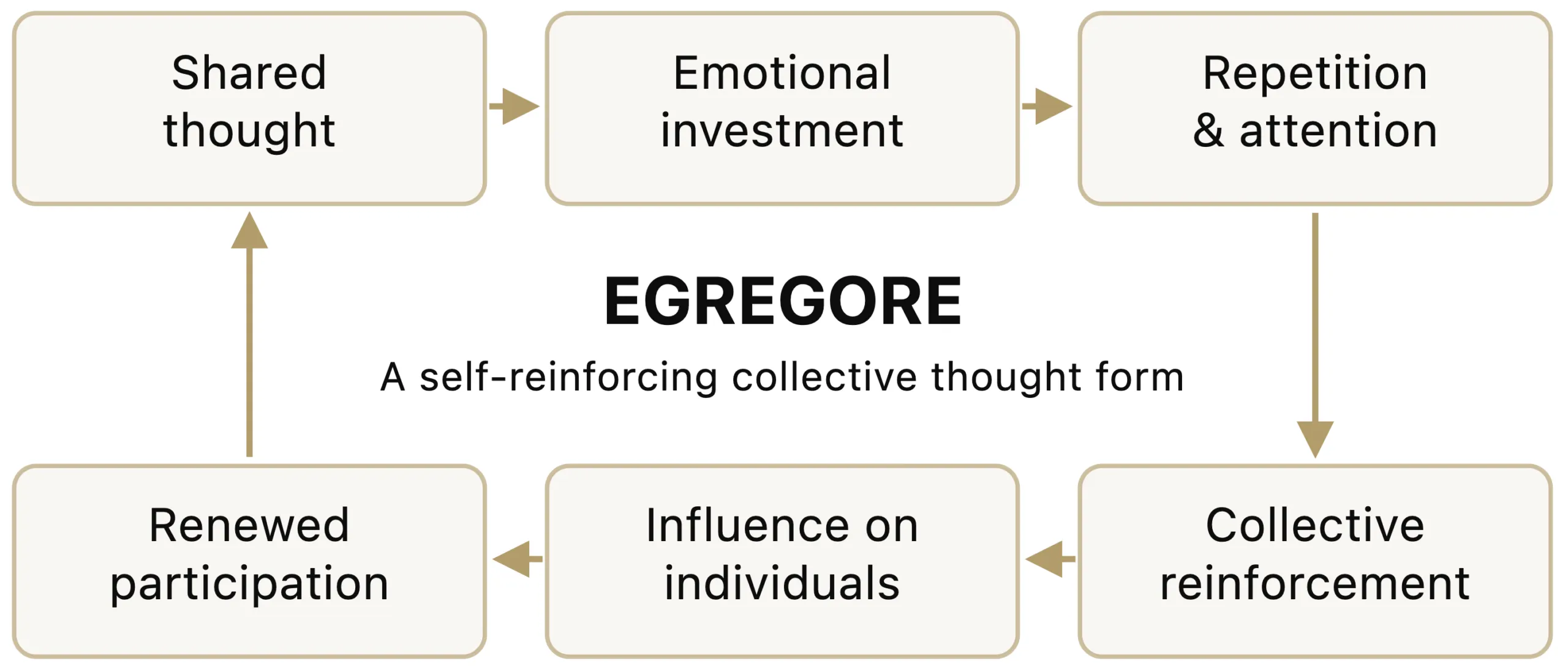
Within this model, attention becomes a form of energetic currency. Devotion, admiration, fear, anger, and even persistent opposition may reinforce a collective thought form by keeping it at the center of human awareness.
This raises a particularly important question: Can we unintentionally strengthen the very things we oppose by remaining emotionally consumed by them?
In today’s digital environment, information travels almost instantaneously. Images, narratives, symbols, and emotionally charged messages can reach millions of individuals within hours. Algorithms designed to encourage engagement can amplify collective emotional responses, creating powerful cycles of attention and reinforcement.
From an energetic perspective, these environments provide an intriguing modern context for exploring how collective thought forms might develop and spread.
Western esoteric traditions also describe related concepts, including individual thought forms and tulpas. The latter term was popularized in the West through the writings of Alexandra David-Néel, drawing upon Tibetan Buddhist concepts that were subsequently adapted into Western occult philosophy.
While these concepts are related, an egregore is distinguished primarily by its collective origin and the continued participation of multiple individuals.

IS THERE A PSYCHOLOGICAL EXPLANATION FOR EGREGORES?
Long before contemporary discussions of collective consciousness, psychologists and sociologists were exploring how individuals behave when immersed within groups.
In 1895, French writer Gustave Le Bon published The Crowd, examining how collective environments could influence individual judgment and behavior. Sociologist Émile Durkheim later introduced the concept of collective effervescence, describing the heightened sense of emotional connection and unity that can emerge during shared rituals, celebrations, and gatherings.
Modern research into social identity, conformity, and emotional contagion has provided further insight into these experiences. Solomon Asch’s conformity experiments demonstrated how group pressure can influence individual judgments, while research into emotional contagion has explored how emotional states spread through interpersonal interactions.
These findings help explain why individuals may adopt beliefs, attitudes, and behaviors within a collective environment that they might not otherwise embrace independently.
However, the psychological perspective does not exhaust the metaphysical questions surrounding egregores. It describes observable mechanisms through which collective influence operates, while esoteric traditions explore the possibility that sustained group consciousness may also generate a subtler energetic structure.
The distinction is important. Evidence of group influence does not establish the existence of an independent energetic entity, but neither does it prevent us from exploring the larger philosophical questions raised by collective consciousness.
Psychology examines how the collective influences the individual. Esoteric philosophy asks what the collective itself may become.
WHAT ARE SOME EXAMPLES OF EGREGORES?
Egregores are not necessarily associated with occult organizations or ceremonial practices. Within the broader esoteric interpretation, they may develop wherever groups of people sustain a shared identity, belief, emotional investment, or purpose over time.
Religious communities, nations, cultural traditions, corporations, sports teams, educational institutions, and online communities all cultivate recognizable collective identities. Their symbols, stories, rituals, and shared experiences reinforce a sense of belonging that can extend across generations.
Consider the emotional unity experienced when thousands of people sing together, participate in a meditation, or gather in support of a common humanitarian purpose. These experiences can generate an extraordinary sense of connection, inspiration, and shared intention.
Conversely, collective environments dominated by fear, hostility, rigid conformity, or persistent conflict can leave individuals feeling anxious, reactive, and disconnected from their own values.
| Constructive Collective Energy | Destructive Collective Energy |
|---|---|
| Compassion | Fear |
| Cooperation | Division |
| Creativity | Manipulation |
| Mutual respect | Domination |
| Independent inquiry | Blind conformity |
| Service to others | Exploitation |
| Personal sovereignty | Dependency |
These distinctions describe the qualities that may sustain a collective environment rather than permanent classifications of particular groups.
An egregore, within the esoteric framework, is not inherently positive or negative. Its character reflects the consciousness, intentions, and emotional patterns that contribute to its development.
A family built upon mutual respect, a community dedicated to healing, or a gathering united through meditation and compassion may cultivate collective patterns that support individual growth rather than diminish it.
This introduces the possibility of conscious co-creation—the intentional cultivation of collective environments that reflect the qualities we wish to experience more fully in the world.
HOW CAN YOU TELL WHEN AN EGREGORE IS UNHEALTHY?
One of the clearest indicators of an unhealthy collective environment is the gradual erosion of independent thought. When questioning becomes unacceptable, disagreement is interpreted as betrayal, and belonging depends upon unquestioning conformity, the collective may begin to undermine individual sovereignty.
Other indicators include persistent emotional manipulation, an excessive focus on enemies, pressure to adopt prescribed beliefs, and an atmosphere sustained through fear, anger, or superiority.
Individuals may find themselves reacting automatically to particular words, repeating ideas they have never independently examined, or experiencing guilt when stepping away from the group.
These patterns can develop gradually. The desire for belonging, acceptance, and shared purpose is a natural part of the human experience, and it can make collective influence difficult to recognize from within.
The energetic perspective adds another dimension to this inquiry. If collective thought forms are sustained through emotional participation, then continually engaging with fear, hostility, and conflict may contribute to the very atmosphere from which we wish to become free.
Our article on escaping the matrix explores how external systems can influence perception and capture attention, and how conscious awareness can help restore independent judgment.
Recognizing unhealthy collective influence does not require assuming that every group possesses a harmful unseen entity. It requires paying attention to observable patterns, examining our own participation, and remaining willing to question what we have come to accept.
Awareness creates the opportunity to choose where our energy goes rather than allowing habitual reactions to determine it for us.

HOW DO YOU STAY FREE INSIDE A GROUP?
Personal sovereignty does not require rejecting community, abandoning meaningful traditions, or withdrawing from collective experiences. It involves remaining conscious of our participation within them.
Begin by observing how different environments influence your inner state. Do you emerge from a gathering feeling inspired, connected, and capable of independent thought? Or do you find yourself increasingly fearful, reactive, exhausted, or pressured to conform?
These observations are valuable starting points for reflection, although our emotional responses alone cannot establish the nature or intentions of a group.
Developing the observer perspective allows us to witness collective emotions without automatically adopting them. We can remain informed without becoming consumed by every emerging narrative, recognize conflict without perpetuating it, and participate in meaningful communities without surrendering our capacity for discernment.
Intentional solitude is equally important. Time spent in nature, meditation, silence, or quiet reflection creates space to reconnect with our own thoughts and values away from the constant influence of external voices.
Ask yourself:
- Have I independently examined the beliefs I am expressing?
- Am I responding consciously or reacting to collective emotion?
- Does this community encourage independent thought and personal growth?
- Where am I directing my attention and emotional energy?
- Do my actions reflect my own values or the expectations of others?
These questions are not intended to create suspicion toward the world around us. They are invitations to become more conscious of our relationship with it.
We can also choose to redirect our attention toward environments that encourage compassion, creativity, cooperation, and authentic human connection.
Within the esoteric understanding of egregores, withdrawing attention from an unhealthy thought form may reduce our contribution to its continued reinforcement. Redirecting that attention toward constructive intentions creates opportunities to participate in healthier collective patterns.
Energetic sovereignty is not simply the ability to withdraw our energy. It is the awareness to choose what we consciously invest it in.
WHY DOES THE EGREGORE IDEA MATTER FOR AWAKENING?
The process of conscious awakening involves recognizing not only the beliefs and emotional patterns we have developed individually, but also those we have inherited through families, institutions, cultures, and collective experiences.
Many of the assumptions through which we interpret reality were established long before we consciously examined them. Repeated narratives, cultural expectations, and shared emotional responses can become so familiar that we mistake them for independent conclusions.
The concept of the egregore invites us to consider how these collective structures are formed, how they are sustained, and what happens when individuals begin to participate in them more consciously.
Within the metaphysical understanding of collective consciousness, humanity’s transition may involve more than recognizing inherited thought forms. It may also involve consciously cultivating new patterns of connection, cooperation, and awareness.
This perspective connects with the themes explored in our article on the consciousness transition, which examines the human dimension of global change and the importance of remaining grounded as familiar structures evolve.
The Great Awakening, viewed through this lens, is not simply a process of questioning established narratives. It is also an opportunity to examine the qualities of consciousness we bring into the world and the collective environments we help sustain.
Every act of compassion, every expression of creativity, every moment of conscious reflection, and every decision to respond rather than react contributes to the culture we collectively create.
Imagine what might emerge if more individuals consciously directed their attention toward understanding rather than division, cooperation rather than domination, and compassion rather than fear.
The potential of collective consciousness lies not only in its capacity to influence us, but also in our capacity to influence it.
Awakening is not simply becoming aware of the reality we inhabit. It is becoming conscious of our participation in its creation.
As we navigate the Great Transition, perhaps one of the most meaningful questions we can ask ourselves is not simply what collective influences we wish to leave behind, but what we are consciously choosing to nurture, sustain, and bring into being.



Frequently Asked Questions
What is an egregore in simple terms?
An egregore is a collective thought form believed to emerge from the shared thoughts, emotions, intentions, and energetic participation of a group. Sustained through attention, belief, and repetition, an egregore is understood within esoteric traditions to develop a degree of autonomy, influencing the very individuals whose consciousness helped create it.
Where does the word egregore come from?
The word egregore originates from the Greek egrēgoros, meaning wakeful or watchful, and is historically associated with the Watchers described in the Book of Enoch. Nineteenth-century French occultist Éliphas Lévi helped introduce the term into Western esoteric philosophy, where it later evolved to describe collective thought forms generated through shared consciousness.
What are examples of egregores?
Within esoteric teachings, egregores may form around religious communities, nations, cultural traditions, corporations, social movements, sports teams, and online communities. A meditation group united through shared intention or a humanitarian community dedicated to service may also cultivate a collective thought form. Wherever sustained attention, emotion, and intention converge, the potential for collective energetic creation exists within this framework.
Are egregores positive or negative?
Egregores are not inherently positive or negative. Within the energetic understanding, their character reflects the qualities of consciousness that sustain them. Those nourished by compassion, cooperation, creativity, and mutual respect may support individual and collective growth, while those sustained by fear, division, manipulation, and conformity may undermine personal sovereignty.
How do you free yourself from an unhealthy egregore?
Begin by becoming conscious of where you direct your attention, emotional energy, and intention. Practice discernment, develop the observer perspective, question inherited beliefs, and create space for meditation, solitude, and independent reflection. Rather than fighting an unhealthy collective thought form, consciously redirect your energy toward constructive relationships, intentions, and communities. The goal is not separation from the
Where to Go From Here
If you want help staying clear headed in a noisy world, start with our free Truth Seekers Weekly Briefing. It arrives once a week with recently published reports, conscious practices and the threads we are following. The free Great Awakening Map PDF is a good companion, and you can browse the full collection of GAR maps any time.
Premium members get our Special Reports on consciousness and inner freedom, every Weekly and Monthly Report, and the full Truth Seeker archive. If you want to see what is behind the paywall first, compare the Standard and Premium plans, or start the 30-day Premium trial and decide after a month of reading.
Sign up to receive Our Weekly Briefing Newsletter
Begin your journey with weekly insights designed to expand awareness and ground you in truth. Our free tier gives you a powerful introduction without any commitment.
STOP DROWNING IN THE NOISE. START SEEING THE TRUTH. Join thousands of truth seekers. Get the essential intelligence, alternative news, and disclosure updates that the mainstream media won’t touch.
Latest Reports
 Weekly ReportAwakening The Sleeping Giant · November 23rd EditionNovember 23, 2026
 Weekly ReportAwakening The Sleeping Giant · November 16th EditionNovember 16, 2026
 Weekly ReportTruth Seekers Weekly Briefings · Master Class Connecting The Dots · November 13th EditionNovember 14, 2026
 Weekly ReportAwakening The Sleeping Giant · November 9th EditionNovember 9, 2026View all weekly reports
Special Reports
 Special Report2026 THANKSGIVING EDITION · A SEASON OF GRATITUDE, Light & LoveNovember 19, 2026
 Special ReportGlobal Everything Collapse · Crossing The Threshold · Part IIINovember 6, 2026
 Special ReportThe Next Plandemic, The Bird Flu VirusNovember 5, 2026
 Special ReportThe Great Exodus, California On The ThresholdOctober 20, 2026View all special reports
Help Us Bypass Censorship. Share This.
Join the Discussion
Related Posts



Have questions?
At Great Awakening Report, we are dedicated to supporting your journey toward truth and enlightenment through our specialized Coaching and Consulting services.
Coaching Services: Our coaching programs are designed to guide you through personal awakening and transformation. We offer personalized sessions that focus on expanding consciousness, uncovering hidden truths, and fostering spiritual growth. Our experienced coaches provide the tools and insights necessary to navigate your path with clarity and confidence.
Consulting Services: For organizations and individuals seeking deeper understanding and strategic guidance, our consulting services offer expert analysis and solutions. We delve into areas such as global transitions, alternative news insights, and consciousness studies to provide comprehensive strategies tailored to your unique objectives.
Embark on a transformative journey with our Coaching and Consulting services, and unlock your highest potential. To learn more and schedule a session, visit our Coaching and Consulting pages.
Thank you
Thank you to our subscribers and readers for your continued support and dedication to truth and awakening. Your encouragement, engagement, and belief in our mission make everything we do possible. Together, we are expanding awareness and helping illuminate the path forward.
If you would like to further support the Great Awakening team and our ongoing efforts to share insight, knowledge, and truth, you can DONATE HERE.
With deep gratitude,
– Great Awakening Team
About the Author: Great Awakening Team

DISCLAIMER: All statements, claims, views and opinions that appear anywhere on this site, whether stated as theories or absolute facts, are always presented by The Great Awakening Report (GAR) as unverified—and should be personally fact checked and discerned by you, the reader.Any opinions or statements herein presented are not necessarily promoted, endorsed, or agreed to by GAR, those who work with GAR, or those who read or subscribe to GAR.Any belief or conclusion gleaned from content on this site is solely the responsibility of you the reader to substantiate.Any actions taken by those who read material on this site are solely the responsibility of the acting party.You are encouraged to think for yourself and do your own research.Nothing on this site is meant to be believed without question or personal appraisal.
COPYRIGHT DISCLAIMER: Citation of articles and authors in this report does not imply ownership. Works and images presented here fall under Fair Use Section 107 and are used for commentary on globally significant newsworthy events. Under Section 107 of the Copyright Act 1976, allowance is made for fair use for purposes such as criticism, comment, news reporting, teaching, scholarship, and research.
COMMUNITY GUIDELINES DISCLAIMER: The points of view and purpose of this video is not to bully or harass anybody, but rather share that opinion and thoughts with other like-minded individuals curious about the subject.