





















Help Us Bypass Censorship. Share This.
Sign up to receive Our Weekly Briefing Newsletter
Begin your journey with weekly insights designed to expand awareness and ground you in truth. Our free tier gives you a powerful introduction without any commitment.
“The measure of healthy aging is not simply how many years we accumulate, but how much life we remain capable of living within them.”
What does it really mean to be healthy as we age?
For most of our lives, health is measured by numbers. Blood pressure. Cholesterol. Blood sugar. Weight. Resting heart rate. We undergo screenings, watch laboratory markers, and look for signs of disease. All of these measurements matter, but they can miss something equally important: What are we still physically capable of doing?
Can you climb several flights of stairs without becoming exhausted? Walk through an airport carrying your own luggage? Spend the day exploring a new city? Hike a mountain trail, work in the garden, play a sport, dance at a wedding, or keep up with your grandchildren? Can you say yes to an adventure without first wondering whether your body will allow you to do it?
That is another way of thinking about health.
Health is not simply the absence of disease. Health is vitality—the physical capacity to participate fully in your own life.
And one of the most revealing measurements of that capacity is something many people have never had tested, even though the smartwatch on their wrist may already be estimating it.
It is called VO₂ max.
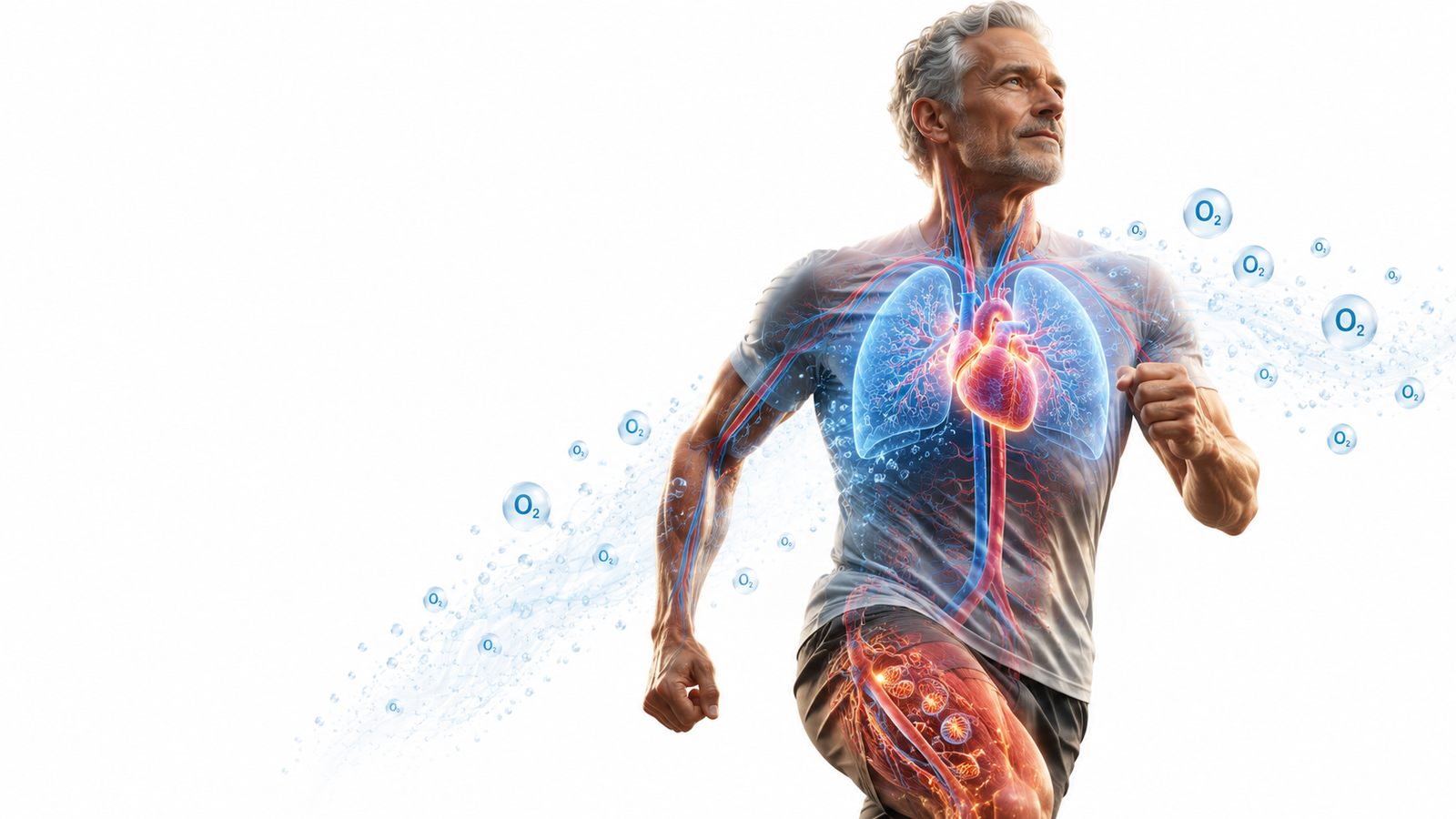
VO₂ max measures the maximum amount of oxygen your body can take in, transport, and use during physical exertion. Behind that relatively simple number is an extraordinary biological network involving the lungs, heart, blood vessels, circulation, muscles, and mitochondria. Together, these systems determine how effectively oxygen can be transformed into the energy that allows us to move, work, recover, and live.
For decades, VO₂ max was discussed primarily in the world of endurance sports. Runners, cyclists, and elite athletes used it to measure performance and determine just how powerful their aerobic engines had become. But the significance of VO₂ max extends far beyond athletic performance.
A growing body of research has established cardiorespiratory fitness as one of the strongest indicators associated with long-term health and survival. Higher levels of fitness are associated with substantially lower risks of cardiovascular disease and premature death, while low cardiorespiratory fitness has emerged as an important health risk in its own right. That makes VO₂ max particularly interesting as we grow older.
Our maximum aerobic capacity generally declines with age. At the same time, life continues to demand energy. Stairs still need to be climbed. Groceries still need to be carried. Airports still need to be crossed. Vacations still involve walking. Homes and gardens still need attention. And hopefully, there are still mountains to hike, places to explore, grandchildren to chase, and experiences we have not yet imagined.
The question therefore isn’t simply how high your VO₂ max is today.
It is how much capacity you are carrying into tomorrow.
Someone who enters later life with greater aerobic capacity has something enormously valuable: physiological reserve. There is more room between what the body can do and what everyday life requires it to do.
That reserve may ultimately be one of the differences between simply adding years to life and maintaining the vitality to enjoy them.
Because longevity alone was never really the goal. The goal is to arrive in our 70s, 80s, and perhaps well beyond with enough strength, energy, mobility, and independence to continue choosing how we want to live. And remarkably, the capacity that helps make that possible is not entirely predetermined by age or genetics.
It can be trained. It can be improved. And at almost any age, we can begin building a larger reserve for the life still ahead.
What VO₂ Max Actually Measures
Every movement we make requires energy. Whether we are walking across a room, climbing a hill, playing tennis, or running several miles, our muscles need a continuous supply of energy to keep contracting. Much of that energy is produced aerobically, using oxygen delivered from the air we breathe all the way down to the mitochondria inside our cells.
VO₂ max is a measure of how effectively that entire system performs when the body is working near its maximum aerobic capacity. The “V” refers to volume, the “O₂” to oxygen, and “max” to the maximum amount the body can use during intense exercise. It is generally expressed as milliliters of oxygen used per kilogram of body weight per minute, or mL/kg/min.
What makes the measurement so valuable is that it does not evaluate just one organ. To achieve a high VO₂ max, the lungs must bring oxygen into the body, the heart must pump oxygen-rich blood effectively, the circulatory system must deliver it to working tissues, and the muscles must be able to extract and use that oxygen efficiently. Inside those muscles, mitochondria convert nutrients and oxygen into ATP, the usable form of energy that powers cellular activity and movement.
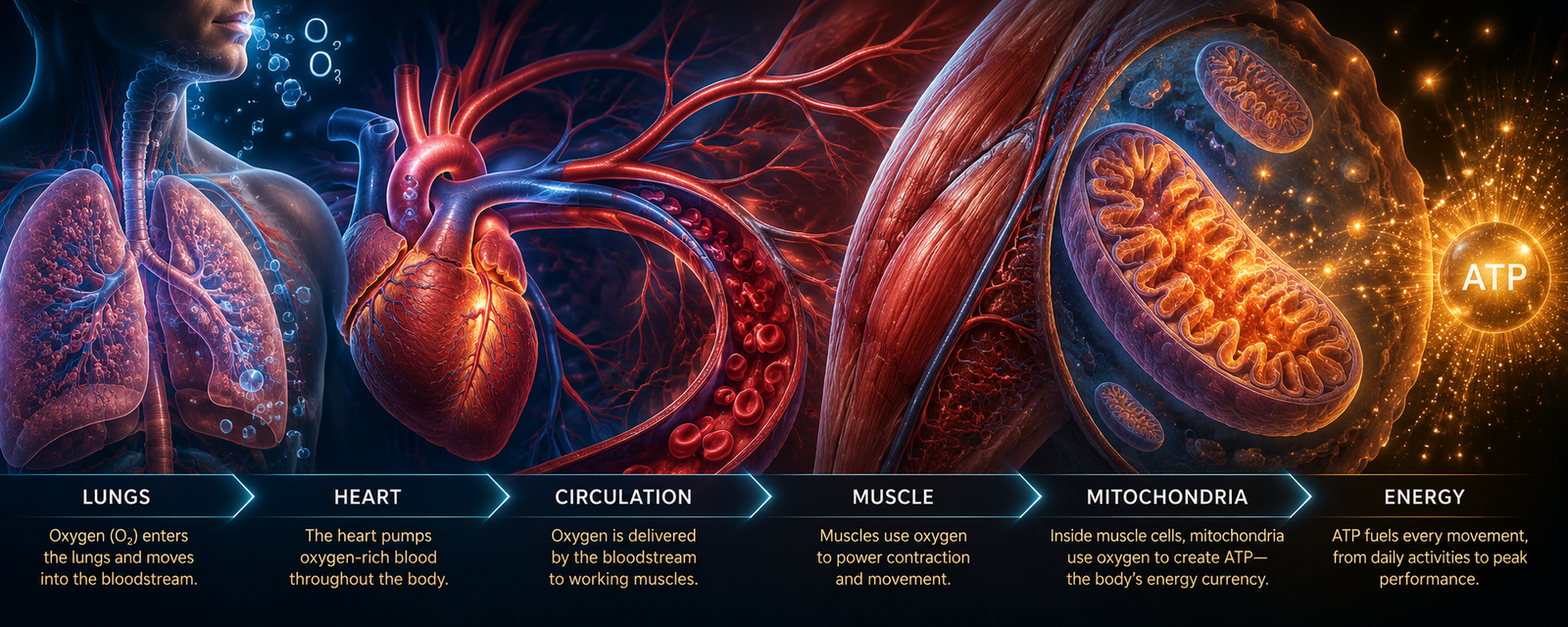
In that sense, VO₂ max provides a window into how well several of the body’s most important systems are working together. A limitation anywhere along the chain—from oxygen delivery and cardiac output to circulation, muscle mass, or mitochondrial function—can influence the body’s overall aerobic capacity.
This also explains why VO₂ max belongs naturally in a larger conversation about healthy aging. In our recent exploration of mitochondrial health, we looked at the importance of preserving the cellular machinery responsible for producing energy. VO₂ max allows us to zoom outward and see what happens when those cellular engines work as part of an integrated human system. Healthy mitochondria matter, but so do the heart that delivers oxygen, the blood vessels that transport it, and the muscles capable of putting that energy to work.
From Oxygen to Vitality
The easiest way to understand VO₂ max may be to think of it as the size and efficiency of your body’s aerobic engine. A larger engine does not mean you have to use all of its power every day. Instead, it means you have more capacity available when life asks for it.
Consider something as ordinary as climbing a long flight of stairs. Two people may complete exactly the same climb, yet experience it very differently. For the person with greater aerobic fitness, the task may require only a moderate portion of their available capacity. Their breathing increases, their heart works a little harder, and within moments they recover. For someone with much lower aerobic capacity, those same stairs may demand a far greater percentage of everything their cardiovascular system can provide.
That difference becomes increasingly important with age because the activities of daily life do not necessarily become less demanding simply because we get older. A suitcase still weighs the same. The airport terminal does not become shorter. The hill leading to a favorite overlook does not become flatter. What can change is the amount of physical reserve we have available to meet those demands.
This is why VO₂ max should not be viewed simply as an athletic performance number. It helps describe the relationship between what life requires and what your body is capable of delivering.
What Is Your VO₂ Max? | Finding Your Starting Point
Once you understand what VO₂ max represents, the next question is fairly obvious: What is mine?
Until relatively recently, answering that question usually required a visit to an exercise physiology laboratory. Today, VO₂ max can be measured or estimated in several ways, ranging from sophisticated clinical testing to simple walking tests and the smartwatch many people already wear every day. These methods are not equally precise, but each can provide useful information when its limitations are understood.
The most accurate measurement comes from a cardiopulmonary exercise test, or CPET, typically performed on a treadmill or stationary bicycle while wearing a mask connected to equipment that analyzes the oxygen and carbon dioxide in each breath. As exercise intensity gradually increases, the test directly measures how much oxygen the body is able to consume. Because respiratory gases are actually being measured rather than estimated, laboratory testing remains the gold standard for determining VO₂ max.
For most people interested primarily in healthy aging, however, laboratory testing is not the only useful option. Field tests such as the Cooper 12-minute run or Rockport one-mile walk use performance, heart rate, age, sex, body weight, or combinations of these factors to estimate aerobic capacity. They are less precise than direct testing, but they make assessing cardiorespiratory fitness far more accessible.
Your Watch May Already Know
Smartwatches have brought VO₂ max estimation into everyday life. Devices from Apple, Garmin, Fitbit and other manufacturers use combinations of heart rate, pace, movement, age, sex, body information, and proprietary algorithms to estimate cardiorespiratory fitness during qualifying activities. Depending on the device, the result may appear as VO₂ max, cardio fitness, or a similar measurement.
A smartwatch estimate should not be confused with a laboratory measurement. Wrist-based heart rate readings can be affected by fit, movement, temperature, medication, terrain, and other factors, while the algorithms themselves differ among manufacturers. A single reading therefore should not be treated as a definitive assessment of cardiovascular health.
Where wearable technology becomes particularly useful is in identifying trends over time. If the same device consistently estimates your VO₂ max under similar conditions and that number gradually moves upward over several months, it can provide meaningful evidence that your aerobic fitness is improving. Conversely, a sustained downward trend may be worth paying attention to, particularly if it accompanies declining activity or functional capacity.
For that reason, the most useful question may not always be, “Is my watch exactly right?” but rather, “Which direction am I moving?”
How Does Your Number Compare?
VO₂ max is reported in mL/kg/min, and normal values differ substantially by age and sex. Aerobic capacity is generally highest in early adulthood and tends to decline over time, which means a value that would be relatively low for a 25-year-old could represent very good cardiorespiratory fitness several decades later.
For our reference point, the chart below uses age- and sex-specific cardiorespiratory fitness data rather than comparing everyone against a single universal standard.
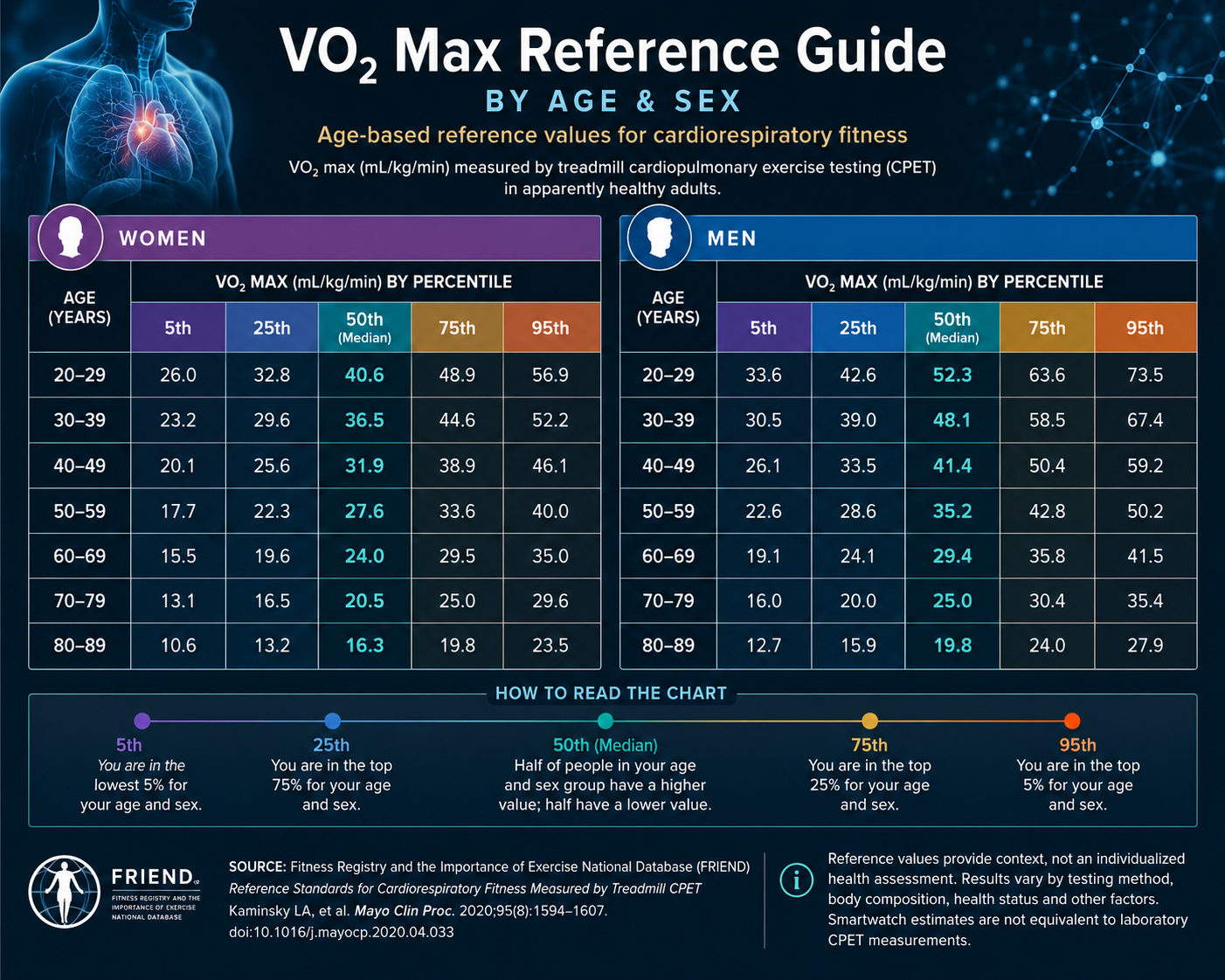
The chart provides context, but it should not become another scorecard for judging health. Genetics, body composition, medications, medical conditions, training history, altitude, and testing method can all influence VO₂ max. What matters is understanding approximately where you are today and recognizing that cardiorespiratory fitness is highly responsive to training. A conversation with your healthcare practitioner can also be valuable, particularly if your number is unexpectedly low, you have underlying health concerns, or you are considering a significant change in exercise intensity.
That makes VO₂ max different from many of the numbers associated with aging. Your chronological age will continue moving in only one direction, but your aerobic capacity does not have to follow the steepest possible decline.
Know your number, understand your starting point, and then pay attention to your trajectory. Because when it comes to healthy aging, where you are today matters—but where you are headed may matter even more.
Why VO₂ Max Tells Us So Much About Healthy Aging
VO₂ max has attracted growing attention in longevity research for a simple reason: cardiorespiratory fitness consistently shows a strong relationship with long-term health outcomes. Across large studies involving thousands of adults, people with greater aerobic fitness tend to have lower rates of cardiovascular disease and premature death than those with poor cardiorespiratory fitness. The relationship is particularly striking because improvements appear to matter across the fitness spectrum; moving from very low fitness toward even moderate fitness can be meaningful, while higher levels of fitness are generally associated with additional benefit.
This does not mean that VO₂ max determines how long someone will live. Longevity is influenced by genetics, metabolic health, muscle strength, nutrition, sleep, stress, environmental exposures, medical care, social connection, lifestyle, and many other factors. VO₂ max should therefore be viewed as one important indicator within a much larger picture of health, not as a standalone prediction of an individual’s future. As with any health measurement, personal results are best interpreted in context and, when appropriate, discussed with a healthcare practitioner.
What makes cardiorespiratory fitness particularly valuable is how much of the body it reflects at once. A strong aerobic system requires the heart to pump effectively, blood vessels to deliver oxygen efficiently, muscles to extract and use that oxygen, and mitochondria to convert available fuel into usable energy. It also tends to reflect something much more ordinary but equally important: a body that is regularly being asked to move.
Over time, those demands matter. Physical activity challenges the cardiovascular system to become more efficient, encourages adaptations within skeletal muscle, supports mitochondrial function, and helps preserve the body’s ability to respond when greater effort is required. Rather than measuring one isolated biological process, VO₂ max provides a glimpse into the performance of an interconnected system that we depend upon every day.
The Fitness Difference Can Be Remarkably Large
One of the most influential large-scale studies in this area followed more than 120,000 adults who had undergone exercise treadmill testing at the Cleveland Clinic. Researchers found a strong inverse relationship between cardiorespiratory fitness and long-term mortality: as fitness increased, mortality risk declined. Importantly, the researchers did not identify a level of high aerobic fitness at which the benefits appeared to reverse, challenging the idea that very high cardiorespiratory fitness is inherently harmful.
Other research has reached a similar conclusion from a different direction. When cardiorespiratory fitness is expressed in metabolic equivalents, or METs, even relatively modest improvements in exercise capacity have been associated with meaningful reductions in mortality risk. The message is not that everyone needs an elite VO₂ max. It is that moving out of the lowest levels of fitness may be one of the most valuable changes a person can make.
That distinction matters enormously in a healthy-aging conversation because it moves the goal away from athletic competition. A 65-year-old does not need the cardiovascular capacity of a 25-year-old endurance athlete to benefit from improving fitness. The relevant comparison is with their own starting point, their age-appropriate reference range, their overall health, and the physical demands of the life they want to continue living.
The research therefore gives us a compelling reason to pay attention to VO₂ max, but the number becomes far more meaningful when we translate it out of the laboratory and into everyday life. Because ultimately, the most important question is not whether your VO₂ max places you in a particular percentile.
It is how much reserve you have between what your body can do and what your life asks it to do.
The Capacity Gap | Why Reserve Matters as We Age
One of the most important concepts in healthy aging is physiological reserve—the difference between the maximum capacity of your body and the amount of that capacity required to perform everyday activities. When that reserve is large, life generally feels easier. Walking several miles, climbing stairs, carrying groceries, working in the yard, traveling, or spending an active day with family may challenge the body, but they do not require everything it has available.
The importance of that reserve becomes clearer as we grow older. VO₂ max naturally tends to decline with age, particularly when regular physical activity is not maintained. Yet the physical requirements of everyday life do not decline at the same rate. A suitcase does not become lighter because we are 75. A staircase does not lose steps, and the distance through an airport terminal remains the same. As our maximum capacity decreases, those ordinary activities can begin consuming a progressively larger percentage of what the body is capable of producing.
This creates what we might call the capacity gap. Imagine two people who are both fully independent at 60. One has spent years maintaining strong cardiorespiratory fitness, while the other has enough aerobic capacity to comfortably meet the demands of everyday life but relatively little reserve beyond them. At that moment, their lives may look very similar. Both can shop, travel, climb stairs, maintain their homes, and participate in the activities they enjoy.
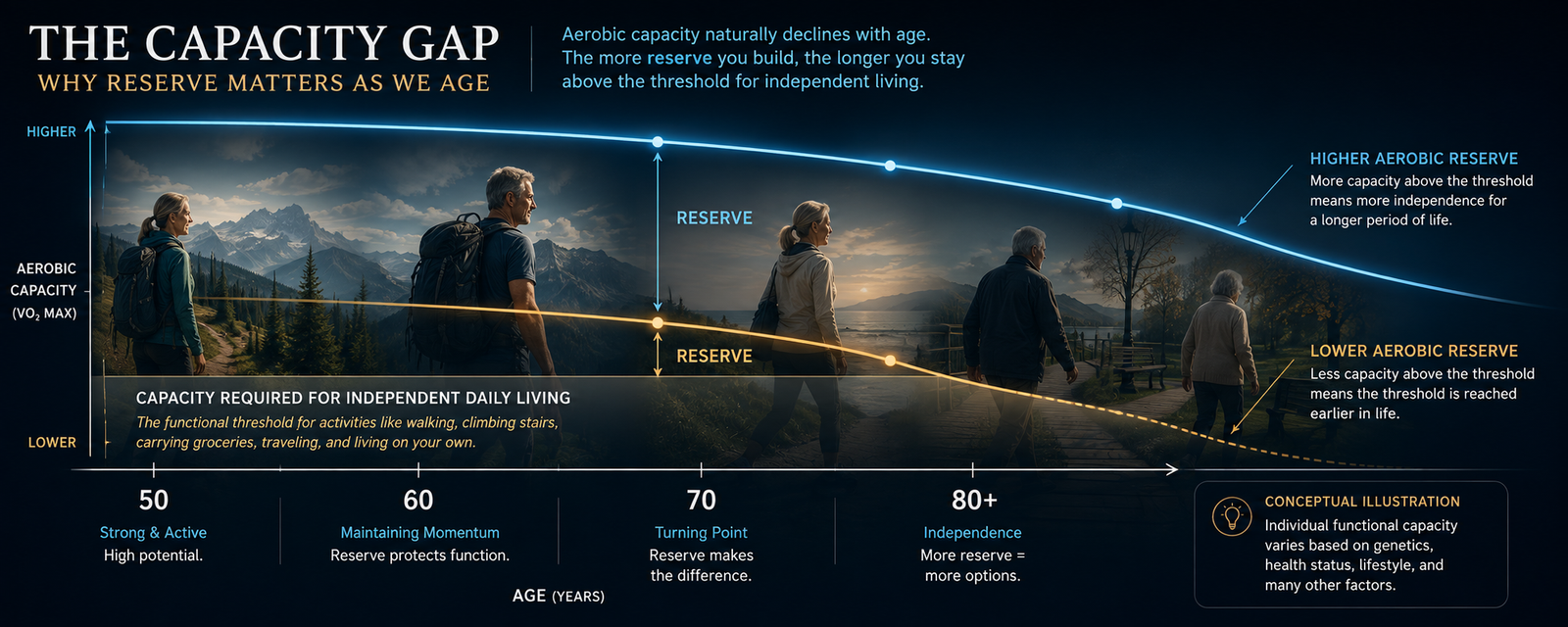
The difference may become much more apparent twenty years later. If aerobic capacity declines for both individuals, the person who began with the larger reserve has farther to fall before ordinary activities approach the limits of their physical ability. The goal is not to prevent aging or guarantee independence—neither can be reduced to a single measurement—but to enter later life with as much usable capacity as reasonably possible.
That capacity creates something far more meaningful than a favorable fitness score. It creates options.
It may mean being able to walk through Rome at 75 instead of watching from the tour bus, hike a favorite trail at 70, carry your own luggage, play eighteen holes of golf, spend an afternoon gardening, dance at a family wedding, keep up with grandchildren, or simply walk up a flight of stairs without having to think about it. These may seem like ordinary moments, but together they represent something extraordinary: the freedom to continue participating in your own life.
Greater physical reserve may also become especially valuable when life temporarily asks more of the body. Illness, surgery, injury, periods of inactivity, and other health challenges can reduce strength and conditioning. While greater aerobic fitness cannot prevent those events or guarantee recovery, entering them with more reserve may provide a stronger functional starting point.
This is why improving VO₂ max is not ultimately about chasing an impressive number. The number simply helps us measure something much larger.
We are building distance between what life requires and what our bodies are capable of giving.
The wider that gap remains, the more room there may be for independence, resilience, adventure, and choice—and those are among the things that transform longevity from simply living longer into living with vitality.
Building Your Aerobic Reserve | How to Improve VO₂ Max
The encouraging part of the VO₂ max conversation is that cardiorespiratory fitness is not fixed. Although genetics, age, health status, medications, and training history all influence aerobic capacity, the cardiovascular system, skeletal muscles, and mitochondria remain capable of adapting to appropriate physical challenges throughout much of life. For someone beginning from a relatively low level of fitness, even modest improvements can be meaningful.
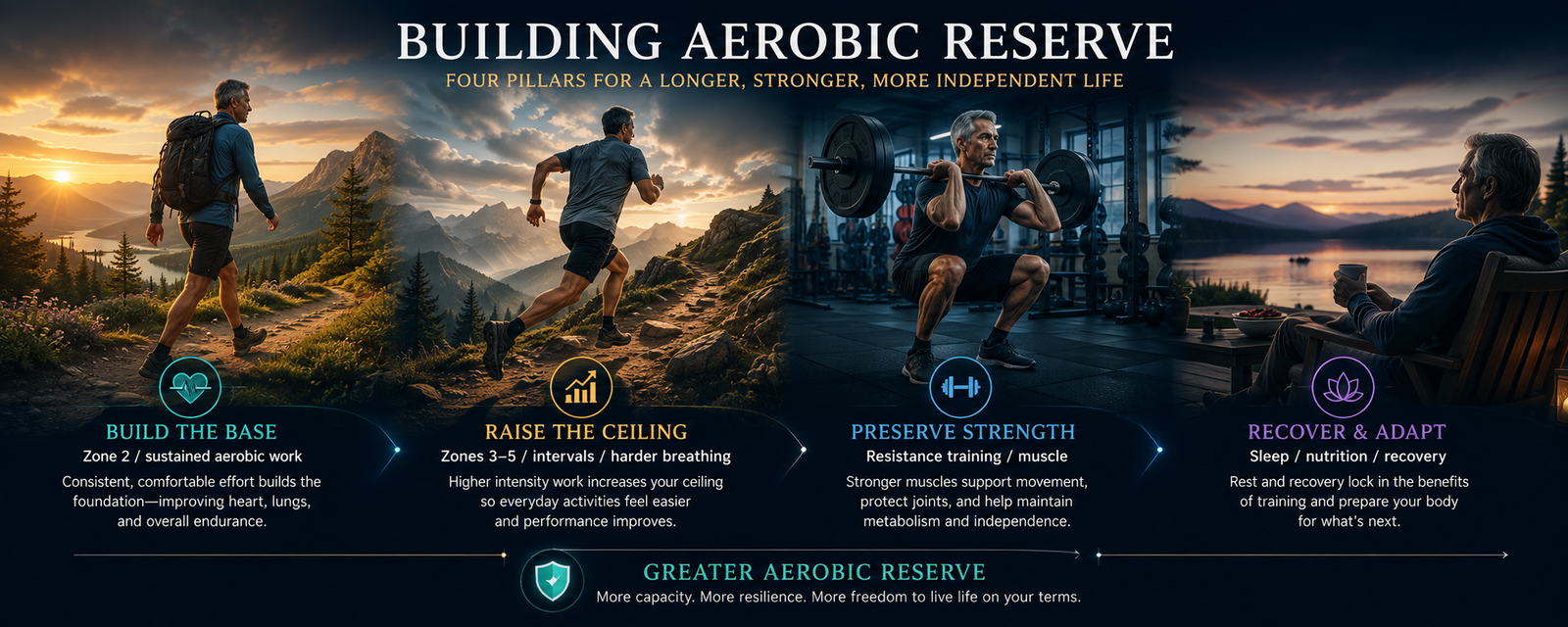
Improving VO₂ max does not require becoming a runner or training like an endurance athlete. The most effective approach generally combines a strong aerobic foundation with occasional periods of higher-intensity effort, while maintaining the muscle and strength needed to put that aerobic capacity to use.
Build the aerobic base. Moderate aerobic exercise—often described as Zone 2 training—teaches the body to produce energy efficiently over longer periods of time. Brisk walking, hiking, cycling, swimming, rowing, jogging, dancing, or other sustained activities can all contribute. The exact heart-rate range varies among individuals, so perceived effort can also be useful: the pace should feel purposeful but sustainable, with breathing elevated while conversation remains possible.
Challenge the upper limit. While moderate aerobic exercise builds the foundation, spending short periods at higher intensities can provide an important stimulus for improving VO₂ max. Depending on the individual and the heart-rate system being used, this may involve moving into Zones 3, 4, or briefly Zone 5 through activities such as faster uphill walking, running or cycling intervals, short sprints, rowing, stair climbing, or simply increasing the pace enough to significantly raise the heart rate. At these intensities, breathing becomes noticeably harder, conversation becomes increasingly difficult, and the cardiovascular system is being asked to work closer to its upper capacity. Alternating these harder efforts with periods of recovery can gradually help raise that aerobic ceiling. Because heart-rate zones and appropriate intensity vary considerably by age, fitness level, medications, and health status, the goal is not to chase a particular zone or maximum heart rate, but to introduce higher-intensity work safely and progressively based on individual capacity.
Preserve strength and muscle. Aerobic capacity does not exist separately from the rest of the body. Strong legs, adequate muscle mass, balance, and mobility help translate cardiovascular fitness into real-world function. Combining aerobic exercise with regular resistance training becomes increasingly important with age because the goal is not simply to deliver oxygen efficiently, but to maintain a body capable of using that energy to move through life.
Recovery also belongs in the equation. Exercise creates the stimulus for adaptation, but sleep, adequate nutrition, hydration, rest, and sufficient recovery allow those adaptations to occur. More training is not automatically better, particularly when intensity begins interfering with recovery or consistency.
For someone who has been sedentary, has cardiovascular or respiratory disease, experiences symptoms with exertion, or is considering a substantial increase in exercise intensity, discussing an appropriate starting point with a healthcare practitioner is valuable. The objective is not to pursue someone else’s VO₂ max or immediately begin intense interval training; it is to safely and progressively expand your own capacity.
Perhaps the simplest strategy is also the most sustainable: move regularly, occasionally challenge yourself, maintain your strength, recover well, and continue doing it over time.
The body responds to what we repeatedly ask of it. When we continue asking it to carry us farther, work a little harder, and remain strong, we give ourselves a better opportunity to preserve the reserve that keeps life open.
Train for the Life You Want to Keep Living
There is a tendency to think about exercise in terms of what it does for us today: the calories burned, the miles walked, the weight lifted, or the number displayed on a watch. But perhaps one of the most valuable reasons to maintain cardiorespiratory fitness has very little to do with today.
It is about preserving possibilities for tomorrow.
Think about the life you hope to be living at 70, 80, or even 90. Perhaps you want to travel, hike, play golf or pickleball, work in your garden, walk along a beach, explore a new city, dance, volunteer, spend active time with family, or simply continue moving through your own home with confidence and independence. Those experiences require more than the absence of disease. They require enough physical capacity to participate in them.
That is why VO₂ max is ultimately much more interesting than the number itself. It gives us another way to think about the reserve we are building today for the person we will become decades from now. We cannot control every aspect of aging, and no fitness measurement can guarantee longevity, independence, or health. What we can do is continue giving our bodies reasons to adapt, remain strong, and preserve as much capacity as possible.
Healthy aging is not about trying to remain young forever. It is about maintaining enough vitality to continue saying yes to the experiences that make life meaningful.
Perhaps that is the most useful way to think about VO₂ max—not as a score to chase, but as a reminder that our physical capacity helps determine how large our world can remain.
The goal is not simply to add years to your life. It is to preserve enough vitality to keep living well in those years.
Sign up to receive Our Weekly Briefing Newsletter
Begin your journey with weekly insights designed to expand awareness and ground you in truth. Our free tier gives you a powerful introduction without any commitment.
STOP DROWNING IN THE NOISE. START SEEING THE TRUTH. Join over 99,000 truth seekers. Get the essential intelligence, alternative news, and disclosure updates that the mainstream media won’t touch.
Latest Reports
 Monthly ReportConscious Practices · October 2026 EditionOctober 5, 2026
 Weekly ReportAwakening The Sleeping Giant · October 5th EditionOctober 5, 2026
 Weekly ReportAwakening The Sleeping Giant · September 28th EditionSeptember 28, 2026
 Weekly ReportAwakening The Sleeping Giant · September 21st EditionSeptember 21, 2026View all weekly reports
Special Reports
 Special ReportTHE AWAKENING JOURNEY: Hero’s Journey Part II · Week 1October 3, 2026
 Special ReportGlobal Everything Collapse · Economic Chaos · Part IOctober 1, 2026
 Special ReportCreating A Conscious Culture · Part ISeptember 3, 2026
 Special ReportThe Great Healing: Detox, Defense & Sovereignty In an Engineered World · Part ISeptember 1, 2026View all special reports
Help Us Bypass Censorship. Share This.
Join the Discussion
Related Posts

Have questions?
At Great Awakening Report, we are dedicated to supporting your journey toward truth and enlightenment through our specialized Coaching and Consulting services.
Coaching Services: Our coaching programs are designed to guide you through personal awakening and transformation. We offer personalized sessions that focus on expanding consciousness, uncovering hidden truths, and fostering spiritual growth. Our experienced coaches provide the tools and insights necessary to navigate your path with clarity and confidence.
Consulting Services: For organizations and individuals seeking deeper understanding and strategic guidance, our consulting services offer expert analysis and solutions. We delve into areas such as global transitions, alternative news insights, and consciousness studies to provide comprehensive strategies tailored to your unique objectives.
Embark on a transformative journey with our Coaching and Consulting services, and unlock your highest potential. To learn more and schedule a session, visit our Coaching and Consulting pages.
Thank you
Thank you to our subscribers and readers for your continued support and dedication to truth and awakening. Your encouragement, engagement, and belief in our mission make everything we do possible. Together, we are expanding awareness and helping illuminate the path forward.
If you would like to further support the Great Awakening team and our ongoing efforts to share insight, knowledge, and truth, you can DONATE HERE.
With deep gratitude,
– Great Awakening Team
About the Author: Great Awakening Team

We are a community. We are cultural creatives and like minded people seeking the truth and focusing on disclosure, awakening and consciousness. Our focus is real news as researchers, reporters and truth seekers. We are here to teach, to spread the word, to serve and to help. We are a collective, a movement, free from all programing, not closed minded and not discriminatory. We are not political. We are not religious but we are spiritual. We study, research, and report on a wide range of subjects and topics, from the current geopolitical climate to health and wellness, from earth’s history to spiritual practices. We are forward thinkers and visionaries, we are guides for the transition as we usher in The Great Awakening.
THIS WEBSITE DOES NOT PROVIDE MEDICAL ADVICE: The information, including but not limited to text, graphics, images, and other material contained on this website, are for informational purposes only. No material on this site is intended to be a substitute for professional medical advice, diagnosis, or treatment. Always seek the advice of your physician or other qualified health care provider with any questions you may have regarding a medical condition or treatment and before undertaking a new health care regimen, and never disregard professional medical advice or delay in seeking it because of something you have read on this website.
DISCLAIMER: All statements, claims, views and opinions that appear anywhere on this site, whether stated as theories or absolute facts, are always presented by The Great Awakening Report (GAR) as unverified—and should be personally fact checked and discerned by you, the reader.Any opinions or statements herein presented are not necessarily promoted, endorsed, or agreed to by GAR, those who work with GAR, or those who read or subscribe to GAR.Any belief or conclusion gleaned from content on this site is solely the responsibility of you the reader to substantiate.Any actions taken by those who read material on this site are solely the responsibility of the acting party.You are encouraged to think for yourself and do your own research.Nothing on this site is meant to be believed without question or personal appraisal.
COPYRIGHT DISCLAIMER: Citation of articles and authors in this report does not imply ownership. Works and images presented here fall under Fair Use Section 107 and are used for commentary on globally significant newsworthy events. Under Section 107 of the Copyright Act 1976, allowance is made for fair use for purposes such as criticism, comment, news reporting, teaching, scholarship, and research.
COMMUNITY GUIDELINES DISCLAIMER: The points of view and purpose of this video is not to bully or harass anybody, but rather share that opinion and thoughts with other like-minded individuals curious about the subject.