




















Help Us Bypass Censorship. Share This.
Sign up to receive Our Weekly Briefing Newsletter
Begin your journey with weekly insights designed to expand awareness and ground you in truth. Our free tier gives you a powerful introduction without any commitment.
How to prepare for economic collapse: build resilience in layers: pay down high-interest debt, hold an emergency fund and some cash, store food and water you already use, learn practical skills, and build a local network you can rely on. None of it requires predicting a date. The same steps protect you from a layoff, a recession or a long supply disruption.
Key takeaways:
- Prepare for economic collapse in layers: money, food and water, skills and community.
- You do not need to predict a date; the same steps protect against layoffs and recessions.
- Start small: one week of food, one paid-off card, two neighbors you can call.
- Preparation should make you calmer, not more anxious.
We write about economic pressure every week in our Awakening the Sleeping Giant Report. The question readers send back most is not “when?” It is “what do I actually do?” This is our answer.
Step 1: Shore Up Your Money
Kill high-interest debt first. Credit card balances get more expensive when rates and prices rise, so every balance you clear is a guaranteed return. List every debt with its balance and interest rate, and start with the most expensive one.
Then build an emergency fund. The Consumer Financial Protection Bureau has a straightforward guide to building an emergency fund. Start with one month of essentials and grow it from there, in a separate account so it does not get spent by accident.
Keep some physical cash at home in small bills for outages when cards and ATMs do not work. Know your deposit coverage, too. The FDIC explains how deposit insurance works and the limits per bank and account type.
Finally, diversify your income. A side skill people will pay for is worth more than almost any asset in a downturn. If you run a small business or freelance, keep at least one month of business expenses separate from personal savings, avoid relying on a single client or platform, and build direct relationships with customers through email rather than only through social platforms that can change their rules overnight.

Step 2: Food, Water and Basics
Build a pantry of what you already eat and rotate it, oldest first. Start with two weeks, then a month. Buying food you would never cook is the most common beginner mistake, and it wastes money you could have put toward debt.
Store water and a way to purify more. Keep a stock of prescriptions, first aid supplies, hygiene items, batteries and lighting. The Ready.gov emergency supply kit checklist is a quick way to spot gaps.
FEMA’s financial preparedness guidance also covers protecting key documents, which people often forget. Gather IDs, insurance policies, deeds, titles and account numbers in one folder you can grab quickly.
Limited space does not mean you cannot prepare. If you rent or live in an apartment, store food under beds and in closets and choose compact water containers. Focus more on money, skills and relationships, which take no square footage. In a long disruption, a friendly building is worth more than a basement full of supplies.
Step 3: Skills and Health That Hold Value
Cooking from scratch, gardening, food preservation, basic repair and first aid. Pick one and practice it this month. Skills cannot be inflated away, and they make you useful to your neighbors. The National Center for Home Food Preservation has tested, safe preservation methods, and the Red Cross offers first aid classes in most areas.
Health preparedness is economic preparedness. A medical emergency is one of the fastest ways for a household to fall into debt. Keeping a supply of prescriptions, staying on top of preventive care, and building basic health habits are financial decisions as much as health decisions.
Our breathing and health article is one small piece of a broader approach to staying well on a budget. Small, steady habits cost almost nothing and pay off for years.
If you have kids, bring them in. Children pick up on adult anxiety quickly, so frame preparation as a family project, the same way you would talk about a fire drill. Let them help rotate the pantry, plant a few vegetables or learn to cook a simple meal. Skills give children confidence. Fear gives them nightmares.

Step 4: Build Community
Every serious preparedness guide arrives at the same conclusion: the households that do best in a crisis are the ones connected to other people. Know your neighbors. Trade skills. Join or start a local group, such as a church, garden club or community network.
Start small. Introduce yourself to two neighbors you do not know. Agree on a check-in plan with family in case phones or power go down. These are free, and they matter more than most of the gear you could buy.
Barter works best with skills, not stockpiles. A person who can fix a generator or set a bone is worth more than a closet of trade goods. That is another reason the skills in Step 3 matter so much.
This is also where the spiritual side of our work meets the practical side. Communities that share values, skills and trust handle shocks better. We explore it in pieces on conscious communities and the 5D transition, and in Creating a Conscious Culture.
Signs of Economic Collapse to Watch
True collapse is rare. Long, grinding decline is far more common, and it is easier to miss. You do not need to watch markets all day, though. A few signals tell you a lot: prices of essentials rising faster than wages for months at a time, rising card and auto loan delinquencies, and job losses spreading from one sector into others.
Also watch for bank stress, withdrawal limits or emergency government actions, supply chain gaps where shelves stay empty for specific goods, and currency weakness, especially when imported goods jump in price. We covered the supply chain side in Global Supply Chains Hit Breaking Point.
For a real-world case of what currency destabilization looks like on the ground, see our analysis of Venezuela’s managed collapse. For how environmental and financial stress feed each other, read ecological collapse meets economic collapse. And the October 5 Weekly Report on economic pressure covers the signals as they stood last week.
If those signals start flashing, stay steady. Do not panic sell or panic buy. Top up essentials you are low on, at normal quantities, withdraw a modest amount of extra cash, check in with family and neighbors, and reduce nonessential spending until the picture is clearer. Keep following reliable information, and limit the doom feeds.
Cash, Precious Metals and What Not to Do
Readers ask about cash, metals and barter more than anything else, so here is our honest take. Cash is the most practical. Short outages are far more likely than a total currency failure, and small bills solve them. Keep a modest amount at home and the rest in insured accounts.
Precious metals are a long-term store of value for some people, but they are not liquid in a short emergency, they carry dealer markups, and you should never put money you need for bills into them. If you are considering it, learn the basics of investing first. The SEC’s Investor.gov site is a free, neutral starting point.
A few things to avoid. Do not drain retirement accounts in a panic. Do not buy expensive gear you will never use; start with what you eat and need. And keep your records and tax filings current, so you can access relief programs if they appear.
Most of all, do not let fear run your life. Preparation should make you calmer, not more anxious.

A 30-Day Plan to Prepare for Economic Collapse
Big lists can freeze people, so spread the work over four weeks: money first, then food and water, then skills, then people. Most households can manage this without a large budget.
In week 1, know where you stand. List every debt with its balance and interest rate, write down your true monthly essentials (housing, food, utilities, transport, insurance, medicine), open a separate emergency savings account if you do not have one, and gather your key documents in one folder. In week 2, buy one extra week of the shelf-stable food you already eat, store water and get a basic filter, and refill any medicines that are running low.
In week 3, pick one skill and practice it twice: bread, canning, mending, a basic repair or first aid. In week 4, introduce yourself to two neighbors, agree on a family check-in plan, and find one local group to join.
By the end of the month you should be able to tick off this checklist: a debt payoff plan started, an emergency fund started toward one month of essentials, small-bill cash at home, deposits within insurance limits, two weeks of rotated food, stored water plus a filter, prescriptions and first aid stocked, key documents in one folder, one skill practiced, two neighbors you can call, and a family check-in plan agreed.
The Mental Side of Preparedness
Fear is expensive. It drives panic buying, bad investments and frayed relationships. The goal of preparation is the opposite: to be calm enough to think clearly and help others when things get hard.
Slow breathing, regular sleep and time in nature are not soft extras. They are part of the plan. Our article on breath techniques that reset your nervous system is a practical place to start.
Our Weekly Reports pull together prices, credit, jobs, banking and supply chain signals and put them in the context of the bigger shifts we cover across the site. The goal is not to frighten anyone. It is to give readers enough lead time to make calm decisions.
If that sounds useful, the free briefing below is the easiest way to start, and the full plan is there when you want to go deeper.

Frequently Asked Questions
How do I prepare for an economic collapse?
Reduce high-interest debt, build an emergency fund and some cash, store food and water you already use, learn practical skills and build local community.
What should I stock up on before an economic collapse?
Start with food you already eat, water and purification, prescriptions, first aid, hygiene supplies, batteries and lighting. Build two weeks, then a month.
Should I keep cash at home?
A modest amount of cash in small bills helps during outages when cards and ATMs do not work. Keep the rest in insured accounts.
What are the signs of economic collapse?
Watch for rising essential prices, growing loan delinquencies, regional layoffs, banking stress and supply chain disruptions.
Is it too late to prepare?
No. Each small step, like a week of food or paying off one card, makes you more resilient right away.
Is an economic collapse coming?
No one can predict the timing. Preparation makes sense regardless, because the same steps protect you from job loss, recessions and supply disruptions.
Should I buy gold to prepare for economic collapse?
Some people hold precious metals long term, but they are not a substitute for an emergency fund and food. Learn the basics before buying.
How much food should I store?
Start with two weeks of food you already eat, then build toward a month or more as space and budget allow.
Get the Full Plan: The Sovereign Household
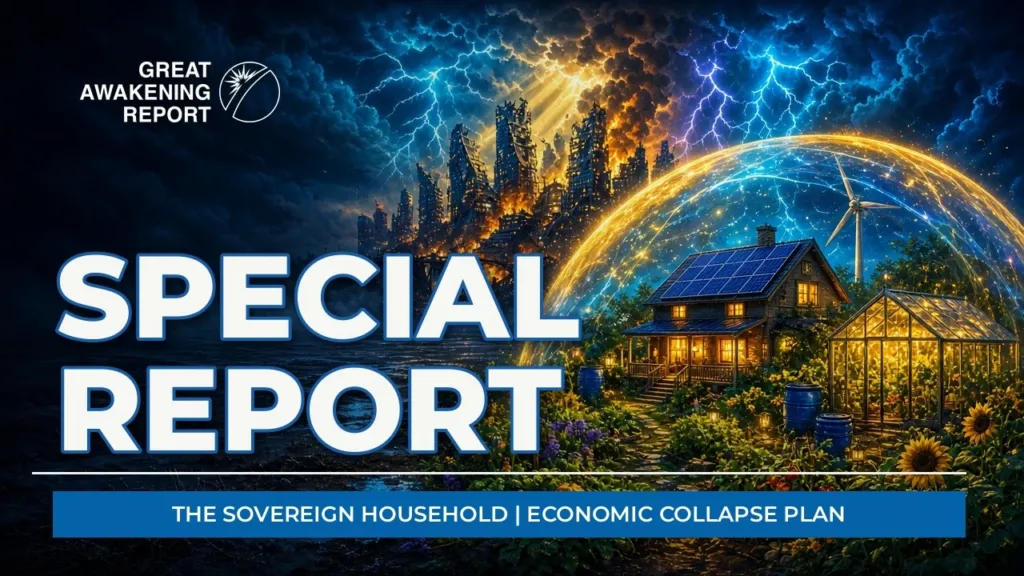
This article is the quick version. Our Special Report The Sovereign Household is the complete plan: FDIC insurance explained, how to spread money across banks, a 90-day to one-year food and water plan with checklists by household size, health independence, skills and barter, plus printable 30, 60 and 90-day action plans and worksheets.
Get the full plan for $27 or start a 30-day Premium trial and get it included.
Free: The 72-Hour Household Readiness Checklist
Not ready for the full plan yet? Start with the first three days. Our free, printable 2-page checklist covers water, food, light, first aid, cash and documents, and your family plan.
Where to Go From Here
The free Truth Seekers Weekly Briefing gives you the economic signals we are watching each week in a few minutes of reading. It is free.
Standard members get every Weekly and Monthly Report, including the full economic squeeze coverage, and Premium adds our Special Reports on the global economic reset. If you want to see what is behind the paywall first, compare the Standard and Premium plans, or start the 30-day Premium trial and decide after a month of reading.
Sign up to receive Our Weekly Briefing Newsletter
Begin your journey with weekly insights designed to expand awareness and ground you in truth. Our free tier gives you a powerful introduction without any commitment.
STOP DROWNING IN THE NOISE. START SEEING THE TRUTH. Join thousands of truth seekers. Get the essential intelligence, alternative news, and disclosure updates that the mainstream media won’t touch.
Latest Reports
 Weekly ReportAwakening The Sleeping Giant · November 2nd EditionNovember 2, 2026
 Monthly Report• November 2026 • Volume IX • Chapter XINovember 2, 2026
 Weekly ReportAwakening The Sleeping Giant · October 26th EditionOctober 26, 2026
 Weekly ReportAwakening The Sleeping Giant · October 19th EditionOctober 19, 2026View all weekly reports
Special Reports
 Special ReportGlobal Everything Collapse · Crossing The Threshold · Part IIINovember 6, 2026
 Special ReportThe Next Plandemic, The Bird Flu VirusNovember 5, 2026
 Special ReportThe Great Exodus, California On The ThresholdOctober 20, 2026
 Special ReportThe Sovereign Household: How to Prepare for Economic CollapseOctober 14, 2026View all special reports
Help Us Bypass Censorship. Share This.
Join the Discussion
Related Posts



Have questions?
At Great Awakening Report, we are dedicated to supporting your journey toward truth and enlightenment through our specialized Coaching and Consulting services.
Coaching Services: Our coaching programs are designed to guide you through personal awakening and transformation. We offer personalized sessions that focus on expanding consciousness, uncovering hidden truths, and fostering spiritual growth. Our experienced coaches provide the tools and insights necessary to navigate your path with clarity and confidence.
Consulting Services: For organizations and individuals seeking deeper understanding and strategic guidance, our consulting services offer expert analysis and solutions. We delve into areas such as global transitions, alternative news insights, and consciousness studies to provide comprehensive strategies tailored to your unique objectives.
Embark on a transformative journey with our Coaching and Consulting services, and unlock your highest potential. To learn more and schedule a session, visit our Coaching and Consulting pages.
Thank you
Thank you to our subscribers and readers for your continued support and dedication to truth and awakening. Your encouragement, engagement, and belief in our mission make everything we do possible. Together, we are expanding awareness and helping illuminate the path forward.
If you would like to further support the Great Awakening team and our ongoing efforts to share insight, knowledge, and truth, you can DONATE HERE.
With deep gratitude,
– Great Awakening Team
About the Author: Great Awakening Team

DISCLAIMER: All statements, claims, views and opinions that appear anywhere on this site, whether stated as theories or absolute facts, are always presented by The Great Awakening Report (GAR) as unverified—and should be personally fact checked and discerned by you, the reader.Any opinions or statements herein presented are not necessarily promoted, endorsed, or agreed to by GAR, those who work with GAR, or those who read or subscribe to GAR.Any belief or conclusion gleaned from content on this site is solely the responsibility of you the reader to substantiate.Any actions taken by those who read material on this site are solely the responsibility of the acting party.You are encouraged to think for yourself and do your own research.Nothing on this site is meant to be believed without question or personal appraisal.
COPYRIGHT DISCLAIMER: Citation of articles and authors in this report does not imply ownership. Works and images presented here fall under Fair Use Section 107 and are used for commentary on globally significant newsworthy events. Under Section 107 of the Copyright Act 1976, allowance is made for fair use for purposes such as criticism, comment, news reporting, teaching, scholarship, and research.
COMMUNITY GUIDELINES DISCLAIMER: The points of view and purpose of this video is not to bully or harass anybody, but rather share that opinion and thoughts with other like-minded individuals curious about the subject.