


Help Us Bypass Censorship. Share This.
Sign up to receive Our Weekly Briefing Newsletter
Begin your journey with weekly insights designed to expand awareness and ground you in truth. Our free tier gives you a powerful introduction without any commitment.
Consciousness • The Life Review • The Other Side • What They Say We Are Here to Learn
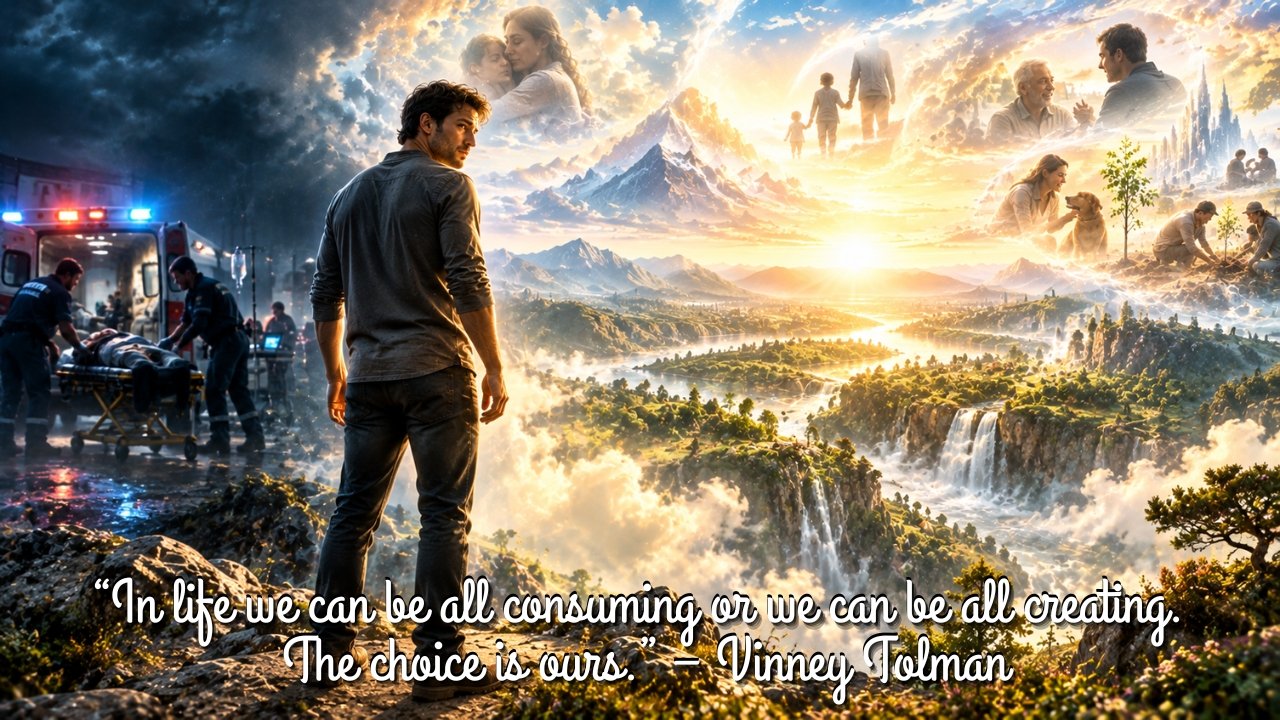
“In life we can be all consuming or we can be all creating. The choice is ours.” — Vinney Tolman
Near-death experiences occupy one of the strangest territories in the study of human consciousness. For centuries, people who came frighteningly close to death have returned describing experiences that seem to defy the ordinary boundaries of perception: observing their bodies from somewhere outside themselves, encountering deceased loved ones or guides, entering realms of extraordinary light or clarity, reviewing moments from their lives, and returning with the conviction that what they experienced was somehow more real than ordinary reality.
Science has proposed explanations for many aspects of these experiences, from changes in oxygen and brain chemistry to altered electrical activity, memory formation and the extraordinary ways the brain can construct experience under extreme conditions. Yet decades of research have not completely closed the question, particularly when people report structured awareness surrounding periods of profound physiological crisis or apparently accurate perceptions of events they say occurred while they were unconscious.
But there may be another part of the NDE phenomenon that deserves just as much attention as what happens near death: what happens afterward. Many experiencers return profoundly changed. Fear of death diminishes. Material priorities shift. Relationships become more important. Forgiveness becomes urgent. Service acquires new meaning. And beneath those changes appears something resembling a progression—from understanding ourselves more authentically to reconsidering what we are creating through the lives we’ve been given.
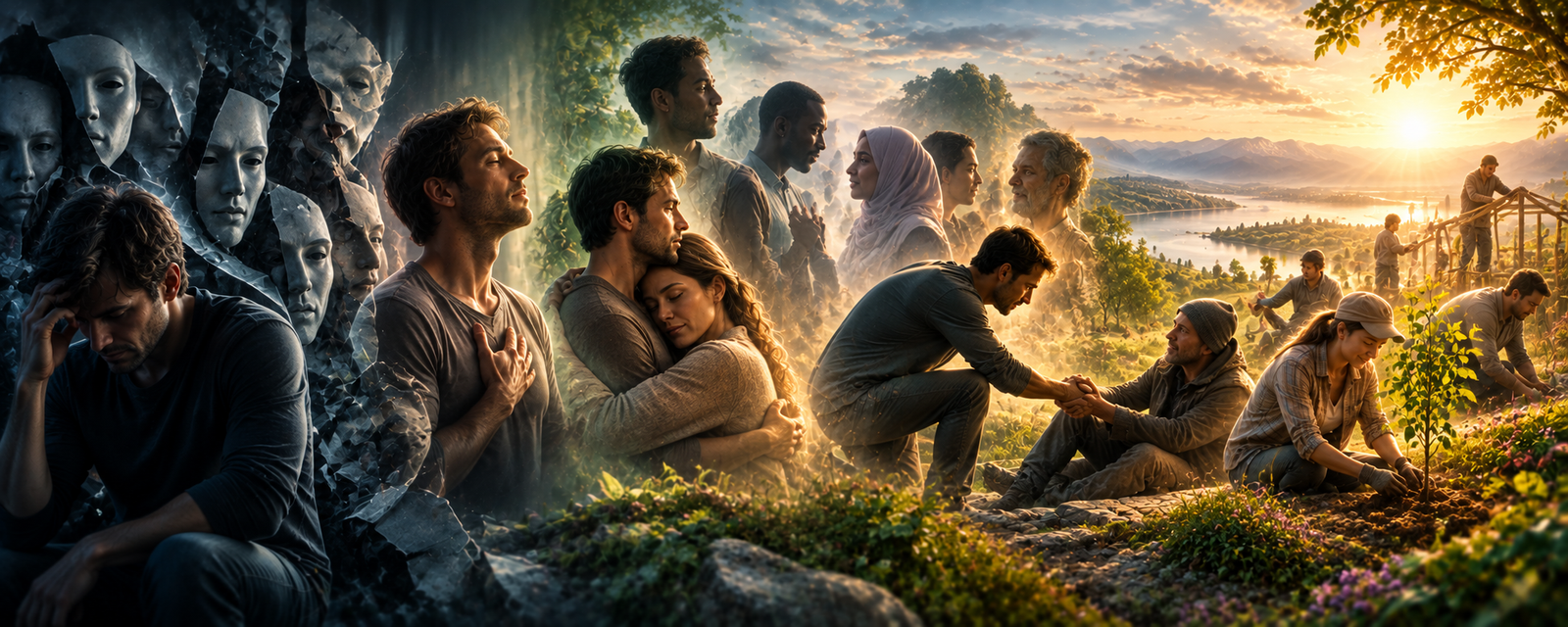
Authenticity → Self-Love → Love of Others → Release of Prejudice → Forgiveness → Service → Creation
The remarkable near-death experience described by Vinney Tolman offers one man’s journey through that progression—and a doorway into a much larger mystery.
THE DAY VINNEY TOLMAN DIED
In January 2003, 25-year-old Vinney Tolman had no expectation that an ordinary day would become the dividing line between two completely different versions of his life. After taking a supplement with a friend, he became violently ill inside a Dairy Queen bathroom. His condition deteriorated rapidly, and he eventually collapsed.
What happened next is Vinney’s account of his experience, and that distinction matters. We cannot independently enter another person’s consciousness or establish from testimony alone precisely when a near-death experience occurred relative to brain function. But we can listen carefully to what experiencers report—and compare those reports with the much larger body of NDE accounts collected over decades.
Vinney says his awareness continued after his body became unresponsive. He describes observing the scene from outside himself, initially without even realizing that the young man emergency responders were attempting to revive was his own body. He watched the activity unfold until, according to his account, one responder recognized something others had apparently missed and insisted, “This one’s not dead.” Resuscitation continued, his heartbeat returned, and after several days he regained ordinary waking consciousness.
Yet Vinney says that during the interval between collapse and return, his awareness had gone somewhere else entirely. He describes encountering a guide he calls Drake, moving through an environment that felt intensely real, undergoing a life review, confronting parts of himself he had spent years avoiding, and eventually experiencing what he understood as another realm of existence.
The details are uniquely his. The architecture of the experience is not.
THE PEOPLE WHO COME BACK
People from remarkably different backgrounds have described some combination of the same phenomena: leaving the physical body, observing events from another vantage point, moving through darkness or toward light, encountering deceased relatives or other beings, experiencing extraordinary peace or love, undergoing a review of their lives, reaching a boundary, and eventually returning.
There is no universal NDE. Some people report only one or two elements. Others describe experiences that are frightening or disorienting rather than peaceful. Religious and cultural backgrounds can influence the language people use to interpret what happened. Memory is imperfect. Expectation matters. And similarity among stories does not establish that every experience represents literal travel beyond the physical body.
Still, the similarities have been persistent enough to attract serious scientific attention. And perhaps the most intriguing commonality appears after the medical emergency has passed. Many experiencers say they are simply not the same people anymore. Death becomes less frightening. Status and possessions often become less compelling. Relationships, compassion, purpose and service assume greater importance.
For Vinney, however, the first lesson wasn’t love, heaven or even death.
It was authenticity.
THE FIRST LESSON WAS AUTHENTICITY
Vinney says he expected his experience to teach him about love. Instead, Drake surprised him:
“You’re right in a way, but the first thing I have to teach you is authenticity.”
Vinney initially believed he was already authentic. But his experience, as he describes it, began revealing the different identities he had constructed for different people and situations—the versions of himself designed to gain acceptance, avoid rejection or protect wounds accumulated earlier in life. Some of those masks had served a purpose. The problem was that after wearing them long enough, it became difficult to distinguish protection from identity.
That gives his first lesson considerably more depth than the familiar instruction to simply “be yourself.” Authenticity requires discovering which parts of ourselves are actually ours and which were built from fear, conditioning, trauma, expectation or the need to belong. It means becoming willing to encounter the person underneath all of them.
And according to Vinney, that leads directly to the next step:
“We have to learn how to authentically love ourselves so that we can authentically love others.”
Self-love in this context isn’t self-absorption. It is the removal of one of the barriers separating us from other people. If we cannot encounter ourselves without judgment, performance or rejection, perhaps our ability to encounter someone else without those filters will always be limited as well.
And that brings us to one of the most challenging parts of Vinney’s account.
THE LIFE REVIEW | SEEING OURSELVES THROUGH OTHER EYES
Life reviews appear frequently enough in NDE accounts to have become one of the phenomenon’s most recognizable features. But they are often described very differently from the image of standing before a celestial judge while a ledger of good and bad behavior is opened.
Vinney describes something much more intimate—and considerably more uncomfortable.
He says he experienced painful moments from his life from his own perspective and through the experience of the people affected by his choices. Actions he had forgotten or barely considered consequential suddenly looked different when experienced from the other side. The point was not simply remembering what he had done. It was understanding what he had created in someone else.
Then the review changed.
At a moment when Vinney says he began questioning the value of his own existence, he was shown the other side of the ledger—not as reward, but as perspective. He experienced good he had done, including moments when he had helped someone without realizing how much it mattered.
That may be one of the most compelling ideas contained within the entire life-review phenomenon. What if the complete measure of a human life cannot be understood solely from inside the person living it? What if seemingly insignificant moments of kindness travel farther than we know? And what if careless words, withheld compassion or casual cruelty do too?
Suddenly judgment begins giving way to understanding.
And Vinney’s description of Earth itself changes accordingly.
A CLASSROOM, NOT A COURTROOM
Before his NDE, Vinney says he largely understood earthly life as a test. Make the correct choices, pass. Make the wrong choices, fail.
What he says he encountered instead was a very different model:
“Earth is much more of a classroom and not a courtroom.”
A classroom exists because we don’t already know everything. We make mistakes. We encounter challenges. We discover consequences. We learn through relationships and experiences that cannot be replicated in theory. Most importantly, failure within a classroom isn’t necessarily a final verdict. It can become information.
That doesn’t eliminate responsibility. In some ways, the life review makes responsibility even more profound because there is nowhere to hide from the consequences of our choices. But responsibility and condemnation aren’t the same thing. One asks us to understand what happened and choose differently. The other permanently identifies us with what happened.
This is also where forgiveness enters Vinney’s story. He recalls working later in life with actress and minister Della Reese, who expressed the lesson memorably:
“Not forgiving is like drinking poison and hoping someone else dies.” — Della Reese via Vinney Tolman
Forgiveness does not require pretending harm never happened, abandoning boundaries or inviting destructive people back into our lives. It can mean refusing to allow an injury from the past to continue determining the emotional conditions of the present.
And if Earth really is a classroom, then perhaps one of its hardest lessons involves what we do with the people we have already decided we understand.

THE GATES WE BUILD BETWEEN US
Vinney repeatedly returns to prejudice, but his use of the word extends beyond the categories with which we usually associate it. He is describing the judgments human beings construct before genuinely encountering another person—the assumptions that tell us who someone is, what they believe, what they deserve and whether they belong inside our circle of compassion.
“Prejudice is a gate. It’s a gate that keeps us out of our home.”
Race can create that gate. So can religion, politics, nationality, wealth, education, social status, appearance, lifestyle and belief. Human beings are remarkably proficient at dividing themselves into categories and then treating those categories as though they contain the entirety of another human being.
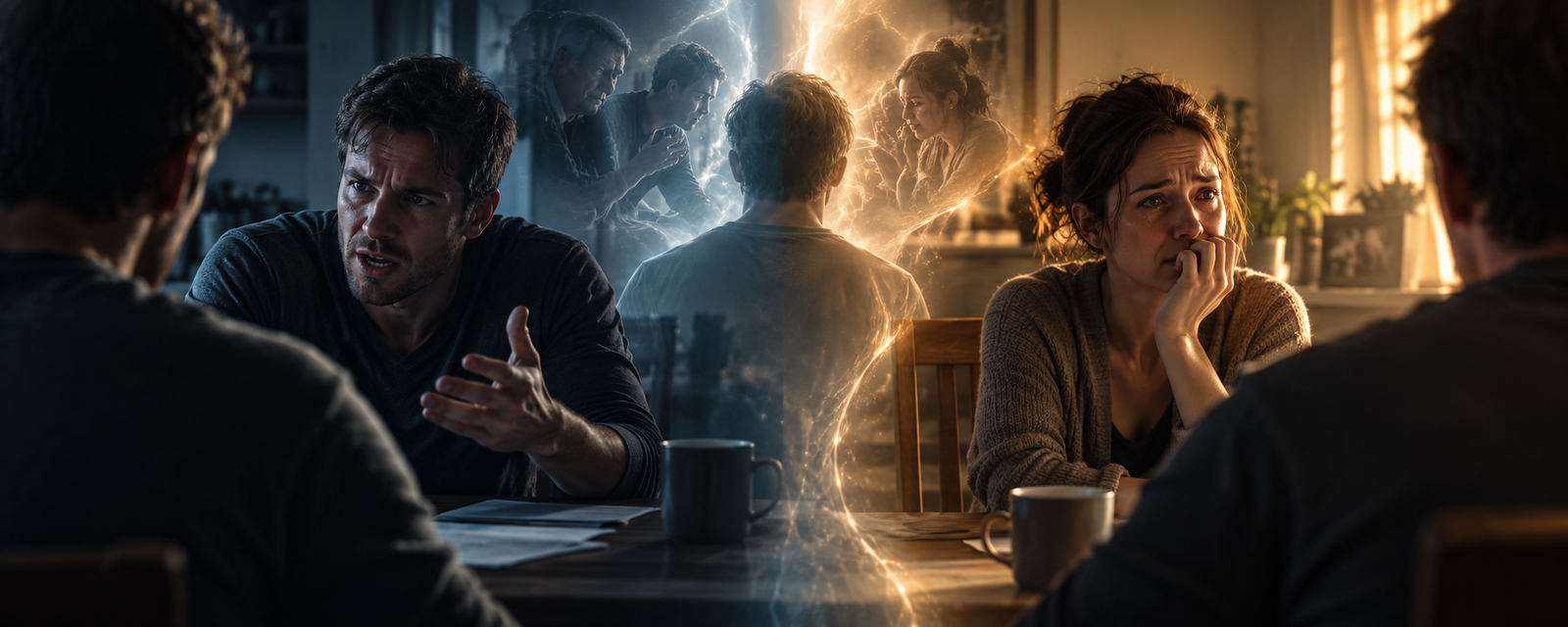
The life review introduces an intriguing counterpoint. Imagine actually experiencing another person’s fear, grief, hope, humiliation, loneliness or love from inside their perspective. How much prejudice could survive that encounter?
This doesn’t require abandoning discernment. Harmful behavior remains harmful. Boundaries remain necessary. People remain responsible for their choices. But Vinney’s progression suggests that discernment does not require dehumanization. The more authentically we encounter ourselves, the more capable we may become of recognizing the humanity underneath someone else’s masks as well.
Authenticity becomes self-love. Self-love expands our capacity to love others. Love begins dismantling prejudice. And eventually, we encounter another barrier that can keep us locked inside ourselves:
what we refuse to release.
FROM FORGIVENESS TO SERVICE
For Vinney, forgiveness became part of a much larger shift away from living primarily through the self. His account repeatedly returns to what happens when our attention moves outward—not because our own needs cease to matter, but because helping another person creates something neither person possessed before the interaction.
He describes the work he does today as “transformational assistance”—helping people reconsider how they live, think and understand themselves. But the deeper lesson he took from service is remarkably simple:
“I thrive when I can help others in whatever way I can.”
And then he takes it further:
“When you can help someone outside yourself, you’re giving yourself access to a joy that you can’t have without helping others.”
There is an interesting paradox here. Much of modern life teaches us to search for fulfillment by acquiring whatever appears to be missing. More success. More recognition. More money. More attention. More certainty. Vinney’s experience led him toward almost the opposite experiment.
“Whatever you’re missing, go give that to someone else and you walk away having it.”
If you need kindness, offer kindness. If you feel invisible, truly see someone. If you need encouragement, encourage another person. If you feel disconnected, create connection.
The movement is subtle but profound. We stop asking only what life can give us and begin asking what can move through us. And that’s where service becomes creation.
ALL-CONSUMING OR ALL-CREATING
One of Vinney’s strongest observations may also be the one most applicable to ordinary life:
“In life we can be all consuming or we can be all creating. The choice is ours.”
Consumption isn’t inherently wrong. We need food, shelter, resources, knowledge, entertainment and countless things created by other people. The distinction is one of orientation. Do we experience life primarily as something from which we are constantly attempting to extract value—or as something to which we can also contribute?
Creation can mean raising a child. Building a company. Growing food. Writing a book. Repairing a relationship. Solving a problem. Making music. Caring for an animal. Teaching someone a skill. Restoring a piece of land. Comforting someone who is grieving. Creating peace where there was conflict. Creating understanding where there was prejudice. Vinney puts it much more simply:
“Go create, go serve, love, help those who deserve it or don’t. Doesn’t matter.”
And there is our progression.
Authenticity → Self-Love → Love of Others → Release of Prejudice → Forgiveness → Service → Creation
What began as an encounter with death has quietly become a philosophy of life. But one enormous question remains.
What actually happened to Vinney Tolman?
WHAT DOES SCIENCE DO WITH THE NEAR-DEATH EXPERIENCE?
Near-death experiences present researchers with an unusually difficult problem because subjective experience and objective physiology do not always map neatly onto one another. People can emerge from cardiac arrest or other profound medical crises with extraordinarily vivid memories, but determining precisely when those memories were formed and what the brain was doing at that moment is much harder.
Several conventional mechanisms deserve serious consideration. Severe physiological stress can alter oxygen and carbon-dioxide levels, neurotransmitters and electrical activity. REM-like processes may intrude into waking awareness. Memory can be reconstructed after consciousness returns. The brain is capable of producing extraordinarily realistic experiences during dreams, anesthesia, seizures and altered states. None of that should be dismissed simply because an NDE feels transcendent to the person experiencing it.
Yet the subject hasn’t disappeared from scientific inquiry. Prospective cardiac-arrest studies have attempted to investigate reports of awareness during resuscitation, including whether patients can accurately describe events occurring around them. Researchers have debated allegedly veridical out-of-body perceptions, the timing of conscious experience around cardiac arrest, and whether unusual brain activity during the dying process might explain portions of the phenomenon.
The evidence has not established that consciousness leaves the body or survives physical death. But neither has science solved the larger mystery of consciousness itself. We can increasingly map the neural activity associated with perception, memory, emotion and decision-making, yet explaining why physical activity in the brain produces the subjective experience of being someone remains one of science’s deepest problems.
That leaves room for investigation without requiring either blind belief or automatic dismissal.
Perhaps the brain creates consciousness entirely. Perhaps extraordinary experiences emerge during transitions into or out of severely compromised brain states.
Or perhaps our present model of consciousness is incomplete. Vinney reached his own spiritual conclusion. Speaking about Creator, he says:
“That’s where I find the creator—is in the little things.”
Not only in extraordinary realms or near-death visions, but in people, relationships, laughter, kindness and the ordinary moments we routinely overlook. Which brings the entire investigation back to life.
THE PEOPLE WHO COME BACK DIFFERENT
Perhaps we will eventually understand near-death experiences entirely through neuroscience. Perhaps future research will reveal aspects of consciousness our present models cannot adequately explain. Or perhaps the phenomenon contains elements of both—a physiological event interpreted through something much deeper about the nature of human awareness.
We don’t have to settle that question to notice something else.
People who report profound NDEs frequently return talking less about what they can acquire and more about how they can live. Vinney’s account follows that pattern almost perfectly. His experience begins with authenticity and moves outward—toward love, forgiveness, compassion, service and eventually creation.
Even happiness becomes something different:
“Happiness happens here inside. And it’s a choice first.”
That may be the quietest lesson in a story filled with extraordinary experiences. After describing leaving his body, encountering another realm, meeting a guide and reviewing his life, Vinney ultimately brings the meaning of it all back to the world most of us occupy every day: the person across the table, the stranger we may have already judged, the relationship that still needs forgiveness, the person we have an opportunity to help, and the small thing we can create that wasn’t here before.
Perhaps that is what makes his story so compelling. After everything extraordinary he says he experienced, the lesson isn’t to spend our lives searching for another realm. It is to become more conscious of this one—to notice the life unfolding while we are waiting for something extraordinary to happen.
Near-death experiences may someday tell us much more about death and perhaps even about the nature of consciousness itself. For now, they leave us with an equally provocative question about how we choose to live:
If we knew we would someday experience the full effect of what we created here—not only through our own eyes, but through the lives we touched—what would we choose to create differently today?
Vinney Tolman’s answer brings us back to where his journey ultimately leads—from authenticity and self-love, through forgiveness and service, and finally to creation:
“Go create, go serve, love, help those who deserve it or don’t. Doesn’t matter.” — Vinney Tolman
Perhaps that is the deeper lesson of Earth School. We are not here simply to pass judgment on ourselves or one another, nor merely to consume the experience we’ve been given. We are here to learn from it, participate in it, help one another through it—and ultimately decide what we will create with it.
Sign up to receive Our Weekly Briefing Newsletter
Begin your journey with weekly insights designed to expand awareness and ground you in truth. Our free tier gives you a powerful introduction without any commitment.


Help Us Bypass Censorship. Share This.
Related Posts

Have questions?
At Great Awakening Report, we are dedicated to supporting your journey toward truth and enlightenment through our specialized Coaching and Consulting services.
Coaching Services: Our coaching programs are designed to guide you through personal awakening and transformation. We offer personalized sessions that focus on expanding consciousness, uncovering hidden truths, and fostering spiritual growth. Our experienced coaches provide the tools and insights necessary to navigate your path with clarity and confidence.
Consulting Services: For organizations and individuals seeking deeper understanding and strategic guidance, our consulting services offer expert analysis and solutions. We delve into areas such as global transitions, alternative news insights, and consciousness studies to provide comprehensive strategies tailored to your unique objectives.
Embark on a transformative journey with our Coaching and Consulting services, and unlock your highest potential. To learn more and schedule a session, visit our Coaching and Consulting pages.
Thank you
Thank you to our subscribers and readers for your continued support and dedication to truth and awakening. Your encouragement, engagement, and belief in our mission make everything we do possible. Together, we are expanding awareness and helping illuminate the path forward.
If you would like to further support the Great Awakening team and our ongoing efforts to share insight, knowledge, and truth, you can DONATE HERE.
With deep gratitude,
– Great Awakening Team
About the Author: Great Awakening Team

We are a community. We are cultural creatives and like minded people seeking the truth and focusing on disclosure, awakening and consciousness. Our focus is real news as researchers, reporters and truth seekers. We are here to teach, to spread the word, to serve and to help. We are a collective, a movement, free from all programing, not closed minded and not discriminatory. We are not political. We are not religious but we are spiritual. We study, research, and report on a wide range of subjects and topics, from the current geopolitical climate to health and wellness, from earth’s history to spiritual practices. We are forward thinkers and visionaries, we are guides for the transition as we usher in The Great Awakening.
THIS WEBSITE DOES NOT PROVIDE MEDICAL ADVICE: The information, including but not limited to text, graphics, images, and other material contained on this website, are for informational purposes only. No material on this site is intended to be a substitute for professional medical advice, diagnosis, or treatment. Always seek the advice of your physician or other qualified health care provider with any questions you may have regarding a medical condition or treatment and before undertaking a new health care regimen, and never disregard professional medical advice or delay in seeking it because of something you have read on this website.
DISCLAIMER: All statements, claims, views and opinions that appear anywhere on this site, whether stated as theories or absolute facts, are always presented by The Great Awakening Report (GAR) as unverified—and should be personally fact checked and discerned by you, the reader.Any opinions or statements herein presented are not necessarily promoted, endorsed, or agreed to by GAR, those who work with GAR, or those who read or subscribe to GAR.Any belief or conclusion gleaned from content on this site is solely the responsibility of you the reader to substantiate.Any actions taken by those who read material on this site are solely the responsibility of the acting party.You are encouraged to think for yourself and do your own research.Nothing on this site is meant to be believed without question or personal appraisal.
COPYRIGHT DISCLAIMER: Citation of articles and authors in this report does not imply ownership. Works and images presented here fall under Fair Use Section 107 and are used for commentary on globally significant newsworthy events. Under Section 107 of the Copyright Act 1976, allowance is made for fair use for purposes such as criticism, comment, news reporting, teaching, scholarship, and research.
COMMUNITY GUIDELINES DISCLAIMER: The points of view and purpose of this video is not to bully or harass anybody, but rather share that opinion and thoughts with other like-minded individuals curious about the subject.