











Help Us Bypass Censorship. Share This.
Sign up to receive Our Weekly Briefing Newsletter
Begin your journey with weekly insights designed to expand awareness and ground you in truth. Our free tier gives you a powerful introduction without any commitment.
THE PROMISE OF WALKABLE COMMUNITIES IS APPEALING. BUT WHEN CONVENIENCE CONVERGES WITH SURVEILLANCE, DIGITAL PERMITS, AI AND MANAGED MOBILITY, THE QUESTION IS NO LONGER HOW CLOSE EVERYTHING IS—IT IS WHO CONTROLS YOUR ABILITY TO GO FARTHER.
“A free society should be able to offer everything you need within fifteen minutes without requiring permission to go fifteen miles.” — GAR
THE PROMISE SOUNDS WONDERFUL
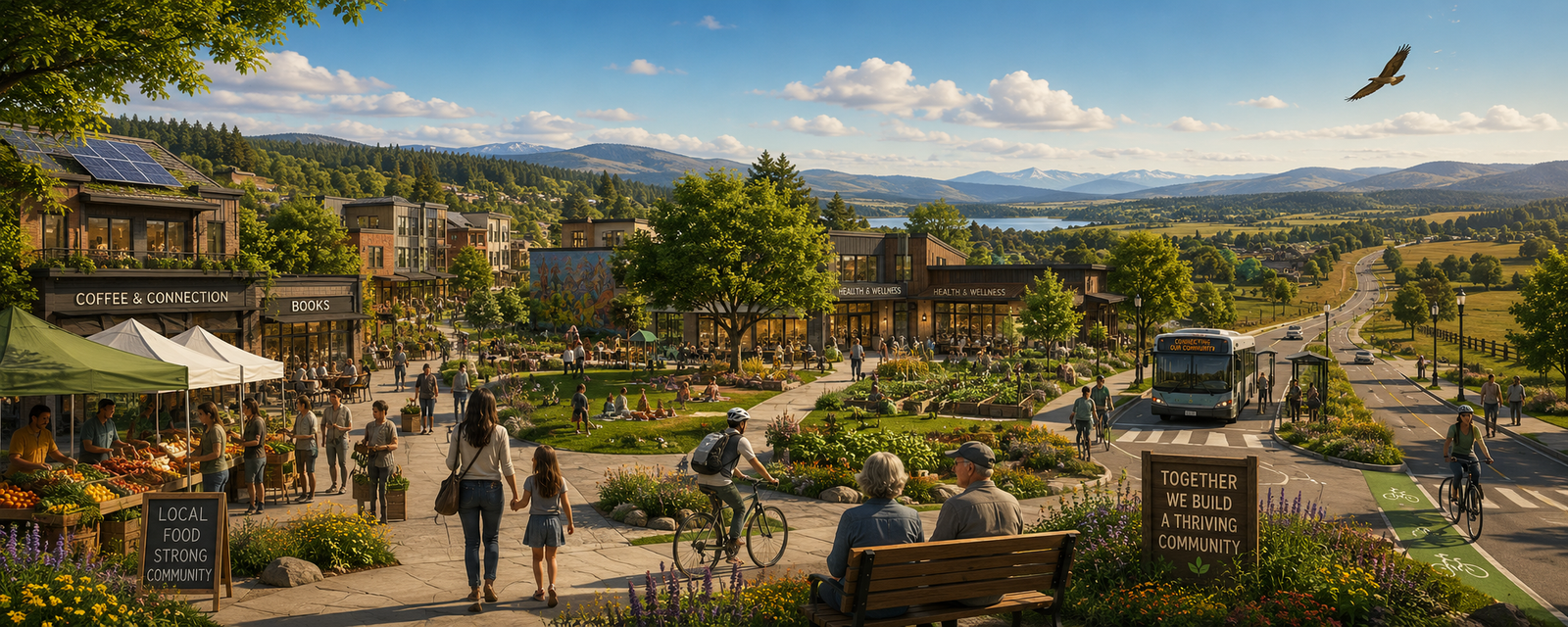
Imagine waking in the morning and walking a few blocks for coffee. Your grocery store is nearby. Your doctor is around the corner. Children can bicycle to school. Parks, restaurants, shops and perhaps even your workplace are all close enough that getting into a car becomes a choice rather than a necessity.
This is the basic promise of the 15-minute city, an urban-planning concept popularized by French-Colombian professor Carlos Moreno. The idea is straightforward: organize communities so that most daily needs can be reached within approximately fifteen minutes by walking or cycling.
There is much about that vision that sounds appealing.
Long commutes consume enormous amounts of people’s lives. Traffic creates stress. Neighborhood businesses benefit when residents shop locally. Walking and cycling encourage physical activity. Elderly residents and people unable to drive can benefit enormously from having essential services nearby.
And there is nothing particularly revolutionary about any of it. For centuries, communities naturally developed around marketplaces, churches, schools, tradespeople and public squares. Many older European cities remain highly walkable today.
GAR does not oppose walkable communities.
We oppose systems that transform freedom of movement from an inherent choice into a managed privilege.
And that distinction changes the conversation completely.
WALKABILITY IS NOT THE ISSUE | SOVEREIGNTY IS
There is an enormous difference between designing a community where someone doesn’t need to drive and designing systems intended to make driving progressively more difficult.
There is another difference between encouraging someone to use public transportation and requiring authorization to drive through a particular public street. The first offers an alternative and the second begins managing behavior.
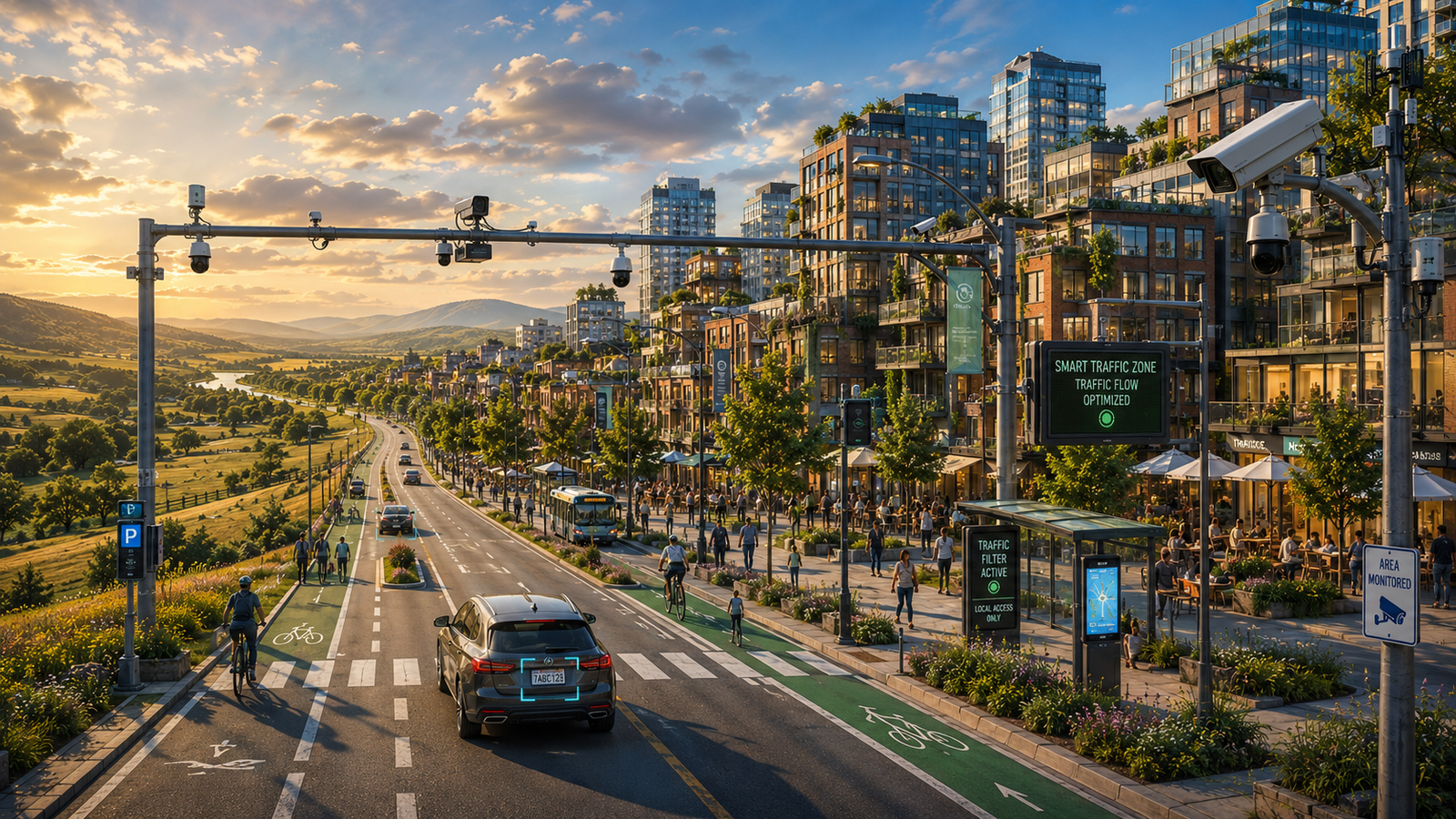
That is where the 15-minute-city debate becomes more complicated than either side often acknowledges. Supporters understandably focus on proximity and quality of life. Critics increasingly focus on the infrastructure being built around modern urban planning: cameras, digital permits, automated enforcement, smart-city sensors, congestion pricing and eventually AI-driven transportation systems.
The concern isn’t that your grocery store is too close, but whether the systems designed to encourage you to remain close can eventually be used to discourage—or condition—your ability to travel farther.
That isn’t merely a hypothetical discussion anymore.
OXFORD | WHEN THE ROAD BECOMES MANAGED
Oxford, England, has become ground zero for much of the controversy surrounding 15-minute cities.
Some claims about Oxford have gone too far. The city has not been divided into districts that residents are forbidden to leave, and Oxfordshire County Council explicitly states that every part of Oxford will remain accessible by car.
But what Oxford actually is implementing deserves attention on its own.
Beginning September 28, 2026, Oxfordshire plans to begin an 18-month traffic-filter trial at six locations around the city. Automatic Number Plate Recognition cameras will identify cars passing through those locations. Cars require valid permits to use the filters during operating hours; otherwise drivers must use another route. Unauthorized passage can result in a £70 fine.
Oxford residents can receive permits providing 100 days of access per year. Residents elsewhere in Oxfordshire receive 25. The permits are entirely virtual. Cameras read a vehicle’s number plate and check the database for a corresponding permit. Once an Oxford resident’s registered car passes through a filter, one of those annual day passes is deducted.
Again, residents remain free to drive elsewhere using alternative routes. That distinction matters and so does this one:
A public road has become a digitally managed access point where a camera identifies your vehicle, a database determines whether authorization exists, and a computer system can initiate a financial penalty when it does not.
That is not physical confinement, but something subtler—and perhaps more relevant to the future.
SOFT CONTROL | WHEN FRICTION REPLACES THE WALL
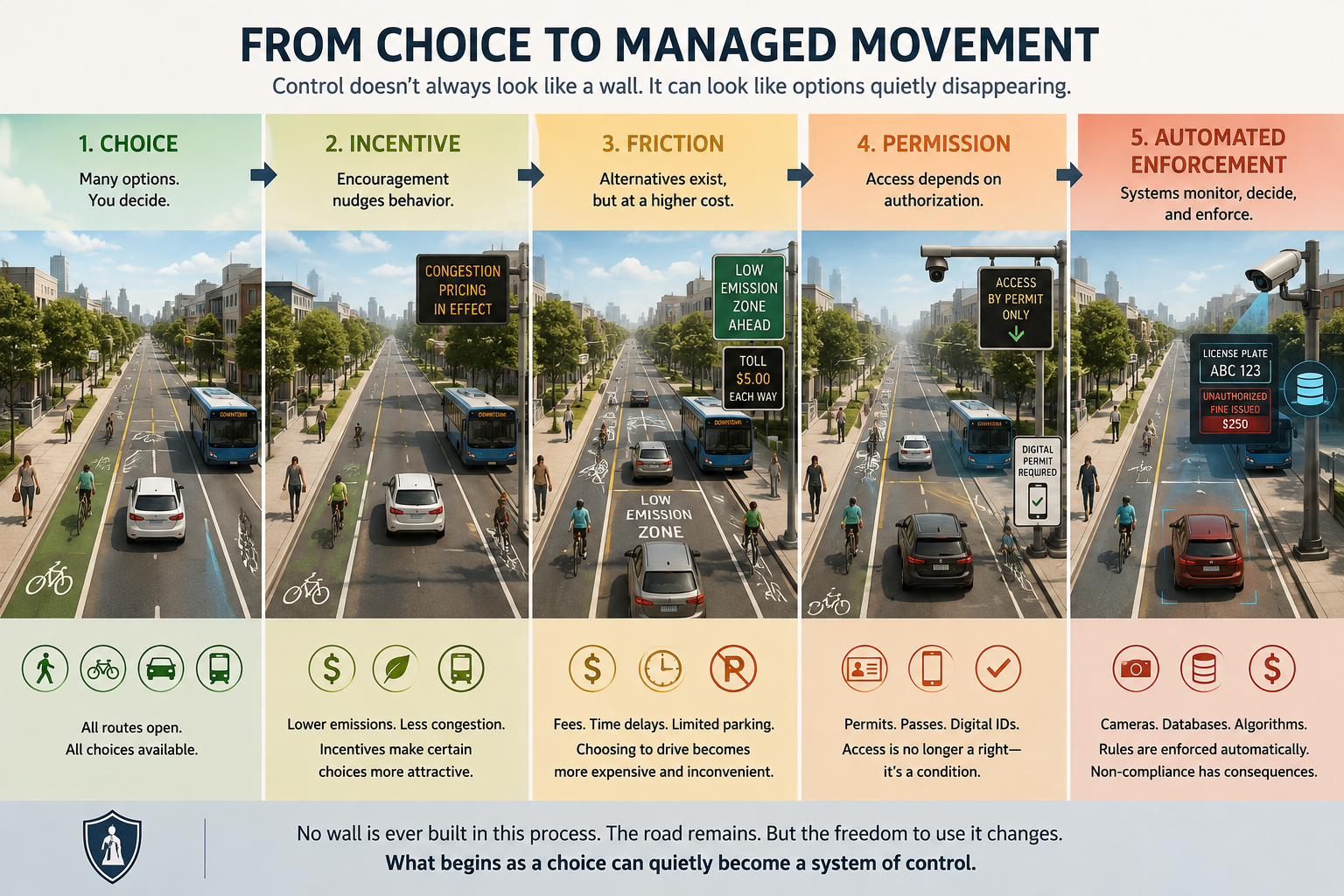
Much of the debate surrounding 15-minute cities eventually arrives at the same dramatic question: will people someday be prohibited from leaving their neighborhoods? It is an understandable question, particularly after the restrictions experienced during COVID, but it may also distract from a much subtler issue. Control does not always require an outright prohibition, a physical barrier, or someone telling you that you cannot leave. Human behavior can be influenced just as effectively by changing the environment around a choice—making one option increasingly easy, affordable and convenient while making another progressively more expensive, complicated or burdensome.
There is nothing inherently troubling about encouraging people to walk, cycle or use public transportation. Build safe bicycle lanes and more people may choose to ride. Create reliable public transportation and commuters may willingly leave their cars at home. Develop neighborhoods with restaurants, shops, schools and healthcare nearby and people may naturally travel shorter distances. In each case, the individual has gained another useful option without losing the choices already available to them. The sovereignty question emerges when encouragement begins moving toward behavioral management—when parking becomes deliberately scarce or more expensive, certain roads become restricted, congestion charges increase, permits determine access, and cameras automatically identify and penalize those who fail to comply.
Individually, each measure can be explained as a reasonable response to congestion, pollution, safety or urban efficiency. Taken together, however, they can gradually reshape the relationship between the individual and the city. A person may remain technically free to drive across town, but if doing so requires additional fees, longer routes, digital permissions or repeated interaction with automated enforcement systems, the freedom still exists under increasingly restrictive conditions. Most people will not spend their lives resisting those conditions. They will adapt to them, choosing the route that costs less, requires fewer permissions and creates the least inconvenience. Over time, “I am free to go wherever I choose” can quietly become “It is easier just to stay here.”
That is why GAR believes the conversation must extend beyond whether a government literally prevents someone from leaving a neighborhood. The more important question is whether the surrounding system gradually creates enough friction that people begin restricting themselves. A wall is obvious. A system that quietly changes behavior while preserving the appearance of choice is much harder to recognize.
Sign up to receive Our Weekly Briefing Newsletter
Begin your journey with weekly insights designed to expand awareness and ground you in truth. Our free tier gives you a powerful introduction without any commitment.
STOP DROWNING IN THE NOISE. START SEEING THE TRUTH. Join over 99,000 truth seekers. Get the essential intelligence, alternative news, and disclosure updates that the mainstream media won’t touch.
Latest Reports
 Monthly ReportConscious Practices · October 2026 EditionOctober 5, 2026
 Weekly ReportAwakening The Sleeping Giant · October 5th EditionOctober 5, 2026
 Weekly ReportAwakening The Sleeping Giant · September 28th EditionSeptember 28, 2026
 Weekly ReportAwakening The Sleeping Giant · September 21st EditionSeptember 21, 2026View all weekly reports
Special Reports
 Special ReportTHE AWAKENING JOURNEY: Hero’s Journey Part II · Week 1October 3, 2026
 Special ReportGlobal Everything Collapse · Economic Chaos · Part IOctober 1, 2026
 Special ReportCreating A Conscious Culture · Part ISeptember 3, 2026
 Special ReportThe Great Healing: Detox, Defense & Sovereignty In an Engineered World · Part ISeptember 1, 2026View all special reports
Help Us Bypass Censorship. Share This.
Join the Discussion
Related Posts


Have questions?
At Great Awakening Report, we are dedicated to supporting your journey toward truth and enlightenment through our specialized Coaching and Consulting services.
Coaching Services: Our coaching programs are designed to guide you through personal awakening and transformation. We offer personalized sessions that focus on expanding consciousness, uncovering hidden truths, and fostering spiritual growth. Our experienced coaches provide the tools and insights necessary to navigate your path with clarity and confidence.
Consulting Services: For organizations and individuals seeking deeper understanding and strategic guidance, our consulting services offer expert analysis and solutions. We delve into areas such as global transitions, alternative news insights, and consciousness studies to provide comprehensive strategies tailored to your unique objectives.
Embark on a transformative journey with our Coaching and Consulting services, and unlock your highest potential. To learn more and schedule a session, visit our Coaching and Consulting pages.
Thank you
Thank you to our subscribers and readers for your continued support and dedication to truth and awakening. Your encouragement, engagement, and belief in our mission make everything we do possible. Together, we are expanding awareness and helping illuminate the path forward.
If you would like to further support the Great Awakening team and our ongoing efforts to share insight, knowledge, and truth, you can DONATE HERE.
With deep gratitude,
– Great Awakening Team
About the Author: Great Awakening Team

We are a community. We are cultural creatives and like minded people seeking the truth and focusing on disclosure, awakening and consciousness. Our focus is real news as researchers, reporters and truth seekers. We are here to teach, to spread the word, to serve and to help. We are a collective, a movement, free from all programing, not closed minded and not discriminatory. We are not political. We are not religious but we are spiritual. We study, research, and report on a wide range of subjects and topics, from the current geopolitical climate to health and wellness, from earth’s history to spiritual practices. We are forward thinkers and visionaries, we are guides for the transition as we usher in The Great Awakening.
THIS WEBSITE DOES NOT PROVIDE MEDICAL ADVICE: The information, including but not limited to text, graphics, images, and other material contained on this website, are for informational purposes only. No material on this site is intended to be a substitute for professional medical advice, diagnosis, or treatment. Always seek the advice of your physician or other qualified health care provider with any questions you may have regarding a medical condition or treatment and before undertaking a new health care regimen, and never disregard professional medical advice or delay in seeking it because of something you have read on this website.
DISCLAIMER: All statements, claims, views and opinions that appear anywhere on this site, whether stated as theories or absolute facts, are always presented by The Great Awakening Report (GAR) as unverified—and should be personally fact checked and discerned by you, the reader.Any opinions or statements herein presented are not necessarily promoted, endorsed, or agreed to by GAR, those who work with GAR, or those who read or subscribe to GAR.Any belief or conclusion gleaned from content on this site is solely the responsibility of you the reader to substantiate.Any actions taken by those who read material on this site are solely the responsibility of the acting party.You are encouraged to think for yourself and do your own research.Nothing on this site is meant to be believed without question or personal appraisal.
COPYRIGHT DISCLAIMER: Citation of articles and authors in this report does not imply ownership. Works and images presented here fall under Fair Use Section 107 and are used for commentary on globally significant newsworthy events. Under Section 107 of the Copyright Act 1976, allowance is made for fair use for purposes such as criticism, comment, news reporting, teaching, scholarship, and research.
COMMUNITY GUIDELINES DISCLAIMER: The points of view and purpose of this video is not to bully or harass anybody, but rather share that opinion and thoughts with other like-minded individuals curious about the subject.