






















Help Us Bypass Censorship. Share This.
Sign up to receive Our Weekly Briefing Newsletter
Begin your journey with weekly insights designed to expand awareness and ground you in truth. Our free tier gives you a powerful introduction without any commitment.
For more than eighty years, the U.S. dollar has served as the foundation of the global financial system. International trade, commodity markets, central bank reserves, and cross-border finance have all been built around its role as the world’s primary reserve currency. That framework has provided remarkable stability, helping to shape an era of unprecedented economic growth and globalization.
No monetary system, however, remains unchanged forever, and the idea of a global currency reset is now discussed openly by economists, central bankers, and investors.
Throughout history, reserve currencies have risen, matured, and eventually given way to new financial arrangements as economic power shifted, technologies advanced, and geopolitical priorities evolved. The British pound once occupied the position now held by the dollar. Before that came the Dutch guilder and other dominant currencies that reflected the balance of power in their respective eras. Each transition unfolded differently, yet they shared one common characteristic: change arrived gradually before it became obvious.
Today, many of those same long-term signals are beginning to emerge once again, which is why the phrase global currency reset keeps surfacing.
Governments are expanding trade agreements that reduce dependence on the dollar, central banks are developing digital versions of national currencies, international institutions are exploring new settlement mechanisms, and emerging economic blocs are building financial systems that reflect an increasingly multipolar world. None of these developments, by themselves, signals the collapse of the dollar or an imminent financial crisis. Taken together, however, they suggest the architecture of global finance is entering a new phase of evolution.
The purpose of this global currency reset report is not to predict exactly how that transition will unfold. Rather, it is to examine the observable evidence, place current developments within their historical context, and better understand what they may mean for investors, businesses, and families over the years ahead. Like many of the larger themes explored throughout the Great Awakening Report, the currency reset is best viewed as a developing process rather than a single event.
The Visible Global Currency Reset: What We Can Already See
The strongest evidence that the global financial system is changing is that much of it is happening in public. Governments, central banks, and international organizations are openly discussing initiatives that would have seemed unlikely only a decade ago. While analysts disagree on the ultimate destination of these changes, there is little debate that the financial landscape is becoming more diversified and more complex.
The BRICS+ De-Dollarization Movement
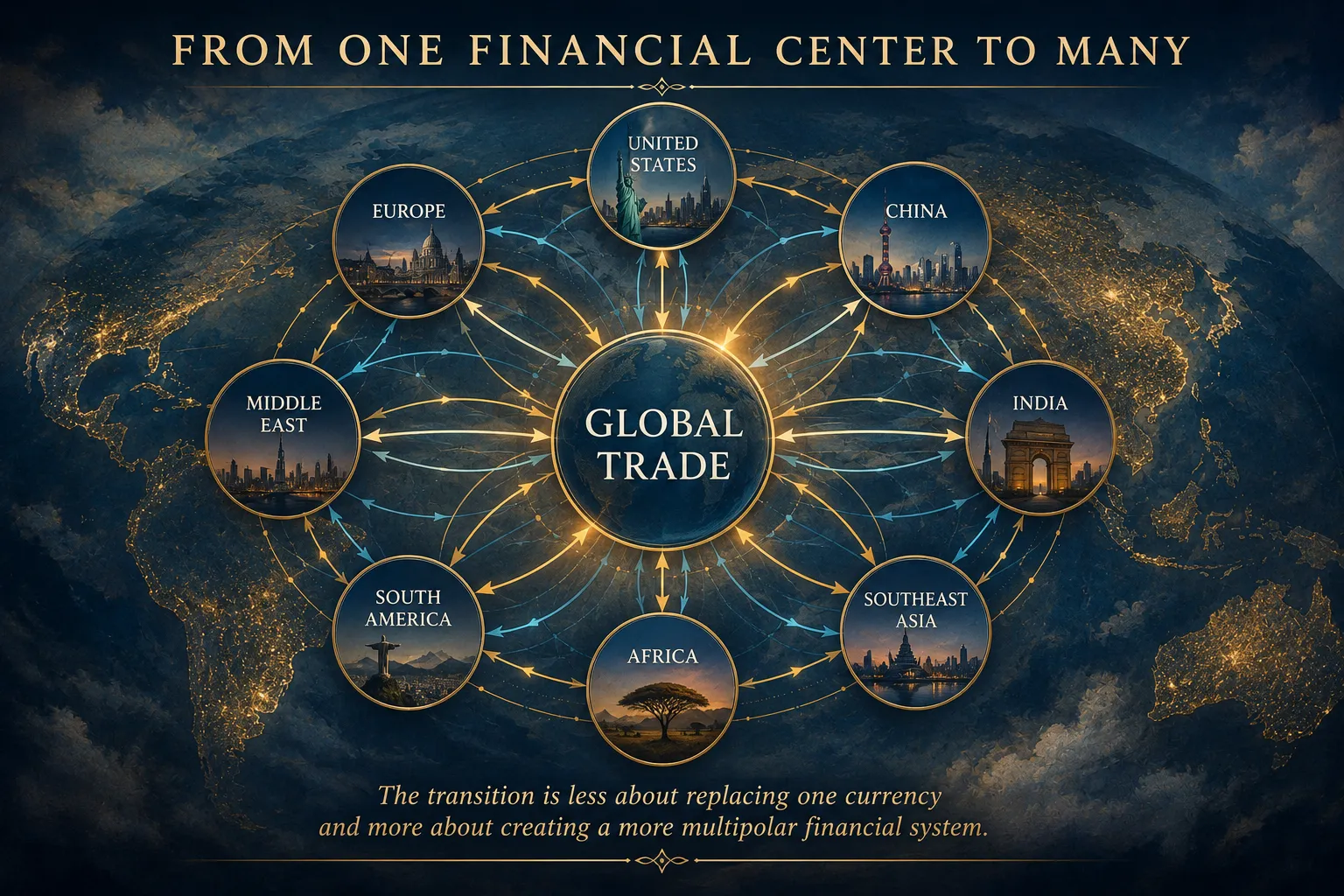
One of the most significant developments is the continued expansion of BRICS and its growing emphasis on reducing dependence on the U.S. dollar for international trade.
Originally formed by Brazil, Russia, India, China, and South Africa, the organization has expanded to include additional nations representing a substantial share of the world’s population, energy production, manufacturing capacity, and natural resources. Beyond expanding membership, BRICS has focused considerable attention on creating alternative payment systems and increasing the use of national currencies in cross-border commerce.
India and Russia have dramatically expanded bilateral trade settled in rupees and rubles. China and Brazil now conduct significant portions of their trade using yuan and reais rather than dollars. Similar arrangements continue to emerge throughout Asia, the Middle East, Africa, and South America as governments seek greater flexibility in how they conduct international business.
Individually, these agreements may appear modest. Collectively, they represent a meaningful shift away from a financial system in which nearly every major transaction required the dollar as an intermediary. The dollar remains the world’s dominant reserve currency, but its exclusive role is gradually becoming less central as alternative trade networks mature.
This trend is often described as de-dollarization, and it is the most visible driver of a global currency reset. Rather than eliminating the dollar, it reflects a broader effort by nations to diversify the currencies they use for trade and investment while reducing dependence on any single financial system.
Central Bank Digital Currencies
At the same time, central banks are pursuing another transformation that could reshape the future of money itself.
More than eighty countries are researching, developing, or piloting Central Bank Digital Currencies (CBDCs). China’s Digital Yuan has moved beyond limited testing into broader real-world use. India continues expanding its Digital Rupee program, while the European Central Bank has spent several years evaluating a Digital Euro. Numerous additional countries remain in various stages of development, and the Federal Reserve continues researching the implications of a potential digital dollar.
Unlike cryptocurrencies such as Bitcoin, CBDCs are digital versions of sovereign national currencies issued and managed by central banks. Supporters argue they could improve payment efficiency, reduce settlement times, strengthen financial inclusion, and modernize aging payment infrastructure.
Critics, however, point to another aspect of digital currency that deserves careful consideration. Because CBDCs exist entirely within digital systems, they make programmable features technically possible. Researchers have explored concepts such as targeted stimulus payments, expiration dates, spending limitations, geographic restrictions, and automated policy implementation. Whether individual nations ultimately adopt any of these capabilities remains uncertain, but the discussions themselves illustrate how digital currency introduces possibilities that traditional cash never possessed.
The significance of CBDCs for any global currency reset extends beyond technology. They represent an evolution in the relationship between governments, central banks, and money itself, making them one of the most important financial developments currently underway.
The IMF and the Future of Reserve Assets
Another institution attracting increased attention is the International Monetary Fund and its ongoing work involving Special Drawing Rights, commonly known as SDRs.
Unlike traditional currencies, SDRs function as international reserve assets whose value is derived from a basket of major global currencies. For decades they have played a relatively limited role in the international monetary system, primarily serving central banks and member nations rather than individuals or businesses.
Recent years, however, have brought renewed discussion surrounding SDR allocations, global liquidity, and long-term monetary resilience. Some analysts view these developments simply as prudent modernization of existing financial tools. Others believe they represent early preparation for a future in which reserve assets become more diversified as the international monetary system evolves.
Regardless of which interpretation of a global currency reset ultimately proves correct, the broader direction is difficult to ignore. International financial institutions continue evaluating how a changing global economy may require new approaches to reserve management, cross-border settlements, and financial stability.
Bilateral Trade Is Quietly Changing
Perhaps the least discussed, yet most important, trend is the steady increase in bilateral trade agreements that bypass the traditional dollar settlement system altogether.
Countries across Asia are expanding local currency swap agreements. African nations are strengthening regional payment networks. Energy producers are increasingly accepting multiple currencies for international transactions, while new financial partnerships continue to emerge between countries seeking greater monetary independence.
None of these developments individually replaces the dollar. Together, however, they gradually reshape the financial architecture that has governed global commerce for generations. Like many structural changes, the process unfolds slowly until enough individual pieces begin forming a recognizable pattern.
The Hidden Architecture
Building the Financial System of Tomorrow
Policy announcements and trade agreements tell only part of the global currency reset story. Beneath the surface, governments, central banks, and financial institutions are investing heavily in the infrastructure that could support the next generation of global finance.
Modern payment systems require secure settlement networks, international banking standards, cybersecurity, regulatory coordination, and increasingly sophisticated digital technologies. The Bank for International Settlements has coordinated numerous cross-border payment initiatives involving central banks around the world, while financial institutions continue investing in blockchain settlement, artificial intelligence, advanced analytics, and quantum computing research.
Much of this work receives little public attention because infrastructure rarely dominates the news cycle. Yet history consistently demonstrates that new systems are built long before they become visible to the broader public. Roads are constructed before traffic arrives. Electrical grids are built before cities expand. Financial systems evolve in much the same way, with foundational infrastructure often preceding widespread adoption by many years.
History Offers an Important Perspective
Understanding today’s global currency reset becomes easier when viewed through the lens of history.
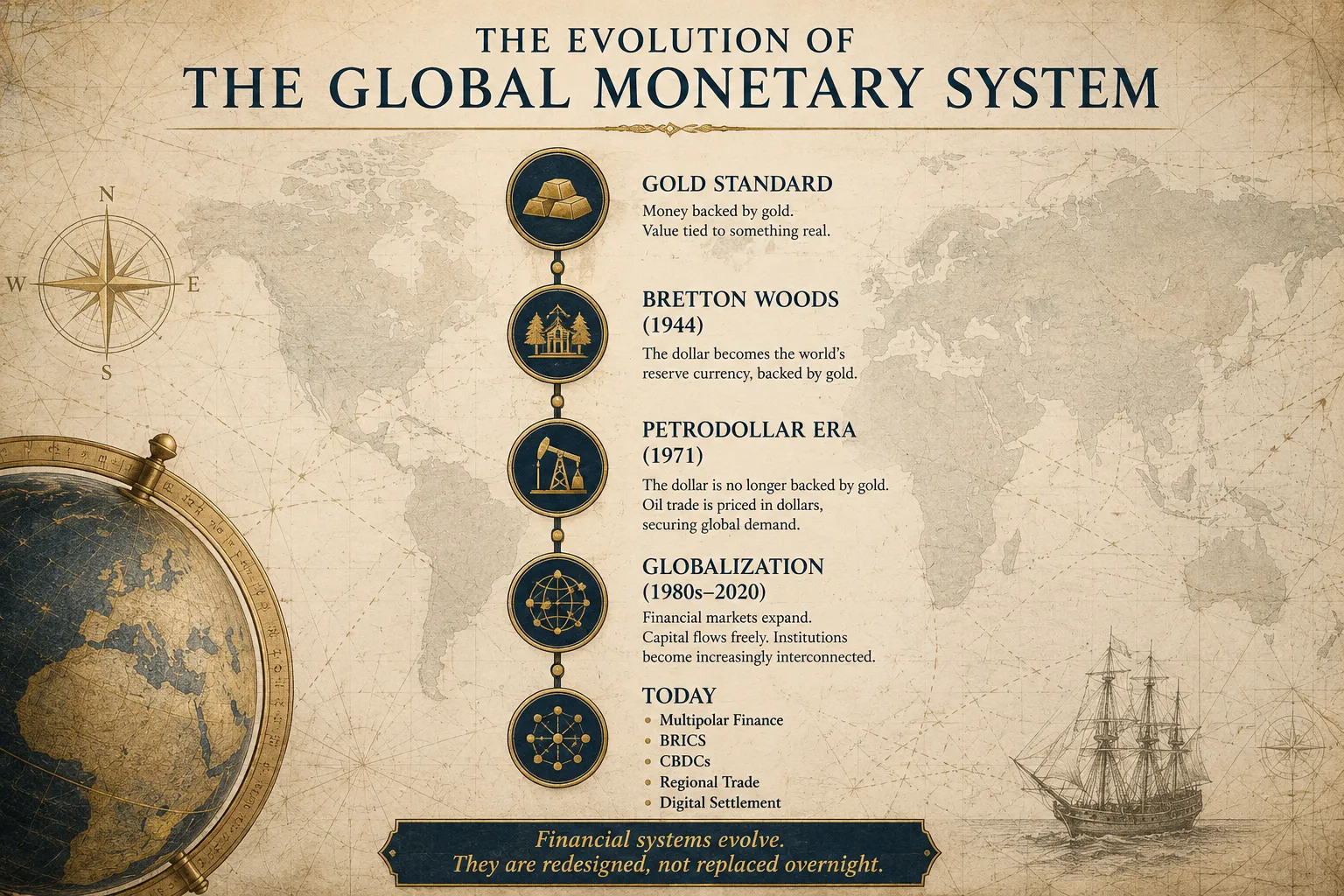
In 1944, the Bretton Woods Agreement established the U.S. dollar as the centerpiece of the post-war international monetary system, with currencies tied to the dollar and the dollar itself backed by gold. That framework provided stability for nearly three decades until President Richard Nixon suspended gold convertibility in 1971, fundamentally changing how the global financial system operated.
The transition was not instantaneous. Markets experienced volatility, inflation accelerated, and governments adapted to an entirely new monetary environment before a different equilibrium gradually emerged through floating exchange rates and the expansion of the petrodollar system.
History suggests that major monetary transitions rarely occur through a single dramatic event. More often, they unfold in phases as institutions adapt, new systems mature, and confidence gradually shifts from one framework to another. Whether today’s developments ultimately lead to a similar transformation remains to be seen, but the historical pattern provides valuable context for understanding the changes already underway.
The Timeline: How a Global Currency Reset Could Unfold
One of the most common misconceptions about a global currency reset is that it will occur through a single dramatic event. History suggests otherwise. Major monetary transitions tend to unfold over years as governments, financial institutions, businesses, and consumers gradually adapt to new realities. While no one can predict the exact path ahead, the observable trends allow us to outline a reasonable framework for understanding where the current transition may be heading.
Phase One: Regional Financial Realignment
The first phase is already underway.
Around the world, nations are expanding regional trade partnerships, strengthening local currency settlement systems, and reducing their dependence on the U.S. dollar for selected transactions. BRICS continues developing alternative payment infrastructure while central banks accelerate research into digital currencies and next-generation settlement networks. Although the dollar remains the world’s dominant reserve currency, it no longer occupies the uncontested position it once held.
This phase of the global currency reset is characterized by diversification rather than replacement. Governments are building alternatives without abandoning the existing system, allowing new financial architecture to develop alongside the old.
Phase Two: Parallel Financial Systems
As these new systems mature, the world may enter a period where multiple monetary frameworks operate simultaneously. Regional payment networks, digital currencies, traditional banking systems, and existing reserve currencies could coexist for an extended period, giving governments and businesses greater flexibility in how they conduct international trade.
Periods of transition often bring increased volatility. Exchange rates may fluctuate more frequently, capital may flow toward regions offering greater stability, and investors may place increased value on tangible assets, productive businesses, and diversified portfolios. Rather than representing financial collapse, this stage reflects the adjustment process that accompanies structural change.
Phase Three: A New Equilibrium
Eventually, every monetary transition reaches a point where new systems become familiar rather than experimental. Whether that future consists of several dominant reserve currencies, expanded use of digital settlement networks, greater regional financial independence, or some combination of these developments remains uncertain. What history consistently demonstrates, however, is that financial systems evolve to reflect the economic realities of their time.
The ultimate destination matters less than understanding that the transition itself creates both challenges and opportunities. Investors who recognize these long-term shifts are generally better positioned than those who assume existing systems will remain unchanged indefinitely.
What This Means for Investors
For most people, discussions about reserve currencies, international settlements, and central bank policy can feel distant from everyday life. Yet the decisions made within these institutions eventually work their way through interest rates, inflation, investment markets, borrowing costs, retirement accounts, and purchasing power.
That is why understanding the broader direction of the global currency reset matters.
If the international monetary system continues becoming more multipolar, investors should expect a world where diversification becomes increasingly important. Currency risk, geopolitical developments, supply chains, commodity markets, and regional economic strength may all play larger roles in long-term portfolio performance than they have during the past several decades.
This does not necessarily mean abandoning traditional investments or attempting to predict every market movement. It does suggest recognizing that the financial assumptions which guided previous generations may not fully describe the decades ahead.
History repeatedly demonstrates that periods of monetary transition reward adaptability. Investors who remain informed, maintain diversified portfolios, and avoid emotional decision-making are generally better positioned than those reacting to headlines or attempting to time major geopolitical events.
Building Financial Resilience
Practical Steps You Can Take Today
Preparation for a global currency reset should never be confused with fear.
The purpose of understanding long-term financial trends is not to encourage panic or dramatic action. It is to make thoughtful decisions that strengthen resilience regardless of how the future ultimately unfolds.
Diversification remains one of the most effective principles in investing because it recognizes a simple truth: no one can predict every outcome. A balanced mix of productive assets, cash reserves, precious metals, real estate, and long-term investments provides flexibility across a wide range of economic environments.
Financial resilience also extends beyond investment portfolios. Developing valuable skills, reducing unnecessary debt, maintaining emergency savings, and creating multiple sources of income often provide greater long-term security than attempting to anticipate short-term market movements.
For many investors, education may be the most valuable asset of all. Understanding how monetary policy, inflation, interest rates, and global trade interact creates confidence during periods when uncertainty dominates public conversation. Those who understand the larger system are less likely to make emotional decisions when markets inevitably experience periods of volatility.
Regardless of where the global financial system ultimately evolves, these principles remain remarkably consistent. Sound financial habits, disciplined investing, and continuous learning have historically served individuals well through every major economic transition.
Looking Beyond the Headlines
Financial transitions rarely unfold according to simple narratives.
Some observers see the current changes as evidence of an inevitable decline in the existing monetary order. Others view them as a natural modernization of global finance driven by technology, changing trade relationships, and the emergence of new economic powers. Reality will likely contain elements of both perspectives.
What remains clear is that governments, central banks, and international institutions are investing enormous resources into building the financial infrastructure of the future. Trade relationships are becoming more diversified. Payment systems are evolving. Digital currencies continue advancing. Regional alliances are strengthening their economic independence while new technologies reshape how money moves around the world.
None of these developments guarantee a particular outcome. They do, however, point toward a financial system that is becoming increasingly dynamic, interconnected, and multipolar.
Rather than asking whether a single global currency reset will occur on a specific date, a more useful question may be this:
How should investors prepare for a world where the rules of global finance continue evolving?
That perspective shifts the conversation away from speculation and toward preparation, allowing individuals to focus on the factors they can actually influence.
The GAR Perspective
One of the central themes throughout the Great Awakening Report is that major transitions rarely happen all at once. They develop gradually as technological innovation, geopolitical shifts, economic pressures, and institutional change begin reinforcing one another. Financial systems are no exception.
The global currency reset should therefore be viewed less as a single event than as part of a much broader realignment already reshaping international trade, monetary policy, digital finance, and global governance. Whether these developments ultimately produce a more resilient multipolar system or a more centralized financial framework remains one of the defining questions of the coming decade.
For investors, the lesson is not to react out of fear but to remain informed, diversified, and adaptable. History consistently favors those who recognize change early, understand the larger patterns, and prepare thoughtfully rather than emotionally.
The global financial system has evolved many times before. There is every reason to believe it will continue evolving again.
The question is not whether change is coming.
The question is whether we choose to understand it while it is still unfolding.
Continue Your Research
This report provides an overview of the visible trends shaping the next chapter of global finance. Subscribers can explore these developments in greater depth through our ongoing Weekly Report coverage of BRICS expansion, central bank digital currencies, geopolitical realignment, precious metals, financial sovereignty, and emerging economic systems.
As always, our objective is not to tell readers what to think, but to provide the context needed to think more clearly, recognize larger patterns, and make informed decisions during a period of historic global change.
Sign up to receive Our Weekly Briefing Newsletter
Begin your journey with weekly insights designed to expand awareness and ground you in truth. Our free tier gives you a powerful introduction without any commitment.
STOP DROWNING IN THE NOISE. START SEEING THE TRUTH. Join over 99,000 truth seekers. Get the essential intelligence, alternative news, and disclosure updates that the mainstream media won’t touch.
Latest Reports
 Monthly ReportConscious Practices · October 2026 EditionOctober 5, 2026
 Weekly ReportAwakening The Sleeping Giant · October 5th EditionOctober 5, 2026
 Weekly ReportAwakening The Sleeping Giant · September 28th EditionSeptember 28, 2026
 Weekly ReportAwakening The Sleeping Giant · September 21st EditionSeptember 21, 2026View all weekly reports
Special Reports
 Special ReportTHE AWAKENING JOURNEY: Hero’s Journey Part II · Week 1October 3, 2026
 Special ReportGlobal Everything Collapse · Economic Chaos · Part IOctober 1, 2026
 Special ReportCreating A Conscious Culture · Part ISeptember 3, 2026
 Special ReportThe Great Healing: Detox, Defense & Sovereignty In an Engineered World · Part ISeptember 1, 2026View all special reports
Help Us Bypass Censorship. Share This.
Join the Discussion
Related Posts



Have questions?
At Great Awakening Report, we are dedicated to supporting your journey toward truth and enlightenment through our specialized Coaching and Consulting services.
Coaching Services: Our coaching programs are designed to guide you through personal awakening and transformation. We offer personalized sessions that focus on expanding consciousness, uncovering hidden truths, and fostering spiritual growth. Our experienced coaches provide the tools and insights necessary to navigate your path with clarity and confidence.
Consulting Services: For organizations and individuals seeking deeper understanding and strategic guidance, our consulting services offer expert analysis and solutions. We delve into areas such as global transitions, alternative news insights, and consciousness studies to provide comprehensive strategies tailored to your unique objectives.
Embark on a transformative journey with our Coaching and Consulting services, and unlock your highest potential. To learn more and schedule a session, visit our Coaching and Consulting pages.
Thank you
Thank you to our subscribers and readers for your continued support and dedication to truth and awakening. Your encouragement, engagement, and belief in our mission make everything we do possible. Together, we are expanding awareness and helping illuminate the path forward.
If you would like to further support the Great Awakening team and our ongoing efforts to share insight, knowledge, and truth, you can DONATE HERE.
With deep gratitude,
– Great Awakening Team
About the Author: Great Awakening Team

We are a community. We are cultural creatives and like minded people seeking the truth and focusing on disclosure, awakening and consciousness. Our focus is real news as researchers, reporters and truth seekers. We are here to teach, to spread the word, to serve and to help. We are a collective, a movement, free from all programing, not closed minded and not discriminatory. We are not political. We are not religious but we are spiritual. We study, research, and report on a wide range of subjects and topics, from the current geopolitical climate to health and wellness, from earth’s history to spiritual practices. We are forward thinkers and visionaries, we are guides for the transition as we usher in The Great Awakening.
THIS WEBSITE DOES NOT PROVIDE MEDICAL ADVICE: The information, including but not limited to text, graphics, images, and other material contained on this website, are for informational purposes only. No material on this site is intended to be a substitute for professional medical advice, diagnosis, or treatment. Always seek the advice of your physician or other qualified health care provider with any questions you may have regarding a medical condition or treatment and before undertaking a new health care regimen, and never disregard professional medical advice or delay in seeking it because of something you have read on this website.
DISCLAIMER: All statements, claims, views and opinions that appear anywhere on this site, whether stated as theories or absolute facts, are always presented by The Great Awakening Report (GAR) as unverified—and should be personally fact checked and discerned by you, the reader.Any opinions or statements herein presented are not necessarily promoted, endorsed, or agreed to by GAR, those who work with GAR, or those who read or subscribe to GAR.Any belief or conclusion gleaned from content on this site is solely the responsibility of you the reader to substantiate.Any actions taken by those who read material on this site are solely the responsibility of the acting party.You are encouraged to think for yourself and do your own research.Nothing on this site is meant to be believed without question or personal appraisal.
COPYRIGHT DISCLAIMER: Citation of articles and authors in this report does not imply ownership. Works and images presented here fall under Fair Use Section 107 and are used for commentary on globally significant newsworthy events. Under Section 107 of the Copyright Act 1976, allowance is made for fair use for purposes such as criticism, comment, news reporting, teaching, scholarship, and research.
COMMUNITY GUIDELINES DISCLAIMER: The points of view and purpose of this video is not to bully or harass anybody, but rather share that opinion and thoughts with other like-minded individuals curious about the subject.