


Help Us Bypass Censorship. Share This.
Sign up to receive Our Weekly Briefing Newsletter
Begin your journey with weekly insights designed to expand awareness and ground you in truth. Our free tier gives you a powerful introduction without any commitment.
Why Scientists Are Closely Watching One of the Strongest El Niño Events in Modern History
“The Earth functions as one interconnected system. A change in one place is rarely confined to one place.”
Introduction
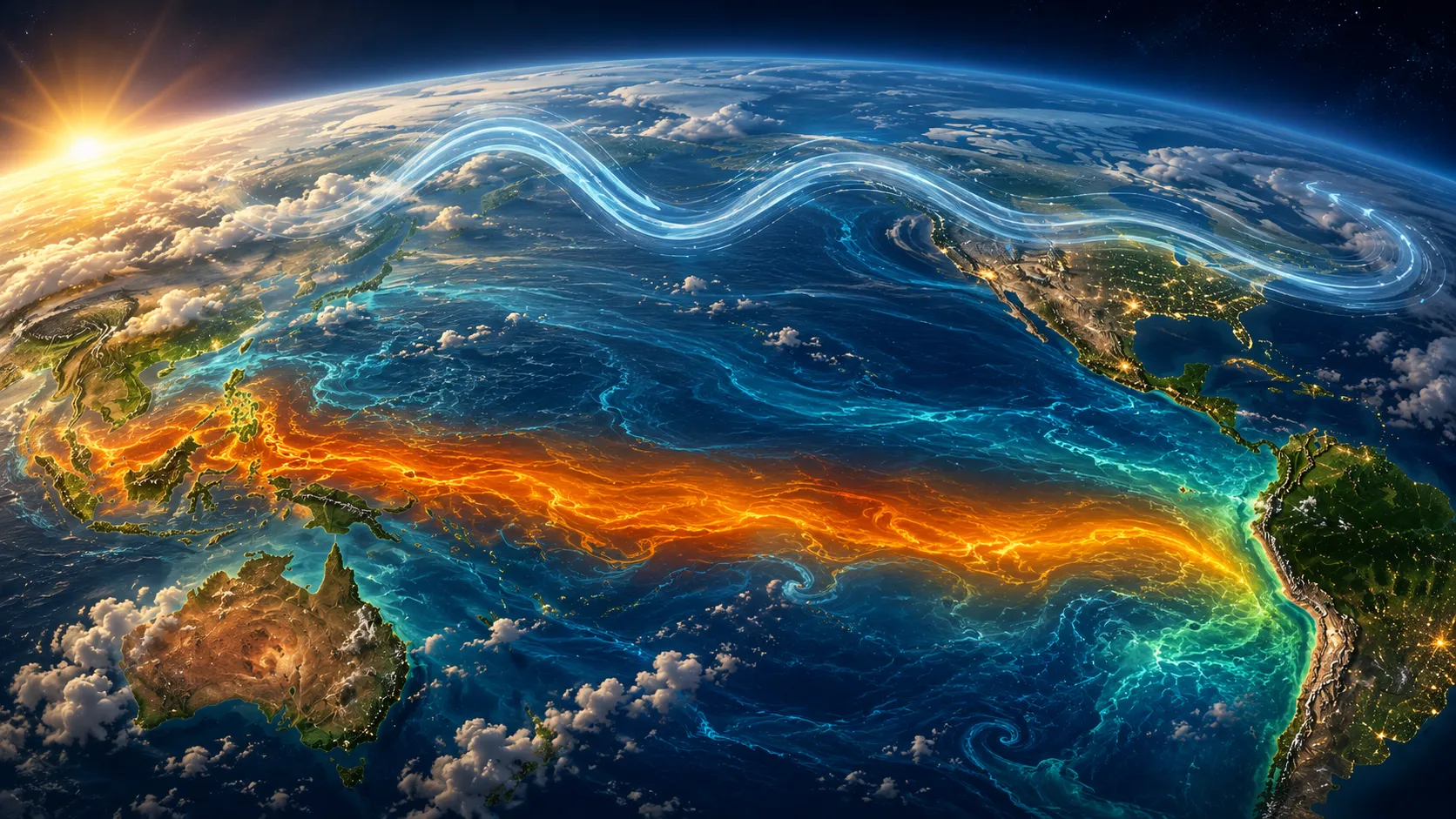
Thousands of miles from the nearest city, far out across the equatorial Pacific Ocean, a slow but powerful shift is underway. There are no towering storm clouds visible from shore and no dramatic weather event signaling its arrival. Yet beneath the ocean’s surface, an immense reservoir of unusually warm water is steadily reorganizing one of Earth’s most important climate systems, setting the stage for the 2026 El Niño.
Scientists have watched this process unfold many times before. It is known as El Niño—a naturally recurring climate pattern capable of influencing rainfall, temperatures, storm tracks, agriculture, fisheries, water supplies, and energy demand across much of the globe. While every El Niño is different, forecasts now suggest the 2026 event could become one of the strongest observed in modern history, prompting governments, farmers, emergency planners, insurers, and scientists to watch conditions with unusual attention.
The reason is not that El Niño guarantees catastrophe. Rather, it serves as a reminder of how deeply interconnected our modern world has become. A shift in one ocean basin can eventually influence food production in Asia, drought conditions in Australia, rainfall across North America, fisheries along South America, insurance markets, transportation networks, and even grocery prices half a world away.
Understanding those connections may be just as important as understanding the weather itself.
What Is El Niño?
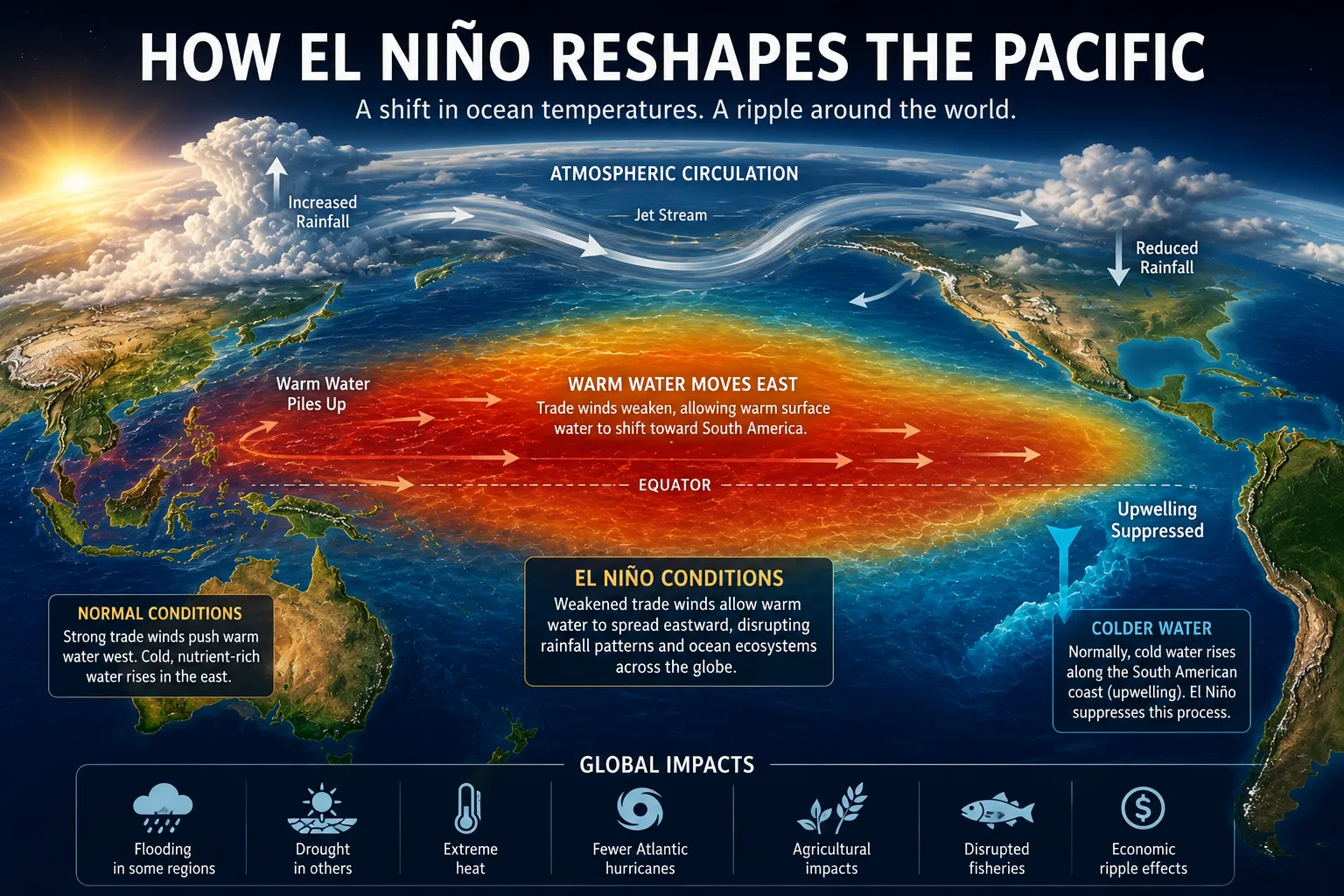
Under normal conditions, steady trade winds push warm surface water westward across the tropical Pacific toward Indonesia and Australia. As that warm water moves away from the coast of South America, colder, nutrient-rich water rises from the deep ocean in a process known as upwelling, supporting one of the world’s richest marine ecosystems.
During an El Niño, those trade winds weaken. The warm water that has accumulated in the western Pacific gradually moves back toward the central and eastern Pacific, suppressing the normal upwelling of colder water and releasing enormous amounts of stored heat into the atmosphere.
Because the Pacific Ocean covers nearly one-third of the Earth’s surface, that shift alters atmospheric circulation on a planetary scale. Jet streams migrate, rainfall patterns change, temperatures rise or fall in different regions, and weather systems begin behaving differently across multiple continents.
Scientists have monitored this cycle for decades, and while its basic mechanics are well understood, every El Niño develops differently. Its ultimate impacts depend upon ocean temperatures, atmospheric conditions, regional climate patterns, and countless interactions occurring throughout the global climate system.
Why the 2026 El Niño Is Different
El Niño is not unusual.
A very strong El Niño is.
Climate scientists continue monitoring oceanic and atmospheric conditions as unusually warm water expands beneath the surface of the equatorial Pacific. Current forecasts from NOAA and the World Meteorological Organization indicate a high probability that the developing 2026 El Niño will strengthen significantly through the second half of 2026 and persist well into 2027.
Some media outlets have adopted the phrase “Super El Niño” to describe these projections, although it is not an official scientific classification. Meteorologists instead refer to events as weak, moderate, strong, or very strong based on observed sea surface temperature anomalies. Current model guidance suggests the 2026 El Niño may ultimately rank among the strongest measured during the modern observational era.
Even so, scientists remain appropriately cautious.
Climate forecasting deals in probabilities rather than certainty. A powerful El Niño increases the likelihood of certain weather patterns, but it does not determine exactly how every season or every region will unfold. Other climate oscillations, ocean temperatures, atmospheric circulation, and regional conditions continue influencing local weather.
What forecasters do agree upon is that the 2026 El Niño deserves close observation because of its potential to influence multiple global systems simultaneously.
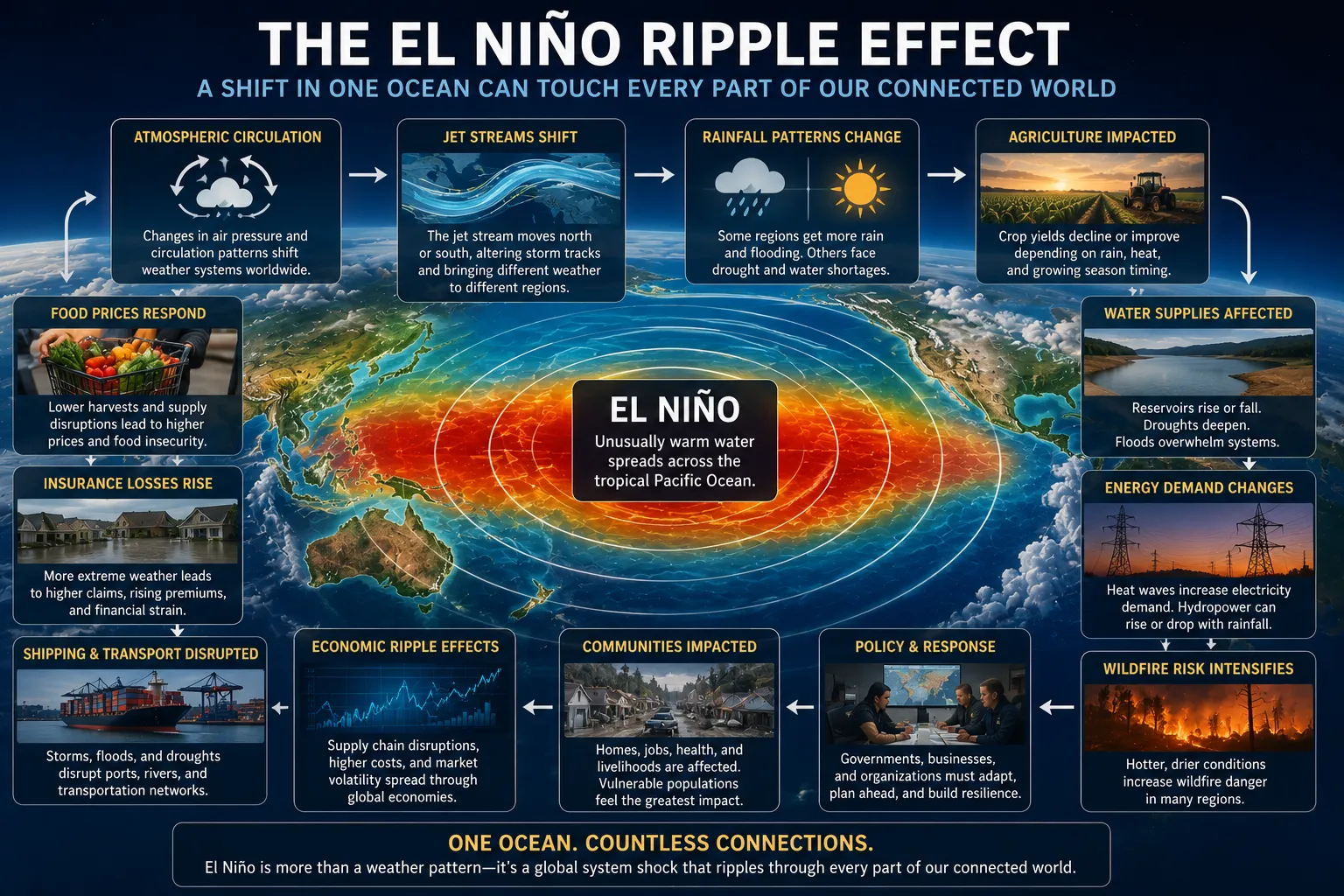
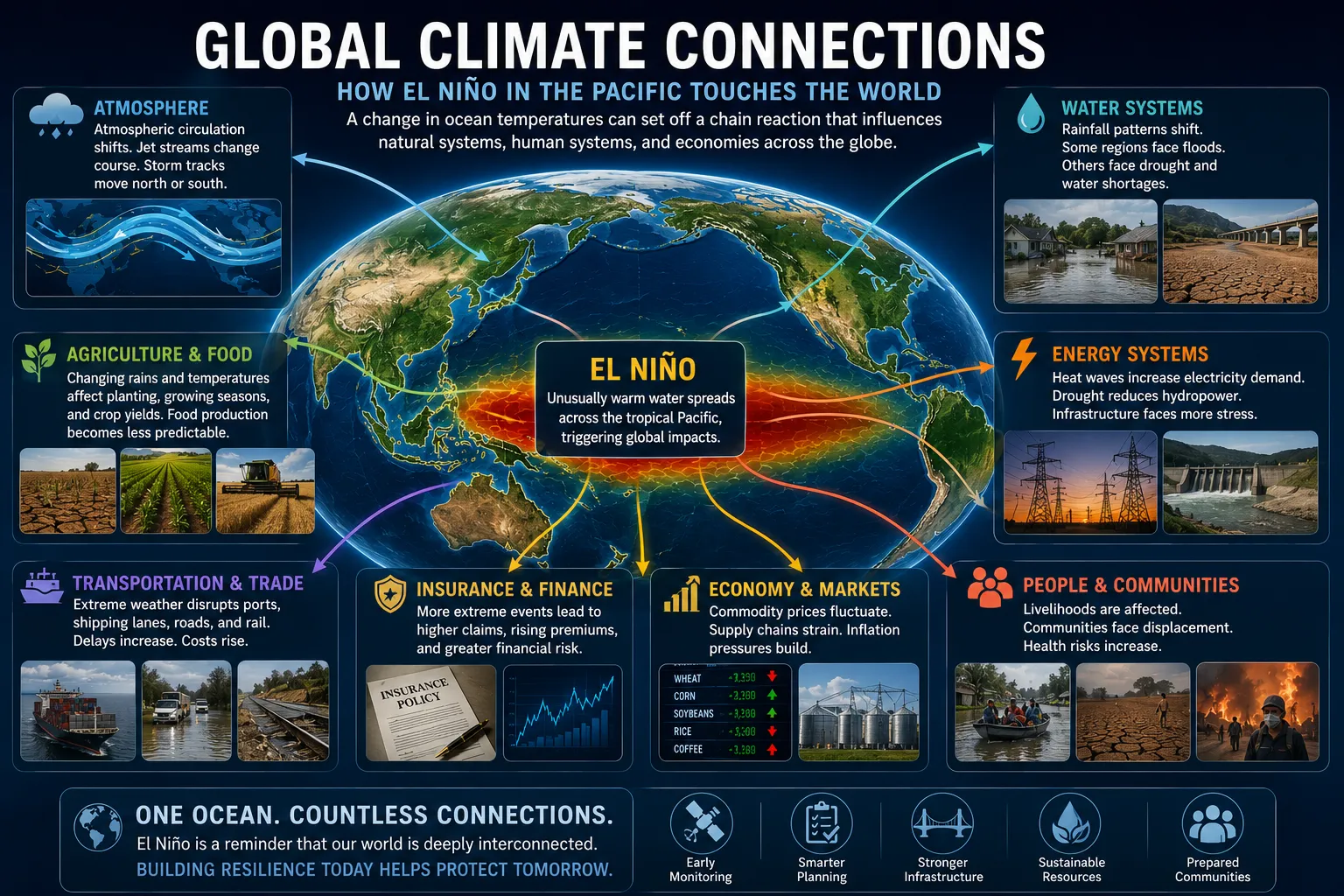
Perhaps the most remarkable aspect of El Niño is not the weather it produces, but the chain reaction it sets into motion. What begins as a gradual warming of surface waters across the tropical Pacific eventually reshapes atmospheric circulation on a planetary scale. Jet streams shift their usual paths, storm tracks migrate, and rainfall patterns begin changing in regions thousands of miles apart. Some areas receive abundant rainfall while others slip into prolonged drought. Reservoirs fill in one part of the world as water shortages deepen in another. Growing seasons are altered, wildfire conditions intensify, and communities accustomed to predictable seasonal patterns suddenly find themselves adapting to very different conditions.
The ripple effects extend far beyond weather itself. Agriculture responds to changing rainfall and temperatures. Energy systems experience increased demand during prolonged heat events. Rivers that support transportation and commerce rise or fall with changing precipitation, while insurance companies, commodity markets, and emergency planners begin adjusting to a landscape where risks are shifting. What initially appears to be an isolated oceanic event gradually reveals itself as something much larger—a reminder that modern civilization operates through an intricate network of interconnected systems, each influencing the others in ways that are not always immediately visible.
Over the past century, our world has become increasingly efficient, but that efficiency has also created greater interdependence. Global supply chains span continents, agricultural production has become concentrated within relatively few growing regions, and energy, transportation, and manufacturing all depend upon relatively stable environmental conditions. When one of Earth’s largest climate systems begins to change, those interconnected networks often feel the effects long before the public fully recognizes what is happening.
That is why governments, agricultural markets, insurers, utility companies, emergency managers, and infrastructure planners monitor El Niño so closely. They understand that the weather itself is only one part of the story. The greater challenge lies in understanding how changes within one natural system can ripple outward through the many human systems that depend upon it.
Agriculture and the World’s Breadbaskets
Food is often where these interconnected systems become most visible.
Even a strong 2026 El Niño does not automatically produce global food shortages, nor does it guarantee widespread crop failure. Modern agriculture depends upon many variables, including irrigation, soil conditions, fertilizer availability, transportation, energy costs, government policy, and local weather.
Nevertheless, prolonged shifts in rainfall and temperature can place additional stress on regions responsible for producing much of the world’s food.
Today, global agricultural production is highly concentrated. A relatively small number of countries produce a significant share of internationally traded corn, soybeans, wheat, rice, sugar, and other essential crops. If several of these regions experience drought, excessive rainfall, flooding, or heat during the same growing season, markets can respond quickly through higher prices and increased volatility.
History offers useful perspective. One of the strongest El Niño events on record coincided with widespread drought and famine during the late 1870s. Historians are careful to note that weather alone did not cause that tragedy. Colonial policies, poverty, political decisions, inadequate transportation, and unequal food distribution all contributed significantly to the humanitarian crisis.
The lesson is not that history will repeat itself.
Rather, it reminds us that environmental stress often exposes vulnerabilities already present within human systems, a theme we explore further in Extreme Weather Explained and our August Global Weather Watch.
What Scientists Are Really Watching
Although headlines often focus on record temperatures, dramatic storms, or individual weather events, the scientific community is asking a much broader question. Rather than concentrating on isolated extremes, researchers are increasingly studying the resilience of the systems that support modern society and how well those systems respond when environmental conditions become less predictable.
How will water resources respond if rainfall shifts significantly from historical averages? Can agricultural regions adapt if multiple growing seasons experience unusual heat or drought? Will electrical grids withstand sustained periods of extreme demand? How resilient are transportation networks, emergency services, and critical infrastructure if several climate-related challenges unfold simultaneously rather than one at a time? These are the questions driving much of today’s research because they move beyond forecasting individual weather events and toward understanding society’s capacity to adapt.
In many ways, this represents an important shift in perspective. The conversation is becoming less about predicting exactly where the next storm or heat wave will occur and more about evaluating the resilience of the systems that sustain our communities. The developing 2026 El Niño serves as a reminder that preparedness is not simply about responding to the next weather event—it is about strengthening the interconnected networks that allow societies to continue functioning when conditions inevitably change.
The GAR Perspective
One of the defining characteristics of our time is not simply that individual events are becoming more complex, but that they are becoming increasingly interconnected. The developing 2026 El Niño offers a powerful example. What begins as a shift in ocean temperatures thousands of miles away can eventually influence agriculture, water resources, energy demand, transportation, insurance markets, and communities around the world.
That is why this story matters. It is not about predicting catastrophe or amplifying alarming headlines. It is about recognizing how modern civilization functions as a connected system, where changes in one region often ripple outward in unexpected ways. Understanding those connections allows governments, businesses, and individuals to prepare thoughtfully rather than react impulsively.
Whether the 2026 El Niño ultimately ranks among the strongest on record will become clear only with time. What is already clear, however, is the value of early observation. Advances in satellite monitoring, ocean science, and climate forecasting provide opportunities that previous generations never had—to anticipate challenges, strengthen resilience, and make more informed decisions before disruptions occur.
Perhaps that is the broader lesson. Resilience is not built during a crisis; it is built beforehand. And the more we understand the interconnected systems that sustain modern life, the better prepared we are to navigate whatever conditions the future may bring.
Sign up to receive Our Weekly Briefing Newsletter
Begin your journey with weekly insights designed to expand awareness and ground you in truth. Our free tier gives you a powerful introduction without any commitment.
STOP DROWNING IN THE NOISE. START SEEING THE TRUTH. Join over 99,000 truth seekers. Get the essential intelligence, alternative news, and disclosure updates that the mainstream media won’t touch.
Latest Reports
 Weekly ReportAwakening The Sleeping Giant · October 12th EditionOctober 12, 2026
 Monthly ReportConscious Practices · October 2026 EditionOctober 5, 2026
 Weekly ReportAwakening The Sleeping Giant · October 5th EditionOctober 5, 2026
 Weekly ReportAwakening The Sleeping Giant · September 28th EditionSeptember 28, 2026View all weekly reports
Special Reports
 Special ReportTHE AWAKENING JOURNEY: Hero’s Journey Part II · Week 1October 3, 2026
 Special ReportGlobal Everything Collapse · Economic Chaos · Part IOctober 1, 2026
 Special ReportCreating A Conscious Culture · Part ISeptember 3, 2026
 Special ReportThe Great Healing: Detox, Defense & Sovereignty In an Engineered World · Part ISeptember 1, 2026View all special reports
Help Us Bypass Censorship. Share This.
Join the Discussion
Related Posts

Have questions?
At Great Awakening Report, we are dedicated to supporting your journey toward truth and enlightenment through our specialized Coaching and Consulting services.
Coaching Services: Our coaching programs are designed to guide you through personal awakening and transformation. We offer personalized sessions that focus on expanding consciousness, uncovering hidden truths, and fostering spiritual growth. Our experienced coaches provide the tools and insights necessary to navigate your path with clarity and confidence.
Consulting Services: For organizations and individuals seeking deeper understanding and strategic guidance, our consulting services offer expert analysis and solutions. We delve into areas such as global transitions, alternative news insights, and consciousness studies to provide comprehensive strategies tailored to your unique objectives.
Embark on a transformative journey with our Coaching and Consulting services, and unlock your highest potential. To learn more and schedule a session, visit our Coaching and Consulting pages.
Thank you
Thank you to our subscribers and readers for your continued support and dedication to truth and awakening. Your encouragement, engagement, and belief in our mission make everything we do possible. Together, we are expanding awareness and helping illuminate the path forward.
If you would like to further support the Great Awakening team and our ongoing efforts to share insight, knowledge, and truth, you can DONATE HERE.
With deep gratitude,
– Great Awakening Team
About the Author: Great Awakening Team

We are a community. We are cultural creatives and like minded people seeking the truth and focusing on disclosure, awakening and consciousness. Our focus is real news as researchers, reporters and truth seekers. We are here to teach, to spread the word, to serve and to help. We are a collective, a movement, free from all programing, not closed minded and not discriminatory. We are not political. We are not religious but we are spiritual. We study, research, and report on a wide range of subjects and topics, from the current geopolitical climate to health and wellness, from earth’s history to spiritual practices. We are forward thinkers and visionaries, we are guides for the transition as we usher in The Great Awakening.
THIS WEBSITE DOES NOT PROVIDE MEDICAL ADVICE: The information, including but not limited to text, graphics, images, and other material contained on this website, are for informational purposes only. No material on this site is intended to be a substitute for professional medical advice, diagnosis, or treatment. Always seek the advice of your physician or other qualified health care provider with any questions you may have regarding a medical condition or treatment and before undertaking a new health care regimen, and never disregard professional medical advice or delay in seeking it because of something you have read on this website.
DISCLAIMER: All statements, claims, views and opinions that appear anywhere on this site, whether stated as theories or absolute facts, are always presented by The Great Awakening Report (GAR) as unverified—and should be personally fact checked and discerned by you, the reader.Any opinions or statements herein presented are not necessarily promoted, endorsed, or agreed to by GAR, those who work with GAR, or those who read or subscribe to GAR.Any belief or conclusion gleaned from content on this site is solely the responsibility of you the reader to substantiate.Any actions taken by those who read material on this site are solely the responsibility of the acting party.You are encouraged to think for yourself and do your own research.Nothing on this site is meant to be believed without question or personal appraisal.
COPYRIGHT DISCLAIMER: Citation of articles and authors in this report does not imply ownership. Works and images presented here fall under Fair Use Section 107 and are used for commentary on globally significant newsworthy events. Under Section 107 of the Copyright Act 1976, allowance is made for fair use for purposes such as criticism, comment, news reporting, teaching, scholarship, and research.
COMMUNITY GUIDELINES DISCLAIMER: The points of view and purpose of this video is not to bully or harass anybody, but rather share that opinion and thoughts with other like-minded individuals curious about the subject.