
























Help Us Bypass Censorship. Share This.
Sign up to receive Our Weekly Briefing Newsletter
Begin your journey with weekly insights designed to expand awareness and ground you in truth. Our free tier gives you a powerful introduction without any commitment.
EXPLORING THE PHILADELPHIA EXPERIMENT, PROJECT PHOENIX, THE MONTAUK BOYS & ALLEGED TIMELINE MANIPULATION
“The greatest mysteries are not always found in what history remembers, but in what may have been deliberately left outside the record.” — Great Awakening Report
THE MYSTERY BENEATH MONTAUK
At the easternmost tip of Long Island, where the Atlantic Ocean meets a rugged stretch of coastal bluffs, stands one of the most unusual remnants of America’s Cold War military history. Rising above the surrounding landscape is an enormous radar tower, its weathered steel structure a reminder of an era when national security, technological experimentation, and government secrecy became deeply intertwined.
Today, the surrounding property is known as Camp Hero State Park. Visitors come for the ocean views, wooded trails, and remnants of a military installation that once helped defend the northeastern United States. Yet beyond its documented history, Camp Hero has become associated with something considerably more mysterious: allegations of classified experiments involving electromagnetic technology, human consciousness, psychological conditioning, and the manipulation of time itself.
Collectively known as the Montauk Project, these accounts describe a secret research program reportedly operating during the 1970s and early 1980s. According to individuals who claimed involvement, the experiments grew out of earlier military investigations into radar invisibility, electromagnetic fields, and the possibility that consciousness could interact with physical reality in ways conventional science had not yet explained.
The story entered public awareness primarily through the work of Preston Nichols and Peter Moon, whose 1992 book The Montauk Project: Experiments in Time introduced readers to an extraordinary world of underground laboratories, psychic experimentation, time tunnels, and individuals whose memories allegedly had been deliberately suppressed. Other witnesses, including Al Bielek, Duncan Cameron, and later Larry James, expanded the narrative with accounts of covert operations, temporal manipulation, and attempts to influence historical events.
What makes the Montauk story particularly compelling is the historical environment in which these allegations emerged. The United States had already conducted classified human experimentation through programs such as MKUltra and Project Artichoke, while intelligence agencies spent decades investigating remote viewing and other unconventional methods of gathering information. Operation Paperclip had brought German scientists into American research institutions following World War II, and the expanding national security establishment operated through increasingly complex networks of classified programs and restricted funding.
These documented activities do not establish that the extraordinary experiments attributed to Montauk occurred. They do, however, provide a historical backdrop in which questions about secrecy, technological ambition, and the boundaries of government authority deserve serious consideration.
And at the center of the Montauk mystery lies a question that reaches far beyond one abandoned military installation: What happens when the pursuit of technological power begins to extend into the human mind, the nature of reality, and potentially the course of history itself?
CAMP HERO | THE MILITARY INSTALLATION BEHIND THE MYSTERY
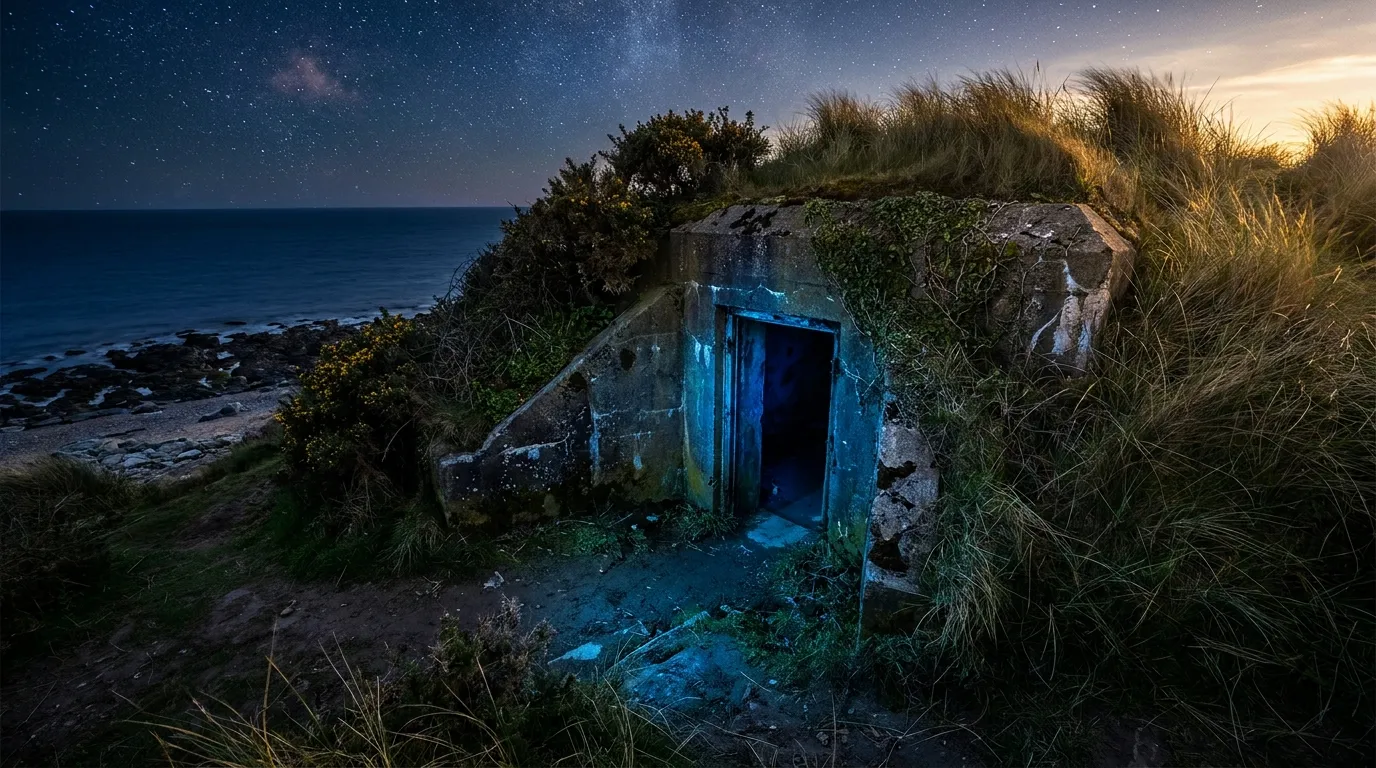
Long before Montauk became associated with time travel and psychic warfare, Camp Hero served an important military purpose. Established during World War II, the installation formed part of the coastal defense network protecting New York Harbor and Long Island Sound. Its artillery batteries, fortified bunkers, and support facilities were designed to respond to the possibility of enemy attacks along the Atlantic coastline.
Some buildings were constructed to resemble ordinary civilian structures, helping the installation blend into its surroundings. Beneath this seemingly quiet coastal setting existed the infrastructure of a substantial military operation, including hardened positions, communications facilities, and restricted areas.
As World War II gave way to the Cold War, the site’s mission changed. Camp Hero became associated with Montauk Air Force Station, an air-defense installation responsible for monitoring potential Soviet aircraft approaching American airspace. Its most recognizable feature was the AN/FPS-35 radar system, a massive antenna mounted above a concrete tower that remains visible from miles away.
The installation’s radar capabilities, electrical infrastructure, and relative isolation would later become central elements of the Montauk narrative. According to Preston Nichols and other witnesses, the powerful radar equipment was allegedly adapted for purposes extending far beyond conventional aircraft detection.
Their accounts described experiments involving electromagnetic transmissions, psychological influence, and the interaction between human consciousness and sophisticated electronic systems. The radar installation, in this telling, became part of a larger technological network capable of transmitting unusual forms of energy and influencing the minds of experimental subjects.
The Air Force station officially closed in 1981, and the surrounding land eventually became Camp Hero State Park, which opened to the public in 2002. The timing of that closure has attracted attention because several Montauk witnesses described activities continuing into August 1983, suggesting that any such operations would have occurred outside the site’s acknowledged military mission.
Visitors today can observe the imposing radar tower and portions of the former installation, although old military structures and restricted areas remain inaccessible. The physical remnants offer a tangible connection to the Cold War, while the allegations surrounding the site continue to inspire investigations into what may have occurred beyond the public record.
THE PHILADELPHIA EXPERIMENT & PROJECT PHOENIX | THE ROAD TO MONTAUK
To understand the origins of the Montauk narrative, it is necessary to return to an earlier and equally controversial episode in American military lore: the Philadelphia Experiment.
According to accounts that began circulating publicly in the 1950s, the United States Navy conducted an experiment in 1943 involving the USS Eldridge, a destroyer escort allegedly subjected to powerful electromagnetic fields in an attempt to make the vessel invisible to enemy detection.
The story eventually expanded beyond radar invisibility. Witness accounts described a ship that vanished from its physical location, strange luminous effects surrounding the vessel, and severe physical and psychological consequences for members of the crew. Later interpretations suggested that the experiment had unintentionally interfered with space-time, producing effects far beyond the original objective.
The Navy has not substantiated these extraordinary claims, and the historical origins of the Philadelphia Experiment remain disputed. Nevertheless, the account became a foundational element of the Montauk story through the testimony of Al Bielek and Duncan Cameron.
Bielek claimed that the Philadelphia Experiment had created a connection between two different periods: August 1943 and August 1983. According to his account, he and Duncan Cameron became involved in an event that transported them from the wartime experiment into the future, where researchers at Montauk were conducting related investigations.
In one version of the testimony, the men reportedly encountered an older John von Neumann, the mathematician whose work contributed to computing, game theory, and numerous scientific disciplines. Von Neumann allegedly informed them that they had arrived forty years beyond their original departure point.
This element of the account is historically problematic because von Neumann died in 1957, decades before the alleged 1983 encounter. Within the Montauk narrative, however, witnesses offered explanations involving unconventional technology, altered identities, and temporal displacement. These remain parts of their testimony rather than independently established biographical events.
The broader story continues through a series of alleged research initiatives collectively described as Project Phoenix.
Following World War II, American intelligence and military institutions rapidly expanded their scientific capabilities. Operation Paperclip recruited German specialists, while facilities such as Brookhaven National Laboratory and Los Alamos became important centers of advanced research. The CIA and other agencies also began exploring behavioral influence, psychological conditioning, and unconventional intelligence techniques.
According to Nichols and Bielek, elements of these research directions eventually converged in programs concerned with the interaction between electromagnetic technology and human consciousness. Their accounts described Project Phoenix as an effort to explore whether electrical and electromagnetic systems could influence perception, emotional states, memory, and psychic functioning.
The alleged research eventually moved toward Montauk, where the radar installation was said to provide capabilities useful for transmitting powerful electromagnetic signals. Nichols described a progression from experiments involving behavioral influence toward increasingly ambitious attempts to amplify psychic abilities and manipulate physical reality.
Within this narrative, the objective was no longer simply to control what a person perceived or remembered. Researchers were allegedly investigating whether consciousness itself could become an instrument capable of affecting matter, space, and time.
That possibility would become the defining concept behind the Montauk Chair.
THE MONTAUK CHAIR | TECHNOLOGY, THOUGHT & MANIFESTATION
Among the many devices described by Montauk witnesses, none became more closely associated with the project than the Montauk Chair.
According to Preston Nichols, the chair was designed to amplify the mental and psychic abilities of a human subject through a combination of specialized electronics, electromagnetic fields, and transmitting equipment. The system reportedly translated the subject’s mental activity into signals that could be strengthened and projected beyond the immediate environment.
Duncan Cameron was frequently identified as one of its principal operators. Witnesses described Cameron entering altered states of consciousness while connected to the apparatus, visualizing objects or situations that researchers then attempted to detect, influence, or manifest through the surrounding technology.
The alleged experiments progressed from thought projection and remote perception toward increasingly unusual results. Some accounts described mental images appearing on electronic equipment, while others claimed that objects or environments could be influenced through focused consciousness amplified by the chair.
As the narrative developed, researchers allegedly discovered that the same principles might allow them to affect the structure of space-time. Rather than merely transmitting thoughts across distance, the system was said to establish openings into other locations or historical periods.
These claims represent a dramatic departure from established scientific capabilities, and no authenticated technical demonstration of the Montauk Chair has entered the public record. Nevertheless, the underlying relationship between consciousness and technology remains one of the story’s most fascinating dimensions.
Modern neuroscience has demonstrated that brain activity can be measured and translated into commands for external devices, while brain-computer interfaces continue to expand the possibilities for communication between the nervous system and machines. Such developments do not validate the extraordinary capabilities attributed to Montauk, but they illustrate how the relationship between thought and technology has become a legitimate area of scientific investigation.
The Montauk accounts take that relationship into far more speculative territory, suggesting that consciousness might function not simply as a biological process but as an active component in the structure of physical reality.
If such a capability were ever demonstrated, its implications would extend well beyond scientific discovery. The ability to amplify or manipulate human thought would raise profound questions about privacy, autonomy, consent, and the ethical boundaries of technological development.
And according to the Montauk witnesses, those ethical boundaries were already being crossed.

THE MONTAUK BOYS | MIND CONTROL & HUMAN EXPERIMENTATION
Perhaps the most disturbing allegations associated with the Montauk Project concern the treatment of children and adolescents reportedly used as experimental subjects.
The term Montauk Boys became associated with accounts of young people allegedly recruited, abducted, or otherwise brought into classified programs involving psychological conditioning, psychic experimentation, and behavioral manipulation.
Al Bielek and several later witnesses described techniques intended to fragment memory, create dissociative states, and establish patterns of obedience through severe psychological trauma. Some claimed that children with particular psychic abilities or psychological characteristics were selected for experiments involving the Montauk Chair and other technologies.
Bielek further alleged that the programs extended beyond the Montauk installation and involved networks of facilities operating in different parts of the United States. In a 1997 interview, he claimed that millions of children had been subjected to related forms of programming. That figure remains an unsubstantiated assertion from his testimony, rather than a documented estimate.
The accounts also describe alleged efforts to develop individuals capable of carrying out assignments without conscious recollection of their training or instructions. Within the Montauk narrative, psychological conditioning, memory suppression, and electromagnetic influence were presented as interconnected methods of controlling human behavior.
These allegations are serious, particularly because they involve children and claims of abuse. They warrant careful attribution rather than being treated as established events. Yet the broader historical context reveals why accounts of clandestine psychological experimentation cannot be dismissed simply because they involve government secrecy.
The CIA’s MKUltra program, initiated in 1953, investigated methods of influencing human behavior through psychoactive substances, hypnosis, psychological manipulation, and other techniques. Some experiments were conducted without the knowledge or consent of the individuals involved.
Project Artichoke, an earlier CIA initiative, explored interrogation methods and the possibility of influencing subjects through combinations of psychological and chemical techniques. The existence of these programs became publicly established through investigations and surviving records, particularly during the 1970s. Much of the MKUltra documentation had been destroyed in 1973, leaving significant gaps in the historical record.
The government also supported research into remote viewing and other alleged psychic abilities through programs eventually associated with Project STARGATE. These investigations continued for decades before portions of the research were declassified in the 1990s.
The documented history establishes that American intelligence agencies explored both psychological manipulation and unconventional aspects of human perception. It does not independently confirm the specific Montauk Boys allegations, but it provides an important foundation for understanding the environment in which those claims emerged.
The central ethical concern extends beyond whether every reported experiment can be verified. It concerns the willingness of powerful institutions to treat human consciousness, psychological vulnerability, and bodily autonomy as resources available for exploitation. When research is conducted without meaningful oversight or informed consent, the distinction between scientific exploration and institutional abuse can disappear.
For GAR, the Montauk Boys accounts bring the investigation back to one of its most important themes: human sovereignty begins with the right to control one’s own body, mind, and consciousness.
PHOENIX III | TIME TRAVEL, MEMORY & COMPETING REALITIES
According to Montauk witnesses, the research eventually entered a phase known as Phoenix III, during which experiments involving psychic amplification and electromagnetic technology reportedly evolved into attempts to manipulate time itself.
The accounts describe a system capable of creating openings into different temporal locations, allowing individuals to travel into the past or future. Some witnesses claimed these passages could be used for reconnaissance, the retrieval of information, and the introduction of advanced technology into earlier historical periods.
The alleged connection between August 1943 and August 1983 became particularly significant. Bielek and Cameron described these dates as linked through the electromagnetic experiments associated with the Philadelphia Experiment and the later activities at Montauk.
Within their interpretation, the two projects had created a temporal relationship that allowed events separated by forty years to interact.
The reported culmination occurred in August 1983, when experiments allegedly became unstable and the project was brought to an abrupt end. Different witnesses described the circumstances in different ways, including accounts of equipment failures, uncontrolled manifestations, and efforts to shut down the system.
The story also introduced the possibility that individuals participating in the experiments might experience fragmented memories or conflicting personal histories. Preston Nichols described gradually recovering memories of activities he believed had been concealed through psychological programming. Other participants reported missing time, altered identities, and recollections that seemed inconsistent with their ordinary lives.
Within the Montauk framework, such experiences were sometimes interpreted as consequences of temporal displacement or deliberate memory manipulation.
The reliability of recovered memories is a complicated psychological issue, and recollection alone cannot establish that time travel occurred. Nevertheless, memory and identity became central themes in the testimony, particularly as witnesses attempted to reconstruct experiences they believed had been hidden from conscious awareness.
The accounts also raise philosophical questions about the nature of time. Human beings ordinarily experience history as a continuous progression from past to present to future, yet modern physics has demonstrated that time is not entirely independent of motion, gravity, and the structure of space-time.
That scientific understanding does not establish the existence of operational time portals. It does, however, remind us that the nature of time is more complex than everyday experience suggests.
The Montauk witnesses proposed an extraordinary extension of that complexity: the possibility that advanced technology could allow historical events to be revisited, observed, or deliberately altered.
Few individuals described that alleged capability more directly than Larry James.
LARRY JAMES | THE MAN WHO CLAIMED HISTORY COULD BE CHANGED
In a recorded interview conducted in 2000 by Michael Houtzager, engineer Larry James described his alleged involvement in time-travel operations associated with the Montauk Project. Unlike accounts focused primarily on experimental subjects or the technological apparatus, James presented himself as someone involved in directing operations and evaluating the consequences of interventions in historical events.
His testimony introduced an especially provocative possibility: that researchers were not simply traveling through time to observe the past, but deliberately changing events to study how different historical outcomes might reshape the future.
One of his most extraordinary claims concerned World War II. James stated that the project had conducted an experiment in which personnel intervened in the historical timeline to produce a German victory. According to his account, the operation involved substantial resources and coordinated efforts to influence military and political developments.
He described the introduction or acceleration of technologies that could have altered the balance of power, including advanced aircraft, long-range bombers, infrared equipment, and developments in nuclear research.
James suggested that Germany’s wartime technological programs offered opportunities for intervention, particularly in areas where successful development might have produced significant strategic advantages. The purpose, he claimed, was to observe what would happen if the outcome of World War II were fundamentally different.
After examining the consequences of that alternate history, James said the project undertook further interventions to restore the original outcome, in which Germany was defeated.
The implications of this testimony are remarkable. Within James’s account, the past was not treated as a fixed sequence of events but as an environment in which researchers could introduce changes, examine the resulting future, and potentially reverse their actions.
He also described unconventional methods of financing the alleged operations. According to James, personnel could exploit knowledge of future economic developments by acquiring property and other assets in earlier periods, then benefiting from their appreciation decades later. He additionally claimed that valuable assets, including gold associated with wartime activities, had been diverted to support the program.
These claims have not been independently verified, and the historical record does not establish that World War II was altered through time travel. Yet the interview reveals the extraordinary scope of the operations James believed he had participated in.
His testimony also extended to the assassination of President John F. Kennedy.
James claimed that researchers had explored an alternate historical outcome in which Kennedy survived November 22, 1963. In his account, that intervention produced substantial changes in subsequent American history, including developments involving the Vietnam War, government institutions, and the country’s economic trajectory. The central premise was that preventing one event could create a cascade of consequences extending far beyond the original intervention.
James’s descriptions suggested that researchers evaluated these alternative outcomes not simply in terms of individual events but through their broader effects on political, military, and economic systems.
This introduced a difficult philosophical question: even if an event could be changed, how could anyone determine whether the resulting future would ultimately be better?
A seemingly beneficial intervention might produce unintended consequences decades later, while an apparently disastrous event could influence developments that would otherwise never occur.
James further claimed that repeated interventions at the same historical point could destabilize the timeline itself.
He described the possibility of temporal fractures arising when too many changes were introduced into a particular period or reality. Although he acknowledged that he had not personally witnessed an entire reality being destroyed, he suggested that unstable timelines could produce unusual sensations and potentially dangerous consequences.
Within his account, time travel therefore carried limitations and risks. The ability to revisit historical events did not necessarily imply complete control over their consequences. These allegations remain unverified, but they expand the Montauk narrative beyond experiments in psychic abilities or electromagnetic technology into the possibility of deliberate historical engineering.
They also introduce a larger question concerning power. If a government, intelligence organization, or private institution ever possessed the capability to alter historical events, who would determine which outcomes should be preserved, which should be changed, and whose interests would guide those decisions?
The concept reaches beyond technological capability into the fundamental relationship between authority, collective memory, and human freedom.

WHY THE MONTAUK PROJECT CONTINUES TO MATTER
The Montauk Project occupies an unusual position between documented Cold War history, personal testimony, speculative technology, and the enduring mystery of human consciousness.
Its physical setting is real. The government’s history of classified psychological experimentation is documented. Research into remote viewing and unconventional intelligence techniques took place over several decades.
Beyond those established facts lies a collection of extraordinary accounts describing technologies and operations that have not been publicly substantiated.
What gives the Montauk narrative its staying power is not simply the possibility of time travel or the existence of hidden laboratories. It is the convergence of several profound questions about the nature of reality and the responsibilities of those who possess advanced technological capabilities.
The story asks whether consciousness can interact with technology in ways not yet fully understood, whether psychological conditioning can be used to override individual autonomy, and whether institutions operating beyond public accountability might pursue experiments that society would otherwise reject.
These questions remain relevant as neuroscience, artificial intelligence, biotechnology, and increasingly sophisticated behavioral technologies continue to develop.
Modern systems already possess capabilities for monitoring attention, influencing behavior, analyzing neurological activity, and translating certain brain signals into machine commands. While these developments are fundamentally different from the extraordinary technologies described in the Montauk accounts, they raise legitimate concerns about privacy, informed consent, and the boundaries of human autonomy.
The Montauk story has also left a significant cultural imprint. The creators of Stranger Things originally developed the series under the working title Montauk, incorporating themes involving secret laboratories, children with unusual abilities, and openings into other dimensions.
Yet the enduring fascination with Montauk reaches beyond popular entertainment.
For many, the story represents a larger concern about the distance between publicly acknowledged technological capabilities and research conducted within classified institutions. For others, it raises questions about consciousness, the nature of time, and the possibility that reality contains dimensions not yet understood.
The most useful approach is neither automatic acceptance nor reflexive dismissal, but sustained curiosity grounded in an awareness of how secrecy, testimony, and documented history intersect.
CLOSING REFLECTIONS | WHO CONTROLS THE FUTURE?
History is often presented as a sequence of settled events, preserved through documents, institutions, and collective memory. Yet history also contains hidden operations, classified programs, destroyed records, and revelations that emerge only decades after the events themselves.
The Montauk Project sits at the intersection of these realities.
The testimony of Preston Nichols, Al Bielek, Duncan Cameron, Larry James, and others presents an extraordinary narrative involving electromagnetic technology, consciousness, psychological manipulation, time travel, and the alleged alteration of historical events. Some of the broader programs and institutions surrounding these accounts are documented, while the most remarkable claims remain unresolved.
Perhaps the most important question raised by Montauk is not simply whether human beings can travel through time, but what would happen if such capabilities were ever developed and concentrated in the hands of a few.
Would they serve discovery, healing, and the advancement of humanity? Or would they become another means of influencing history, controlling populations, and determining which futures are permitted to unfold?
The same question applies to technologies already emerging in our own time. Scientific progress offers extraordinary opportunities, but technological capability alone does not guarantee ethical responsibility. Without transparency, meaningful oversight, and respect for individual autonomy, even remarkable discoveries can become instruments of control.
Ultimately, the Montauk story returns us to a principle that transcends any particular experiment or technology.
The future of humanity should never belong exclusively to those who possess the greatest power. It should remain rooted in consciousness, individual sovereignty, ethical responsibility, and the freedom to choose what comes next.
FREQUENTLY ASKED QUESTIONS
What was the Montauk Project?
The Montauk Project refers to alleged secret experiments involving mind control, psychic abilities, electromagnetic technology, and time travel, reportedly conducted at or connected to Camp Hero on Long Island.
Is Camp Hero a real military installation?
Yes. Camp Hero served as a World War II coastal defense installation and later as Montauk Air Force Station, a Cold War radar facility. The property is now part of Camp Hero State Park.
What is the connection between the Philadelphia Experiment and Montauk?
Several Montauk witnesses claimed that the alleged 1943 Philadelphia Experiment and later Montauk research were linked through electromagnetic and temporal experimentation.
Who were Preston Nichols and Al Bielek?
Nichols and Bielek were among the principal individuals who publicly described alleged involvement in the Montauk Project. Their accounts helped popularize the story through books, interviews, and lectures.
What were the Montauk Boys?
The term refers to children and adolescents whom witnesses alleged were subjected to psychological conditioning, psychic experimentation, and other secret research activities. These specific allegations have not been independently established.
Did the Montauk Project involve time travel?
Several participants claimed that time-travel experiments were conducted, including alleged missions into historical periods. No publicly authenticated evidence has established that these experiments occurred.
What did Larry James claim about World War II and JFK?
James claimed that Montauk-associated researchers experimented with alternate historical outcomes, including a German victory in World War II and a scenario in which President Kennedy survived his assassination.
Was MKUltra real?
Yes. MKUltra was a documented CIA program involving research into psychological manipulation and behavioral control, including experiments conducted without informed consent.
Was Stranger Things inspired by the Montauk Project?
Yes. The series was originally developed under the working title Montauk, and its early concepts incorporated themes associated with the Montauk narrative.
Keep exploring on GAR



Frequently Asked Questions
What was the Montauk Project?
The Montauk Project is a story, popularized in a 1992 book by Preston Nichols and Peter Moon, claiming that secret time travel and mind control experiments took place at Camp Hero in Montauk, New York. The base is real, but no official records support the experiments described in the book.
Is Camp Hero a real place?
Yes. Camp Hero began as a coastal defense base during World War II and later became Montauk Air Force Station, a radar site that closed in 1981. Today it is Camp Hero State Park, and its giant radar antenna still stands.
Is Stranger Things based on the Montauk Project?
The Duffer brothers’ early pitch for Stranger Things carried the working title Montauk and was set on Long Island. The finished show moved to a fictional town in Indiana, but the secret lab and mind experiment themes clearly echo the legend.
Was MKUltra real?
Yes. MKUltra was a real CIA program that ran from 1953 into the early 1970s and tested drugs and psychological techniques on people, sometimes without their consent. Most of its records were destroyed in 1973, and its existence was confirmed through Senate investigations in the 1970s.
Can you visit Camp Hero today?
Yes. Camp Hero State Park in Montauk is open to the public for hiking, fishing and ocean views, and you can see the radar tower from the trails. The old military buildings themselves are fenced off and closed.
Where to Go From Here
If you want help separating documented secrets from legend, start with our free Truth Seekers Weekly Briefing. It arrives once a week with recently published reports, disclosure news and the threads we are following. The free Great Awakening Map PDF shows how the hidden history fits into the bigger picture, and you can browse the full collection of GAR maps any time.
Premium members get our Disclosure Files and Special Reports, every Weekly and Monthly Report, and the full Truth Seeker archive. If you want to see what is behind the paywall first, compare the Standard and Premium plans, or start the 30-day Premium trial and decide after a month of reading.
SOURCES & FURTHER EXPLORATION
- Preston B. Nichols and Peter Moon, The Montauk Project: Experiments in Time (1992).
- Diana Barahona, The Montauk Project, Parts 1–3, and Larry James — Time Travel Controller for the Montauk Project, Parts 4–5.
- Michael Houtzager, interview with Larry James (2000).
- CIA records and congressional investigations concerning MKUltra and related behavioral research.
- Declassified records concerning Project STARGATE and remote-viewing research.
- Great Awakening Report: Project Artichoke, Psionics & Project STARGATE, and Black Budget: The Entire History of the CIA.
Sign up to receive Our Weekly Briefing Newsletter
Begin your journey with weekly insights designed to expand awareness and ground you in truth. Our free tier gives you a powerful introduction without any commitment.
STOP DROWNING IN THE NOISE. START SEEING THE TRUTH. Join thousands of truth seekers. Get the essential intelligence, alternative news, and disclosure updates that the mainstream media won’t touch.
Latest Reports
 Weekly ReportAwakening The Sleeping Giant · November 2nd EditionNovember 2, 2026
 Monthly Report• November 2026 • Volume IX • Chapter XINovember 2, 2026
 Weekly ReportAwakening The Sleeping Giant · October 26th EditionOctober 26, 2026
 Weekly ReportAwakening The Sleeping Giant · October 19th EditionOctober 19, 2026View all weekly reports
Special Reports
 Special ReportGlobal Everything Collapse · Crossing The Threshold · Part IIINovember 6, 2026
 Special ReportThe Next Plandemic, The Bird Flu VirusNovember 5, 2026
 Special ReportThe Great Exodus, California On The ThresholdOctober 20, 2026
 Special ReportThe Sovereign Household: How to Prepare for Economic CollapseOctober 14, 2026View all special reports
Help Us Bypass Censorship. Share This.
Join the Discussion
Related Posts



Have questions?
At Great Awakening Report, we are dedicated to supporting your journey toward truth and enlightenment through our specialized Coaching and Consulting services.
Coaching Services: Our coaching programs are designed to guide you through personal awakening and transformation. We offer personalized sessions that focus on expanding consciousness, uncovering hidden truths, and fostering spiritual growth. Our experienced coaches provide the tools and insights necessary to navigate your path with clarity and confidence.
Consulting Services: For organizations and individuals seeking deeper understanding and strategic guidance, our consulting services offer expert analysis and solutions. We delve into areas such as global transitions, alternative news insights, and consciousness studies to provide comprehensive strategies tailored to your unique objectives.
Embark on a transformative journey with our Coaching and Consulting services, and unlock your highest potential. To learn more and schedule a session, visit our Coaching and Consulting pages.
Thank you
Thank you to our subscribers and readers for your continued support and dedication to truth and awakening. Your encouragement, engagement, and belief in our mission make everything we do possible. Together, we are expanding awareness and helping illuminate the path forward.
If you would like to further support the Great Awakening team and our ongoing efforts to share insight, knowledge, and truth, you can DONATE HERE.
With deep gratitude,
– Great Awakening Team
About the Author: Great Awakening Team

DISCLAIMER: All statements, claims, views and opinions that appear anywhere on this site, whether stated as theories or absolute facts, are always presented by The Great Awakening Report (GAR) as unverified—and should be personally fact checked and discerned by you, the reader.Any opinions or statements herein presented are not necessarily promoted, endorsed, or agreed to by GAR, those who work with GAR, or those who read or subscribe to GAR.Any belief or conclusion gleaned from content on this site is solely the responsibility of you the reader to substantiate.Any actions taken by those who read material on this site are solely the responsibility of the acting party.You are encouraged to think for yourself and do your own research.Nothing on this site is meant to be believed without question or personal appraisal.
COPYRIGHT DISCLAIMER: Citation of articles and authors in this report does not imply ownership. Works and images presented here fall under Fair Use Section 107 and are used for commentary on globally significant newsworthy events. Under Section 107 of the Copyright Act 1976, allowance is made for fair use for purposes such as criticism, comment, news reporting, teaching, scholarship, and research.
COMMUNITY GUIDELINES DISCLAIMER: The points of view and purpose of this video is not to bully or harass anybody, but rather share that opinion and thoughts with other like-minded individuals curious about the subject.