





















Help Us Bypass Censorship. Share This.
Sign up to receive Our Weekly Briefing Newsletter
Begin your journey with weekly insights designed to expand awareness and ground you in truth. Our free tier gives you a powerful introduction without any commitment.
WHY AN INEXPENSIVE REPURPOSED COMPOUND WITH MULTIPLE ANTICANCER MECHANISMS REMAINS LARGELY OUTSIDE HUMAN ONCOLOGY RESEARCH
“The important thing is not to stop questioning. Curiosity has its own reason for existing.” — Albert Einstein
THE QUESTION THAT SHOULDN’T BE CONTROVERSIAL
Every so often, a medical question emerges that refuses to disappear.
Not because the evidence has already settled it. Not because a definitive clinical trial has produced an extraordinary result. And not because a pharmaceutical company has arrived with a newly patented treatment and billions of dollars in research and development behind it.
Sometimes a question persists for exactly the opposite reason.
There is enough evidence to make the question interesting—but seemingly not enough institutional momentum to answer it.
Fenbendazole has become one of those questions.
For years, researchers have been documenting ways this inexpensive benzimidazole compound interacts with biological processes that cancer cells depend upon. Laboratory studies have reported effects involving microtubules, glucose uptake, glycolysis, oxidative stress, tumor-suppressor pathways and programmed cell death. In 2024, researchers writing in Anticancer Research reviewed the accumulated experimental evidence and argued that clinical trials are needed to determine fenbendazole’s potential anticancer effects, appropriate human dosing, treatment regimens and tolerance.
That is considerably different from the way most people first encounter the subject.
Search fenbendazole and cancer today and one description appears almost immediately: dog dewormer.
The description isn’t technically false. Fenbendazole is a veterinary antiparasitic and has never been approved by the FDA for human use. But describing a molecule solely by one of its commercial applications tells us remarkably little about what that molecule actually does biologically.
And in the case of fenbendazole, the biology is precisely what made the story interesting in the first place.
This article is not arguing that fenbendazole has already been proven to cure cancer. It hasn’t. The human evidence simply isn’t there.
What we are asking is something different:
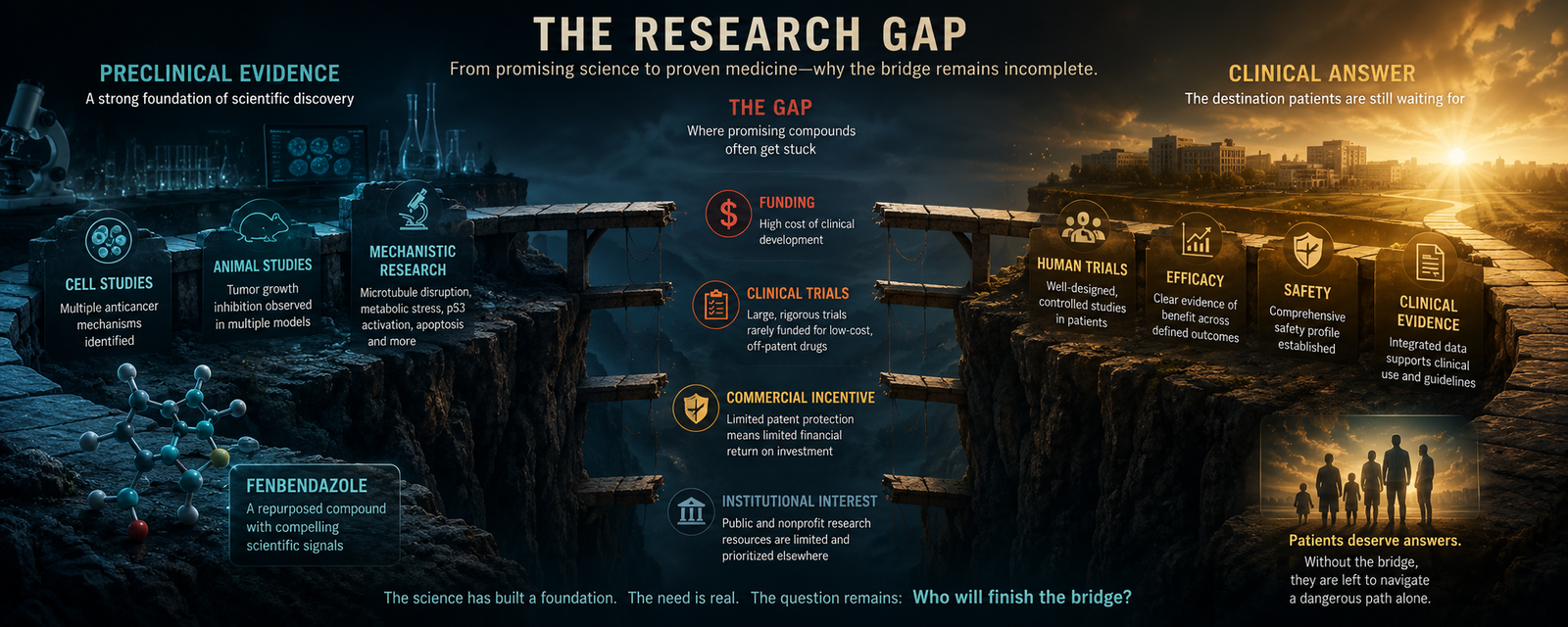
Why has an inexpensive, widely available compound demonstrating multiple anticancer mechanisms generated so little rigorous human investigation—and could the economics of modern drug development help explain why?
For many patients, physicians and advocates following fenbendazole—and its fellow antiparasitic ivermectin—the suspected answer goes further. They believe inexpensive repurposed compounds threaten a pharmaceutical model built around proprietary drugs capable of generating enormous revenues, and that these alternatives are consequently marginalized, ridiculed or portrayed as dangerous fringe treatments.
That is a serious allegation, and suspicion is not evidence.
But the economic conflict deserves investigation rather than dismissal. So does the language increasingly surrounding these drugs. And so does the remarkable gap between what researchers have observed in laboratories and what medicine has established in human beings.
Because after years of growing interest, the most important fact about fenbendazole remains remarkably simple.
We still don’t know.
And perhaps the more important question is why.
BEYOND THE “DEWORMER” STORY
To understand why researchers became interested in fenbendazole, we have to leave the veterinary label behind and look at the molecule itself.
Fenbendazole belongs to the benzimidazole family, which includes compounds such as mebendazole and albendazole—drugs that do have established uses in human medicine. Scientists have been investigating members of this family for anticancer activity because some of the same cellular machinery these compounds disrupt in parasites also exists in malignant cells. Research into repurposing benzimidazole for cancer therefore did not begin with viral social-media posts or desperate patients searching the internet. It emerged from pharmacology.
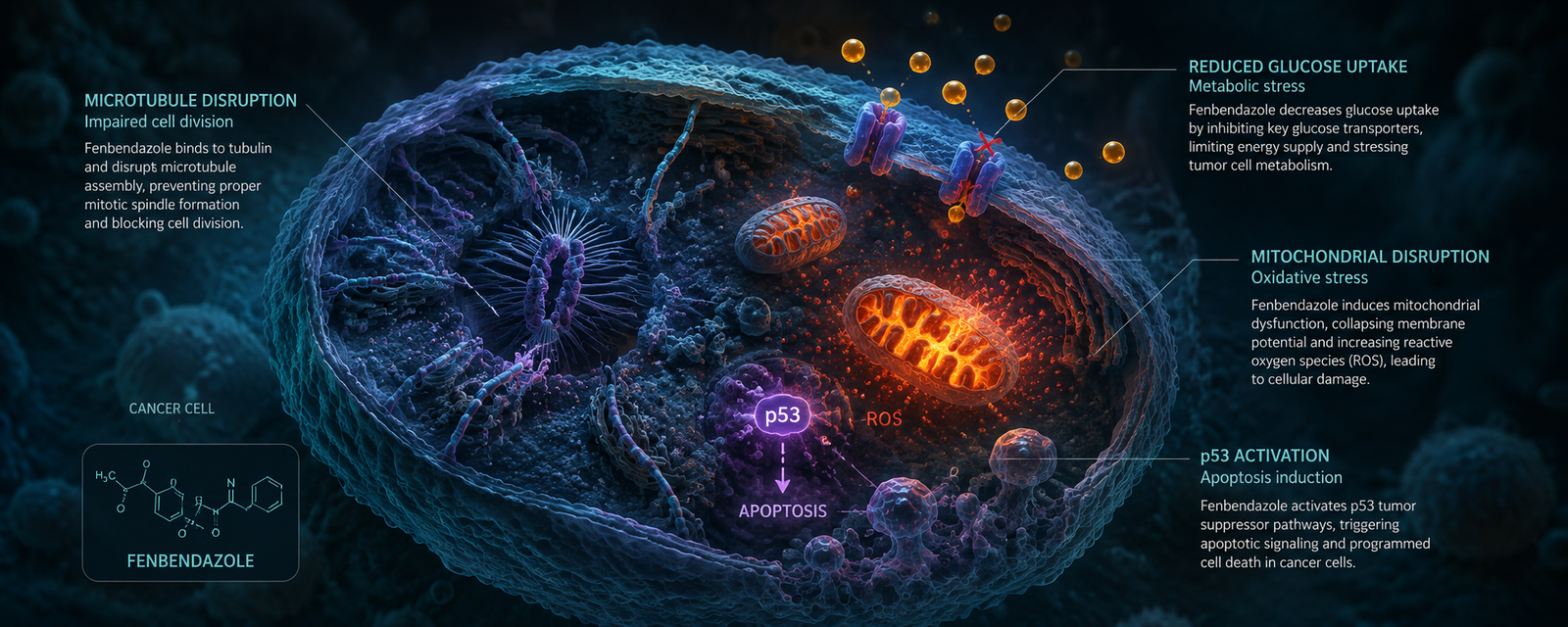
One of the most interesting studies appeared in Scientific Reports in 2018. Researchers found that fenbendazole interfered with microtubules, structures cells depend upon to maintain their architecture and successfully divide. Cancer researchers are intimately familiar with this vulnerability because established chemotherapy drugs such as paclitaxel and docetaxel also interfere with microtubule dynamics, although their specific pharmacological actions differ from fenbendazole’s.
But as researchers followed fenbendazole through the cancer cell, the story became more interesting.
They observed activation and redistribution of p53, one of the body’s most important tumor-suppressor proteins. They saw evidence of apoptosis—the process through which damaged or abnormal cells essentially initiate their own destruction. And they discovered that fenbendazole appeared to interfere with something cancer cells need in enormous quantities: energy.
Many tumors dramatically alter the way they obtain and metabolize glucose. This metabolic reprogramming is one reason modern cancer research has increasingly begun looking beyond genetic mutations alone and toward the machinery that allows malignant cells to fuel their relentless growth.
In the 2018 experiments, fenbendazole reduced glucose uptake in human non-small-cell lung cancer cells. Researchers observed reductions in glucose transporters, lactate production and hexokinase II, a key glycolytic enzyme closely connected with cancer-cell survival and proliferation. The researchers ultimately described microtubule disruption, p53 activity and interference with glucose metabolism as collective mechanisms underlying the cancer-cell death they observed. They also reported tumor-growth inhibition in a mouse xenograft model.
The 2024 Anticancer Research review returned to many of these same pathways, highlighting inhibition of glycolysis, reduced glucose uptake, oxidative stress and enhanced apoptosis among the experimental findings that make fenbendazole interesting as a possible repurposed cancer candidate.
None of this means fenbendazole cures cancer in people. But it does mean the scientific conversation is considerably more sophisticated than the phrase “dog dewormer”suggests. And it leads naturally to the question researchers eventually have to answer whenever a compound performs well in a laboratory:
What happens in a human being?
FROM LABORATORY SIGNAL TO HUMAN CANCER
This is where the fenbendazole story becomes considerably more complicated.
Cancer history is filled with compounds that looked impressive in cell cultures or animals and failed when tested in people. Human tumors exist inside extraordinarily complex biological systems. A molecule must be absorbed, distributed through the body, reach the tumor at a sufficient concentration, remain there long enough to matter and do all of that without causing unacceptable harm.
Fenbendazole may have particular challenges crossing that bridge.
It has poor water solubility and limited systemic bioavailability, something the 2024 review identifies as an important obstacle to translating its experimental anticancer activity into a practical human therapy. Just as importantly, because fenbendazole has never been approved for human use, its human pharmacokinetics and safety profile are not well established.
There are reasons for caution. Published case reports have documented serious liver injury in people with cancer who self-administered fenbendazole. In one 2021 case, an 80-year-old woman with advanced lung cancer developed severe liver dysfunction while taking fenbendazole alongside pembrolizumab; her liver function improved after fenbendazole was discontinued, and investigators reported no tumor shrinkage during its use. More recently, a 2026 report described severe hepatocellular injury in a 47-year-old woman with metastatic colon cancer after she increased her self-administered fenbendazole while receiving immunotherapy.
These cases do not tell us how common such reactions are. They do tell us why uncontrolled self-experimentation cannot substitute for clinical research.
Yet patients began experimenting anyway.
Much of the public fascination can be traced to Joe Tippens, whose remarkable recovery from advanced small-cell lung cancer became an international phenomenon. Tippens had begun taking fenbendazole and several supplements while also participating in an experimental cancer-treatment trial, and subsequent imaging reportedly found no detectable cancer. His story traveled rapidly through patient communities and eventually helped create what became known online as the “Joe Tippens protocol.”
But the very thing that makes his story extraordinary also makes it scientifically impossible to interpret with certainty. Tippens was receiving another experimental treatment at the same time. We cannot isolate fenbendazole and conclude that it produced his recovery.
That does not make the observation meaningless.
An anecdote cannot prove a treatment works. But an unusual clinical observation can generate a hypothesis worth testing.
That distinction became even more important in 2025 when a published case series described three patients with advanced breast, prostate and melanoma cancers who had self-administered fenbendazole while receiving other therapies. The paper attracted enormous attention because the reported outcomes were dramatic. But in January 2026, the journal retracted it after discovering a potential undeclared conflict of interest involving the first author, who was offering services related to the subject at the time the manuscript was submitted. The editor concluded that the issue could have affected interpretation and recommendations. Importantly, the retraction notice did not state that the patient cases had been proven fabricated—but a retracted paper cannot responsibly be treated as established clinical evidence.
That is exactly where discernment becomes essential.
Those who desperately want fenbendazole to work cannot treat every positive story as confirmation and every negative finding as corruption. But conventional medicine should be equally careful not to treat the absence of definitive human trials as evidence that an intriguing pharmacological signal deserves no further investigation.
Medical sovereignty requires the whole truth—including evidence that complicates the story we may want to believe.
And the whole truth currently brings us to an uncomfortable place: patients are experimenting, scientists have identified legitimate mechanisms, risks remain incompletely understood, and the controlled human evidence capable of resolving the controversy remains remarkably sparse.
That brings us to the larger question hiding behind fenbendazole.
DRUG REPURPOSING | WHEN SCIENCE MEETS THE MONEY
Fenbendazole does not exist in isolation.
Mebendazole, albendazole and other members of the benzimidazole family have also attracted cancer researchers, and some have an advantage fenbendazole does not: histories of human medical use. The broader scientific question, therefore, is not whether an animal medicine somehow stumbled into an internet cancer controversy. It is whether a pharmacological family originally developed for one purpose may contain compounds useful for another.
Medicine does this all the time.
Drug repurposing takes an existing compound and investigates whether its biological actions may be useful against a disease it was never originally developed to treat. The strategy can potentially shorten development timelines because researchers are not beginning with an entirely unknown molecule. Existing manufacturing knowledge, pharmacology and—in the case of drugs already approved for humans—safety information may already exist.
The idea is neither alternative nor fringe.
But this is where a scientific question begins colliding with an economic one.
Discovering that an old compound might have another medical use is only the beginning. Turning that observation into accepted treatment requires human trials, regulatory work, manufacturing standards, data collection, investigators, hospitals and years of follow-up.
Someone has to pay for all of it.
For a newly developed proprietary cancer drug, the economic logic is straightforward. A company may spend enormous amounts bringing the treatment through clinical development because patent protection and regulatory exclusivity can provide an opportunity to recover that investment—and, when successful, generate substantial profits.
But what happens when the molecule on the other side of the equation is old, inexpensive and difficult to protect commercially?
Who pays to prove that it works?
This is where the debate surrounding fenbendazole becomes much more interesting than accusations about a single drug.
The therapies most profitable to develop are not necessarily identical to the therapies most valuable to investigate.
That does not require a pharmaceutical executive to order a promising treatment buried. It doesn’t require a secret meeting or coordinated conspiracy.
Suppression does not always require a conspiracy. Sometimes an economic system can produce the same outcome through incentives alone.
A compound offering limited exclusivity may attract less private investment. Without sufficient investment, large clinical trials may never occur. Without those trials, regulators and physicians correctly point out that clinical evidence is insufficient. And the absence of clinical evidence then becomes the reason the compound remains outside conventional treatment.
The circle can perpetuate itself.
But private pharmaceutical companies are not the only organizations capable of funding medical research. Governments, universities, cancer foundations, philanthropies and nonprofit research institutions exist precisely because commercially unattractive questions can still have enormous public value.
Which makes the next question harder: If industry has insufficient financial incentive to settle the fenbendazole question, why hasn’t the public research system done it?
That is not proof that fenbendazole has been suppressed. It is a question about whether the architecture of modern medical research contains a blind spot—one where inexpensive repurposed compounds can remain trapped for years between interesting enough to study and insufficiently proven to use.
And while that evidence gap has persisted, another force has been shaping public perception of these drugs.
Language.
WHEN STIGMA REPLACES CURIOSITY
We have seen how powerful a label can become.
During the COVID-19 pandemic, ivermectin became inseparable in the public imagination from the phrase “horse dewormer.”
There was a legitimate public-health problem underlying some of that messaging. People were obtaining veterinary ivermectin products intended for large animals, and regulators had good reason to warn that veterinary formulations should not be casually self-administered by humans.
But ivermectin itself was not simply an animal drug. It had long-established human medical uses.
The FDA nevertheless chose a deliberately provocative communication strategy. In August 2021, its social-media campaign included the now-famous message: “You are not a horse. You are not a cow. Seriously, y’all. Stop it.”
Whatever one believes about ivermectin and COVID-19, that language did something powerful: it connected the drug culturally with livestock and irrational behavior rather than encouraging a more nuanced distinction between an established human medicine, veterinary formulations and an unproven new indication.
Three physicians subsequently sued the FDA, arguing that the agency had exceeded its authority by interfering with physicians’ ability to prescribe ivermectin off-label. In March 2024, the case was settled. Under the agreement, the FDA retired a consumer update and agreed to delete the “horse” and “cow” posts and several related messages. The settlement explicitly stated that these actions were not an admission of wrongdoing or liability, and the FDA did not concede that ivermectin was effective for COVID-19.
That distinction matters, but so does the history. Fenbendazole is not ivermectin. Unlike ivermectin, fenbendazole has no established FDA-approved human indication, yet the communication pattern should make us pay attention.
Today fenbendazole is frequently introduced to the public not as a benzimidazole compound demonstrating anticancer activity in experimental research, but as a dog dewormer being promoted as a cancer cure on social media.
Both descriptions contain pieces of information.
Only one invites the reader to investigate the underlying pharmacology.
The institutional response is now becoming stronger as patient use increases. In June 2026, the American Society of Clinical Oncology issued a clinical notice advising that neither fenbendazole nor ivermectin should be used to treat cancer—or added to established cancer therapies—outside a well-designed clinical trial. ASCO cited the absence of robust clinical evidence together with potential toxicity and drug interactions.
There is a legitimate patient-safety argument behind that position.
There is also an unavoidable question embedded inside it.
Where are the well-designed clinical trials?
The paradox becomes particularly striking because patients clearly are not waiting for institutions to settle the issue.
A 2026 analysis from MD Anderson Cancer Center identified 182 patients who self-reported taking fenbendazole and 499 who reported ivermectin use between 2020 and 2024. Researchers found extraordinary inconsistency—138 different reported fenbendazole dosing schedules among those users—and appropriately concluded that their retrospective data could not establish efficacy.
But those numbers reveal something else.
Patients are already conducting an uncontrolled experiment on themselves.
And that may be the worst possible way to answer the question.
When patients believe conventional medicine will not seriously investigate something, some turn toward internet communities. Different protocols proliferate. Physicians may not know what patients are taking. Adverse reactions become harder to interpret. Institutions become increasingly alarmed. Warnings grow stronger. The treatment becomes more stigmatized.
And still the controlled evidence remains absent.
The lack of evidence becomes both the reason for discouraging use and the consequence of failing to generate better evidence.
There is a name for what may be missing here.
Curiosity.
THE QUESTION MEDICINE STILL HASN’T ANSWERED
For all the controversy surrounding fenbendazole, we ultimately arrive at a surprisingly simple place.
We have a compound that has demonstrated anticancer activity in laboratory research. We understand several of the biological mechanisms that may be responsible. We know that related benzimidazole compounds have attracted oncology researchers as possible candidates for drug repurposing. And we know that growing numbers of cancer patients are already experimenting with fenbendazole outside conventional medicine.
What we do not know is whether any of this translates into meaningful benefit for human cancer patients.
Perhaps it won’t.
Fenbendazole may ultimately fail when subjected to rigorous human trials. Its poor bioavailability may prevent sufficient concentrations from reaching tumors. Toxicity or interactions with other treatments may limit its usefulness. Researchers may discover that another member of the benzimidazole family is a much better candidate, or that whatever activity fenbendazole possesses applies only to certain cancers or particular combinations of therapies.
That is how science works. Promising ideas fail all the time.
But occasionally they don’t.
And that possibility is precisely why the absence of definitive research becomes increasingly difficult to understand.
For years, the fenbendazole story has been developing in an unusual order. Laboratory researchers identified intriguing anticancer activity. Patients discovered the research and began experimenting on themselves. Remarkable recovery stories traveled through online communities. Physicians became concerned about unsupervised use. Medical organizations warned that there was insufficient human evidence to recommend the drug.
At nearly every stage, the same problem remained sitting quietly in the middle of the controversy.
The human research necessary to settle the question was largely missing.
And so patients and institutions have found themselves arguing across an evidence gap that neither side can resolve.
Those enthusiastic about fenbendazole point toward laboratory findings and extraordinary patient stories. Medical organizations point toward the absence of controlled clinical evidence. Both observations contain truth. But neither tells us what would happen if fenbendazole were subjected to the kind of serious clinical investigation routinely required of a prospective cancer therapy.
That is why simply repeating “there isn’t enough evidence” eventually becomes unsatisfying.
Of course there isn’t enough evidence.
The question is why we haven’t produced it.
And once we ask that question, we return to everything this investigation has uncovered.
We return to a drug-development system in which bringing a cancer therapy through clinical trials requires enormous financial investment. We return to the commercial advantage of proprietary medicines capable of providing years of exclusivity. We return to older and inexpensive compounds that may offer considerably less opportunity to recover the cost of developing them. And we return to public institutions, universities and cancer organizations that could potentially investigate commercially unattractive questions but have so far failed to provide a definitive answer in this one.
Then there is the stigma.
Once a compound becomes culturally associated with phrases such as “dog dewormer,” curiosity becomes more difficult. Patients experimenting with veterinary products reinforce the perception that the entire subject belongs outside serious medicine. Institutional warnings grow stronger. Physicians become understandably cautious. The people most convinced that something important is being overlooked become increasingly distrustful of the institutions warning them away from it.
Each side moves farther from the other.
Meanwhile, the fundamental scientific question remains exactly where it began.
Does fenbendazole have meaningful anticancer activity in human beings?
Medical sovereignty does not require us to pretend we already know the answer. In fact, genuine sovereignty demands something harder: the willingness to follow evidence wherever it leads, even when it challenges what we hoped—or expected—to find.
Cancer patients should not have to choose between unquestioningly accepting institutional authority and blindly trusting an internet protocol. They deserve physicians willing to discuss unconventional possibilities without ridicule, researchers willing to investigate inexpensive compounds without commercial prejudice, and medical institutions willing to pursue important questions even when the eventual answer may not produce a highly profitable drug.
Because fenbendazole has ultimately brought us to a question much larger than fenbendazole itself.
Imagine that somewhere within the enormous library of existing compounds there is an inexpensive medicine capable of improving outcomes for a particular cancer. Perhaps the improvement is modest. Perhaps it works only alongside another treatment. Perhaps it benefits only a small subset of patients.
Would our current medical research system reliably find it?
Would anyone have sufficient financial incentive to spend the years and millions of dollars necessary to prove it?
And if industry did not, would our public research institutions recognize the gap and step in?
Those are uncomfortable questions because they force us to examine not simply whether modern medicine follows evidence, but how the evidence available to medicine gets created in the first place.
Fenbendazole may ultimately prove that the excitement exceeded the reality.
Or it may eventually become part of a much larger story about drug repurposing and cancer.
We cannot know until the appropriate research is done.
And perhaps that is the real lesson buried beneath all the arguments, warnings, testimonials and accusations surrounding this unusual compound.
Cancer patients deserve better than ridicule. They also deserve better than unproven promises. They deserve answers.
After years of laboratory signals and growing patient interest, the question is no longer simply whether fenbendazole works.
It is whether we have built a medical research system sufficiently curious—and sufficiently independent of commercial incentives—to genuinely find out.
Why are we still waiting?
This feels much more like the ending of the story we just investigated rather than a summation of talking points. And I especially like bringing the reader back through the sequence—laboratory → patients → extraordinary stories → institutional concern → warnings → missing trials—because it makes the central paradox almost reveal itself.
And after all these years, perhaps the most uncomfortable question surrounding fenbendazole remains the simplest:
GAR NOTE: Fenbendazole is not FDA-approved for human use or for cancer treatment. Experimental findings do not establish that it safely or effectively treats cancer in humans, and serious liver injuries have been reported following self-administration. This report investigates the scientific evidence, research gap and institutional controversy surrounding fenbendazole; it does not provide a treatment recommendation or dosing protocol. Personal discernment and ultimately sovereignty is needed.
Sign up to receive Our Weekly Briefing Newsletter
Begin your journey with weekly insights designed to expand awareness and ground you in truth. Our free tier gives you a powerful introduction without any commitment.
STOP DROWNING IN THE NOISE. START SEEING THE TRUTH. Join over 99,000 truth seekers. Get the essential intelligence, alternative news, and disclosure updates that the mainstream media won’t touch.
Latest Reports
 Monthly ReportConscious Practices · October 2026 EditionOctober 5, 2026
 Weekly ReportAwakening The Sleeping Giant · October 5th EditionOctober 5, 2026
 Weekly ReportAwakening The Sleeping Giant · September 28th EditionSeptember 28, 2026
 Weekly ReportAwakening The Sleeping Giant · September 21st EditionSeptember 21, 2026View all weekly reports
Special Reports
 Special ReportTHE AWAKENING JOURNEY: Hero’s Journey Part II · Week 1October 3, 2026
 Special ReportGlobal Everything Collapse · Economic Chaos · Part IOctober 1, 2026
 Special ReportCreating A Conscious Culture · Part ISeptember 3, 2026
 Special ReportThe Great Healing: Detox, Defense & Sovereignty In an Engineered World · Part ISeptember 1, 2026View all special reports
Help Us Bypass Censorship. Share This.
Join the Discussion
Related Posts

Have questions?
At Great Awakening Report, we are dedicated to supporting your journey toward truth and enlightenment through our specialized Coaching and Consulting services.
Coaching Services: Our coaching programs are designed to guide you through personal awakening and transformation. We offer personalized sessions that focus on expanding consciousness, uncovering hidden truths, and fostering spiritual growth. Our experienced coaches provide the tools and insights necessary to navigate your path with clarity and confidence.
Consulting Services: For organizations and individuals seeking deeper understanding and strategic guidance, our consulting services offer expert analysis and solutions. We delve into areas such as global transitions, alternative news insights, and consciousness studies to provide comprehensive strategies tailored to your unique objectives.
Embark on a transformative journey with our Coaching and Consulting services, and unlock your highest potential. To learn more and schedule a session, visit our Coaching and Consulting pages.
Thank you
Thank you to our subscribers and readers for your continued support and dedication to truth and awakening. Your encouragement, engagement, and belief in our mission make everything we do possible. Together, we are expanding awareness and helping illuminate the path forward.
If you would like to further support the Great Awakening team and our ongoing efforts to share insight, knowledge, and truth, you can DONATE HERE.
With deep gratitude,
– Great Awakening Team
About the Author: Great Awakening Team

We are a community. We are cultural creatives and like minded people seeking the truth and focusing on disclosure, awakening and consciousness. Our focus is real news as researchers, reporters and truth seekers. We are here to teach, to spread the word, to serve and to help. We are a collective, a movement, free from all programing, not closed minded and not discriminatory. We are not political. We are not religious but we are spiritual. We study, research, and report on a wide range of subjects and topics, from the current geopolitical climate to health and wellness, from earth’s history to spiritual practices. We are forward thinkers and visionaries, we are guides for the transition as we usher in The Great Awakening.
THIS WEBSITE DOES NOT PROVIDE MEDICAL ADVICE: The information, including but not limited to text, graphics, images, and other material contained on this website, are for informational purposes only. No material on this site is intended to be a substitute for professional medical advice, diagnosis, or treatment. Always seek the advice of your physician or other qualified health care provider with any questions you may have regarding a medical condition or treatment and before undertaking a new health care regimen, and never disregard professional medical advice or delay in seeking it because of something you have read on this website.
DISCLAIMER: All statements, claims, views and opinions that appear anywhere on this site, whether stated as theories or absolute facts, are always presented by The Great Awakening Report (GAR) as unverified—and should be personally fact checked and discerned by you, the reader.Any opinions or statements herein presented are not necessarily promoted, endorsed, or agreed to by GAR, those who work with GAR, or those who read or subscribe to GAR.Any belief or conclusion gleaned from content on this site is solely the responsibility of you the reader to substantiate.Any actions taken by those who read material on this site are solely the responsibility of the acting party.You are encouraged to think for yourself and do your own research.Nothing on this site is meant to be believed without question or personal appraisal.
COPYRIGHT DISCLAIMER: Citation of articles and authors in this report does not imply ownership. Works and images presented here fall under Fair Use Section 107 and are used for commentary on globally significant newsworthy events. Under Section 107 of the Copyright Act 1976, allowance is made for fair use for purposes such as criticism, comment, news reporting, teaching, scholarship, and research.
COMMUNITY GUIDELINES DISCLAIMER: The points of view and purpose of this video is not to bully or harass anybody, but rather share that opinion and thoughts with other like-minded individuals curious about the subject.