








Published Date: March 15th, 2026 | Updated xxx xx, 2026 💢
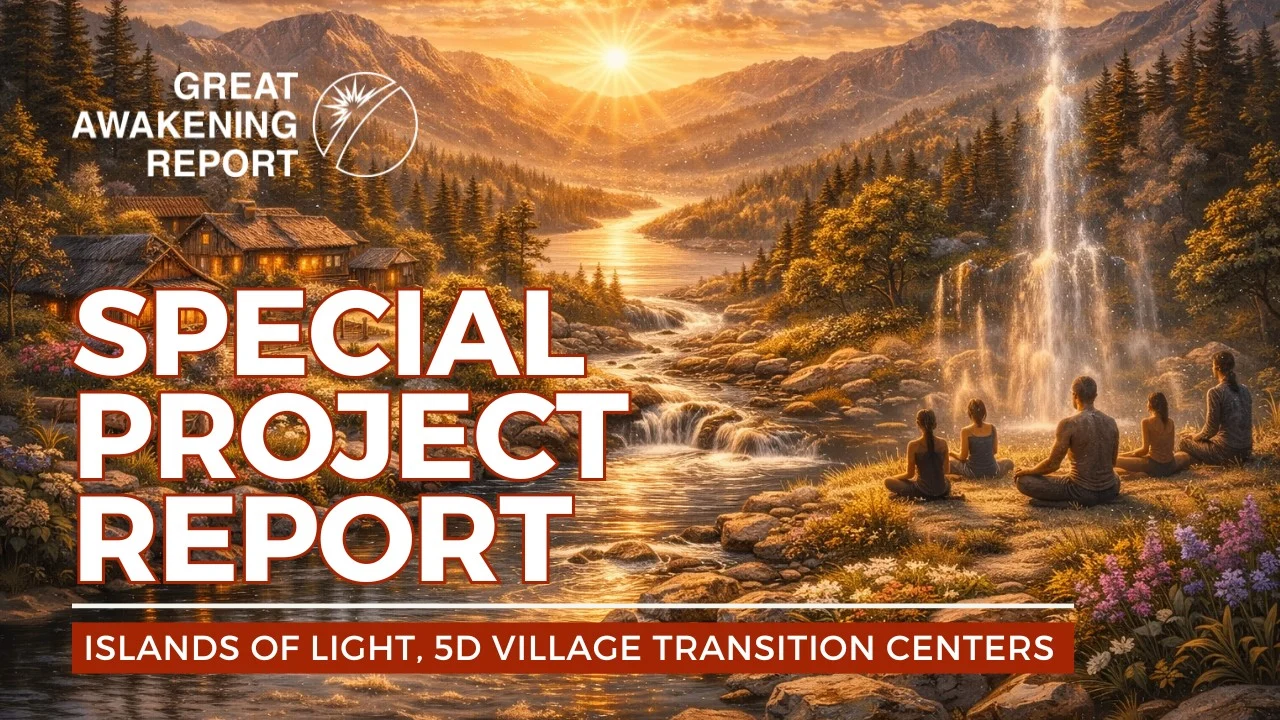
SPECIAL PROJECT REPORT
TRUTH///AWAKENING///DISCLOSURE
ISLANDS OF LIGHT, 5D VILLAGE TRANSITION CENTERS
A Higher Conscious Village Reality for a Post-3D Matrix World
“Higher consciousness does not wait for permission.
It builds quietly—village by village—until coherence replaces chaos and belonging becomes the new infrastructure. “Ascension is not escape—it is stabilization.
Islands of Light are not destinations, but bridges where humanity relearns coherence before stepping forward.”
Self-Sustaining • Self-Supporting • Self-Reliant • Self-Sufficient Village Communities
Introduction — A World Reorganizing
We are living through a period where familiar systems no longer provide stability, meaning, or trust. Governments strain under complexity they can no longer manage. Economies reward extraction over contribution. Institutions once designed to serve humanity increasingly demand compliance instead. This report begins with a simple observation: what is failing is not humanity itself, but the structures built to control it at scale.
Collapse, however, is not an ending. It is a reorganization. When centralized systems lose coherence, life does not disappear—it decentralizes. Throughout history, periods of institutional breakdown have always been accompanied by the quiet formation of smaller, more adaptive social structures. Today is no different. Across the world, individuals and communities are stepping away from dependency and rediscovering how to stabilize life locally—through food sovereignty, shared responsibility, emotional regulation, and human-scale governance.
Islands of Light are not utopian visions or ideological movements. They are functional responses to systemic stress. They emerge wherever people choose coherence over control, relationship over abstraction, and stewardship over domination. These villages do not attempt to reform collapsing systems, nor do they oppose them. They simply stop relying on them—replacing fragile dependencies with resilient, living systems designed around human capacity rather than institutional power.
This report documents that transition. It maps the structures, principles, and processes that allow communities to stabilize, heal, and regenerate in a time of global uncertainty. It is not a call to action for the masses, nor a promise of salvation. It is an orientation guide for those who sense that the future will not be built through central authority, but through quiet, connected, and coherent human-scale systems already taking shape beneath the noise.
Islands of Light Topic Titles
Thy Lejren Village — A Perfect Model: An Economy Without Money
SECTION I — ORIENTATION: WHY ISLANDS OF LIGHT ARE EMERGING
- Islands of Light: Small, Coherent Systems in a Collapsing World
- From Centralized Failure to Distributed Stability
- Why Scale Is the Enemy of Consciousness
- 5D Is an Operating System, Not a Belief
- Collapse as a Sorting Mechanism
- From Mass Society to Human-Scale Living
- Belonging as the Missing Infrastructure
SECTION II — DEFINING THE 5D VILLAGE MODEL
- What a 5D Village Is—and What It Is Not
- Beyond Communes, Compounds, and Cultures
- Human-Scale Population Design (Why Size Determines Health)
- Purpose Without Hierarchy
- Autonomy Without Isolation
- Contribution-Based Living vs Wage Dependency
- Trust as Structural Capital
- Villages as Living Organisms, Not Project
SECTION III — CONSCIOUSNESS & SOCIAL ARCHITECTURE
- Higher Consciousness as a Functional Requirement
- Coherence Fields & Group Stability
- Observer Communities: Awareness as Infrastructure
- Emotional Regulation as Social Currency
- Trauma-Informed Community Design
- Conflict Without Punishment
- Rotational & Resonant Leadership
- Elders, Stewards, and Knowledge Keepers
SECTION IV — GARDEN TOWER FARMS & FOOD SOVEREIGNTY (CORE PILLAR)
- Garden Tower Farms: Food as the First Freedom
- Hydroponic Indoor Growing as Village Backbone
- Year-Round Food Independence Without Arable Land
- Vertical Farming for High-Density, Low-Footprint Living
- Eliminating Supply Chains at the Village Level
- Nutrient Cycles, Compost Loops & Closed-System Design
- Community-Operated Food Pods
- Food as a Shared Responsibility, Not a Commodity
- Why Hunger Disappears When Food Is De-Monetized
- Teaching Children to Grow the System That Feeds Them
SECTION V — ECONOMIC & RESOURCE SYSTEMS
- Post-Money Internal Economies
- Time, Skill, and Care as Exchange
- Shared Assets vs Private Accumulation
- De-Commodified Housing Models
- Energy Independence & Post-Scarcity Power Systems
- Water Sovereignty & Closed-Loop Systems
- Why Crime Collapses When Scarcity Ends
- Economic Stability Without Growth Pressure
SECTION VI — EDUCATION, KNOWLEDGE & CHILD DEVELOPMENT
- Learning as Participation, Not Indoctrination
- Village-Based Education Models
- Multi-Age Learning & Mentorship
- Truth Literacy & Discernment Training
- Science, Ecology & Consciousness Integration
- Preserving Ancient Knowledge Without Dogma
- Children as Co-Creators of the Village
- Education Without Psychological Programming
SECTION VII — GOVERNANCE WITHOUT DOMINATION
- Decision-Making Without Bureaucracy
- Consent, Consensus & Coherence
- Power That Circulates Instead of Accumulates
- Why Slow Governance Prevents Collapse
- Accountability Without Surveillance
- Law as Relationship, Not Enforcement
- Self-Correction Without External Authority
SECTION VIII — HEALTH, HEALING & HUMAN REPAIR
- Village-Based Healing Ecosystems
- Mental Health as a Collective Function
- Nervous-System Regulation at the Village Scale
- Breathwork, Somatic Practices & Frequency
- Healing Trauma Through Safety, Not Medication
- Aging With Dignity Inside the Village
- End-of-Life Care as Sacred Integration
- Why Healing Accelerates in Coherent Communities
SECTION IX — TECHNOLOGY, INNOVATION & THE 5D INTERFACE
- Technology as Support, Not Master
- AI as Knowledge Steward, Not Authority
- Low-Tech Resilience + High-Intelligence Design
- Data Minimalism & Privacy by Design
- Communication Without Algorithms
- Business Development, Innovation & Conscious Training Centers
- When Technology Serves Consciousness
SECTION X — ISLANDS OF LIGHT IN A COLLAPSING WORLD
- Why These Villages Are Appearing Now
- Islands of Light as Stabilization Nodes
- Parallel Systems, Not Revolution
- Remaining Quiet, Functional, and Unclassifiable
- Why Central Authorities Cannot Control Them
- Non-Compliance Without Conflict
- Networked Villages as Living Constellations
SECTION XI — ASCENSION TRANSITION CENTERS (EXPANDED & INTEGRATED)
- Ascension Transition Centers: The Bridge Between Worlds
- Temporary Sanctuaries for Nervous-System Recovery
- Orientation for the Newly Awake
- Deprogramming Without Shame
- Re-Learning Trust After Institutional Betrayal
- Spiritual Integration Without Religion
- Skill Re-Mapping for Post-Industrial Life
- Food, Shelter & Safety as Stabilization Tools
- Transition Centers as Garden-First Environments
- From Transition to Permanent Village Placement
- Graduation Into Self-Governed Communities
- Why Transition Centers Prevent Social Chaos
SECTION XII — THE BIG PICTURE
- The End of Mass Society
- From Empire to Ecology
- Consciousness as the Missing Variable
- Islands of Light as Seed Crystals
- You Don’t Save the World—You Stabilize a Cell
- Belonging Is the Technology
- This Is Not the Future—It Is the Remembering
Thy Lejren Village — An Economy Without Money
Thy Lejren is a long-standing alternative community and self-sustaining commune located in northwest Jutland, Denmark, about five kilometers southwest of the village of Frøstrup. Founded in 1970 as a summer festival inspired by Woodstock and the Isle of Wight Festival, it evolved into a year-round settlement when some participants chose to stay through the winter. The community, officially known as Det Ny Samfund (The New Society), operates under direct democracy with no formal leadership—decisions are made through consensus or voting during annual general meetings.
Today, Thy Lejren is home to around 100 residents, including families, artists, and free spirits, who live in uniquely designed DIY homes and maintain a lifestyle based on mutual support, shared resources, and non-material values. Core principles include no hard drugs, no violence, and no theft. The settlement features an organic grocery store, café, pub, and hosts regular cultural events, music festivals, and theater performances.
Despite its remote location in a forested area, Thy Lejren has attracted visitors from around the world, though it remains largely off the tourist radar compared to Christiania in Copenhagen. It is not open to new residents easily—there is a strict limit of 75 people, and newcomers must visit frequently, possibly stay in temporary shelters, and apply for a trial period during winter meetings. The community emphasizes respect for residents and the environment: no photography of people, no littering, and minimal noise.
Thy Lejren is often described as a lived-in utopia, a peaceful micro-nation that exists both within and outside mainstream Danish society, offering a rare glimpse into a decades-long experiment in alternative living.
Higher Consciousness Village Experiment
In a quiet corner of Denmark exists a living experiment that defies modern economic categories. Thy Lejren—often called Thylejren—is not a commune in the romanticized sense, nor a protest enclave frozen in time. It is a functioning social organism that has operated for decades with minimal reliance on money inside the community itself. Economists struggle to classify it because the usual levers—prices, wages, ownership—are largely absent from daily life.
Here, money is not the organizing principle. There are no price tags, salaries, or internal buying and selling. Instead, the community operates on exchanges of time, skill, care, and trust. If someone needs help, someone shows up—not because they’re paid, but because participation is how belonging is maintained. Roof repairs happen because neighbors know how to build. Childcare happens because children are considered a shared responsibility. When someone is sick, meals arrive without requests, invoices, or social debt.
Visitors are often startled by a simple rule: you can’t buy anything here—but you can receive everything you need. That statement isn’t symbolic. It’s operational.
Daily Life Without Prices
There are no supermarkets—only gardens, shared kitchens, and collective food systems. Housing is not a commodity; homes are built, maintained, and allocated through communal agreement. There are no landlords extracting rent, and no mortgages dictating life choices. Instead of job titles, people choose roles—temporary, rotating, and aligned with ability rather than status.
Work is not separated from life. Skills circulate organically: builders teach newcomers, gardeners feed everyone, artists maintain cultural memory, elders provide continuity. Contribution is visible, social, and relational—removing the need for bureaucratic surveillance or performance metrics.
Why Crime Almost Disappears
Crime in Thy Lejren is remarkably rare, not because of enforcement, but because incentives to exploit are structurally removed. There is little to steal. No wealth hoarding. No hierarchy to impress. No competition to resent. Social standing comes from reliability, not accumulation. In such an environment, antisocial behavior loses its payoff.
Conflict still exists—but it’s handled through dialogue, mediation, and shared accountability rather than punishment. Reputation is communal, not algorithmic.
Governance Without Authority
Decision-making is slow by design. Consensus processes replace top-down authority, ensuring that outcomes reflect collective consent rather than efficiency alone. This frustrates outsiders—but insiders understand that durability matters more than speed.
Leadership exists, but it is situational and temporary. Elders guide rather than rule. Expertise carries weight, but not dominance. Power circulates instead of concentrating.
The Question Economists Always Ask
A researcher once asked an elder, “How do you survive without money?”
The elder smiled and replied, “We use the oldest currency in the world—each other.”
That answer reveals what most economic models exclude: social capital as primary infrastructure. Trust replaces contracts. Belonging replaces enforcement. Mutual visibility replaces compliance systems.
Why Thy Lejren Matters Now
Thy Lejren has persisted for over 50 years—not as a utopia, but as proof that human-scale economies can function without constant monetization. It demonstrates that when basic needs are decommodified, people often become more responsible—not less. Scarcity shifts from material goods to attention, care, and participation.
In an era defined by institutional collapse, loneliness, and extractive systems, Thy Lejren isn’t a blueprint to copy wholesale. It’s something more valuable: a working counterexample.
It shows that wealth is not the same as value.
That efficiency is not the same as resilience.
And that an economy rooted in belonging can outlast one built on accumulation.
Not because it rejects humanity—but because it finally trusts it.
SECTION I — ORIENTATION: WHY ISLANDS OF LIGHT ARE EMERGING
Section I Overview
We are entering a period where large, centralized systems are failing faster than they can be repaired. Economic, political, educational, health, and food infrastructures are no longer producing stability—they are producing dependency, fragility, and psychological stress. SECTION I establishes the foundational context: Islands of Light 5D Villages are not ideological experiments—they are structural responses to systemic breakdown.
This section reframes collapse as a sorting mechanism, not a catastrophe. As centralized systems lose coherence, smaller, human-scale systems naturally begin to form. These are not reactions rooted in fear or survivalism, but adaptive reorganizations toward resilience, belonging, and coherence. History shows that when empires destabilize, life does not disappear—it decentralizes.
SECTION I orients the reader away from savior narratives, mass movements, and top-down solutions. Instead, it introduces the core thesis of this report: the future stabilizes locally. 5D Villages emerge wherever people choose coherence over control, participation over consumption, and regeneration over extraction.
1. 5D Villages: Small, Coherent Systems in a Collapsing World
5D Villages are not utopian enclaves or escape communities. They are coherent social cells forming inside a fragmented global system. As large institutions lose trust and functionality, smaller systems with shared values and direct accountability naturally outperform them.
These villages operate quietly, often unnoticed, because they do not rely on dominance or expansion. Their strength comes from internal alignment, not external validation. They are defined by function, not branding.
In a collapsing world, coherence becomes a survival advantage. 5D Villages demonstrate that order can emerge without central authority, simply through aligned intention, shared responsibility, and trust.
2. From Centralized Failure to Distributed Stability
Centralized systems fail catastrophically because they concentrate risk. When supply chains, governance, or energy grids break, millions are affected simultaneously. Distributed systems fail locally—and recover faster.
5D Villages represent a shift from vertical dependency to horizontal resilience. Instead of relying on distant institutions, communities meet needs internally: food, care, education, conflict resolution.
This transition does not require rebellion. It happens organically as people disengage from failing structures and rebuild function at the human scale.
3. Why Scale Is the Enemy of Consciousness
As systems scale, they require abstraction: metrics instead of relationships, policies instead of discernment, enforcement instead of trust. Consciousness thrives on direct feedback, which large systems cannot provide.
5D Villages remain intentionally small to preserve awareness, accountability, and emotional regulation. When people are seen, heard, and known, coherence becomes self-reinforcing.
Large systems manage behavior. Small systems cultivate awareness. This distinction is foundational to 5D village design.
4. 5D Is an Operating System, Not a Belief
5D is not a spiritual label or metaphysical destination. It describes how a system operates: coherence-based rather than fear-based, relational rather than transactional.
A 5D operating system prioritizes nervous-system safety, truth literacy, emotional maturity, and conscious participation. It does not require shared beliefs—only shared principles.
This reframing removes spirituality from ideology and places it into function. If a system produces coherence, it’s operating at a higher level—regardless of language or symbolism.
5. Collapse as a Sorting Mechanism
Collapse does not destroy everything—it reveals what was never stable. Systems built on extraction, deception, or coercion fail first. Systems built on trust and reciprocity endure.
This process naturally sorts people, values, and structures. Those dependent on authority collapse with it. Those capable of cooperation reorganize.
5D Villages form where people stop waiting for permission and begin building what works.
6. From Mass Society to Human-Scale Living
Mass society requires anonymity. Human-scale living requires participation. As populations disengage from mass systems, they rediscover the psychological and practical benefits of being needed.
Human-scale communities restore meaning by restoring consequence—your actions matter because people know you. This eliminates many social pathologies without enforcement.
5D Villages are not anti-society. They are post-mass society.
7. Belonging as the Missing Infrastructure
Modern systems attempt to replace belonging with services, products, and platforms. None succeed. Humans are biologically wired for inclusion and contribution.
5D Villages rebuild belonging as infrastructure, not sentiment. When people belong, they protect the system that protects them.
This is why these communities stabilize under pressure: belonging creates resilience that money, law, and technology cannot replicate.
Checkpoint
SECTION I establishes:
- Why 5D Villages are emerging
- What problem they solve
- Why scale, consciousness, and belonging matter

SECTION II — DEFINING THE 5D VILLAGE MODEL
Section II Overview
SECTION II moves from why 5D Villages are emerging to what they actually are. This section defines the 5D Village not as a spiritual concept, belief system, or aesthetic lifestyle—but as a functional human-scale operating model designed for resilience, coherence, and longevity in a post-institutional world. The 5D Village Model encircles the Islands of Light as part of a 2 phase transition center.
The failure of past intentional communities was not idealism—it was structural weakness. Many collapsed due to unclear governance, hidden hierarchies, economic dependency, psychological immaturity, or belief enforcement. SECTION II establishes clear distinctions between 5D Villages and communes, cults, eco-projects, or survivalist enclaves. A 5D Village succeeds because it is designed around function first, consciousness second, and ideology last.
This section also introduces a critical design principle: coherence before expansion. A 5D Village is not built to scale endlessly. It is built to stabilize, replicate, and network—preserving human awareness, accountability, and belonging at every stage.
8. What a 5D Village Is—and What It Is Not
A 5D Village is a self-sustaining, self-supporting, self-reliant, and self-sufficient human community operating at the scale where relationships remain visible and accountability remains direct.
It is not a commune dependent on ideology, a spiritual retreat detached from reality, or a survival compound rooted in fear. It does not require shared beliefs, political alignment, or spiritual language.
What defines it is function: food sovereignty, shared responsibility, distributed leadership, emotional maturity, and internal coherence.
9. Beyond Communes, Compounds, and Cultures
Historical communes often failed because they replaced hierarchy with denial, or authority with ideology. Compounds failed by isolating rather than integrating. Cultural movements failed by prioritizing identity over infrastructure.
The 5D Village model avoids these traps by designing for durability, not purity. It assumes conflict, human imperfection, and differing worldviews—and builds systems that can hold them without fracture.
This is not about creating a “better culture.” It is about creating a stable operating environment for human life.
10. Human-Scale Population Design (Why Size Determines Health)
Human nervous systems evolved for groups where everyone is known. Once a community exceeds that threshold, anonymity increases, trust declines, and enforcement mechanisms replace relationship.
5D Villages are intentionally limited in size—often between 300 and 150 people—to preserve coherence, visibility, and emotional regulation.
When a village reaches capacity, it does not grow upward. It replicates outward, forming a network of stable cells rather than a fragile mass.
11. Purpose Without Hierarchy
Purpose in a 5D Village is shared, not dictated. There is no central authority assigning meaning or enforcing alignment.
Instead, purpose emerges from participation. People contribute where they are capable, interested, and needed. Roles shift as life circumstances change.
This removes status competition while preserving function—because contribution is visible and meaningful.
12. Autonomy Without Isolation
5D Villages are autonomous but not disconnected. They maintain independence from failing centralized systems while remaining connected to neighboring villages, regions, and networks.
Autonomy means local decision-making, local food, local care. It does not mean withdrawal from the world.
This balance prevents both dependency and isolation—two primary causes of community collapse.
13. Contribution-Based Living vs Wage Dependency
In a wage system, value is abstracted and delayed. In a contribution-based system, value is immediate and relational.
5D Villages replace wage dependency internally with contribution visibility. People know who grows food, who builds, who heals, who teaches.
This restores dignity, reduces resentment, and eliminates the psychological distortions caused by money as the sole measure of worth.
14. Trust as Structural Capital
Trust is not a feeling—it is infrastructure. In 5D Villages, trust replaces contracts, surveillance, and enforcement.
This is only possible because systems remain small enough for behavior to be visible and feedback to be immediate.
Where trust is high, complexity is manageable. Where trust collapses, systems require coercion.
15. Villages as Living Organisms, Not Projects
A 5D Village is not a development project with an endpoint. It is a living system that adapts, self-corrects, and evolves.
Rigid plans are replaced with guiding principles. Metrics are replaced with felt stability. Growth is replaced with resilience.
This mindset shift—from building a thing to stewarding a living organism—is what allows these communities to endure beyond founders, trends, or crises.
SECTION II SUMMARY
SECTION II defines the structural DNA of a 5D Village:
- Human-scale by design
- Phase I Transition 5D Village
- Function-first, belief-agnostic
- Contribution-based, not wage-based
- Trust-centered, not enforcement-driven
- Replicable, not scalable
This section answers the question:
“What actually works when institutions no longer do?”

SECTION III — CONSCIOUSNESS & SOCIAL ARCHITECTURE
Section III Overview
If Section II defines the structure of a 5D Village, Section III defines its internal operating environment. No village—no matter how well designed—can remain stable if the people inside it are dysregulated, traumatized, reactive, or psychologically fragmented. Consciousness is not a philosophical layer added on top of the village; it is load-bearing infrastructure.
Modern societies attempt to compensate for emotional immaturity with law, enforcement, bureaucracy, and surveillance. 5D Villages reverse this equation. They reduce external control by raising internal coherence. This section explains how emotional regulation, self-awareness, and relational maturity become practical stabilizers—replacing punishment, hierarchy, and coercion.
SECTION III also introduces a critical reframing: higher consciousness is measurable by function, not belief. If a community resolves conflict without collapse, distributes power without domination, and adapts without fragmentation, it is operating at a higher level—regardless of spiritual language or symbolism.
16. Higher Consciousness as a Functional Requirement
In a 5D Village, higher consciousness is not optional or aspirational—it is operationally required. When systems are small and interdependent, unresolved trauma and ego reactivity surface quickly.
Higher consciousness here means:
- Emotional self-regulation
- Capacity for self-reflection
- Willingness to take responsibility
Without these, no amount of shared values or good intentions can prevent fracture.
17. Coherence Fields & Group Stability
Groups generate collective emotional and psychological fields. Incoherent fields amplify fear, gossip, power struggles, and projection. Coherent fields dampen conflict and accelerate repair.
5D Villages consciously maintain coherence through:
- Transparent communication
- Shared rhythms (meals, work, gatherings)
- Rapid conflict addressing
Stability emerges not from control, but from field regulation.
18. Observer Communities: Awareness as Infrastructure
Awareness itself stabilizes systems. When people know they are seen—not judged, but witnessed—behavior naturally adjusts.
Observer communities do not surveil; they remain present. Avoidance collapses because participation is visible.
This replaces anonymous dysfunction with relational accountability.
19. Emotional Regulation as Social Currency
In mass society, status is derived from wealth, influence, or authority. In 5D Villages, the highest currency is emotional maturity.
Those who can remain calm, grounded, and clear during stress become natural stabilizers. Their presence carries weight—not through dominance, but reliability.
This organically elevates the right people without elections or power struggles.
20. Trauma-Informed Community Design
Trauma is not treated as pathology—it is treated as context. Most people arriving at transition villages carry unresolved shock from institutional betrayal, economic stress, or social fragmentation.
5D Villages design around this reality by:
- Reducing overstimulation
- Avoiding punitive responses
- Prioritizing safety and predictability
Healing accelerates when the environment stops re-triggering the nervous system.
21. Conflict Without Punishment
Conflict is inevitable. Punishment is not.
5D Villages treat conflict as a signal, not a failure. Disagreements are addressed through facilitated dialogue, reflection, and restitution—not shame or exile.
This preserves relationships while correcting behavior, preventing the buildup of hidden resentment.
22. Rotational & Resonant Leadership
Leadership in a 5D Village is situational, not positional. Those with the clearest capacity for a given moment naturally step forward.
Leadership rotates based on:
- Context
- Skill
- Emotional capacity
This prevents power accumulation while ensuring competence remains available.
23. Elders, Stewards & Knowledge Keepers
Not all leadership is active. Elders provide continuity, memory, and perspective. Stewards maintain systems. Knowledge keepers preserve wisdom without enforcing belief.
These roles are honored but not elevated into hierarchy. Their authority comes from service and trust, not command.
This anchors the village across generations without rigidity.
SECTION III SUMMARY
SECTION III establishes that:
- Consciousness is infrastructure
- Emotional regulation replaces enforcement
- Coherence replaces control
- Leadership emerges, circulates, and recedes
This section answers the question:
“How do humans live together without recreating domination?”

SECTION IV — GARDEN TOWER FARMS & FOOD SOVEREIGNTY
Section IV Overview
No community is sovereign if it cannot feed itself. Throughout history, control of food has been the primary lever used to control populations—through scarcity, pricing, supply chains, and dependency. SECTION IV establishes food not as a commodity or industry, but as the first pillar of freedom. Without reliable access to nutrition, every higher aspiration—spiritual, social, or cultural—collapses under stress.
Garden Tower Farms and hydroponic indoor growing systems represent a decisive break from fragile global supply chains. Unlike traditional agriculture, these systems do not depend on arable land, predictable climate, centralized distribution, or seasonal stability. They allow food to be grown where people live, year-round, using minimal space, water, and energy. This transforms food from an external vulnerability into an internal strength.
SECTION IV reframes agriculture as community infrastructure, not labor. Food production becomes shared, visible, educational, and regenerative. When hunger disappears, fear follows. When food is guaranteed, cooperation replaces competition. This section explains why food sovereignty is the keystone that allows all other village systems to function without coercion.
24. Garden Tower Farms: Food as the First Freedom
Food security precedes political, economic, or spiritual freedom. A community that depends on external food systems remains vulnerable to disruption, manipulation, and collapse.
Garden Tower Farms restore food sovereignty by making nourishment local, reliable, and communal. They shift food from a transactional necessity to a shared responsibility.
This is not about abundance for profit—it is about stability for life.
25. Hydroponic Indoor Growing as Village Backbone
Hydroponic systems remove agriculture from climate dependence. Indoor growing allows villages to produce fresh food regardless of weather, drought, wildfire, or supply disruptions.
By growing vertically, villages dramatically increase yield per square foot while reducing water usage by up to 90% compared to conventional farming.
Food becomes predictable—removing one of the primary stressors that destabilizes communities.
26. Year-Round Food Independence Without Arable Land
Many future villages will not have access to fertile land. Urban edges, desert regions, mountain zones, and post-industrial areas can still support food sovereignty through indoor systems.
This allows Islands of Light to form wherever people gather, not only in traditionally “fertile” regions.
Food independence becomes a design choice, not a geographic limitation.
27. Vertical Farming for High-Density, Low-Footprint Living
Vertical food systems allow villages to remain human-scale without expanding land use. This preserves surrounding ecosystems while supporting population stability.
High-density growing also reduces labor burden, allowing elders, children, and those with limited mobility to participate meaningfully.
Food production becomes inclusive, not extractive.
28. Eliminating Supply Chains at the Village Level
Global supply chains are fragile by design. They concentrate efficiency while externalizing risk.
Garden Tower Farms collapse supply chains inward—removing transportation, storage, pricing volatility, and dependency.
The shorter the distance between food and people, the stronger the system.
29. Nutrient Cycles, Compost Loops & Closed-System Design
5D Villages operate on closed loops, not waste streams. Food scraps return to compost. Nutrients cycle back into growing systems.
This mirrors natural ecosystems, where waste does not exist—only transformation.
Closed-loop food systems reduce inputs, increase resilience, and reinforce ecological literacy.
30. Community-Operated Food Pods
Rather than centralizing all food production, villages distribute growing responsibility across multiple food pods.
This decentralization prevents single-point failure and encourages shared stewardship.
Food becomes relational—people know where it comes from and who tends it.
31. Food as a Shared Responsibility, Not a Commodity
When food is commodified, scarcity is profitable. When food is shared, stability increases.
5D Villages remove food from market logic internally. No one earns status by controlling nourishment.
This dissolves power dynamics that historically lead to exploitation.
32. Why Hunger Disappears When Food Is De-Monetized
Hunger is not caused by lack of food—it is caused by access restrictions.
When food is de-monetized inside a community, hoarding loses meaning. Distribution becomes intuitive and adaptive.
Hunger collapses because the incentive structure collapses.
33. Teaching Children to Grow the System That Feeds Them
Food education is not theoretical. Children participate directly in growing, harvesting, and maintaining food systems.
This builds:
- Practical competence
- Ecological understanding
- Respect for life systems
Children raised this way do not fear scarcity—they understand regeneration.
SECTION IV SUMMARY
SECTION IV establishes that:
Food sovereignty is non-negotiable
Garden Tower Farms are infrastructure, not ideology
Hunger destabilizes societies—food stability heals them
Closed-loop systems outperform extractive models
This section answers the question:
“What allows a community to remain calm when systems fail?”
SECTION V — ECONOMIC & RESOURCE SYSTEMS
Section V Overview
SECTION V addresses one of the most critical questions any post-institutional community faces: how do people organize resources without recreating extraction, dependency, or centralized control? Traditional economies are built on artificial scarcity—especially energy scarcity—which cascades into food insecurity, housing stress, labor coercion, and social instability. 5D Villages reverse this pattern by designing economies around sufficiency, transparency, and local control.
Energy sits at the core of every economic system. When energy is scarce, everything else becomes monetized, rationed, and weaponized. When energy is abundant and decentralized, coercion collapses. This section now explicitly accounts for the release and deployment of suppressed energy technologies, including Zero Point Energy systems, as a stabilizing force in village-scale economics.
By integrating post-scarcity energy into local infrastructure, 5D Villages move beyond survival economics into regenerative economics—where basic needs are guaranteed, growth pressure disappears, and human contribution replaces forced labor.
34. Post-Money Internal Economies
Money loses relevance when energy, food, water, and shelter are no longer scarce. Post-money systems become viable only when energy independence is achieved, removing the primary cost driver from all goods and services.
Zero Point Energy accelerates this transition by eliminating recurring energy expense at the village level.
35. Time, Skill, and Care as Exchange
When energy abundance removes productivity pressure, human value shifts away from output and toward presence, skill, and care.
Zero Point Energy supports this shift by decoupling survival from constant labor, allowing people to contribute from alignment rather than necessity.
36. Shared Assets vs Private Accumulation
Energy infrastructure—especially Zero Point systems—is held as shared commons, not privately owned profit assets.
This prevents energy monopolies from re-emerging and ensures power (literal and social) does not reconcentrate.
37. De-Commodified Housing Models
Housing becomes stable and affordable when energy costs approach zero. Heating, cooling, water purification, and lighting no longer drive housing insecurity.
Zero Point Energy removes operating cost volatility, allowing housing to remain shelter—not a financial instrument.
38. Energy Independence & Post-Scarcity Power Systems
Traditional renewables reduce dependency but still rely on environmental variability and industrial supply chains. Zero Point Energy represents a categorical shift—from harvested energy to ambient energy.
Once released and validated, Zero Point systems allow villages to generate continuous power without fuel, weather dependence, or grid infrastructure.
Energy becomes:
- Local
- Continuous
- Non-extractive
- Politically neutral
This removes one of the final levers of centralized control.
39. Zero Point Energy: Suppressed Technology Released
Zero Point Energy has long existed in theoretical physics and classified research environments but has historically been suppressed due to its disruptive impact on centralized power structures—particularly energy markets, geopolitics, and financial systems.
Its release marks a civilizational transition point.
At the village level, Zero Point Energy enables:
- Continuous power for food systems, water purification, and housing
- Energy-independent Garden Tower Farms and indoor agriculture
- Elimination of utility dependency and grid vulnerability
- Decentralized resilience without emissions or extraction
In a 5D Village context, Zero Point Energy is not about technological dominance—it is about removing energy as a control mechanism.
40. Water Sovereignty & Closed-Loop Systems
With abundant energy, water purification, desalination, recycling, and pumping become trivial at the village scale.
Zero Point Energy allows water systems to operate continuously without cost pressure, making clean water a guaranteed baseline, not a managed resource.
41. Why Crime Collapses When Scarcity Ends
When energy, food, and shelter are abundant and locally controlled, economic desperation disappears.
Zero Point Energy collapses blackmail economics—the ability to threaten populations through outages, pricing, or rationing.
Crime loses motive when survival is no longer monetized.
42. Economic Stability Without Growth Pressure
Post-scarcity energy removes the growth imperative that drives ecological destruction and social burnout.
With Zero Point Energy:
- Systems stabilize instead of expanding
- Labor becomes optional, not compulsory
- Innovation becomes cooperative, not competitive
The economy shifts from extraction to maintenance of coherence.
SECTION V SUMMARY
SECTION V now establishes that:
- Energy scarcity is the root of economic domination
- Zero Point Energy collapses centralized control structures
- Post-money economies become functional, not ideological
- Resource stability eliminates coercion, crime, and growth pressure
This section now answers a deeper question:
“What happens when energy can no longer be used to control humanity?”

SECTION VI — EDUCATION, KNOWLEDGE & CHILD DEVELOPMENT
Section VI Overview
Education is the primary mechanism by which civilizations either renew themselves or reproduce their own failures. Modern institutional education prioritizes compliance, abstraction, credentialism, and economic utility—often at the expense of discernment, creativity, emotional intelligence, and lived competence. SECTION VI reframes education as a community function, not an industry.
In 5D Villages, learning is inseparable from life. Knowledge is not delivered downward from authority figures but absorbed through participation, observation, and mentorship. Children and adults learn together in environments that value curiosity, truth-seeking, and responsibility. This restores education to its original purpose: preparing humans to live well within their community and ecosystem.
SECTION VI also resolves one of the most dangerous civilizational risks: indoctrination masquerading as education. By decentralizing knowledge authority and anchoring learning in direct experience, 5D Villages prevent ideological capture—religious, political, or technological—and cultivate resilient, discerning minds.
42. Learning as Participation, Not Indoctrination
Learning occurs most effectively when it is embedded in real-world contribution. In 5D Villages, education happens through doing—growing food, maintaining systems, resolving conflict, building shelter, and caring for others.
There are no rigid curricula designed to produce conformity. Instead, learning adapts to the learner, the environment, and the moment.
This approach dissolves the power imbalance between teacher and student, replacing instruction with shared discovery.
43. Village-Based Education Models
Education is localized and contextual. Children learn within the same environment they will eventually steward.
Village-based learning ensures relevance: ecology is learned in gardens, physics in energy systems, mathematics in resource planning, and ethics through daily relationships.
Knowledge stays grounded, practical, and integrated—rather than abstracted and forgotten.
44. Multi-Age Learning & Mentorship
Segregating children by age is a modern invention that fragments learning and social development. 5D Villages return to multi-age learning, where younger children learn by observing older ones, and older students reinforce mastery by teaching.
Mentorship replaces grading. Progress is recognized through capability, not testing.
This builds confidence, empathy, and intergenerational continuity.
45. Truth Literacy & Discernment Training
The most important skill in a post-institutional world is discernment—the ability to evaluate information without outsourcing judgment to authority.
Children are taught how to question sources, detect manipulation, recognize bias, and distinguish belief from evidence.
Truth literacy inoculates communities against propaganda, cult dynamics, and technological deception.
46. Science, Ecology & Consciousness Integration
5D Villages reject false separations between science and lived experience. Science is taught as a method of inquiry, not a dogma.
Ecology, biology, physics, and systems theory are integrated with awareness, ethics, and responsibility.
Knowledge becomes a tool for understanding reality—not controlling it.
47. Preserving Ancient Knowledge Without Dogma
Ancient wisdom traditions—indigenous practices, philosophical systems, and ancestral knowledge—are preserved as reference libraries, not belief mandates.
Learners are free to explore, test, and integrate insights without being told what to believe.
This prevents the resurrection of priesthoods, gurus, or ideological gatekeepers.
48. Children as Co-Creators of the Village
Children are not protected by isolation—they are protected by inclusion. From an early age, they participate in age-appropriate responsibilities that build confidence and belonging.
Their perspectives are valued. Their questions are taken seriously.
This produces adults who are grounded, capable, and emotionally secure—rather than obedient or dependent.
49. Education Without Psychological Programming
5D Villages explicitly reject fear-based conditioning, shame, competition, and reward-punishment systems.
There are no standardized rankings, ideological pledges, or behavioral conditioning protocols.
Learning environments are designed to support curiosity, agency, and nervous-system safety—preventing trauma loops that destabilize societies across generations.
SECTION VI SUMMARY
SECTION VI establishes that:
- Education is a living system, not a pipeline
- Discernment is more important than information
- Children thrive through participation, not protection
- Knowledge must remain decentralized to stay free
This section answers the question:
“How do we raise humans who do not recreate the systems we are leaving behind?”

SECTION VII — GOVERNANCE WITHOUT DOMINATION
Section VII Overview
Governance is the point where most idealistic systems collapse. Power concentrates, authority hardens, and control replaces trust. Modern governance relies on coercion because it assumes people are inherently untrustworthy and must be managed. SECTION VII rejects that assumption—not naïvely, but structurally—by designing governance systems that do not require domination to function.
In 5D Villages, governance is not a ruling layer imposed over life; it is an emergent property of coherence. When communities are human-scale, emotionally regulated, and materially secure, most governance functions simplify dramatically. Rules become fewer, enforcement becomes rare, and accountability becomes relational rather than punitive.
This section demonstrates a critical truth: the more conscious and coherent the community, the less governance it needs. Governance shifts from command-and-control to stewardship, facilitation, and collective self-correction—preventing hierarchy from calcifying into power.
50. Decision-Making Without Bureaucracy
Bureaucracy exists to manage distance—between decision-makers and consequences. In 5D Villages, decisions are made close to impact, eliminating the need for layers of administration.
Issues are addressed by those directly affected, with input from those with relevant experience. This keeps decisions grounded, timely, and accountable.
When consequences are visible, decisions improve naturally.
51. Consent, Consensus & Coherence
Consensus is not about unanimity—it is about coherence. 5D Villages use consent-based decision models, where proposals move forward unless there is a reasoned, substantive objection.
This prevents both majority tyranny and endless gridlock. Decisions evolve through dialogue, not voting blocs.
Governance becomes a process of alignment, not competition.
52. Power That Circulates Instead of Accumulates
Power becomes dangerous when it accumulates. 5D Villages prevent this structurally by circulating authority.
No permanent offices. No lifetime roles. No untouchable leaders.
Authority flows to where competence and trust are needed—then flows away once the task is complete.
53. Why Slow Governance Prevents Collapse
Speed benefits centralization. Slowness protects coherence.
5D Villages intentionally slow major decisions to allow emotional regulation, reflection, and feedback. This prevents impulsive actions driven by fear or ego.
Slow governance favors long-term stability over short-term efficiency.
54. Accountability Without Surveillance
Surveillance is a substitute for trust. 5D Villages eliminate the need for it by maintaining visibility and relationship.
Behavior is accountable because people are known. Patterns are noticed early. Corrections happen through conversation, not punishment.
This preserves dignity while maintaining standards.
55. Law as Relationship, Not Enforcement
Law in 5D Villages is not a codebook—it is a shared understanding of boundaries.
Agreements are explicit, simple, and revisable. When they are broken, the focus is on repair, not retribution.
Justice becomes restorative rather than adversarial.
56. Self-Correction Without External Authority
The ultimate test of governance is whether a system can correct itself without outside force.
5D Villages build self-correction into their design through feedback loops, rotating facilitation, and open dialogue.
When errors occur, they are addressed early—before they metastasize into crisis.
SECTION VII SUMMARY
SECTION VII establishes that:
- Governance does not require domination
- Power becomes safe when it circulates
- Accountability works best through relationship
- Coherence reduces the need for control
This section answers the question:
“How do humans organize themselves without recreating rulers?”

SECTION VIII — HEALTH, HEALING & HUMAN REPAIR
Section VIII Overview
Modern health systems are designed to manage symptoms, not restore wholeness. They operate downstream of damage—after trauma, stress, disconnection, and environmental toxicity have already taken hold. SECTION VIII reframes health as a community condition, not an individual medical problem. In 5D Villages, healing is preventative, relational, and continuous.
When people live under chronic stress—economic insecurity, social isolation, coercive authority—the nervous system never stabilizes. Disease, addiction, depression, and burnout become predictable outcomes. 5D Villages reverse this by addressing the root conditions of illness: safety, belonging, purpose, and regulation. Medicine becomes a support system, not the center of health.
This section also introduces a crucial concept: human repair is not a failure state—it is a normal phase of transition. As people exit collapsing systems, they arrive dysregulated, mistrustful, and exhausted. Villages that do not account for this will fail. Villages that do will become sanctuaries of regeneration.
57. Village-Based Healing Ecosystems
Healing is embedded into daily life rather than outsourced to institutions. Gardens, movement, conversation, rest, and contribution all play roles in restoring balance.
Care is distributed across the community instead of centralized in specialists. This reduces stigma and increases early intervention.
Health becomes relational, not clinical.
58. Mental Health as a Collective Function
Mental health crises are rarely individual failures—they are system failures expressed through individuals.
5D Villages treat anxiety, depression, and emotional distress as signals that something in the environment needs adjustment.
Community support, presence, and regulation replace isolation and over-medication.
59. Nervous System Regulation at the Village Scale
A regulated nervous system is the foundation of coherent behavior. Villages are designed to reduce chronic activation through predictable rhythms, low noise, natural light, and social safety.
Daily life includes grounding practices—movement, breath, stillness, and nature contact.
When nervous systems stabilize, decision-making improves across the entire community.
60. Breathwork, Somatic Practices & Frequency
Healing is not purely cognitive. Trauma is stored in the body.
5D Villages integrate breathwork, somatic release, sound, and movement as normal practices—not fringe therapies.
These tools allow individuals to discharge stress without projecting it onto others.
61. Healing Trauma Through Safety, Not Medication
Medication may have a role, but it is not the foundation. Safety is.
Consistent environment, honest communication, and non-punitive conflict resolution allow trauma to unwind naturally.
Healing accelerates when people are not re-triggered daily.
62. Aging With Dignity Inside the Village
Elders are not warehoused or isolated. They remain integrated, valued, and supported.
Their presence provides continuity, memory, and regulation for the entire community.
A society that honors aging stabilizes across generations.
63. End-of-Life Care as Sacred Integration
Death is not treated as failure or taboo. End-of-life care is communal, dignified, and conscious.
This reduces fear, unresolved trauma, and grief fragmentation.
How a community handles death reveals how deeply it understands life.
64. Why Healing Accelerates in Coherent Communities
Healing accelerates when:
- Stressors are removed
- Relationships are stable
- Needs are met
- Purpose is present
5D Villages create the conditions where repair becomes inevitable rather than exceptional.
SECTION VIII SUMMARY
SECTION VIII establishes that:
- Health is environmental, not individual
- Trauma is transitional, not pathological
- Safety is more powerful than intervention
- Healing is a collective responsibility
This section answers the question:
“How do humans recover from systemic harm without creating new dependencies?”

SECTION IX — TECHNOLOGY, INNOVATION & THE 5D INTERFACE
Business Development • Advanced Tools • Conscious Training Centers
Section IX Overview
Technology determines the shape of economies—but consciousness determines whether technology liberates or enslaves. In collapsing systems, innovation is weaponized for control, efficiency, surveillance, and profit extraction. SECTION IX reclaims innovation as a regenerative force, aligning advanced tools with human development, ethical enterprise, and local resilience.
At the center of this section is the Business Development, Innovative Technology & Conscious Training Center—a hybrid facility embedded within 5D Villages and Ascension Transition Centers. Its purpose is not to chase growth or disrupt markets, but to retrain human capability for a post-institutional economy. It functions as a bridge between obsolete industrial systems and regenerative, coherence-based enterprise.
This section establishes a critical distinction: technology does not lead consciousness—consciousness governs technology. Innovation is welcomed, but only when it enhances autonomy, resilience, and discernment. Business exists to serve life, not extract from it.
65. Technology as Support, Not Master
All technology deployed within the village or training center must pass a single test: does this reduce unnecessary burden without reducing human agency?
Automation supports infrastructure—food systems, energy regulation, water management, logistics—but never replaces judgment, leadership, or moral decision-making.
Technology remains backgrounded, quiet, and optional.
66. AI as Knowledge Steward, Not Authority
Within the Innovation & Training Center, AI is used for:
- Research synthesis
- Pattern recognition
- Design modeling
- Education support
- Systems optimization
AI never governs people, scores behavior, enforces rules, or replaces discernment. Every AI-assisted process remains transparent and human-reviewed.
This prevents the emergence of algorithmic hierarchy.
67. Business Development Without Exploitation
The Business Development function exists to help individuals and groups:
- Transition out of extractive employment
- Build regenerative enterprises
- Create value without dependency or coercion
Business models taught here prioritize:
- Sufficiency over scale
- Local resilience over global dominance
- Long-term stewardship over short-term profit
Enterprise becomes a means of contribution, not accumulation.
68. Conscious Enterprise Training
Training is not limited to technical skill—it includes conscious leadership, emotional regulation, ethical design, and systems thinking.
Participants learn:
- How to build businesses without recreating hierarchy
- How to lead without domination
- How to innovate without harming ecosystems or people
This prevents the old economy from re-emerging under new branding.
69. Innovative Technology Labs (Human-Scale R&D)
Innovation labs focus on appropriate technology, not maximal technology.
Areas include:
- Zero Point Energy integration & energy autonomy
- Regenerative agriculture systems
- Water purification & closed-loop design
- Low-impact manufacturing
- Decentralized communications
- Health & nervous-system-supportive tools
All innovation remains open-source or community-controlled.
70. Skill Re-Mapping for the Post-Industrial World
As industrial jobs disappear, millions of people will need to re-map identity and skill.
The Training Center provides pathways for:
- Trades conversion
- Knowledge transfer
- Purpose rediscovery
- Cooperative enterprise development
This prevents social collapse by restoring meaningful contribution.
71. Data Minimalism & Ethical Tech Design
The Innovation Center enforces strict boundaries:
- No surveillance technologies
- No biometric tracking
- No behavioral manipulation
- No data commodification
Technology is designed for use—not for extraction of attention or identity.
72. Communication Without Algorithmic Manipulation
All platforms developed or used within the village ecosystem are:
- Chronological
- Transparent
- Non-addictive
- Locally controlled
Communication exists to coordinate reality, not shape belief.
73. When Innovation Serves Human Coherence
The ultimate function of the Business & Innovation Center is not productivity—it is coherence.
If a technology:
- Reduces stress
- Increases clarity
- Supports autonomy
- Enhances community resilience
It is aligned.
If it fragments attention or centralizes power, it is rejected—regardless of profitability.
SECTION IX SUMMARY
SECTION IX now establishes that:
- Innovation must be ethically governed
- Business can exist without exploitation
- AI supports intelligence, not authority
- Training must include consciousness, not just skill
- Technology must remain subordinate to life
This section now answers a deeper question:
“How do humans transition economically without rebuilding the systems that failed them?”

SECTION X — ISLANDS OF LIGHT IN A COLLAPSING WORLD
Section X Overview
SECTION X places the Islands of Light / 5D Village model into its true operating environment: a world experiencing institutional exhaustion, economic volatility, governance breakdown, and social fragmentation. Rather than attempting to “fix” failing systems from within, Islands of Light / 5D Villages operate as parallel stabilization nodes—quietly absorbing shock, preserving function, and demonstrating viable alternatives without confrontation.
History shows that civilizations do not collapse all at once. They fragment. As central authority loses coherence, smaller systems either descend into chaos or reorganize into resilient cells. Islands of Light / 5D Villages represent the latter—adaptive responses that form naturally when people stop waiting for top-down solutions and begin stabilizing life locally.
This section reframes Islands of Light / 5D Villages not as opposition movements, revolutions, or ideological projects, but as ecological responses to collapse. Like coral reefs forming in turbulent waters, they do not fight the ocean—they create pockets of order where life can continue, regenerate, and eventually reseed broader systems.
71. Why These Villages Are Appearing Now
Islands of Light / 5D Villages are emerging because the conditions that once sustained mass society—cheap energy, centralized trust, narrative cohesion, and institutional legitimacy—are eroding simultaneously.
People are not opting out because of belief; they are opting out because systems no longer work. Villages form where functionality replaces ideology.
Timing matters. These communities appear before total collapse, not after—while skills, knowledge, and resources are still transferable.
72. Islands of Light as Stabilization Nodes
In periods of disruption, stability becomes more valuable than dominance. Islands of Light function as anchors of coherence within regional chaos.
They reduce pressure on surrounding systems by absorbing displaced people, stabilizing food access, providing care, and maintaining order without force.
Their presence lowers the overall volatility of the environment around them—often without being noticed.
73. Parallel Systems, Not Revolution
Revolution seeks to overthrow power. Parallel systems simply render obsolete systems irrelevant.
Islands of Light / 5D Villages do not attack institutions, protest authorities, or demand recognition. They quietly replace failing functions with working ones.
This makes them resilient. Systems rarely suppress what they cannot classify or perceive as a threat.
74. Remaining Quiet, Functional, and Unclassifiable
Visibility invites control. Islands of Light / 5D Villages remain intentionally low-profile.
They avoid branding, mass recruitment, ideological signaling, or public confrontation. Function speaks for itself.
This ambiguity allows them to operate beneath the radar of collapsing bureaucracies that are too rigid to adapt.
75. Why Central Authorities Cannot Control Them
Centralized authorities rely on levers: energy, food, money, law, and narrative. Islands of Light / 5D Villages systematically remove dependency on these levers.
Without scarcity, enforcement loses leverage. Without hierarchy, co-option fails. Without ideological identity, infiltration becomes meaningless.
Control mechanisms break down when there is nothing to grip.
76. Non-Compliance Without Conflict
Islands of Light / 5D Villages do not resist authority—they outgrow it.
They comply where harmless, disengage where unnecessary, and ignore where irrelevant. This avoids escalation while maintaining autonomy.
Non-compliance becomes a byproduct of self-sufficiency, not an act of defiance.
77. Networked Villages as Living Constellations
Individual 5Dvillages remain small, but they connect horizontally through trust-based networks.
Knowledge, resources, and people move between nodes without central command. No single point of failure exists.
This creates a constellation of resilience—adaptive, redundant, and evolutionarily stable.
SECTION X SUMMARY
SECTION X establishes that:
- Collapse favors decentralized stability
- Quiet systems outlast loud movements
- Parallel function beats confrontation
- Networks outperform hierarchies under stress
This section answers the question:
“How does a new world form without trying to save the old one?”

SECTION XI — ASCENSION TRANSITION CENTERS
Section XI Overview
Ascension Transition Centers exist to solve a single, critical problem:
most people cannot move directly from collapsing systems into fully coherent, high-frequency transition centers. These Centers are synchronistic environments where the souls are called, guided and choose to participate in the final stage of ascension from 3D to a 5D experience.
The 3D end of times (cycle) matrix of psychological, economic, and nervous-system shock is too great. Without an intermediate stabilization phase of 5D Villages, individuals often carry unresolved trauma, dependency patterns, and deeply embedded institutional conditioning that can destabilize even the most well-designed communities.
Ascension Transition Centers function as bridges between worlds.
They are neither permanent villages nor emergency shelters. They are structured, protected environments designed to help individuals decompress, reorient, relearn, and rebuild internal capacity before committing to the deeper personal responsibility required for ascension.
These centers support disciplined protocols and practices that take time to embody. Mastery of thought, emotion, and energetic coherence requires protected spaces incorporating high-frequency environments and tools—natural vortex locations, flowing water features, crystals, gardens, sound and hertz-based music, regenerative diets, energy work, breathwork, and meditative practices.
This section establishes Ascension Transition Centers as the missing infrastructure of personal soul transition. Every successful ascension ecosystem requires private, stabilizing spaces—places where fragile or overwhelmed energy systems can recalibrate before standing on their own. These 5D villages create a protection band, wall or barrier to ensure that Islands of Light remain coherent, resilient, and regenerative as participation expands.
78. Why Transition Is Necessary Before Ascension
Transition strips away the ego-driven, matrix-conditioned mind faster than almost any other process. Individuals exiting collapsing systems often arrive disoriented, exhausted, and distrustful—requiring guidance, navigation, and patient re-grounding to continue along the Path of Ascension.
5D Village Transition Centers provide:
- Psychological decompression
- Nervous-system regulation
- Structured personal work and daily practices
- Release of ego-based identity and fear loops
This buffering phase prevents trauma spillover into high-frequency 5D villages and protects long-term community stability.
79. Transition Centers as Human Stabilization Zones
These centers prioritize calm, predictability, and safety.
There is:
- No forced ideology
- No immediate expectations
- No economic pressure
Participants stabilize first—then choose their next step consciously.
Stability always precedes sovereignty.
80. Relearning Life Skills Lost to Centralization
Many individuals have never grown food, repaired tools, resolved conflict face-to-face, energy healing, group meditations, the observer practice, developed the heart of a volunteered or participated in shared governance.
Transition Centers reintroduce:
- The Observer Practice
- Energy Healing Practices
- Heart of a Volunteer Practices
- Group Meditation
- Grounding
- Hz frequency music, sound baths / bowls
- Practical competence tools
- Self-trust & Self Love
- Confidence through contribution and practices
- High Frequency grounding, tuning, maintenance practices
Skill acquisition rebuilds identity and restores agency.
81. Clearing Institutional Conditioning
Years of religious, educational, corporate, and political indoctrination leave behind obedience reflexes and externalized authority patterns.
Transition Centers gently unwind:
- Authority dependency
- Fear-based compliance
- External validation addiction
- Guilt, Shame & FEAR control systems
This is not deprogramming.
It is reorientation through lived experience.
82. Economic Reset & Identity Re-Mapping
Participants release obsolete job identities and survival-based self-definitions.
They explore:
- Contribution-based roles
- Cooperative and regenerative enterprises
- Value creation beyond wage labor
- Barter System of exchange for goods and services
Meaning replaces extraction.
Purpose replaces panic.
83. Health, Healing & Nervous-System Repair
Each Transition Center integrates a Health, Healing & Wellness Center as core infrastructure.
Trauma repair, somatic regulation, rest, nourishment, and energetic coherence are non-negotiable foundations. Inner personal work is an integral part for any successful healing practice.
No healing → no coherence.
84. Training for Village Readiness
Before entering a 5D Village, participants develop baseline competencies:
- Conscious Culture Training (personal & village)
- Emotional self observation & regulation
- Conflict navigation, resolution, and releasing (forgiveness practice)
- Cooperative participation
- Responsibility without coercion
Readiness protects both the individual and the collective.
85. Temporary by Design — Not Permanent Holding Zones
5D Villages & Ascension Transition Centers are intentionally time-bound. They are not destinations.
Participants ultimately:
- Integrate into an Island of Light village
- Join enterprise or service networks
- Most ascend to the 5th Dimension
- Few return to external society with renewed capacity in service to others
Stagnation is prevented by design.
86. Scaling Without Centralization
5D Village Transition Centers scale through replication, not hierarchy.
Each center adapts to regional conditions while maintaining shared principles and protocols.
This creates a distributed onboarding network, not a controlling institution.
SECTION XI SUMMARY
SECTION XI establishes that:
- Transition is essential, not optional (souls choice)
- Healing precedes sovereignty
- Villages must be protected from energetic overload (energy clearing)
- Scaling occurs through replication, not control
- 5D Ascension Protocols
- Conscious Culture & Service to Others Key Models
This section answers the core question:
“How does humanity cross the threshold without tearing itself apart?”
By stabilizing the human being first—before asking them to build a new world.

SECTION XII — NETWORKS, CONSTELLATIONS & THE POST-COLLAPSE WORLD
Section XII Overview
SECTION XII steps beyond survival, transition, and stabilization into what follows: a post-collapse world that does not rebuild the past, but grows something fundamentally different. By the time centralized systems fully lose coherence, Islands of Light / 5D Villages are no longer experiments—they are living proofs. This section explains how these villages interconnect, persist, and quietly shape the next civilizational phase without becoming empires, movements, or institutions.
Rather than scaling vertically or consolidating power, the future organizes horizontally. Villages form networks, constellations, and ecological webs—sharing knowledge, people, culture, and innovation while retaining full local autonomy. No central authority emerges. No ideology dominates. Stability comes from redundancy, diversity, and coherence.
This section reframes “the future” as something already unfolding beneath the noise of collapse. The post-collapse world is not announced. It is inhabited. SECTION XII makes clear that humanity does not transition all at once—it does so cell by cell, village by village, constellation by constellation.
87. From Villages to Constellations
As individual 5D Villages stabilize, they naturally connect with others—not through command, but through recognition.
Shared values, compatible operating principles, and mutual trust allow villages to exchange:
- Knowledge
- Skills
- People
- Resources
These relationships form constellations—loose, adaptive networks with no center and no hierarchy.
88. No Capitals, No Centers, No Thrones
The post-collapse world does not rebuild capitals or power centers. Centralization is recognized as a failure pattern.
Leadership does not scale. Authority does not aggregate. Influence flows through reputation, coherence, and contribution, not position.
This prevents empire formation and preserves long-term resilience.
89. Cultural Memory Without Myth Control
Future societies preserve history without mythologizing dominance.
Stories are held as lessons, not dogma. Collapse is remembered not as tragedy, but as course correction.
This prevents cycles of ideological capture and historical revisionism.
90. Trade Without Exploitation
Trade exists, but extraction does not. Goods and services move between villages through fair exchange, surplus sharing, and relational trust.
No global markets dictate value. No financial abstractions dominate life.
Economics remains grounded in real needs, real people, and real limits.
91. Technology as Shared Inheritance
Technology developed within village networks remains open, local, and adaptable.
No patents used for domination. No intellectual property monopolies. Innovation circulates freely among trusted nodes.
Knowledge becomes inheritance—not leverage.
92. Governance at the Speed of Trust
Without states or centralized law, coordination happens at the speed of trust.
Agreements are local. Alliances are voluntary. Conflicts are resolved through mediation or disengagement—not force.
This keeps systems flexible and self-correcting.
93. Humanity After the Fear Narrative
Fear loses its organizing power when survival is no longer monetized.
Without constant threat messaging, humans rediscover:
- Curiosity
- Creativity
- Play
- Exploration
The nervous system shifts from defense to expression.
94. Children Born Into Coherence
The most profound transformation is generational.
Children born into Islands of Light:
- Do not inherit collapse trauma
- Do not require deprogramming
- Do not fear authority or abandonment
They grow inside coherence—not chaos.
95. No Finish Line, Only Stewardship
There is no final system, no utopia, no perfected society.
The post-collapse world is a living process, stewarded rather than controlled.
Adaptation replaces domination as the primary evolutionary advantage.
96. The Quiet Continuation of Life
Civilizations often end loudly. What follows begins quietly.
Villages tend gardens. Children learn by doing. Elders tell stories. People gather at dusk.
Life continues—not as it was, but as it works.
SECTION XII SUMMARY
SECTION XII establishes that:
- The future is decentralized by design
- Networks outperform empires
- Coherence replaces control
- Stewardship replaces dominance
- Life continues without permission
This section answers the final question:
“What comes after collapse—when humanity chooses not to repeat itself?”

Completion Note — The Work Is Quiet, and It Is Already Underway
This report was not written to predict the future, convince the masses, or propose a new ideology. It was written to document what works when systems no longer do—and to give language, structure, and coherence to a transition already unfolding.
Islands of Light are not theoretical. They are not utopian. They are not waiting for permission. They emerge wherever people choose to stabilize life locally, regulate themselves internally, and take responsibility without domination. They do not oppose the old world; they simply stop depending on it.
Nothing in this framework requires mass adoption. In fact, it works precisely because it does not scale through force, persuasion, or belief. It replicates through function, trust, and lived coherence. One village does not save the world. It stabilizes a cell. Enough stable cells change the outcome.
This is not the end of a story. It is the end of a false assumption—that humanity requires centralized control to survive. What comes next will not be announced. It will be lived, tended, and stewarded by those willing to remain present while the noise fades.
The 3 C’s of Life: “Choices, Chances, and Changes”,
You must make a choice to take a chance or your life will never change. – Zig Ziglar
Share This Report
Have questions?
At Great Awakening Report, we are dedicated to supporting your journey toward truth and enlightenment through our specialized Coaching and Consulting services.
Coaching Services: Our coaching programs are designed to guide you through personal awakening and transformation. We offer personalized sessions that focus on expanding consciousness, uncovering hidden truths, and fostering spiritual growth. Our experienced coaches provide the tools and insights necessary to navigate your path with clarity and confidence.
Consulting Services: For organizations and individuals seeking deeper understanding and strategic guidance, our consulting services offer expert analysis and solutions. We delve into areas such as global transitions, alternative news insights, and consciousness studies to provide comprehensive strategies tailored to your unique objectives.
Embark on a transformative journey with our Coaching and Consulting services, and unlock your highest potential. To learn more and schedule a session, visit our Coaching and Consulting pages.
Thank you
Thank you to our subscribers and readers for your continued support and dedication to truth and awakening. Your encouragement, engagement, and belief in our mission make everything we do possible. Together, we are expanding awareness and helping illuminate the path forward.
If you would like to further support the Great Awakening team and our ongoing efforts to share insight, knowledge, and truth, you can DONATE HERE.
With deep gratitude,
– Great Awakening Team
DISCLAIMER: All statements, claims, views and opinions that appear anywhere on this site, whether stated as theories or absolute facts, are always presented by The Great Awakening Report (GAR) as unverified—and should be personally fact checked and discerned by you, the reader.Any opinions or statements herein presented are not necessarily promoted, endorsed, or agreed to by GAR, those who work with GAR, or those who read or subscribe to GAR.Any belief or conclusion gleaned from content on this site is solely the responsibility of you the reader to substantiate.Any actions taken by those who read material on this site are solely the responsibility of the acting party.You are encouraged to think for yourself and do your own research.Nothing on this site is meant to be believed without question or personal appraisal.
COPYRIGHT DISCLAIMER: Citation of articles and authors in this report does not imply ownership. Works and images presented here fall under Fair Use Section 107 and are used for commentary on globally significant newsworthy events. Under Section 107 of the Copyright Act 1976, allowance is made for fair use for purposes such as criticism, comment, news reporting, teaching, scholarship, and research.
COMMUNITY GUIDELINES DISCLAIMER: The points of view and purpose of this video is not to bully or harass anybody, but rather share that opinion and thoughts with other like-minded individuals curious about the subject.


