



Help Us Bypass Censorship. Share This.
Sign up to receive Our Weekly Briefing Newsletter
Begin your journey with weekly insights designed to expand awareness and ground you in truth. Our free tier gives you a powerful introduction without any commitment.
“Architecture is the most honest archive we have. Stone does not speculate — it waits to be interpreted.”
A Name That Refuses to Disappear
For centuries, European maps labeled vast portions of Eurasia with a single word: Tartary.
The term appears across atlases from the 16th through the 19th century. It referred broadly to Central Asia, Siberia, and surrounding territories — regions that European cartographers understood imperfectly. The Strait of Tartary still exists on modern maps today.
In conventional history, Tartary was not a unified empire but a geographic designation — a catch-all label for expansive lands inhabited by diverse peoples.
Yet the repeated appearance of the name across centuries of maps has led some researchers to ask a simple question:
Was Tartary merely a cartographic convenience — or did it represent something more structured and politically cohesive than we currently acknowledge?
At the Great Awakening Report, we approach this not as a settled conclusion, but as a historical inquiry.
Architecture and the Old World Question
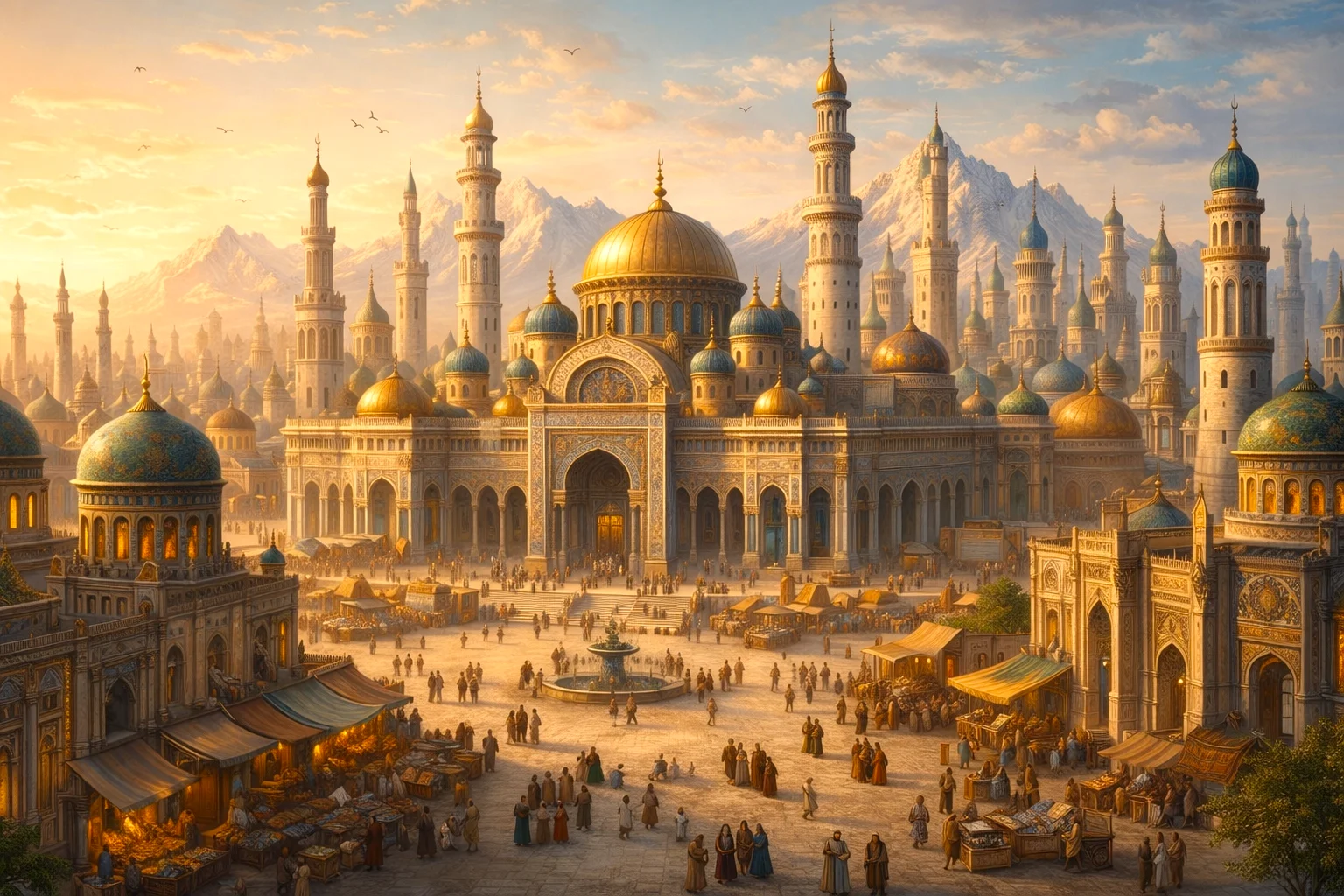
Interest in Tartaria expanded beyond maps and into architecture.
Across Russia, Europe, Central Asia, and even North America, researchers point to monumental structures that seem unusually grand for their time: vast domes, ornate civic buildings, massive cathedrals, intricate stonework, and geometric star forts visible from above.
Mainstream explanations are clear:
- Industrial-era engineering and wealth
- Renaissance military advancements
- Baroque and Neoclassical design movements
- The architectural ambitions of the Gilded Age
These interpretations are well documented.
However, alternative researchers highlight anomalies that fuel ongoing debate:
- Buildings with lower floors partially buried below modern street level
- World’s Fair structures of immense scale built in short timeframes
- Star fort designs appearing across continents with striking geometric precision
- Similar architectural motifs emerging in distant regions
None of these observations automatically confirm the existence of a lost empire. But they do raise questions about funding, engineering capacity, and urban development patterns in the 18th and 19th centuries.
Rather than dismissing these questions outright, we document them and examine both conventional and alternative explanations.
The Mud Flood and the “Civilization Reset” Hypothesis
One of the most controversial elements of the Tartaria narrative is the so-called Mud Flood theory.
The hypothesis suggests that, in the relatively recent past, a large-scale cataclysm buried cities and altered civilization — followed by a reset of historical narrative. Proponents cite partially submerged architecture and underground structures as physical evidence.
Mainstream geology and urban history attribute these features to:
- Gradual sedimentation
- Changing street elevations
- Basement construction
- Normal urban redevelopment
There is currently no verified geological evidence of a global mud catastrophe in the 18th or 19th centuries.
However, the persistence of the theory reflects a broader cultural theme: a growing skepticism toward linear historical storytelling and an instinct to revisit transitional periods where empires rose and fell rapidly.
Even without accepting catastrophic explanations, the 19th century was undeniably a period of enormous structural transformation — industrial, political, and economic.
Russia, National Identity, and Global Reinterpretation
Modern Tartaria discourse gained traction in Russia in the late 20th century, sometimes intertwined with reinterpretations of national history and identity.
From there, the idea evolved. By the mid-2010s, Tartaria had become a global topic of discussion — shifting from a regional reinterpretation to a broader question about architectural and cartographic inconsistencies worldwide.
Some claims extend dramatically — suggesting global reach, advanced technology, or orchestrated suppression. These claims remain unverified and are not supported by mainstream historical scholarship.
At the same time, the documented existence of Tartary on historical maps and the global distribution of star forts and monumental architecture are real, observable phenomena.
Separating documented fact from speculative extension is essential.
A Responsible Approach to Historical Curiosity
The Tartaria question ultimately sits at a crossroads between established scholarship and unresolved curiosity. On one side stands conventional historical understanding: well-documented cartographic records, recognized architectural movements, and the academic consensus that “Tartary” functioned primarily as a geographic designation rather than a unified global empire. These interpretations are supported by archival material, engineering records, and centuries of scholarly research.
On the other side are the anomalies that continue to capture attention — the monumental scale of certain 18th- and 19th-century structures, the global spread of star fort geometry, the partially submerged lower floors of historic buildings, and the speed with which entire cities appeared to rise during periods of industrial transformation. These observations do not automatically validate extraordinary claims, but they do raise questions about how we interpret transitional eras in history and how narratives solidify over time.
Our position is neither to declare Tartaria a suppressed super-empire nor to dismiss every irregularity as coincidence. Instead, we approach it as a case study in historical interpretation — an example of how maps, architecture, and political shifts can be read through different lenses depending on the assumptions we bring to them. History is rarely as linear or as tidy as textbooks suggest. It is layered, revised, and sometimes simplified.
For readers who want to explore the subject more deeply, our Special Report, The Tartarian Empire — 1000 Years of Hidden History & The Mud Floods, was designed as a structured research archive rather than a conclusion. Part I examines 24 distinct topic areas spanning the late 1500s to the early 1900s, offering context around political systems, architectural developments, cultural exchanges, and historical controversies. Part II expands the inquiry through a curated research library of over 30 sources, including maps, articles, and multimedia analyses representing multiple perspectives.
The objective is not persuasion. It is examination.
The Larger Question
History evolves. Borders shift. Maps are redrawn. Empires rise, fragment, and dissolve. What appears settled in one century can be reconsidered in the next as new evidence, reinterpretations, or broader access to archives reshape understanding.
Whether Tartaria ultimately proves to be a misunderstood geographic label, a symbolic narrative of lost knowledge, or a chapter of imperial cartography that deserves greater nuance, the discussion itself reflects something meaningful: a willingness to revisit the historical record rather than accept it passively.
Curiosity does not require conspiracy.
Skepticism does not require extremism.
Re-examining the past does not require abandoning rigor.
The invitation is straightforward.
Look at the maps.
Study the architecture.
Read the documentation.
And arrive at your own conclusions — informed, measured, and thoughtful.
For a deeper look at Tartaria and its contested origins, you can explore related comprehensive analyses and discussions on alternative historical narratives at Great Awakening Report’s The Tartarian Empire | 1000 Yrs Hidden History | The Mudfloods | Part I and Great Awakening Report’s The Tartarian Empire | 1000 Yrs Hidden History | The Mudfloods | Part II
Sign up to receive Our Weekly Briefing Newsletter
Begin your journey with weekly insights designed to expand awareness and ground you in truth. Our free tier gives you a powerful introduction without any commitment.
STOP DROWNING IN THE NOISE. START SEEING THE TRUTH. Join over 99,000 truth seekers. Get the essential intelligence, alternative news, and disclosure updates that the mainstream media won’t touch.
Latest Reports
 Weekly ReportAwakening The Sleeping Giant · September 21st EditionSeptember 21, 2026
 Weekly ReportTruth Seekers Briefing · Master Class Connecting The Dots · September 18th EditionSeptember 18, 2026
 Weekly ReportAwakening The Sleeping Giant · September 14th EditionSeptember 14, 2026
 Monthly ReportSeptember 2026 • Volume IX • Chapter IXSeptember 7, 2026View all weekly reports
Special Reports
 Special ReportCreating A Conscious Culture · Part ISeptember 3, 2026
 Special ReportThe Great Healing: Detox, Defense & Sovereignty In an Engineered World · Part ISeptember 1, 2026
 Special ReportThe Newly Released Fauci DiariesAugust 8, 2026
 Special ReportPersonal Meditation Protocols for Manifestation Series · Part 1August 5, 2026View all special reports
Help Us Bypass Censorship. Share This.
Join the Discussion
Related Posts

Have questions?
At Great Awakening Report, we are dedicated to supporting your journey toward truth and enlightenment through our specialized Coaching and Consulting services.
Coaching Services: Our coaching programs are designed to guide you through personal awakening and transformation. We offer personalized sessions that focus on expanding consciousness, uncovering hidden truths, and fostering spiritual growth. Our experienced coaches provide the tools and insights necessary to navigate your path with clarity and confidence.
Consulting Services: For organizations and individuals seeking deeper understanding and strategic guidance, our consulting services offer expert analysis and solutions. We delve into areas such as global transitions, alternative news insights, and consciousness studies to provide comprehensive strategies tailored to your unique objectives.
Embark on a transformative journey with our Coaching and Consulting services, and unlock your highest potential. To learn more and schedule a session, visit our Coaching and Consulting pages.
Thank you
Thank you to our subscribers and readers for your continued support and dedication to truth and awakening. Your encouragement, engagement, and belief in our mission make everything we do possible. Together, we are expanding awareness and helping illuminate the path forward.
If you would like to further support the Great Awakening team and our ongoing efforts to share insight, knowledge, and truth, you can DONATE HERE.
With deep gratitude,
– Great Awakening Team
About the Author: Great Awakening Team

We are a community. We are cultural creatives and like minded people seeking the truth and focusing on disclosure, awakening and consciousness. Our focus is real news as researchers, reporters and truth seekers. We are here to teach, to spread the word, to serve and to help. We are a collective, a movement, free from all programing, not closed minded and not discriminatory. We are not political. We are not religious but we are spiritual. We study, research, and report on a wide range of subjects and topics, from the current geopolitical climate to health and wellness, from earth’s history to spiritual practices. We are forward thinkers and visionaries, we are guides for the transition as we usher in The Great Awakening.
THIS WEBSITE DOES NOT PROVIDE MEDICAL ADVICE: The information, including but not limited to text, graphics, images, and other material contained on this website, are for informational purposes only. No material on this site is intended to be a substitute for professional medical advice, diagnosis, or treatment. Always seek the advice of your physician or other qualified health care provider with any questions you may have regarding a medical condition or treatment and before undertaking a new health care regimen, and never disregard professional medical advice or delay in seeking it because of something you have read on this website.
DISCLAIMER: All statements, claims, views and opinions that appear anywhere on this site, whether stated as theories or absolute facts, are always presented by The Great Awakening Report (GAR) as unverified—and should be personally fact checked and discerned by you, the reader.Any opinions or statements herein presented are not necessarily promoted, endorsed, or agreed to by GAR, those who work with GAR, or those who read or subscribe to GAR.Any belief or conclusion gleaned from content on this site is solely the responsibility of you the reader to substantiate.Any actions taken by those who read material on this site are solely the responsibility of the acting party.You are encouraged to think for yourself and do your own research.Nothing on this site is meant to be believed without question or personal appraisal.
COPYRIGHT DISCLAIMER: Citation of articles and authors in this report does not imply ownership. Works and images presented here fall under Fair Use Section 107 and are used for commentary on globally significant newsworthy events. Under Section 107 of the Copyright Act 1976, allowance is made for fair use for purposes such as criticism, comment, news reporting, teaching, scholarship, and research.
COMMUNITY GUIDELINES DISCLAIMER: The points of view and purpose of this video is not to bully or harass anybody, but rather share that opinion and thoughts with other like-minded individuals curious about the subject.