
















Help Us Bypass Censorship. Share This.
Sign up to receive Our Weekly Briefing Newsletter
Begin your journey with weekly insights designed to expand awareness and ground you in truth. Our free tier gives you a powerful introduction without any commitment.
“The Central Intelligence Agency owns everyone of any significance in the major media.” – William Colby, CIA Director, 1973–1976
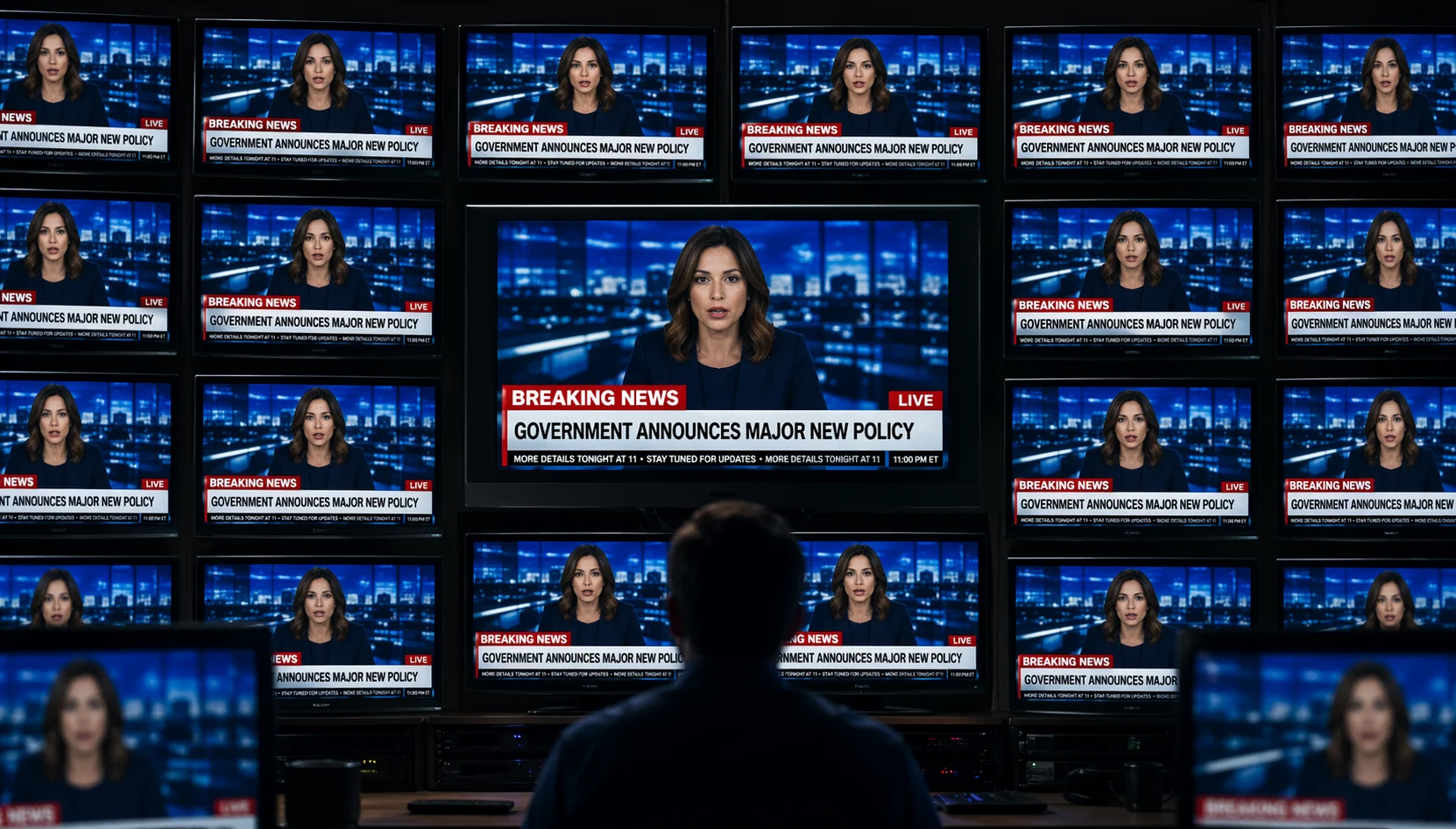
Turn on CNN. Then MSNBC. Then your local news affiliate. Different logos, different anchors, different cities, same framing, same language, often word-for-word the same script. The uniformity is so precise, so consistent across channels that compete with each other for ratings, that it long ago stopped being explainable by coincidence or shared journalistic instinct.
Mockingbird media is not a metaphor. It is a documented historical program, a named CIA operation with a paper trail that runs through Senate committee hearings, a landmark Carl Bernstein investigation, and declassified agency documents. What the program built in the 1950s, a system for shaping public perception through trusted media institutions, was never dismantled. It was modernized, privatized, and scaled into the consolidated corporate media system that reaches into virtually every American home today.
This article does two things. First, it documents the history and present-day architecture of media control using named sources and verified evidence. Second, it gives you the tools to recognize what you’re looking at when you watch, read, or scroll, and to find your way to something better. The goal was never just to expose the system. It was always to help people leave it.
What Is Mockingbird Media? The Documented Program Behind the Name
The CIA didn’t just watch the press. For decades, it ran it.
Operation Mockingbird is the name associated with the Central Intelligence Agency’s large-scale program to infiltrate, influence, and in some cases directly control major American news organizations during the Cold War era. The program is documented, not completely, because many related records remain classified, but substantially enough to establish what it was and how it functioned.
The primary documented record comes from two sources: the Church Committee investigations of 1975–76, and Carl Bernstein’s landmark 25,000-word investigation published in Rolling Stone on October 20, 1977, titled “The CIA and the Media.”
Bernstein’s investigation, drawing on CIA documents, congressional records, and interviews with CIA officials and journalists, documented the following confirmed facts:
- The CIA maintained relationships with journalists at more than 25 major American news organizations, including the New York Times, CBS News, Time magazine, Newsweek, the Associated Press, and the Washington Post.
- These relationships ranged from journalists who were paid CIA assets, to reporters who provided intelligence to the agency voluntarily, to editors who gave the CIA the ability to kill stories or shape coverage.
- The CIA’s media operation included the placement of propaganda stories in foreign press that were then picked up and republished by American outlets, a technique that allowed domestic manipulation while technically circumventing laws against domestic propaganda.
- Frank Wisner, the CIA’s chief of covert operations, reportedly described the agency’s media apparatus as a “Mighty Wurlitzer”, an instrument that could be played to produce whatever tune the agency required.
The CIA’s own declassified documents, available through the agency’s reading room, confirm the existence of a program called PROJECT MOCKINGBIRD, a specific surveillance and influence operation targeting journalists. The Church Committee’s 1976 final report confirmed that the CIA had “at one time or another” used journalists as assets and had influenced American media content.
This is not alleged. It is in the congressional record.
What is less clear, and what GAR presents as named-researcher interpretation rather than confirmed fact, is the precise scope of the program, whether it formally continued under that name after the Church Committee’s exposure, and the full list of participating journalists and organizations. Much of the operational detail remains classified.
What is clear: the mechanism existed, it was significant, and its exposure produced no criminal charges, no lasting reforms, and no fundamental restructuring of the relationship between intelligence agencies and major media organizations.
For a deeper look at the CIA’s documented psychological programs, see our investigation into Project Artichoke and MKUltra in the Forbidden History archive.
Operation Mockingbird CIA: From Cold War Program to Corporate Architecture
They didn’t need to keep running a secret program. They built it into the ownership structure.
By the time Operation Mockingbird CIA was exposed in the mid-1970s, the relationship between media and power had already begun its transition from covert infiltration to overt structural integration. What the CIA did covertly with relationships and payments, the consolidation of media ownership would accomplish organically, and legally.
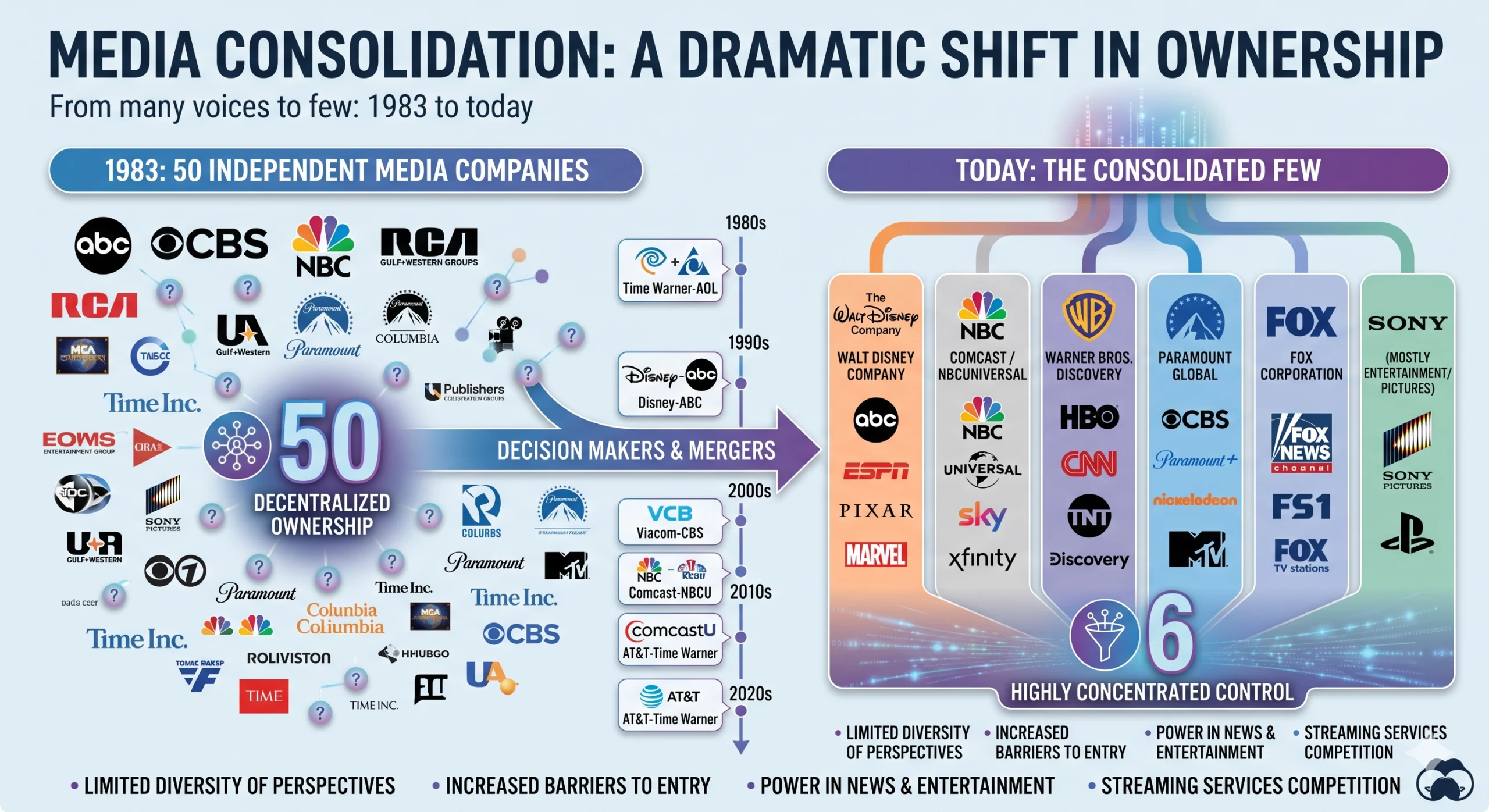
The media landscape of 1970 was genuinely diverse. There were hundreds of independently owned local newspapers, regional television stations, independent radio broadcasters, and competing national print magazines. No single entity could realistically coordinate their coverage. The CIA had to operate covertly because the system was too decentralized to control from the top.
What happened over the following five decades was one of the most consequential structural shifts in American public life, and one of the least examined.
Media consolidation transformed a decentralized ecosystem into a handful of vertically integrated conglomerates. By 2026, according to the Committee to Protect Journalists, virtually all major American media is controlled by six corporations: Comcast/NBCUniversal, Walt Disney Company, Warner Bros. Discovery, Paramount/Skydance, Sony, and Amazon. These six entities collectively control the major television networks, cable news channels, film studios, streaming platforms, and significant digital properties.
The board memberships of these corporations interlock with the boards of major financial institutions, defense contractors, and pharmaceutical companies, the industries whose coverage matters most to the public, and whose advertising revenue matters most to the networks.
You do not need a CIA handler in every newsroom when the newsroom’s parent company shares board members with the companies whose products the newsroom covers.
The Sinclair Broadcasting case is the most visually striking example of what this architecture produces in practice. In 2018, a compilation video went viral showing anchors at dozens of Sinclair-owned local TV stations across the country reading an identical script, word for word, warning viewers about “the troubling trend of irresponsible, one-sided news stories.” Sinclair’s documented “must-run” mandate, which required local affiliates to air centrally produced content including daily terrorism updates, made the coordination impossible to deny. Local faces, trusted community anchors, delivering centrally scripted messaging. That is what the Mighty Wurlitzer sounds like in the 21st century.
See also our full report on who controls the media and why it matters in the Geopolitical archive.
Mainstream Media Propaganda: The Psychological Architecture
Television was never designed to inform you. It was designed to hold your attention long enough to sell it.
Understanding mainstream media propaganda requires understanding the medium before the message. Television, and its successor, the algorithmically curated social media feed, operates on principles of psychological engagement that have been studied, refined, and exploited for decades.
The foundational mechanism is repetition. Propaganda is not primarily about lying. It is about repetition of selected truths, selected framings, and selected omissions until the repeated version becomes the default reality in the viewer’s mind. Psychologists call this the illusory truth effect, a well-documented cognitive phenomenon in which repeated exposure to a statement increases the listener’s perception of its accuracy, regardless of whether the statement is actually true. This is not speculation. It is peer-reviewed cognitive psychology, documented in research published since the 1970s.
The second mechanism is emotional priming. News programming, particularly cable news, is structured to maintain a state of low-level anxiety and outrage in the viewer. Threat-based framing activates the limbic system and reduces the prefrontal cortex’s capacity for critical analysis. A viewer in a state of anxiety is more receptive to authority, more susceptible to binary framing, and less capable of independent evaluation.
This is also documented science. The CIA’s own MKUltra program, confirmed by the Senate Select Committee on Intelligence in 1977, demonstrated that psychological states could be deliberately induced to increase susceptibility to suggestion. The program used extreme methods in a laboratory context. The media system achieves analogous effects at population scale through repetition, threat framing, and social proof.
The third mechanism is the Overton Window, the range of positions that a given media ecosystem presents as legitimate, reasonable, or discussable. What falls outside that window is not necessarily disproven; it is simply not aired, not discussed, labeled as “fringe” or “debunked” by association with the label rather than by engagement with the evidence. Operation Mockingbird didn’t need to control every story. It needed to control which stories were possible to tell.
The Great Awakening Report exists precisely because certain stories are systematically impossible to tell within that window.
For a deeper examination of psychological programming history, see our report on CIA psychological warfare programs in the Forbidden History archive.
Who Owns the Mainstream Media: The Board-Level Reality
Corporate media bias is not a matter of individual reporters’ opinions. It is structurally embedded in ownership.
The who owns the mainstream media question is the one the mainstream media is least equipped, and least motivated, to answer honestly. But the answer is available in SEC filings, corporate governance disclosures, and publicly available board membership records.
A partial picture of what those records show:
General Electric (former owner of NBC) was simultaneously a major defense contractor and military technology manufacturer. NBC News covered defense and military affairs. The board-level conflict of interest was structural and undisclosed to viewers.
The Walt Disney Company, owner of ABC News and a major streaming conglomerate, maintains significant business interests in China. ABC News coverage of China-related stories operates within that context. Board members have included figures from Goldman Sachs and other major financial institutions.
Comcast/NBCUniversal, owner of NBC, MSNBC, and CNBC, maintains board connections to major financial and technology sector interests. CNBC in particular functions as a financial media operation where the separation between market advocacy and journalism is, at minimum, structurally complicated.
None of this requires individual reporters to be dishonest. The selection of stories, the framing of issues, the choice of sources, and the editorial decisions about what is and isn’t newsworthy happen at levels far above the individual journalist. Corporate media bias is a systemic output, not a personal failing.
The result, across all six conglomerates, is a media ecosystem in which:
- Coverage of pharmaceutical companies is shaped by pharmaceutical advertising revenue
- Coverage of financial institutions is shaped by financial sector board membership
- Coverage of defense and intelligence matters is shaped by defense contractor ownership and former intelligence official consultancy
- Coverage of alternative research, disclosure, and the truth community is shaped by the institutional interest in maintaining the Overton Window
The bias is not in the reporters. It is in the architecture.
Related reading: The Khazarian Mafia: Who They Are and Why It Matters, our documented investigation into the concentrated power structures behind global media and finance.
How to Spot Media Manipulation: A Practical Guide
Deprogramming is a skill. It can be learned. Here’s where to start.
Recognizing how to spot media manipulation is the transition from passive media consumption to active, sovereign information processing. These are the specific patterns to watch for:
1. The Coordination Tell
When multiple unconnected outlets use identical or near-identical language to describe the same story on the same day, that coordination is the story. Organic journalism produces variation. Centrally coordinated messaging produces uniformity. The Sinclair script moment was visible because it was compiled into a single video. The same coordination happens in subtler forms every day, watch for it.
2. The Pre-emptive Debunk
When a story is labeled “debunked,” “disinformation,” or “conspiracy theory” before the evidence is examined, often in the headline itself, that framing is doing substitution work. It is replacing evidence evaluation with social stigma. Ask: what specifically is being claimed? What specifically is being denied? On what evidentiary basis? The answer is often that no specific evidence has been engaged at all.
3. The Missing Expert
Every mainstream story on a controversial topic presents a curated set of expert voices. The experts who reach different conclusions, often with equivalent or superior credentials, are simply absent. Identifying what the story doesn’t say is often more informative than what it does say.
4. The Emotional Escalation Pattern
Legitimate journalism informs. Propaganda activates. When coverage is structured to produce anxiety, outrage, or fear rather than understanding, examine what the emotional activation is redirecting attention away from. Fear narrows focus. That narrowing is frequently the point.
5. The Source Laundering Technique
Stories that originate in government agency briefings or think-tank reports are frequently presented as independent journalism. Trace the sourcing: who produced the original information? Who funds the think tank? What are the institutional interests of the source? The story that appears to be “news” is often, at its origin, a press release with a byline.
6. The Memory Hole
Notice what disappears. Stories that contradict the established narrative, successful treatments that never became policy, investigations that were dropped, admissions buried in official reports, simply stop being referenced. The media’s relationship with its own archive is selective. Develop your own.
Media Deprogramming: Building Your Own Information Ecosystem
You don’t fix the system by engaging with it on its own terms. You build something better.
Media deprogramming is not about becoming cynical about everything. It is about becoming precise about sourcing, deliberate about selection, and active rather than passive in information processing. Here is a practical framework:
Go to primary sources directly. Government documents, academic research, congressional testimony, court filings, and primary data are available directly to anyone with internet access. The CIA’s CREST reading room, the Government Publishing Office, and Senate intelligence committee records are all publicly searchable. Reading a government report directly is a fundamentally different cognitive experience than consuming a media summary of it.
Follow researchers, not channels. The individual investigators, scientists, historians, and analysts doing serious work in their fields, regardless of which platform they publish on, are a better primary source than any network or outlet. Follow the people, not the brand.
Apply the “who benefits” test. For every major story, ask: who benefits from this framing? Whose interests are served by the specific way this story is being told, and whose interests would be served by telling it differently? This is not a cynicism exercise. It is basic political economy applied to information.
Seek deliberate cognitive diversity. Read primary sources that challenge your existing frameworks, not just those that confirm them. The goal of an awakened information ecosystem is accuracy, not tribal comfort.
Use the Great Awakening Report as a cross-reference. GAR exists specifically to cover the stories, researchers, and evidence that fall outside the Overton Window, not as a replacement for discernment, but as a complement to it. Our standard is documented evidence, named sources, and the “you decide” posture that the mainstream abandoned long ago. With 99,000+ subscribers and 872+ published reports across eight topic pillars, the archive represents one of the most comprehensive alternative intelligence resources available. Explore Standard and Premium access here →
For further reading on building an independent information diet, see our guide to truth seeker news and alternative media resources in the Path of Awakening archive.
The Mockingbird’s Song Is Getting Harder to Hear
The Church Committee exposed Operation Mockingbird in 1975. Carl Bernstein documented its architecture in 1977. The institutional response was: acknowledgment, no accountability, no structural change, and a quiet acceleration of the consolidation that made covert control unnecessary.
Fifty years later, the tools have changed. The mechanism, shaping what is thinkable, what is discussable, what is real, remains identical. But so does the fundamental human capacity that it has always underestimated: the desire to know what is actually true.
Truth seeker news is not a niche. It is the oldest human impulse there is. The institutions built to suppress it are sophisticated, well-funded, and structurally integrated in ways that Bernstein’s generation could not have anticipated. They are also, in the age of decentralized information, increasingly unable to maintain the illusion of monopoly.
The Mockingbird sang loudly because it needed to drown out everything else. The fact that you are reading this means it didn’t fully succeed.
The deprogramming is not a single moment. It is a practice, of questioning, of sourcing, of building an information life that serves your understanding rather than someone else’s agenda. That practice, multiplied across millions of people choosing differently, is what an awakening actually looks like.
You are already part of it.
Explore the full GAR archive, including our investigations into Project Artichoke, Geoengineering & Weather Warfare, the Khazarian Mafia, and the complete Forbidden History and Geopolitical collections, available to Standard and Premium subscribers. Join 99,000+ truth seekers here →
Sign up to receive Our Weekly Briefing Newsletter
Begin your journey with weekly insights designed to expand awareness and ground you in truth. Our free tier gives you a powerful introduction without any commitment.
STOP DROWNING IN THE NOISE. START SEEING THE TRUTH. Join over 99,000 truth seekers. Get the essential intelligence, alternative news, and disclosure updates that the mainstream media won’t touch.
Latest Reports
 Weekly ReportAwakening The Sleeping Giant · October 12th EditionOctober 12, 2026
 Monthly ReportConscious Practices · October 2026 EditionOctober 5, 2026
 Weekly ReportAwakening The Sleeping Giant · October 5th EditionOctober 5, 2026
 Weekly ReportAwakening The Sleeping Giant · September 28th EditionSeptember 28, 2026View all weekly reports
Special Reports
 Special ReportTHE AWAKENING JOURNEY: Hero’s Journey Part II · Week 1October 3, 2026
 Special ReportGlobal Everything Collapse · Economic Chaos · Part IOctober 1, 2026
 Special ReportCreating A Conscious Culture · Part ISeptember 3, 2026
 Special ReportThe Great Healing: Detox, Defense & Sovereignty In an Engineered World · Part ISeptember 1, 2026View all special reports
Help Us Bypass Censorship. Share This.
Join the Discussion
Related Posts



Have questions?
At Great Awakening Report, we are dedicated to supporting your journey toward truth and enlightenment through our specialized Coaching and Consulting services.
Coaching Services: Our coaching programs are designed to guide you through personal awakening and transformation. We offer personalized sessions that focus on expanding consciousness, uncovering hidden truths, and fostering spiritual growth. Our experienced coaches provide the tools and insights necessary to navigate your path with clarity and confidence.
Consulting Services: For organizations and individuals seeking deeper understanding and strategic guidance, our consulting services offer expert analysis and solutions. We delve into areas such as global transitions, alternative news insights, and consciousness studies to provide comprehensive strategies tailored to your unique objectives.
Embark on a transformative journey with our Coaching and Consulting services, and unlock your highest potential. To learn more and schedule a session, visit our Coaching and Consulting pages.
Thank you
Thank you to our subscribers and readers for your continued support and dedication to truth and awakening. Your encouragement, engagement, and belief in our mission make everything we do possible. Together, we are expanding awareness and helping illuminate the path forward.
If you would like to further support the Great Awakening team and our ongoing efforts to share insight, knowledge, and truth, you can DONATE HERE.
With deep gratitude,
– Great Awakening Team
About the Author: Great Awakening Team

DISCLAIMER: All statements, claims, views and opinions that appear anywhere on this site, whether stated as theories or absolute facts, are always presented by The Great Awakening Report (GAR) as unverified—and should be personally fact checked and discerned by you, the reader.Any opinions or statements herein presented are not necessarily promoted, endorsed, or agreed to by GAR, those who work with GAR, or those who read or subscribe to GAR.Any belief or conclusion gleaned from content on this site is solely the responsibility of you the reader to substantiate.Any actions taken by those who read material on this site are solely the responsibility of the acting party.You are encouraged to think for yourself and do your own research.Nothing on this site is meant to be believed without question or personal appraisal.
COPYRIGHT DISCLAIMER: Citation of articles and authors in this report does not imply ownership. Works and images presented here fall under Fair Use Section 107 and are used for commentary on globally significant newsworthy events. Under Section 107 of the Copyright Act 1976, allowance is made for fair use for purposes such as criticism, comment, news reporting, teaching, scholarship, and research.
COMMUNITY GUIDELINES DISCLAIMER: The points of view and purpose of this video is not to bully or harass anybody, but rather share that opinion and thoughts with other like-minded individuals curious about the subject.