

















Help Us Bypass Censorship. Share This.
Sign up to receive Our Weekly Briefing Newsletter
Begin your journey with weekly insights designed to expand awareness and ground you in truth. Our free tier gives you a powerful introduction without any commitment.
“The quieter you become, the more you are able to hear.” — Rumi
From Ancient Wisdom to Modern Consciousness
For thousands of years, human beings have intentionally stepped away from the activity of the outer world to explore the quieter world within. Long before meditation became associated with wellness programs, mindfulness apps, stress reduction, or morning routines, contemplative practices were woven into humanity’s search for meaning, wisdom, connection, and a deeper understanding of ourselves.
Across cultures and centuries, people entered stillness in very different ways. Some followed the breath or repeated sacred words and mantras. Others prayed, chanted, contemplated, moved rhythmically, observed the mind, or simply sat in silence. Some sought liberation from suffering or greater mastery of the mind, while others sought communion with God, the Divine, or a deeper dimension of consciousness. The beliefs surrounding these practices were often very different, yet the impulse behind them continued to appear throughout human history.
There is something remarkable about that continuity. Civilizations rose and fell, religions and philosophies developed, cultures encountered one another, and eventually the modern world transformed almost every aspect of daily life. Through all of it, human beings continued to discover value in becoming still and turning their attention inward.
Perhaps that is because meditation addresses something technology and progress cannot resolve for us. The world around us can change dramatically, but each generation still encounters many of the same fundamental questions about identity, suffering, meaning, connection, purpose, and the nature of consciousness. Meditation has endured because it offers a way to explore those questions through direct experience rather than thought alone.
The Ancient Roots of Meditation
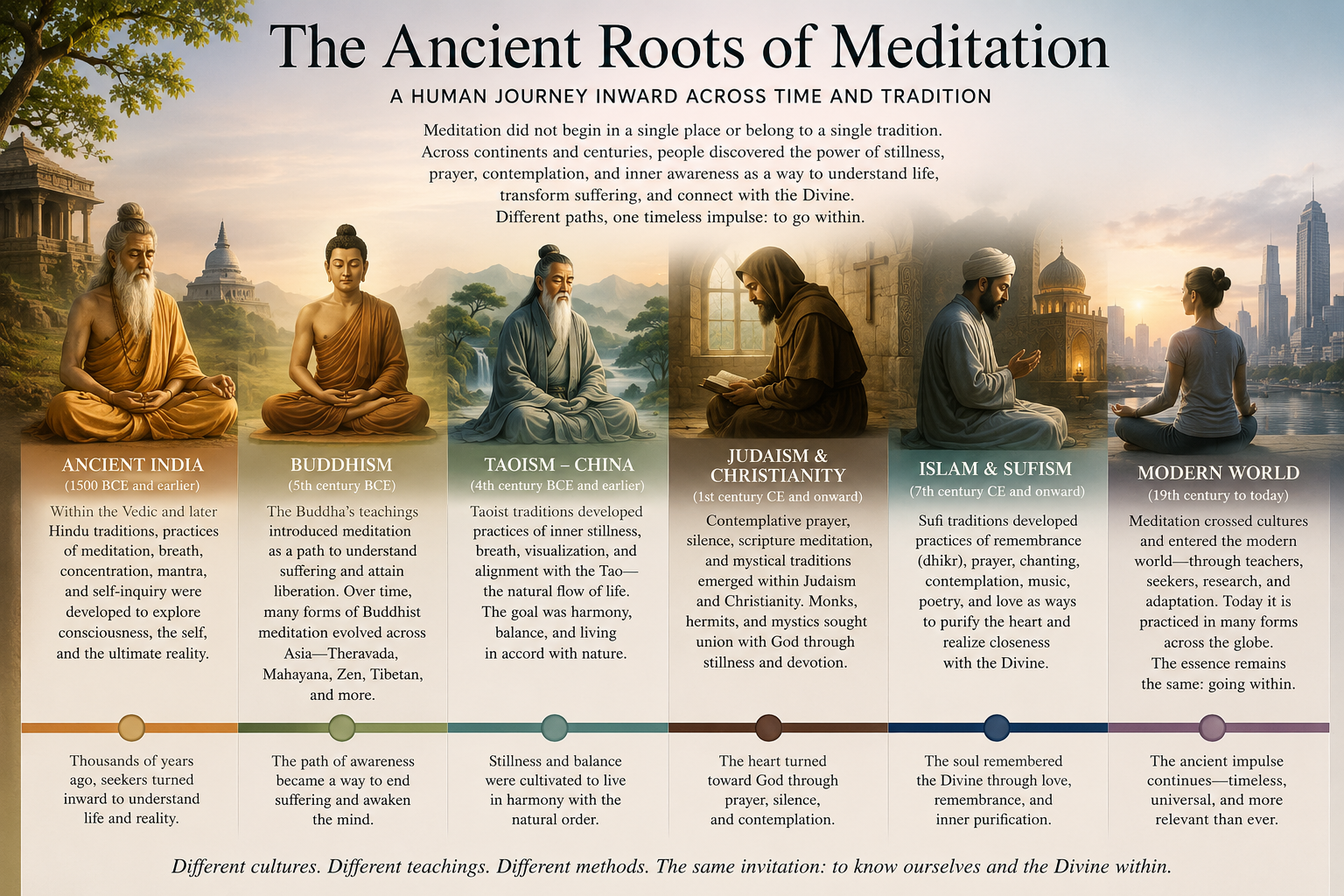
There is no single moment in history when humanity “invented” meditation. Contemplative practices almost certainly existed before they were recorded in writing, and forms of prayer, ritual, silence, breath, focused attention, and altered states of awareness developed in different cultures over long periods of time. Rather than a single origin story, the history of meditation is better understood as several streams of contemplative practice that emerged, developed, and sometimes influenced one another as civilizations evolved.
Some of the earliest surviving written references associated with meditation appear in the ancient traditions of India. Within Vedic and later Hindu and yogic traditions, practices involving concentration, breath, mantra, contemplation, self-inquiry, and inward awareness became part of sophisticated spiritual and philosophical systems. Meditation was not originally separated from the larger questions these were exploring. It was connected to understanding the nature of the self, consciousness, reality, and the relationship between individual existence and a greater spiritual reality.
Buddhism, which emerged in ancient India more than two thousand years ago, placed contemplative practice at the center of another profound inquiry: understanding suffering and the possibility of liberation from it. As Buddhism spread throughout Asia, meditation developed into many different forms. Some traditions emphasized concentration and stillness, while others cultivated mindfulness, compassion, insight, or direct observation of experience. Over time, Theravada, Mahayana, Tibetan, Chan, Zen, and other Buddhist traditions developed distinct approaches while preserving meditation as a central part of spiritual practice.
In China, Taoist contemplative traditions developed practices involving stillness, breathing, internal awareness, balance, and harmony with the natural flow of life. Rather than attempting to dominate experience, Taoist philosophy often emphasized alignment with the rhythms of nature and a way of being that allowed greater harmony between the individual and the larger whole.
The human movement toward contemplation was never limited to Asia. Within Judaism, Christianity, and Islam, rich traditions of prayer, silence, remembrance, contemplation, and mystical experience also developed. Christian monks, hermits, and mystics sought inward communion with God through contemplative prayer and silence. Jewish mystical traditions incorporated prayer, sacred language, focused intention, and contemplation into the search for deeper relationship with the Divine. Within Islam, Sufi traditions developed practices involving remembrance of God, prayer, chanting, breath, music, poetry, contemplation, and, in some traditions, movement.
These paths should not be treated as interchangeable. Their understanding of God, the self, liberation, salvation, suffering, and the purpose of spiritual practice could differ considerably. What is significant is that cultures separated by geography, language, and belief repeatedly discovered that deliberately directing attention inward could profoundly affect the human experience.
Many Traditions, One Inward Journey
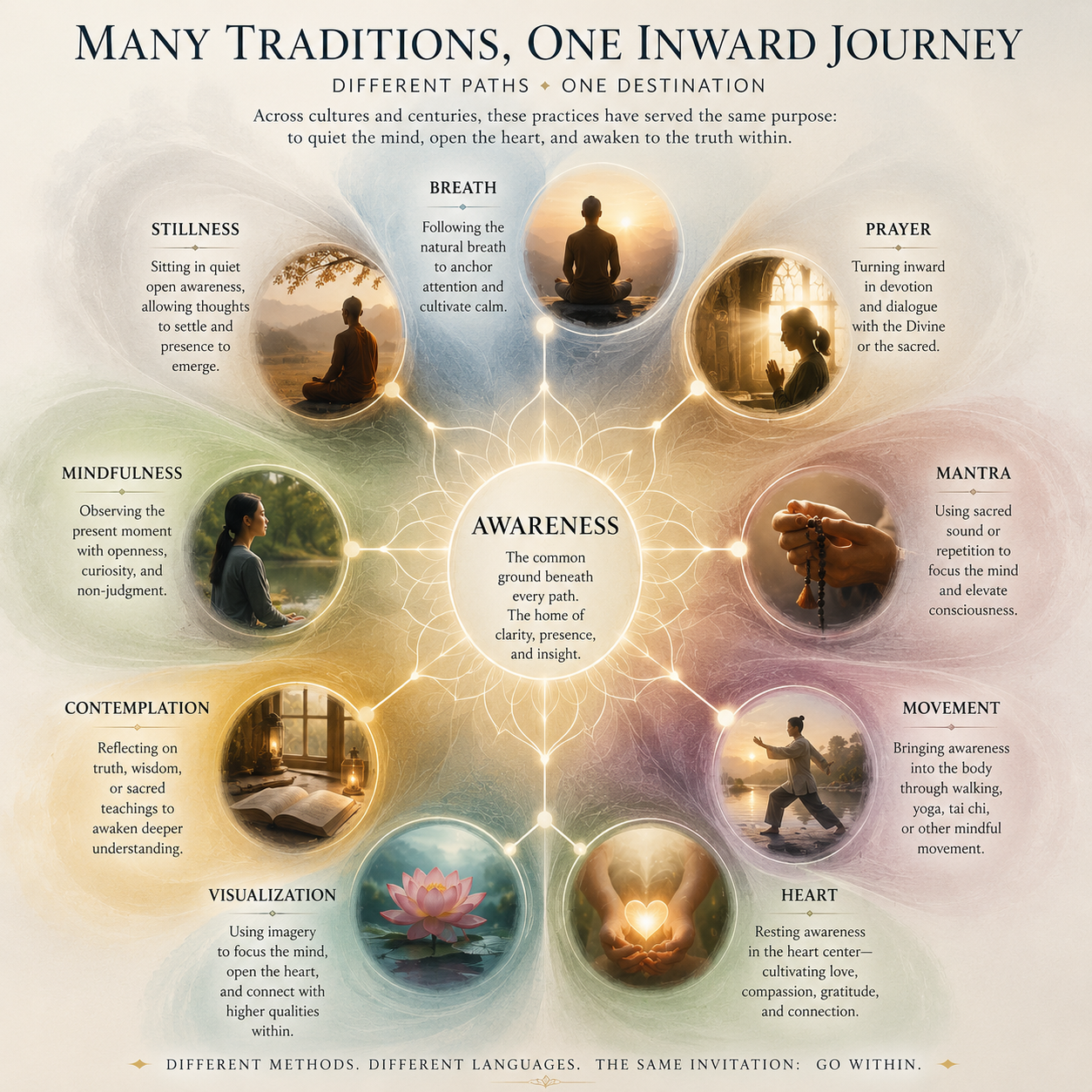
As contemplative traditions developed, so did the methods used to enter deeper states of awareness. This is one reason the word meditation can be confusing today. We often speak about meditation as though it were a single practice, when it is actually an umbrella term encompassing an extraordinary range of approaches that evolved for different purposes.
One tradition might use the breath as an anchor for attention, while another might repeat a sacred mantra or prayer. Some practices invite the meditator to observe thoughts and sensations without attachment, while others deliberately cultivate compassion, gratitude, devotion, or loving-kindness. Visualization can become the focus of one meditation, while another may gradually remove every object of concentration until only stillness remains. Walking, chanting, sacred movement, contemplation, and silence can all become vehicles for meditative awareness.
Even practices that appear similar from the outside may have very different intentions. Sitting quietly in Buddhist mindfulness practice is not necessarily the same experience as entering Christian contemplative prayer, even though both may involve stillness. Repeating a mantra can serve concentration, devotion, spiritual transformation, or other purposes depending upon the tradition in which it is practiced. Movement can be contemplative when attention, intention, and awareness become integral to the experience.
This diversity helps explain why there is no single “correct” way to meditate. Different practices cultivate different capacities, and the practice that resonates at one point in a person’s life may not be the practice that serves them years later. What connects these traditions is not a particular posture, belief, or technique, but the deliberate relationship they create with attention and awareness.
Meditation asks us to notice where our attention is going and, depending upon the practice, to consciously direct it somewhere else or simply become aware of its movement. That principle may sound simple, but it becomes increasingly profound as the practice deepens. The ability to direct attention eventually becomes the ability to observe thought, emotion, sensation, and reaction without being automatically carried by them.
From Sacred Practice to the Modern World
For much of human history, meditation was embedded within the religious, philosophical, and spiritual traditions that developed it. A person generally did not decide to “start meditating” as an isolated wellness practice. Meditation belonged to a larger framework that offered teachings about the nature of life, the purpose of the practice, and the way its insights should be carried into the world.
That began to change as communication and travel brought cultures into greater contact. During the 19th and 20th centuries, Western interest in Indian philosophy, Buddhism, yoga, and other Eastern traditions expanded significantly. Spiritual teachers traveled internationally, philosophical and sacred texts became more widely translated, and Western seekers traveled to Asia to study traditions that previously had been difficult for them to access directly.
By the middle of the 20th century, meditation was becoming increasingly familiar throughout Europe and North America. Zen attracted growing attention, yoga expanded dramatically, Buddhist teachers established communities and meditation centers, and Transcendental Meditation became widely known during the cultural changes of the 1960s and 1970s. Practices that had once seemed distant or unfamiliar gradually entered mainstream Western awareness.
A second transformation occurred as researchers and clinicians became interested in meditation itself. Mindfulness and other contemplative practices were increasingly studied outside their original religious contexts and adapted for secular use. Over time, meditation entered healthcare, psychology, education, athletics, workplaces, wellness programs, and homes, while the arrival of digital technology eventually made thousands of guided practices available almost instantly.
Today, a person can encounter meditation through a spiritual teacher, a therapist, a yoga studio, a physician, a book, a podcast, or an app. That accessibility has opened the practice to millions of people who might never have encountered it otherwise, but it has also changed the language surrounding meditation. Ancient discussions of liberation, spiritual realization, communion with the Divine, and the nature of consciousness now share space with modern conversations about stress, sleep, focus, emotional wellness, and performance.
There is value in both perspectives. Meditation does not become less meaningful because someone begins simply wanting to feel calmer. At the same time, understanding where meditation came from reminds us that its potential has historically extended far beyond relaxation.
Why Meditation Endures
The practical reasons people turn to meditation today are compelling. Modern life places extraordinary demands on attention, and many people begin meditating because they are looking for greater calm, focus, emotional balance, resilience, or relief from the constant mental activity that accompanies a busy life. Research has explored meditation and mindfulness in relation to stress, anxiety, attention, emotional regulation, sleep, pain, and psychological well-being, although the evidence and effects vary according to the practice, the individual, and the outcome being studied.
Those benefits help explain meditation’s modern popularity, but they do not fully explain why contemplative practice has survived for thousands of years. Long before researchers measured stress or people tracked sleep and wellness, human beings were using stillness to explore the fundamental experience of being alive.
The questions they carried into meditation remain familiar. Why do we suffer? Why does the mind continue returning to certain fears, memories, and desires? Can we become less controlled by our reactions? What creates inner peace? What is the nature of the self? How do we deepen our relationship with God, the Divine, nature, or something larger than ourselves? What does it mean to become fully present?
Meditation does not provide one universal answer to these questions, because different traditions have interpreted them in very different ways. What meditation does provide is an environment in which we can begin observing our own experience with greater clarity. When external stimulation becomes quieter, internal patterns that normally move unnoticed through our day can become easier to see.
We may notice how quickly one thought leads to another, how an old memory can create a present emotion, or how often we are responding not to what is happening but to what we fear might happen next. We begin seeing the stories we repeat, the judgments we make, the conversations we continue long after they have ended, and the assumptions that influence how we experience ourselves and other people.
That awareness can create something enormously valuable: space. Instead of moving instantly from experience to interpretation to reaction, we begin to recognize the moment in between. Within that moment, another possibility becomes available. We can respond consciously rather than automatically.
This is where meditation begins moving beyond the pursuit of calm and toward a deeper understanding of ourselves.
Meditation and the Nature of Awareness
One of the most interesting things that happens through meditation is that our relationship with thought begins to change. Most of us spend much of our waking life immersed in the activity of the mind, planning what comes next, remembering what has already happened, evaluating what is happening now, and imagining possibilities that may never occur. Because this mental activity is so constant, it can be difficult to recognize how completely it shapes our experience.
Meditation does not require the mind to stop producing thoughts. Instead, it allows us to become more aware of thoughts as they arise. A memory appears and we notice it. An emotion surfaces and we recognize it. Attention wanders and, at some point, we become aware that it has wandered. That moment of recognition may seem insignificant, yet it reveals something important: there is a difference between a thought and the awareness that notices the thought.
Contemplative traditions have interpreted that distinction in many ways, but it is one of the reasons meditation can evolve into a practice of consciousness rather than remaining solely a technique for relaxation. As awareness develops, we begin noticing not only what we are thinking and feeling, but the patterns through which we experience life. The goal is not to become detached from being human, but to become present enough to recognize what is happening within us while it is happening.
Over time, that can change the questions we bring to the practice. Instead of asking only how to quiet the mind, we may become curious about the awareness capable of observing it. Instead of immediately trying to eliminate an uncomfortable emotion, we may learn to remain present long enough to understand what it is revealing. Meditation becomes less about controlling our internal experience and more about developing a conscious relationship with it.
For some practitioners, that exploration remains psychological and deeply practical. For others, it becomes spiritual and leads toward larger questions about identity, connection, consciousness, and the nature of existence. Meditation has always been spacious enough to hold both journeys.
The Heart as Our Foundation
Within the enormous landscape of meditation traditions, there is no single place from which every practice begins. Some traditions begin with the breath, others with concentration, prayer, sacred sound, bodily awareness, or simple observation. As we move into the practices that follow this foundational report, our approach will begin with the heart.
The heart has held profound symbolic and spiritual meaning across human history, representing love, courage, compassion, devotion, wisdom, truth, and connection. Even in ordinary language, we speak of knowing something in our heart, being wholehearted, having a change of heart, or connecting heart to heart. These expressions endure because human beings have long associated the heart with dimensions of experience that cannot always be captured through analysis alone.
Heart consciousness, as we will use the term throughout this series, describes an orientation toward qualities such as compassion, gratitude, appreciation, openness, forgiveness, connection, love, and presence. It is not a rejection of intellect, nor does it ask us to choose feeling over reason. The mind gives us analysis, language, discernment, imagination, and an extraordinary capacity to understand the world. The intention is to bring the mind and heart into a more conscious relationship rather than allowing constant mental activity to dominate every experience.
Many of us have become accustomed to thinking about how we feel instead of allowing ourselves to experience the feeling itself. We can analyze gratitude without deeply feeling grateful, understand compassion intellectually without allowing another person’s experience to touch us, or talk about peace while remaining internally restless. Heart-centered practice begins to close that distance by inviting awareness into the felt experience of the present moment.
This will become the foundation beneath the meditation practices ahead. As the series progresses, we will explore stillness, breath, observation, sound, mantra, visualization, and increasingly advanced practices, but the techniques will always serve something larger than the technique itself. Meditation is not simply about learning what to do while our eyes are closed; it is about cultivating a quality of awareness that gradually changes how we experience ourselves, other people, and the world around us.
An Ancient Practice for a Changing World
The world surrounding us bears little resemblance to the one in which the earliest contemplative traditions developed, yet the need for intentional awareness may be greater than ever. Modern life continually directs our attention outward through information, technology, responsibilities, entertainment, news, social media, and the endless stream of decisions that fill an ordinary day. Even moments that once offered natural pauses can now be occupied by another screen, another message, or another piece of information.
In this environment, attention has become extraordinarily valuable. Entire industries compete for it, technology is designed to retain it, and the pace of information often encourages reaction before reflection. Meditation creates a deliberate countercurrent by asking us to choose where our awareness goes rather than allowing every external stimulus to choose for us.
That does not require withdrawing from the modern world. In many ways, meditation prepares us to participate in it more consciously. The ability to notice our own reaction before expressing it, remain present during uncertainty, listen without immediately formulating a response, or recognize when fear is shaping our perception has practical value in relationships, work, decision-making, and everyday life.
The deeper value may be even simpler. Meditation gives us permission to stop doing for a moment and experience being. It creates room to notice what is happening beneath the activity, to reconnect with ourselves, and to remember that awareness does not have to move at the same speed as the world around us.
This may be one reason meditation has survived every cultural transformation it has encountered. Its outer forms have changed, its practices have crossed cultures, and its purposes have expanded, yet the essential invitation remains remarkably familiar: turn inward long enough to become aware of what is already there.
The Journey Ahead
Understanding the history and purpose of meditation gives us a foundation, but meditation ultimately becomes meaningful through experience. We can study its traditions, understand the language, explore the research, and appreciate why people have practiced it for thousands of years, but the practice itself begins only when we become willing to enter stillness for ourselves.
That is where the next stage of this series begins. In Meditation Practices | Entering the Heart, we will move from understanding meditation to establishing a personal practice, beginning with the fundamentals of breath, attention, environment, consistency, and the wandering mind before exploring how to intentionally shift awareness into the heart space.
There is no need to arrive there with a perfectly quiet mind or years of spiritual practice behind us. Meditation has always begun with something much simpler: the decision to become present and discover, through experience, what stillness has to teach us.
Sign up to receive Our Weekly Briefing Newsletter
Begin your journey with weekly insights designed to expand awareness and ground you in truth. Our free tier gives you a powerful introduction without any commitment.
STOP DROWNING IN THE NOISE. START SEEING THE TRUTH. Join over 99,000 truth seekers. Get the essential intelligence, alternative news, and disclosure updates that the mainstream media won’t touch.
Latest Reports
 Weekly ReportTruth Seekers Briefing · Master Class Connecting The Dots · September 18th EditionSeptember 18, 2026
 Weekly ReportAwakening The Sleeping Giant · September 14th EditionSeptember 14, 2026
 Monthly ReportSeptember 2026 • Volume IX • Chapter IXSeptember 7, 2026
 Weekly ReportAwakening The Sleeping Giant · September 7th EditionSeptember 7, 2026View all weekly reports
Special Reports
 Special ReportCreating A Conscious Culture · Part ISeptember 3, 2026
 Special ReportThe Great Healing: Detox, Defense & Sovereignty In an Engineered World · Part ISeptember 1, 2026
 Special ReportThe Newly Released Fauci DiariesAugust 8, 2026
 Special ReportPersonal Meditation Protocols for Manifestation Series · Part 1August 5, 2026View all special reports
Help Us Bypass Censorship. Share This.
Join the Discussion
Related Posts



Have questions?
At Great Awakening Report, we are dedicated to supporting your journey toward truth and enlightenment through our specialized Coaching and Consulting services.
Coaching Services: Our coaching programs are designed to guide you through personal awakening and transformation. We offer personalized sessions that focus on expanding consciousness, uncovering hidden truths, and fostering spiritual growth. Our experienced coaches provide the tools and insights necessary to navigate your path with clarity and confidence.
Consulting Services: For organizations and individuals seeking deeper understanding and strategic guidance, our consulting services offer expert analysis and solutions. We delve into areas such as global transitions, alternative news insights, and consciousness studies to provide comprehensive strategies tailored to your unique objectives.
Embark on a transformative journey with our Coaching and Consulting services, and unlock your highest potential. To learn more and schedule a session, visit our Coaching and Consulting pages.
Thank you
Thank you to our subscribers and readers for your continued support and dedication to truth and awakening. Your encouragement, engagement, and belief in our mission make everything we do possible. Together, we are expanding awareness and helping illuminate the path forward.
If you would like to further support the Great Awakening team and our ongoing efforts to share insight, knowledge, and truth, you can DONATE HERE.
With deep gratitude,
– Great Awakening Team
About the Author: Great Awakening Team

We are a community. We are cultural creatives and like minded people seeking the truth and focusing on disclosure, awakening and consciousness. Our focus is real news as researchers, reporters and truth seekers. We are here to teach, to spread the word, to serve and to help. We are a collective, a movement, free from all programing, not closed minded and not discriminatory. We are not political. We are not religious but we are spiritual. We study, research, and report on a wide range of subjects and topics, from the current geopolitical climate to health and wellness, from earth’s history to spiritual practices. We are forward thinkers and visionaries, we are guides for the transition as we usher in The Great Awakening.
THIS WEBSITE DOES NOT PROVIDE MEDICAL ADVICE: The information, including but not limited to text, graphics, images, and other material contained on this website, are for informational purposes only. No material on this site is intended to be a substitute for professional medical advice, diagnosis, or treatment. Always seek the advice of your physician or other qualified health care provider with any questions you may have regarding a medical condition or treatment and before undertaking a new health care regimen, and never disregard professional medical advice or delay in seeking it because of something you have read on this website.
DISCLAIMER: All statements, claims, views and opinions that appear anywhere on this site, whether stated as theories or absolute facts, are always presented by The Great Awakening Report (GAR) as unverified—and should be personally fact checked and discerned by you, the reader.Any opinions or statements herein presented are not necessarily promoted, endorsed, or agreed to by GAR, those who work with GAR, or those who read or subscribe to GAR.Any belief or conclusion gleaned from content on this site is solely the responsibility of you the reader to substantiate.Any actions taken by those who read material on this site are solely the responsibility of the acting party.You are encouraged to think for yourself and do your own research.Nothing on this site is meant to be believed without question or personal appraisal.
COPYRIGHT DISCLAIMER: Citation of articles and authors in this report does not imply ownership. Works and images presented here fall under Fair Use Section 107 and are used for commentary on globally significant newsworthy events. Under Section 107 of the Copyright Act 1976, allowance is made for fair use for purposes such as criticism, comment, news reporting, teaching, scholarship, and research.
COMMUNITY GUIDELINES DISCLAIMER: The points of view and purpose of this video is not to bully or harass anybody, but rather share that opinion and thoughts with other like-minded individuals curious about the subject.