

Help Us Bypass Censorship. Share This.
Sign up to receive Our Weekly Briefing Newsletter
Begin your journey with weekly insights designed to expand awareness and ground you in truth. Our free tier gives you a powerful introduction without any commitment.
“Know that the answers lie within yourself.” — Edgar Cayce
In our previous exploration of karma, we examined the possibility that karma is not a system of punishment, but a process of learning. Rather than viewing life’s challenges as evidence of cosmic judgment, we considered the idea that recurring experiences may simply be opportunities for greater awareness. The lessons return not because we are being punished, but because something within them still seeks understanding. Edgar Cayce took that idea one step further.
Yet that raises a deeper question.
If karma exists to teach us, what happens when the lesson is finally learned?
Can awareness transform karma? Can forgiveness dissolve patterns that once seemed destined to repeat? Can understanding accomplish what years of suffering could not?
These questions sit at the heart of a fascinating perspective offered by Edgar Cayce. While many spiritual traditions describe karma as a cycle of cause and effect, Cayce suggested that consciousness itself could become a mechanism of transformation. In other words, it may be possible to learn through awareness what would otherwise need to be learned through consequence.
At first glance, this sounds appealing. Most people would naturally prefer understanding over suffering and healing over repeated struggle. Yet the deeper one looks into Edgar Cayce’s teachings, the more one realizes that this path is anything but easy.
Because grace is not the avoidance of karma. Grace is the completion of it.
Many people imagine karma as a wheel that continues turning until balance is restored. Every action creates consequences. Every lesson returns until it is learned. Every unresolved wound eventually seeks expression. Whether viewed through the lens of spirituality, psychology, or personal growth, the principle is remarkably similar. Patterns tend to repeat until awareness enters the cycle.
What makes this particularly challenging is that not every pattern begins with us.
Modern psychology speaks of generational trauma. Spiritual traditions often describe ancestral karma. While the language differs, both perspectives point toward a similar observation: emotional wounds, fears, beliefs, coping mechanisms, and behavioral patterns frequently travel through families for generations. A parent who learned to suppress emotion may unknowingly pass that pattern to a child. Unresolved grief can become inherited anxiety. Shame can become silence. Fear can become control. The pattern continues, not because anyone consciously chooses it, but because what remains unconscious naturally seeks expression.
Over time, these inherited patterns can begin to feel like fate. We find ourselves repeating similar relationship dynamics, responding to conflict in familiar ways, or carrying emotional burdens whose origins seem difficult to identify. The challenge is that when a pattern remains unconscious, it often feels permanent. We assume that this is simply who we are.
Many people refer to this process as healing ancestral wounds or breaking karmic cycles, but regardless of the language used, the work begins when unconscious patterns become visible.
Yet the moment a pattern becomes visible, something changes. A choice appears. And with that choice comes the possibility of transformation.
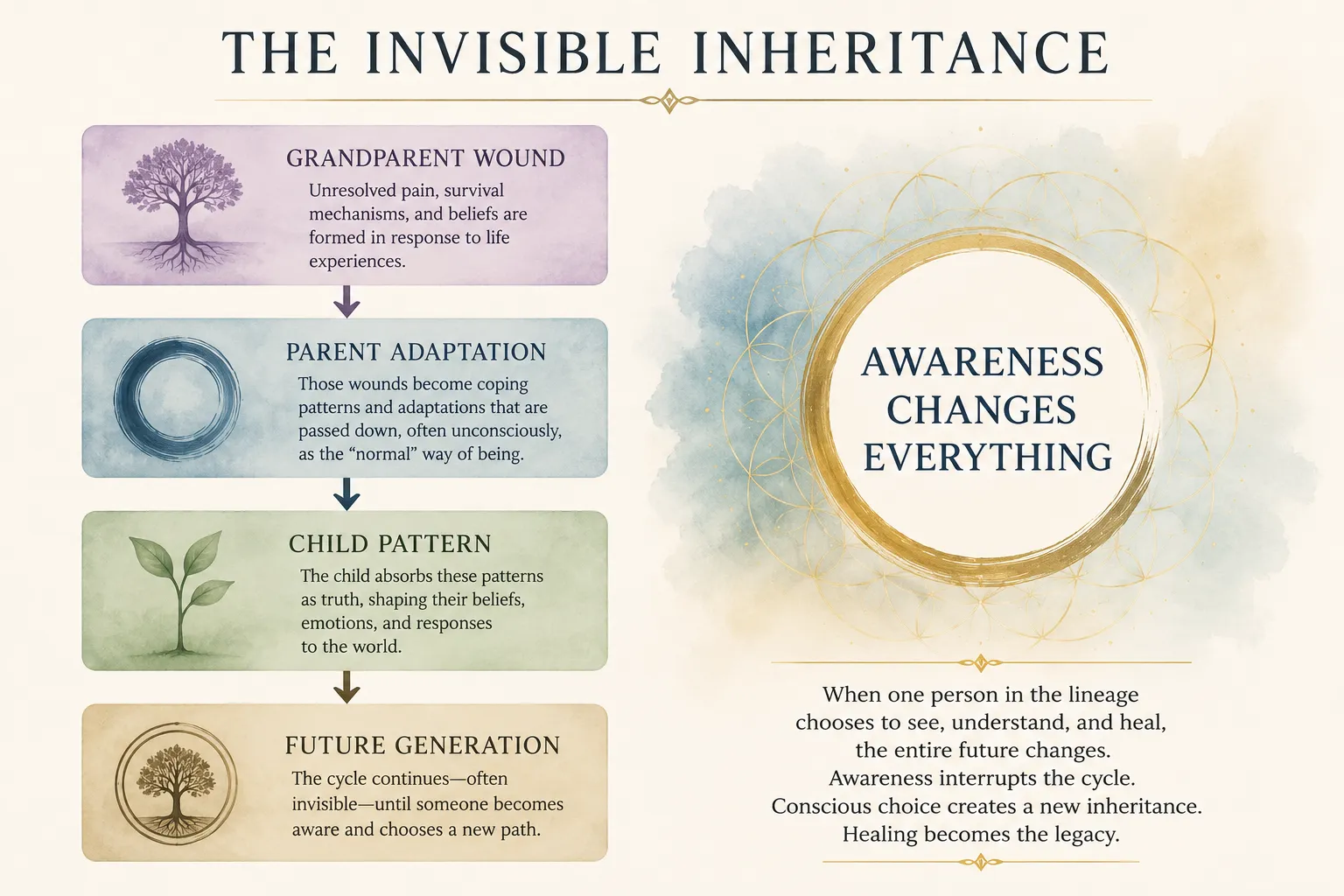
Edgar Cayce: Awareness Changes Everything
This is where Cayce’s teachings become particularly interesting. He suggested that suffering is not the goal of karma. The goal is understanding. Karma may use experience as a teacher, but the lesson itself is what matters. Once genuine understanding is achieved, the need for repetition begins to diminish.
This is where many people misunderstand grace.
Grace is often imagined as a form of spiritual exemption, a way to avoid consequences or bypass difficult lessons. Edgar Cayce’s perspective was far more demanding. Grace does not remove responsibility. It deepens it. It does not eliminate the lesson. It asks us to learn it consciously.
In fact, one could argue that the path of grace is often more difficult than karma itself.
Karma has structure. Cause and effect are relatively straightforward. Consequences teach lessons in a way that is difficult to ignore. Grace, however, requires something much more challenging. It asks us to recognize the lesson before suffering makes it unavoidable. It asks us to become conscious of a pattern before life is forced to repeat it. It asks us to grow through awareness rather than consequence.
This is where genuine shadow work enters the conversation.
Not shadow work as a trendy phrase or social media buzzword. Real shadow work. The kind that requires us to look honestly at the parts of ourselves we would rather avoid. The fears we hide, the resentments we justify, the wounds we carry, and the stories we continue repeating long after they have ceased serving us. It asks us to examine not only the pain we have experienced, but also the pain we may have contributed to along the way.
This is where many people encounter the greatest challenge.
It is one thing to recognize a pattern, it is another thing entirely to feel it.
To feel the grief beneath the anger. To feel the fear beneath the control. To feel the sadness beneath the judgment. To acknowledge where our wounds have influenced our choices, our relationships, and our responses to life. It is even more difficult to recognize where pain may have been passed forward—not from malice, but from unconsciousness.
This is why spiritual bypassing can become such a significant obstacle on the path.
Spiritual bypassing occurs when spiritual ideas are used to avoid emotional work rather than support it. Instead of feeling grief, we tell ourselves everything happens for a reason. Instead of confronting resentment, we declare ourselves above it. Instead of acknowledging our role in a recurring pattern, we convince ourselves we have already transcended it.
Yet what remains unexamined often remains active.
If karma is a teacher, then avoiding the lesson does not dissolve it. In many cases, it simply postpones it. Sometimes the lesson returns with even greater intensity because consciousness is still seeking the understanding that was missed the first time.
The invitation of grace is not to escape the lesson, the invitation is to complete it.
This is why the path Edgar Cayce described contains such a profound paradox. It asks us to take absolute responsibility while simultaneously releasing all guilt. It asks us to own our choices without condemning ourselves for them. It asks us to see clearly where harm was created while holding compassion for the imperfect human being who created it. It asks us to forgive others while extending that same forgiveness inward.
That may sound simple on paper, but in practice, it is some of the deepest work a human being can undertake.
Perhaps this is why Edgar Cayce suggested that many souls are not yet ready for grace. Grace requires spiritual maturity. It asks us to learn without the lesson being forced. To grow without the pressure of suffering. To evolve through conscious choice rather than repeated consequence. In many ways, this path may be more demanding than karma itself because it requires us to voluntarily enter the lesson rather than waiting for life to deliver it.
Yet within that challenge lies the possibility of genuine freedom.
Four Practices for Transforming Karma
If grace represents the conscious completion of a lesson, the natural question becomes: How do we participate in that process?
According to Edgar Cayce, transformation is not something that happens accidentally. It requires intention, awareness, and a sincere desire to understand what life is attempting to teach. Rather than waiting for karma to express itself through repeated circumstances, Cayce encouraged individuals to become active participants in their own growth.
He offered several practices designed to bring consciousness into the karmic process. They are simple in concept, but profound in application.
Conscious Review
The first practice is what Edgar Cayce described as conscious review.
At the end of each day, rather than reviewing events, review consciousness. Look back across your interactions, reactions, choices, and emotional responses. Where did impatience arise? Where did fear influence behavior? Where did judgment appear? Where did kindness emerge? Where did love guide your actions?
The goal is not self-criticism. The goal is awareness.
What makes this practice particularly powerful is that Cayce encouraged individuals to go one step further. Rather than simply observing behavior, he suggested feeling its effects. If impatience created discomfort for another person, feel that discomfort. If kindness created warmth, feel that warmth. If fear created separation, allow yourself to understand the experience from a broader perspective.
In many ways, this practice interrupts karma before it hardens into pattern. Awareness enters the process while the lesson is still fresh, allowing understanding to emerge before repetition becomes necessary.
Karmic Meditation
The second practice involves meditation, but not in the way many people might expect.
Most people meditate in order to find peace, reduce stress, or gain clarity. Edgar Cayce suggested using meditation as a tool for understanding recurring patterns. Rather than asking, “How do I fix this?” he encouraged a different question:
“What is this trying to teach me?”
When a recurring challenge appears, sit with it. Explore it. Trace it backward. What fear sustains it? What belief feeds it? What wound may have created it? Is this pattern entirely your own, or could it be connected to something inherited through family, upbringing, or generational conditioning?
This is where meditation and shadow work often intersect. The objective is not blame. It is not self-judgment. It is understanding. The more deeply we understand a pattern, the less power it tends to hold over us.
Perhaps this is why Cayce believed understanding dissolves karma faster than suffering. Suffering often gets our attention. Understanding transforms our relationship with what created the suffering in the first place.
Preemptive Forgiveness
The third practice may be one of the most difficult.
Forgiveness is often viewed as something we extend after we have been hurt. It is a response to an injury, a betrayal, a disappointment, or a loss. Edgar Cayce suggested something far more radical.
Cultivate forgiveness before it becomes necessary.
This does not mean becoming passive. It does not mean allowing harmful behavior. Nor does it mean pretending difficult experiences do not matter. Rather, it means developing a state of consciousness that is less likely to become trapped by resentment when challenges inevitably arise.
Much of human suffering comes not only from what happens to us, but from our resistance to what has already happened. We replay events, relive conversations, rehearse grievances, and carry emotional burdens long after the original experience has passed.
Forgiveness breaks that cycle.
It allows us to release our attachment to the wound without denying that the wound existed. It creates space for healing where resentment once lived.
Most importantly, it frees us from carrying yesterday’s pain into tomorrow’s experiences.
Conscious Blessing
The final practice may be the most transformative of all.
Edgar Cayce encouraged individuals to consciously bless those who had caused them pain. Not because harmful actions should be excused. Not because difficult experiences should be forgotten. But because blessing reverses the energetic momentum of the pattern itself.
Most people respond to hurt by creating more hurt. Judgment creates judgment. Anger creates anger. Resentment creates resentment. The cycle continues because each reaction feeds the next.
Blessing interrupts the cycle.
When we sincerely wish healing, growth, understanding, or peace for another person, we stop contributing energy to the very pattern we hope to transcend. We choose a different response than the one our wounds might naturally prefer.
This is not weakness, it is freedom.
The moment we stop feeding the cycle, the cycle begins to lose its power over us.
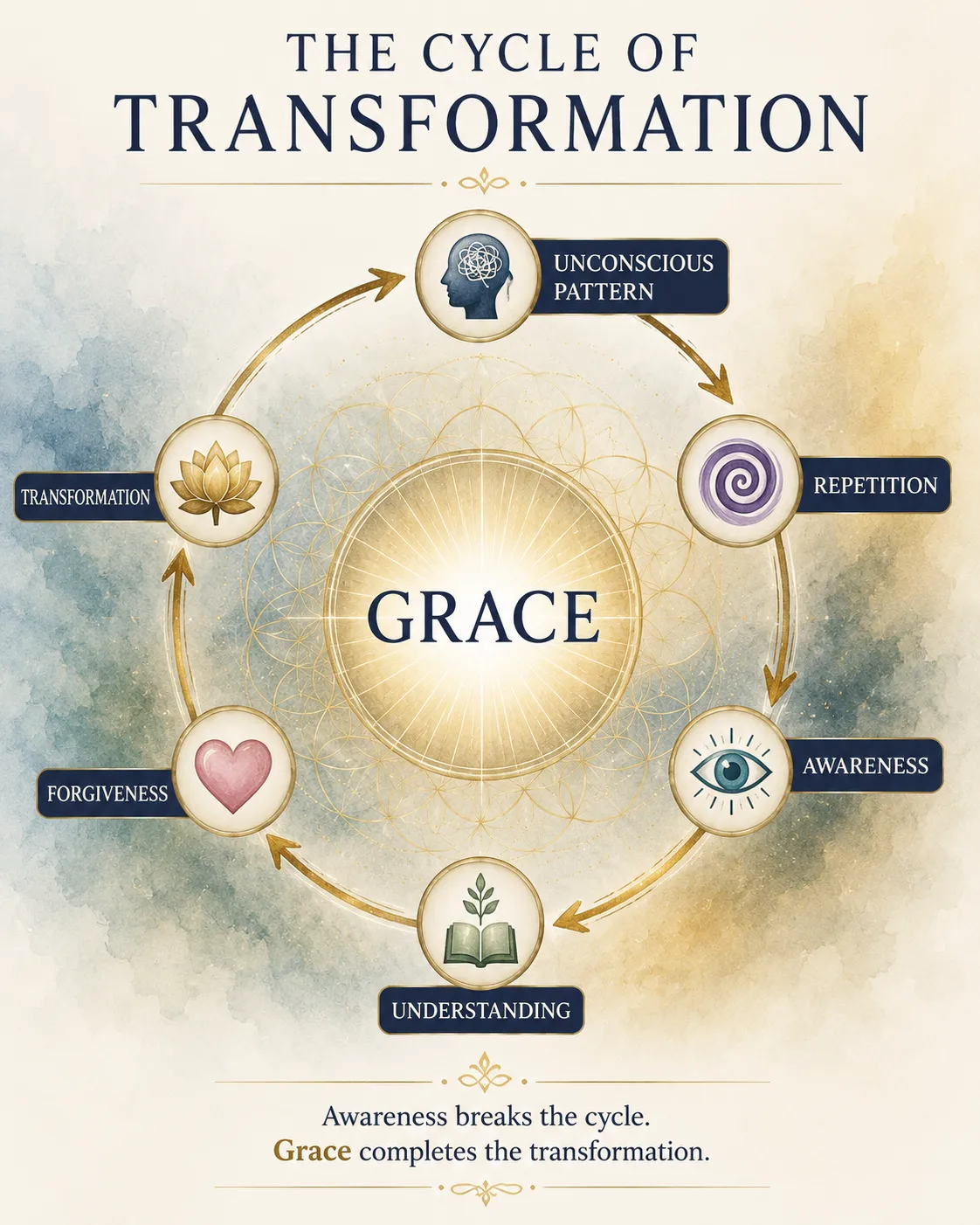
Beyond the Wheel
For centuries, karma has been described as a wheel. A cycle of action and consequence, lesson and repetition, cause and effect. Yet perhaps the deeper purpose of the wheel was never to keep us trapped. Perhaps its purpose was to guide us toward awareness.
The observer sees the pattern. The heart understands the lesson. Forgiveness releases the attachment. Grace completes what suffering began.
This does not mean life suddenly becomes free of challenges. It does not mean difficult experiences disappear. It does not mean every wound is instantly healed. Rather, it means we begin meeting life from a different level of consciousness.
The lesson may still appear. . . the difference is that we recognize it.
The pattern may still emerge. . . the difference is that we understand it.
The wound may still be felt. . . the difference is that we no longer allow it to unconsciously direct our lives.
Perhaps this is what grace, as Edgar Cayce understood it, ultimately offers. Not an escape from responsibility, but a deeper relationship with it. Not freedom from learning, but freedom from unnecessary repetition.
The goal of karma is not suffering. The goal is understanding
And when understanding finally arrives—when responsibility is embraced without guilt, when forgiveness is offered without condition, when awareness illuminates what was once hidden—the wheel may no longer need to turn in quite the same way.
“The way out of the maze is not around the lesson. It is through it.”

Sign up to receive Our Weekly Briefing Newsletter
Begin your journey with weekly insights designed to expand awareness and ground you in truth. Our free tier gives you a powerful introduction without any commitment.





Help Us Bypass Censorship. Share This.
Have questions?
At Great Awakening Report, we are dedicated to supporting your journey toward truth and enlightenment through our specialized Coaching and Consulting services.
Coaching Services: Our coaching programs are designed to guide you through personal awakening and transformation. We offer personalized sessions that focus on expanding consciousness, uncovering hidden truths, and fostering spiritual growth. Our experienced coaches provide the tools and insights necessary to navigate your path with clarity and confidence.
Consulting Services: For organizations and individuals seeking deeper understanding and strategic guidance, our consulting services offer expert analysis and solutions. We delve into areas such as global transitions, alternative news insights, and consciousness studies to provide comprehensive strategies tailored to your unique objectives.
Embark on a transformative journey with our Coaching and Consulting services, and unlock your highest potential. To learn more and schedule a session, visit our Coaching and Consulting pages.
Thank you
Thank you to our subscribers and readers for your continued support and dedication to truth and awakening. Your encouragement, engagement, and belief in our mission make everything we do possible. Together, we are expanding awareness and helping illuminate the path forward.
If you would like to further support the Great Awakening team and our ongoing efforts to share insight, knowledge, and truth, you can DONATE HERE.
With deep gratitude,
– Great Awakening Team
About the Author: Great Awakening Team

DISCLAIMER: All statements, claims, views and opinions that appear anywhere on this site, whether stated as theories or absolute facts, are always presented by The Great Awakening Report (GAR) as unverified—and should be personally fact checked and discerned by you, the reader.Any opinions or statements herein presented are not necessarily promoted, endorsed, or agreed to by GAR, those who work with GAR, or those who read or subscribe to GAR.Any belief or conclusion gleaned from content on this site is solely the responsibility of you the reader to substantiate.Any actions taken by those who read material on this site are solely the responsibility of the acting party.You are encouraged to think for yourself and do your own research.Nothing on this site is meant to be believed without question or personal appraisal.
COPYRIGHT DISCLAIMER: Citation of articles and authors in this report does not imply ownership. Works and images presented here fall under Fair Use Section 107 and are used for commentary on globally significant newsworthy events. Under Section 107 of the Copyright Act 1976, allowance is made for fair use for purposes such as criticism, comment, news reporting, teaching, scholarship, and research.
COMMUNITY GUIDELINES DISCLAIMER: The points of view and purpose of this video is not to bully or harass anybody, but rather share that opinion and thoughts with other like-minded individuals curious about the subject.