

Help Us Bypass Censorship. Share This.
Sign up to receive Our Weekly Briefing Newsletter
Begin your journey with weekly insights designed to expand awareness and ground you in truth. Our free tier gives you a powerful introduction without any commitment.
“I am not what happened to me, I am what I choose to become.” — Carl Jung
Throughout history, human beings have searched for answers to a question that appears in every culture, every generation, and every stage of life. Why do certain experiences seem to repeat? Why do some lessons return again and again despite our efforts to move beyond them? Why do particular fears, challenges, and patterns appear to follow us throughout our lives, often wearing different faces but carrying a familiar lesson beneath the surface? The laws of karma offer one of the oldest answers to these questions.
Across much of the Eastern world, one word emerged to describe this phenomenon: karma.
Although karma is often reduced to the simple phrase “what goes around comes around,” its deeper meaning is far more profound. At its core, karma offers a framework for understanding how our thoughts, actions, intentions, and choices create ripple effects that shape our experiences over time. Rather than a system of punishment or reward, karma can be viewed as a process of learning—a mechanism through which consciousness gradually becomes aware of itself.
This distinction is important because many modern interpretations portray karma as a cosmic scorekeeper keeping track of every good and bad deed. Under this view, positive actions are rewarded while negative actions are punished. Yet many ancient teachings suggest something far more nuanced. Karma is not necessarily about judgment. It is about consequence. It is about understanding. It is about the relationship between our choices and the experiences that follow.
When viewed through this lens, the laws of karma begin to resemble one of life’s most persistent teachers. It does not seek retribution. It seeks awareness. The lessons we resist often return. The patterns we avoid frequently reappear. The experiences that challenge us most deeply often carry within them an opportunity to see something about ourselves that has remained hidden from view.
This idea is not limited to spiritual traditions. Throughout his life’s work, psychologist Carl Jung explored a remarkably similar principle through the study of the unconscious mind. Jung observed that aspects of ourselves that remain hidden from conscious awareness continue to influence our lives in ways we may not fully recognize. Fears, beliefs, wounds, assumptions, and emotional patterns often operate beneath the surface, quietly shaping our decisions, reactions, and relationships.
His famous observation remains one of the most insightful descriptions of human behavior ever written:
“Until you make the unconscious conscious, it will direct your life and you will call it fate.”
Whether viewed through the lens of karma or psychology, the message is remarkably similar. Human beings tend to repeat what they have not yet fully understood.
This does not mean life is predetermined. Nor does it suggest that every challenge is the result of something we have done wrong. Rather, it points toward the possibility that life is constantly providing opportunities for growth, understanding, and greater self-awareness. The recurring lesson is not evidence of failure. It may simply be evidence that a deeper level of understanding is waiting to emerge.
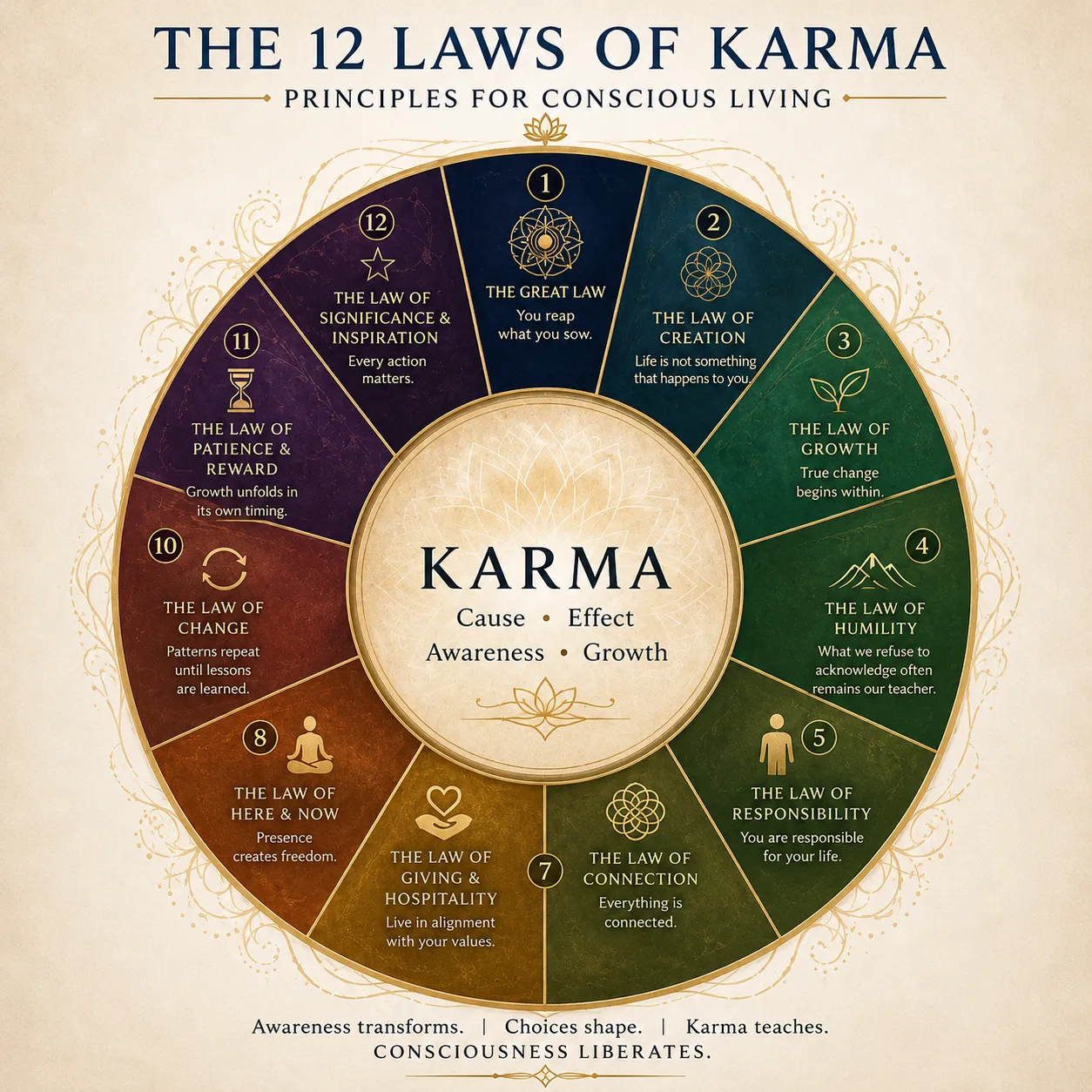
The Twelve Laws of Karma
Over time, spiritual traditions developed what became known as the Twelve Laws of Karma. While the laws vary slightly depending upon the tradition being referenced, they collectively point toward a common theme: life is not random.
The choices we make, the intentions we hold, the beliefs we carry, and the actions we take all create ripple effects that influence our future experiences. Some of these laws emphasize personal responsibility, while others focus on growth, patience, connection, presence, and the importance of conscious action. Together, they offer a framework for understanding how awareness evolves through experience.
Rather than viewing the laws as rigid rules, it may be more useful to see them as observations about how life unfolds. They remind us that growth begins within, that patterns tend to repeat until they are understood, and that every choice contributes to the larger story of who we are becoming.
What the Laws of Karma Are Not
One of the greatest misconceptions surrounding the laws of karma is the belief that it functions as a cosmic reward-and-punishment system. This interpretation has become deeply embedded in popular culture. When something fortunate happens, people often say it is “good karma.” When difficulties arise, they may assume they are somehow being punished for past actions.
Yet most traditional teachings suggest a much more sophisticated understanding.
Karma is not about the universe keeping score. It is not a divine accounting system designed to reward virtue and punish mistakes. Rather, karma reflects the natural relationship between cause and effect. Every action creates consequences. Every choice creates ripples. Every belief influences perception. Over time, these countless interactions help shape the experiences through which we learn and grow.
This perspective changes the conversation entirely.
Instead of asking, “What did I do to deserve this?” a more useful question becomes, “What is this experience trying to teach me?”
That subtle shift moves us from victimhood into awareness. It invites curiosity instead of judgment. It encourages growth rather than guilt.
Life begins to look less like a courtroom and more like a classroom.
Karma, Free Will, and Conscious Choice
Another common misunderstanding is the belief that the laws of karma remove free will. If our present experiences are influenced by previous choices, conditioning, or unresolved lessons, where does personal choice fit into the equation?
The answer lies in understanding the difference between circumstances and responses.
While we may not always control the situations we encounter, we retain the ability to choose how we respond to them. Two people can experience similar hardships and emerge with completely different outcomes. One may become resentful while another develops compassion. One may repeat an old pattern while another uses the experience as a catalyst for growth.
The circumstances may appear similar.
The consciousness brought to those circumstances is not.
This is where karma becomes dynamic rather than deterministic. Every moment presents an opportunity to make a different choice, gain a new perspective, or respond with greater awareness. In that sense, free will is not separate from karma. It is one of the primary mechanisms through which karma evolves.
Carl Jung and the Language of Patterns
Perhaps one of the most fascinating bridges between ancient spiritual teachings and modern psychology can be found in the work of Carl Jung.
Although Jung did not write extensively about karma in the Eastern sense, much of his work explored themes that closely parallel the laws of karma. He observed how unconscious patterns influence behavior, how unresolved emotional material seeks expression, and how individuals often repeat experiences until deeper awareness emerges.
Jung referred to this hidden material as the shadow—the aspects of ourselves we reject, suppress, deny, or fail to recognize. Left unconscious, these patterns continue operating behind the scenes, shaping our perceptions and influencing our choices.
This helps explain why certain themes often recur throughout life.
A person who struggles with abandonment may repeatedly encounter relationships that trigger those fears. Someone carrying deep feelings of unworthiness may unconsciously recreate circumstances that reinforce those beliefs. Families often pass emotional wounds, fears, and coping mechanisms from one generation to the next, creating patterns that persist long after their origins have been forgotten.
Whether viewed as karma, conditioning, or inherited emotional patterning, the result is often the same.
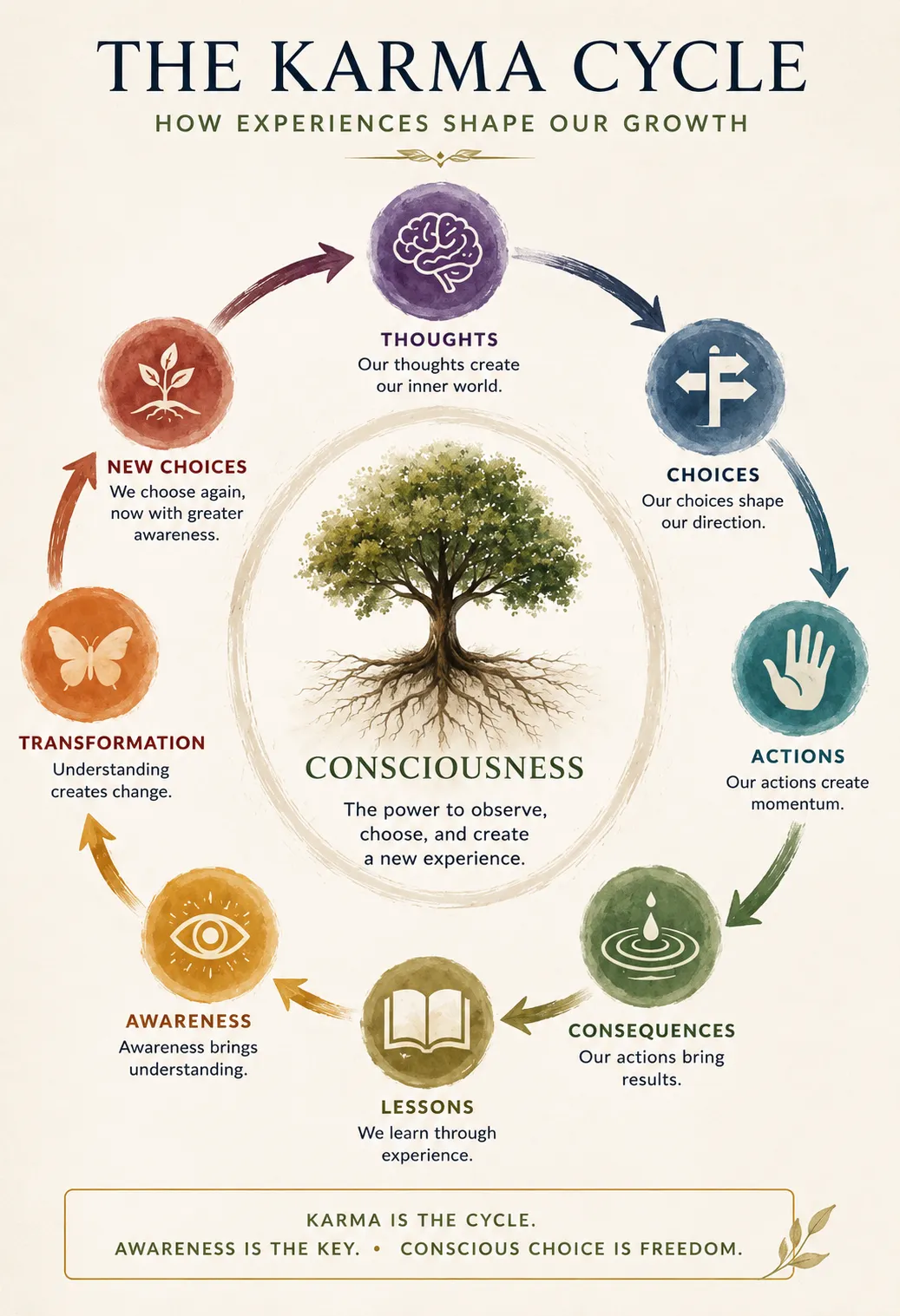
The lesson repeats until awareness enters the cycle.
Why Awareness Changes Everything
This is where the conversation becomes particularly interesting.
If the laws of karma function as a teacher, awareness may be the mechanism through which its lessons are integrated.
The moment we become conscious of a pattern, our relationship with it begins to change. We may still feel the familiar emotions. We may still encounter similar circumstances. Yet something important has shifted. We are no longer operating entirely from unconscious habit.
We begin to observe. . . We begin to recognize. . . We begin to choose.
This is why awareness plays such a central role in virtually every spiritual and psychological tradition. Awareness creates space between stimulus and response. It allows us to see what was previously invisible. It transforms automatic reactions into conscious decisions.
In many ways, awareness is the first step toward freedom.
Not freedom from life’s challenges, but freedom from endlessly repeating the same lessons without understanding them.
The more conscious we become, the more clearly we begin to see the patterns operating beneath the surface of our lives. Some originate from personal experiences. Others may have roots in family systems, cultural conditioning, or inherited beliefs. Regardless of their origin, awareness gives us the opportunity to engage them differently.
And that is where transformation begins.
The Teacher Behind the Lesson
Whether karma is viewed through the lens of Eastern spirituality, modern psychology, ancestral patterns, or personal growth, one theme appears consistently across all of them: awareness matters.
Life has a way of returning us to the lessons we have not yet fully understood. Not because we are being punished, but because growth often requires experience. The pattern repeats until something within us changes.
The Twelve Laws of Karma offer a framework for understanding this process. They remind us that our choices matter, that growth begins within, and that every experience carries the potential for deeper awareness. They encourage responsibility without guilt, reflection without judgment, and growth without fear.
Yet perhaps the most fascinating question remains.
If karma exists to teach us, what happens when the lesson is finally learned?
What role do awareness, forgiveness, and transformation play in ending the cycle?
Can understanding accomplish what years of repetition could not?
These questions lead us into the next stage of the journey—one that sits at the intersection of karma, consciousness, forgiveness, and healing.
Because perhaps karma is not the end of the story.
Perhaps it is only the beginning.
Sign up to receive Our Weekly Briefing Newsletter
Begin your journey with weekly insights designed to expand awareness and ground you in truth. Our free tier gives you a powerful introduction without any commitment.





Help Us Bypass Censorship. Share This.
Have questions?
At Great Awakening Report, we are dedicated to supporting your journey toward truth and enlightenment through our specialized Coaching and Consulting services.
Coaching Services: Our coaching programs are designed to guide you through personal awakening and transformation. We offer personalized sessions that focus on expanding consciousness, uncovering hidden truths, and fostering spiritual growth. Our experienced coaches provide the tools and insights necessary to navigate your path with clarity and confidence.
Consulting Services: For organizations and individuals seeking deeper understanding and strategic guidance, our consulting services offer expert analysis and solutions. We delve into areas such as global transitions, alternative news insights, and consciousness studies to provide comprehensive strategies tailored to your unique objectives.
Embark on a transformative journey with our Coaching and Consulting services, and unlock your highest potential. To learn more and schedule a session, visit our Coaching and Consulting pages.
Thank you
Thank you to our subscribers and readers for your continued support and dedication to truth and awakening. Your encouragement, engagement, and belief in our mission make everything we do possible. Together, we are expanding awareness and helping illuminate the path forward.
If you would like to further support the Great Awakening team and our ongoing efforts to share insight, knowledge, and truth, you can DONATE HERE.
With deep gratitude,
– Great Awakening Team
About the Author: Great Awakening Team

DISCLAIMER: All statements, claims, views and opinions that appear anywhere on this site, whether stated as theories or absolute facts, are always presented by The Great Awakening Report (GAR) as unverified—and should be personally fact checked and discerned by you, the reader.Any opinions or statements herein presented are not necessarily promoted, endorsed, or agreed to by GAR, those who work with GAR, or those who read or subscribe to GAR.Any belief or conclusion gleaned from content on this site is solely the responsibility of you the reader to substantiate.Any actions taken by those who read material on this site are solely the responsibility of the acting party.You are encouraged to think for yourself and do your own research.Nothing on this site is meant to be believed without question or personal appraisal.
COPYRIGHT DISCLAIMER: Citation of articles and authors in this report does not imply ownership. Works and images presented here fall under Fair Use Section 107 and are used for commentary on globally significant newsworthy events. Under Section 107 of the Copyright Act 1976, allowance is made for fair use for purposes such as criticism, comment, news reporting, teaching, scholarship, and research.
COMMUNITY GUIDELINES DISCLAIMER: The points of view and purpose of this video is not to bully or harass anybody, but rather share that opinion and thoughts with other like-minded individuals curious about the subject.