
Help Us Bypass Censorship. Share This.
Sign up to receive Our Weekly Briefing Newsletter
Begin your journey with weekly insights designed to expand awareness and ground you in truth. Our free tier gives you a powerful introduction without any commitment.
Introduction to Cloud-Seeding and Weather Modification
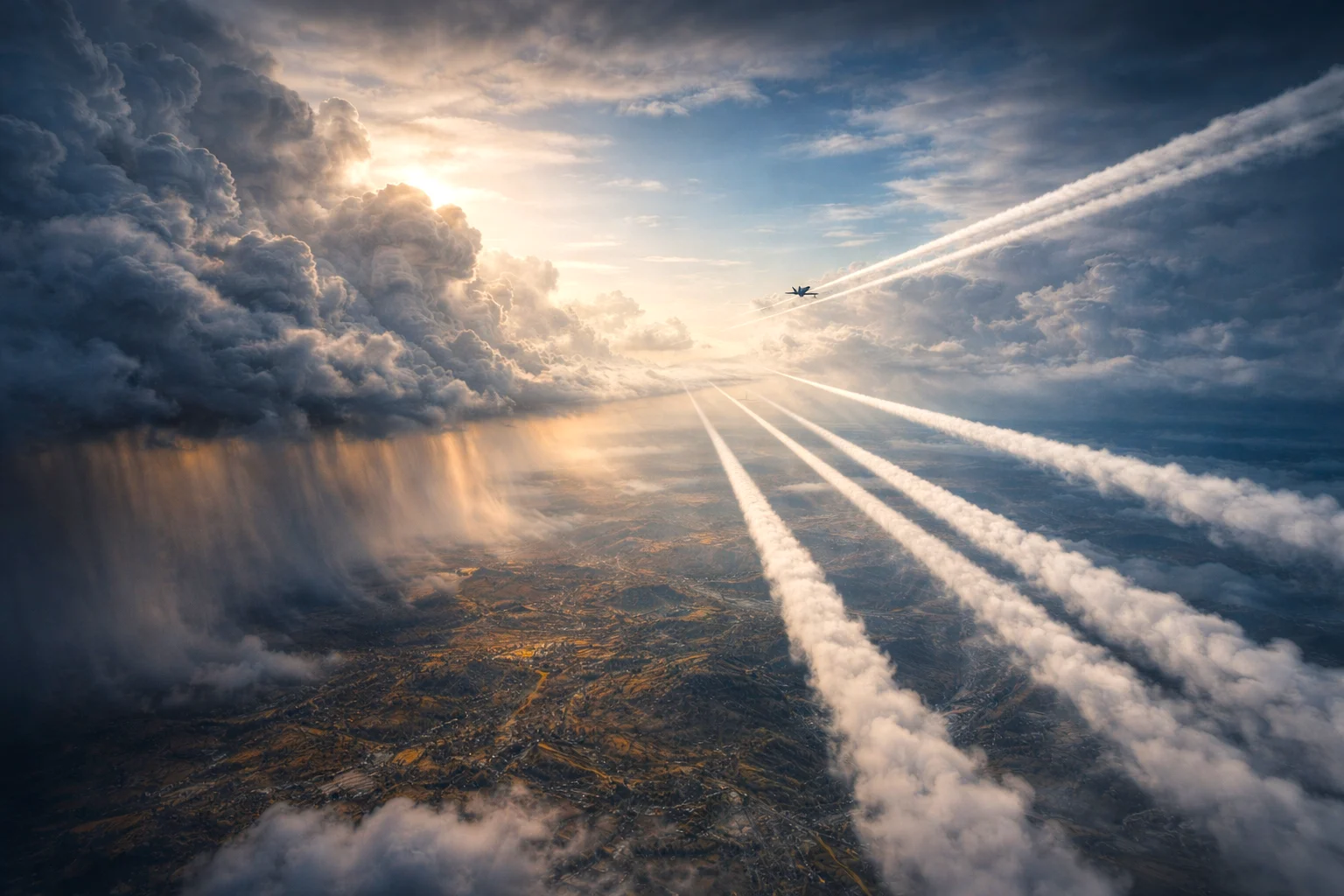
Cloud seeding, an early form of weather modification, originated in the mid-20th century as a technique aimed at enhancing precipitation. The concept was first introduced in the late 1940s when scientists like Vincent Schaefer and Bernard Vonnegut discovered that dispersing substances such as silver iodide or dry ice into clouds could stimulate rain or snow formation. This pioneering effort showcased the potential for peaceful applications in augmenting rainfall in drought-prone areas, managing water resources, and mitigating agricultural risks.
Fundamentally, cloud seeding involves injecting particles into clouds to induce or enhance precipitation by encouraging the coalescence of water droplets or ice crystals. These particles act as nuclei around which moisture condenses, ultimately leading to rainfall or snowfall. This technology has evolved over decades, with ongoing research aimed at refining its efficiency, understanding environmental impacts, and exploring broader applications ranging from hail suppression to fog dispersal.
While cloud seeding is often framed as a benign tool for water management and disaster mitigation, its historical use and evolving technological capabilities raise critical questions about how atmospheric science intersects with military strategy, geopolitical power, and environmental sovereignty in the modern era.
For more on the broader implications of weather modification and its intersection with global environmental challenges, see related insights on weather as weapon and weather as warning.
The Evolution of Weather Warfare: From Theory to Reality
The concept of weather warfare, the manipulation or control of weather as a means of hostile action, has evolved from a theoretical possibility to a realm of growing geopolitical interest and practical experimentation. Early ideas about using weather as a tool of war can be traced back to military and intelligence considerations in the mid-20th century. One key event was during the Vietnam War, where Operation Popeye (1967-1972) involved cloud seeding efforts by the U.S. military to extend the monsoon season over the Ho Chi Minh trail, aimed at disrupting enemy logistics through induced rainfall and flooding. This operation marked a significant milestone in applying weather modification for military advantage.
Subsequently, international concerns over such technology led to the 1977 Environmental Modification Convention (ENMOD), an international treaty banning hostile use of environmental modification techniques. Despite this, advancements in geoengineering and technology have sparked speculation and concern about covert weather control programs by various nations. Recent decades have seen increased interest in integrating atmospheric science, geophysical technologies, and possibly electromagnetic methods to influence weather patterns for strategic purposes.
The contemporary geopolitical landscape reflects a growing recognition of the potential military and economic impacts of weather modification capabilities, with nations reportedly investing in developing such technologies as part of broader defense and security strategies. The discourse surrounding weather warfare also intertwines with conversations about climate change, geoengineering, and environmental ethics, highlighting the precarious balance between scientific innovation and geopolitical power plays. For a detailed exploration of these historical developments and their implications in today’s geopolitical climate, refer to the insightful coverage on Great Awakening Report.
Mechanisms of Cloud-Seeding: How It Alters Weather Patterns
Cloud seeding operates by introducing specific substances into existing clouds to influence atmospheric processes and encourage precipitation. The fundamental scientific principle behind cloud seeding involves the modification of microphysical properties within clouds to stimulate rain or snow formation. Typically, seeding agents such as silver iodide, potassium iodide, or dry ice are dispersed into clouds. These materials act as artificial ice nuclei or condensation sites. When introduced, they encourage water vapor in the cloud to condense and freeze at higher temperatures than normal, resulting in the formation of ice crystals.
As these ice crystals grow and collide with supercooled water droplets, they become heavy enough to fall as precipitation, altering the natural weather patterns by enhancing rainfall or snowfall in a targeted area. In warm clouds, hygroscopic (water-attracting) particles can also be used to boost droplet growth and promote rain. The effectiveness of cloud seeding depends on existing atmospheric conditions, including sufficient moisture and cloud availability.
This process influences weather by accelerating the natural precipitation cycle, potentially alleviating drought or improving water management for agriculture and reservoirs. However, cloud seeding is not a method of creating weather but modifying existing conditions to increase precipitation likelihood and intensity [Source: National Geographic]. For a deeper understanding of how atmospheric modification impacts broader environmental and geopolitical factors, see related insights on climate intervention here.
Weaponisation of Skies: Military Applications and Strategic Advantages
Military applications of cloud-seeding technology exploit the ability to manipulate weather to confer strategic advantages on armed forces. Cloud-seeding, which involves dispersing substances into the atmosphere to induce precipitation, can be used to affect operational environments in several key ways:
- Terrain and Mobility Control: By artificially inducing rain or storms, military forces can alter battlefield conditions—muddying terrain to slow enemy troop movements or hinder mechanized units and supply lines.
- Disruption of Enemy Operations: Adverse weather created via cloud-seeding can impair visibility and sensor effectiveness, grounding enemy aircraft and reducing intelligence, surveillance, and reconnaissance capabilities.
- Water Resource Management: In prolonged operations, cloud-seeding can secure water supplies for troops in arid regions, sustaining military bases and personnel.
- Psychological and Tactical Warfare: Weather manipulation introduces uncertainty and complexity for adversaries, forcing them to contend with unpredictable and possibly hazardous environmental changes.
Globally, various military entities have explored and operationalized weather modification technologies to enhance tactical efficacy and create operational dilemmas for opponents. These capabilities align with broader strategic objectives to shape battlespace conditions favorably without direct kinetic actions.
More detailed insights on technology impacting strategic environments and covert military innovations can be found through related analyses on geo-political and technological shifts at Great Awakening Report’s special reports on advanced technology and global strategic updates.
Ethical and Legal Implications of Weather Warfare
The ethical and legal implications of weather warfare present profound dilemmas that intertwine with international law and moral responsibilities of nations. Weather warfare—using technology to manipulate atmospheric conditions for military advantage—raises critical ethical questions about the intentional alteration of natural systems affecting civilian populations and ecosystems. These actions can cause widespread unintended consequences, challenging just war principles such as proportionality and discrimination.
Internationally, the 1977 Environmental Modification Convention (ENMOD) explicitly prohibits the hostile use of environmental modification techniques that have widespread, long-lasting, or severe effects. This treaty reflects a global consensus to ban weather alteration as a weapon of war due to its potentially catastrophic humanitarian impact. Yet enforcement and verification of compliance remain complex, especially as weather manipulation technologies evolve and dual-use capabilities proliferate.
Furthermore, nations bear moral responsibility to avoid deploying weather warfare tactics, recognizing that such practices threaten not only enemy combatants but also innocent civilians, agriculture, water resources, and global climate stability. The risk of escalations, retaliation, and environmental degradation underscores the need for international dialogue and robust legal frameworks.
The ethical evaluation must consider principles of sovereignty, non-intervention, and the precautionary rule, emphasizing transparency, accountability, and respect for human rights. Ultimately, the convergence of emerging technology and international law demands vigilance and cooperation to prevent weather warfare from undermining global peace and security.
For a broader discussion on geopolitical and environmental control themes relevant to this issue, see related analyses at Great Awakening Report’s Global Weather Wars and Weather as Weapon, Weather as Warning.
Case Studies: Notable Incidents of Weather Manipulation in Warfare
Throughout history, there have been several notable instances where weather manipulation techniques, including cloud seeding, have been utilized in military conflicts to gain strategic advantages. One of the most famous cases occurred during the Vietnam War under the U.S. military’s Operation Popeye from 1967 to 1972. The operation aimed to extend the monsoon season over the Ho Chi Minh Trail to disrupt enemy troop movements and supply lines by artificially inducing rainfall using cloud-seeding technology. This covert effort involved seeding clouds to increase precipitation, leading to prolonged flooding and muddy terrain that hindered North Vietnamese logistics.
Similarly, during World War II, various nations explored weather modification concepts to influence battle conditions, though practical applications were limited by technology at the time. More recent military interests have included the development of geoengineering methods to create fog, disperse clouds, or suppress storms in conflict zones, providing tactical advantages or impairing enemy operations.
These incidents highlight the real-world implications of weather modification as a tool in warfare, raising ethical, environmental, and geopolitical concerns. The use of such technology underscores the pursuit of control over natural forces to influence outcomes in conflicts, a topic of ongoing study and debate among military strategists and climate scientists alike.
For a deeper exploration of weather manipulation technologies and their broader impact, see Global Weather Wars: The Impact of Technology on Climate Control.
Future of Weather Warfare: Technological Advances and Potential Threats
The future of weather warfare is increasingly intertwined with emerging technologies in geoengineering, presenting complex implications for global security and stability. Advances such as artificial intelligence-driven predictive models, like those utilizing artificial neural networks to forecast environmental changes, promise precision in manipulating weather patterns. However, such capabilities could escalate the risks of weaponization, where weather manipulation serves strategic geopolitical interests.
This evolving landscape demands robust international oversight to mitigate potential conflicts arising from technological misuse, as control over climate systems could become a potent form of power projection with consequences for global peace and environmental health. Understanding and addressing these dynamics is critical as nations explore geoengineering’s dual-use potential for climate intervention and military advantage.
For deeper insights into related global security issues, see our analysis on Global Weather Wars and Climate Control.
Mitigation and Global Response: Addressing the Weaponisation of Weather
International efforts to mitigate the weaponization of weather focus primarily on regulating weather modification technologies to prevent their misuse in conflict scenarios. Globally, there is growing awareness of the potential military and geopolitical threats posed by such technologies, prompting calls for comprehensive international treaties and agreements.
Key strategies include the establishment of legal frameworks under global bodies like the United Nations, aimed at overseeing weather modification activities and banning their use as weapons of war. The 1977 Environmental Modification Convention (ENMOD) is one such treaty which prohibits hostile use of environmental modification techniques that have widespread, long-lasting, or severe effects, including weather control for military purposes. However, gaps in enforcement and technological advances necessitate updates and reinforcements of these regulations.
Proposed strategies for mitigation also emphasize transparency and information sharing among nations regarding weather modification activities to reduce suspicion and potential escalation. International cooperation on research and technology standards seeks to balance peaceful, beneficial uses of weather modification—such as drought relief and disaster mitigation—against the risk of weaponization. Additionally, confidence-building measures and verification mechanisms are suggested to reinforce compliance and deter covert hostile applications.
Continued dialogue within global security forums promotes the development of norms and policies that recognize the dual-use nature of weather modification technologies and ensure their alignment with international peace and security objectives. For more detailed exploration of related global security and environmental issues, visit Great Awakening Report.
Sources:
- Great Awakening Report – Weather as Weapon, Weather as Warning
- Great Awakening Report – Global Weather Wars
- National Geographic – Cloud Seeding
- Great Awakening Report – Special Reports on Advanced Technology
- Great Awakening Report – Global Strategic Updates
- United Nations ENMOD Treaty
- United Nations ENMOD Treaty
Sign up to receive Our Weekly Briefing Newsletter
Begin your journey with weekly insights designed to expand awareness and ground you in truth. Our free tier gives you a powerful introduction without any commitment.



Help Us Bypass Censorship. Share This.
Have questions?
At Great Awakening Report, we are dedicated to supporting your journey toward truth and enlightenment through our specialized Coaching and Consulting services.
Coaching Services: Our coaching programs are designed to guide you through personal awakening and transformation. We offer personalized sessions that focus on expanding consciousness, uncovering hidden truths, and fostering spiritual growth. Our experienced coaches provide the tools and insights necessary to navigate your path with clarity and confidence.
Consulting Services: For organizations and individuals seeking deeper understanding and strategic guidance, our consulting services offer expert analysis and solutions. We delve into areas such as global transitions, alternative news insights, and consciousness studies to provide comprehensive strategies tailored to your unique objectives.
Embark on a transformative journey with our Coaching and Consulting services, and unlock your highest potential. To learn more and schedule a session, visit our Coaching and Consulting pages.
Thank you
Thank you to our subscribers and readers for your continued support and dedication to truth and awakening. Your encouragement, engagement, and belief in our mission make everything we do possible. Together, we are expanding awareness and helping illuminate the path forward.
If you would like to further support the Great Awakening team and our ongoing efforts to share insight, knowledge, and truth, you can DONATE HERE.
With deep gratitude,
– Great Awakening Team
About the Author: Great Awakening Team

DISCLAIMER: All statements, claims, views and opinions that appear anywhere on this site, whether stated as theories or absolute facts, are always presented by The Great Awakening Report (GAR) as unverified—and should be personally fact checked and discerned by you, the reader.Any opinions or statements herein presented are not necessarily promoted, endorsed, or agreed to by GAR, those who work with GAR, or those who read or subscribe to GAR.Any belief or conclusion gleaned from content on this site is solely the responsibility of you the reader to substantiate.Any actions taken by those who read material on this site are solely the responsibility of the acting party.You are encouraged to think for yourself and do your own research.Nothing on this site is meant to be believed without question or personal appraisal.
COPYRIGHT DISCLAIMER: Citation of articles and authors in this report does not imply ownership. Works and images presented here fall under Fair Use Section 107 and are used for commentary on globally significant newsworthy events. Under Section 107 of the Copyright Act 1976, allowance is made for fair use for purposes such as criticism, comment, news reporting, teaching, scholarship, and research.
COMMUNITY GUIDELINES DISCLAIMER: The points of view and purpose of this video is not to bully or harass anybody, but rather share that opinion and thoughts with other like-minded individuals curious about the subject.