Published Date: April 1st, 2026
SPECIAL REPORT
TRUTH///AWAKENING///DISCLOSURE
RE-REMEMBERING THE PATH TO HEALING, RESTORING THE CONNECTION BETWEEN MIND, BODY & SPIRIT
The Journey Back to Wholeness: A Guide to Mind, Body & Spirit Alignment, Recovery & Restoration
Awareness Over Reaction • Regulation Before Resolution • Connection Restores Coherence • Alignment Creates Stability • Integration Over Information • Energy Shapes Experience • Return to Wholeness
Introduction
Healing is often misunderstood as something to be achieved—an outcome waiting somewhere in the future after enough effort, information, or time. But the deeper truth is simpler and more profound: healing is a process of return. A return to awareness, to balance, and to the natural state of coherence that exists when mind, body, and spirit are no longer operating in separation. In a world saturated with noise, stimulation, and fragmentation, many have become disconnected not only from their environment, but from themselves. This Special Report offers a different orientation—one that shifts from seeking externally to reconnecting internally.
Re-remembering the Path to Healing is not about adding more complexity, but about removing what obscures clarity. It is a guide to restoring the connection between mind, body, and spirit through awareness, regulation, and integration. Each section—Mind, Body, and Spirit—explores a core dimension of the human experience, beginning with how we think and perceive, moving into how we feel and regulate, and ultimately expanding into how we align with deeper awareness and purpose. The structure of this report is intentional: to move from understanding to embodiment, from observation to lived experience.
This is not a linear process, nor is it something to be mastered all at once. Healing unfolds through cycles—moments of clarity, disruption, release, and reintegration. The invitation is not to perfect the process, but to stay present within it. Through the lenses of consciousness, coherence, orientation, alignment, and integration, this report provides a framework to navigate that journey with greater stability and discernment. What follows is not an endpoint, but a pathway—one that leads back to wholeness, again and again.

Re-remembering the Path to Healing Topic Titles
Restoring the Connection Between Mind, Body & Spirit
SECTION I — MIND
Clarity • Awareness • Perception
This section is about seeing clearly—how thought, belief, and attention shape your experience.
1. The Architecture of Thought
- Thought Loops & Mental Patterning
- Belief Systems & Identity Constructs
- The Language of the Mind
2. Awareness & the Observer
- The Witness State
- Attention as a Creative Force
- Breaking Identification with Thought
3. Perception & Interpretation
- Filters, Bias, and Meaning-Making
- Narrative vs Reality
- Reframing & Cognitive Flexibility
4. Mental Conditioning & Deprogramming
- Social, Cultural & Media Imprints
- Fear-Based Programming
- Rewriting Internal Scripts
5. Focus, Intention & Direction
- The Power of Directed Attention
- Intention Setting & Timeline Selection
- Mental Discipline & Clarity Practices
6. Coherence of Mind
- Mental Stillness & Presence
- Signal vs Noise Discernment
- Establishing Inner Clarity
SECTION II — BODY
Regulation • Sensation • Nervous System
This section grounds healing in the physical and biological system—where most people are actually dysregulated.
1. The Body as an Intelligent System
- The Body’s Innate Wisdom
- Stored Memory & Cellular Imprints
- The Body-Mind Connection
2. The Nervous System & Safety
- Fight / Flight / Freeze / Fawn
- Chronic Stress & Dysregulation
- Creating Internal Safety
3. Somatic Awareness
- Learning to Feel Again
- Sensation vs Story
- Tracking Energy in the Body
4. Emotional Energy in the Body
- How Emotions are Stored
- Suppression vs Expression
- Safe Emotional Release
5. Regulation & Stabilization Practices
- Breathwork & Transformational Breathing
- Grounding Techniques
- Daily Regulation Protocols
6. Physical Alignment & Energy Flow
- Posture, Movement & Flow
- Tension Release & Relaxation
- Restoring Natural Rhythms
SECTION III — SPIRIT
Connection • Meaning • Higher Awareness
This is where everything integrates—beyond mind and body into coherence and purpose.
1. Reconnecting to Self
- The True Self vs Conditioned Identity
- Inner Knowing & Intuition
- Remembering vs Learning
2. Consciousness & Awareness Expansion
- States of Consciousness
- Presence & Stillness
- Beyond the Analytical Mind
3. Energy, Frequency & Vibration
- Understanding the Human Energy Field
- Frequency States & Emotional Alignment
- Raising vs Stabilizing Frequency
4. Alignment & Coherence
- Living in Alignment with Truth
- Coherence Between Mind, Body & Spirit
- Integrity as a State of Being
5. Purpose, Meaning & Direction
- Discovering Inner Purpose
- Contribution & Service
- Living with Intention
6. Integration & Embodiment
- Bringing Awareness into Daily Life
- Consistency Over Intensity
- Becoming the Work
SECTION IV — INTEGRATION (BRIDGE SECTION)
Where It All Comes Together
This is where your framework becomes practical and lived.
1. The Healing Loop
- Awareness → Regulation → Integration → Expansion
2. Daily Coherence Practices
- Mind • Body • Spirit Alignment Routines
- Morning & Evening Protocols
3. Navigating Disruption & Setbacks
- Regression Cycles
- Emotional Waves & Triggers
- Staying Centered During Chaos
4. Building a Coherent Life
- Environment & Relationships
- Information Diet & Boundaries
- Creating Supportive Structures
Closing Section — Orientation Forward
- Healing as a Continuous Path
- Living in Coherence
- Returning to Self, Again and Again
RE-REMEMBERING THE PATH OF HEALING, RESTORING THE CONNECTION BETWEEN MIND, BODY & SPIRIT | Audio Review
“There is a voice that doesn’t use words. Listen.” — Rumi
This audio review offers a reflective journey through Re-remembering the Path to Healing, exploring healing not as something to attain, but as a sacred return to inner wholeness. Moving through the interconnected realms of mind, body, and spirit, it traces the path back to coherence through awareness, nervous system regulation, embodied presence, and deeper spiritual alignment. Rather than treating healing as a final destination, this review invites listeners to experience it as a living rhythm of remembrance, integration, and return—an unfolding process of coming home to the truth of who we are.
SECTION I — MIND
Clarity • Awareness • Perception
This section is about seeing clearly—how thought, belief, and attention shape your experience.
The Mind is the starting point of the healing process because it is where experience is interpreted, organized, and given meaning. Every thought, belief, and internal narrative acts as a lens through which reality is perceived. Over time, these mental patterns become automatic—shaping reactions, influencing emotions, and reinforcing identity without conscious awareness. To begin restoring coherence, we must first learn to see clearly. This means recognizing that not every thought is true, not every belief is ours, and not every internal response reflects the present moment.
At the center of this section is the development of awareness—the ability to observe thought rather than be controlled by it. This shift from identification to observation creates space between stimulus and response, allowing for greater clarity and intentional choice. Attention, when directed consciously, becomes a powerful organizing force. It determines what is amplified, what is ignored, and ultimately, how experience unfolds. By understanding the mechanics of focus, perception, and interpretation, we begin to move from reactive patterns into a more grounded and deliberate state of mind.
Clarity of mind is not achieved through force or constant analysis, but through refinement—reducing noise, releasing distortion, and stabilizing attention. As mental clutter begins to settle, a different quality of awareness emerges—one that is steady, neutral, and capable of discernment. This is where healing at the level of the mind truly begins: not by controlling every thought, but by no longer being unconsciously shaped by them. From this foundation, the pathway opens to deeper regulation in the body and alignment within the spirit, allowing the full system to move toward coherence.
1. The Architecture of Thought
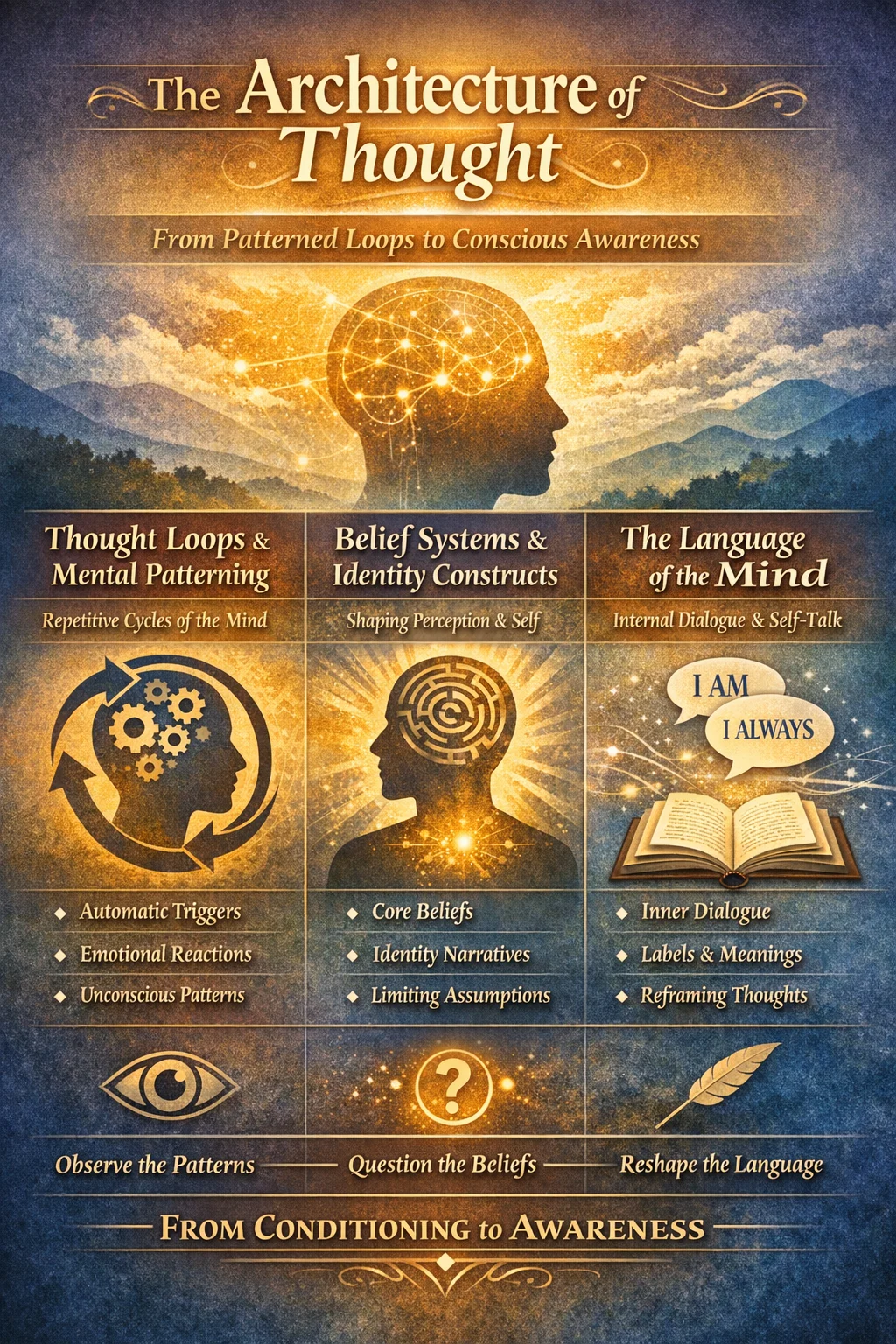
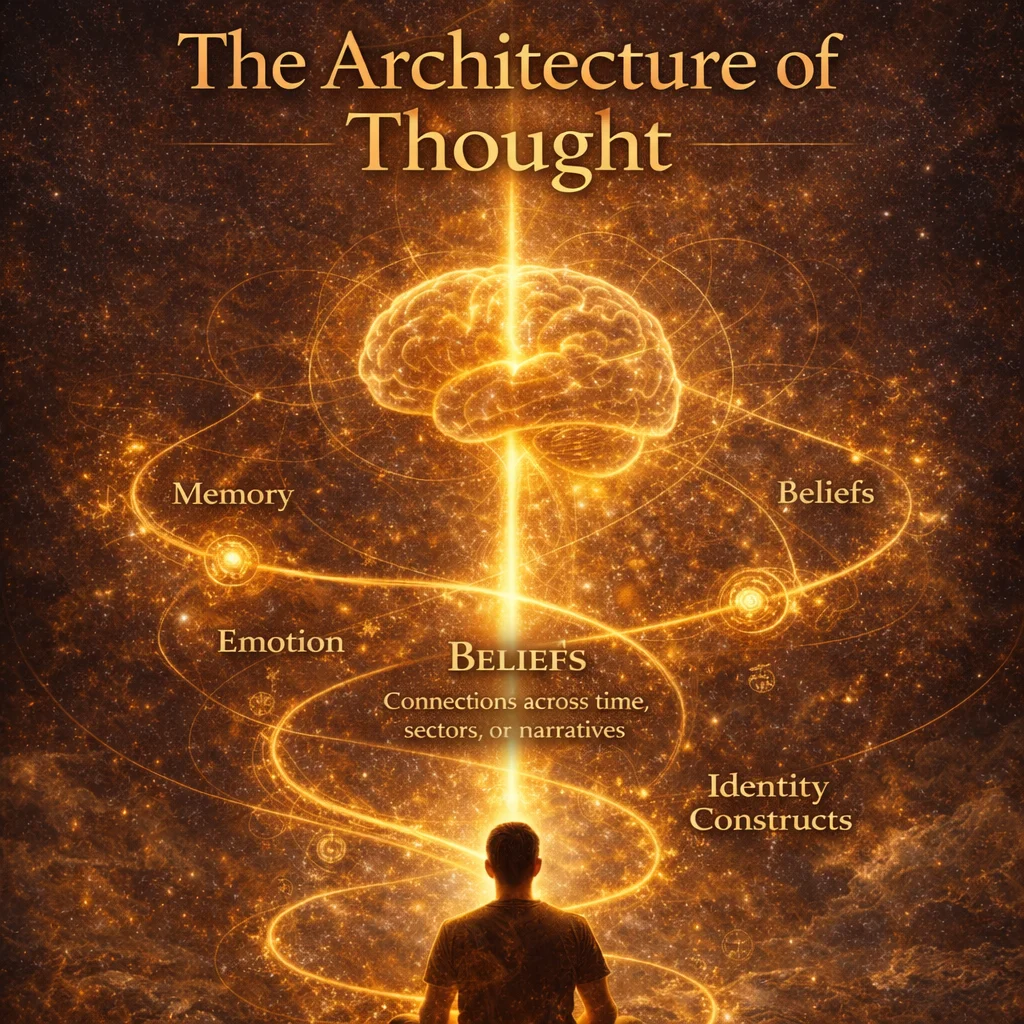
Thought is not random—it follows structure, repetition, and reinforcement. What we experience as “thinking” is often a series of patterned loops built over time through memory, conditioning, and repeated emotional responses. These loops become familiar pathways in the mind, automatically triggered by people, situations, or internal states. Over time, they form the foundation of belief systems—deeply held assumptions about who we are, how the world works, and what is possible. From these beliefs, identity constructs emerge, shaping how we see ourselves and how we engage with reality. Much of this operates beneath conscious awareness, creating a default lens through which life is interpreted.
The language of the mind reinforces this architecture. Internal dialogue—often subtle and continuous—assigns meaning, labels experiences, and maintains the structure of these thought patterns. Words like “I am,” “I always,” or “this means” carry weight, solidifying perception into identity and reinforcing loops that may no longer serve us. As awareness develops, we begin to recognize these patterns not as fixed truths, but as conditioned structures that can be observed and reshaped. This shift is foundational: when we understand how thought is constructed, we gain the ability to interrupt automatic loops, soften rigid beliefs, and create space for a more coherent and aligned way of thinking.
1. The Architecture of Thought
Thought Loops & Mental Patterning
Thought loops are repetitive cycles of thinking that the mind returns to automatically, often without conscious awareness. These loops are formed through repeated experiences, emotional reactions, and reinforced attention over time. When a particular thought pattern is revisited frequently—especially when paired with strong emotion—it becomes neurologically and psychologically familiar. The brain begins to favor these pathways, making them the default response to similar situations. This is why certain thoughts seem to arise instantly, as if they are happening to us rather than being created by us.
Mental patterning extends beyond individual thoughts into broader structures of interpretation. These patterns shape how we anticipate outcomes, perceive challenges, and relate to others. Without awareness, they can keep us locked in predictable reactions, even when circumstances change. Healing at this level begins by recognizing these loops as patterns—not truths. Once observed, they can be interrupted, softened, and gradually replaced with more coherent and aligned ways of thinking. The goal is not to eliminate thought, but to free oneself from unconscious repetition.
Belief Systems & Identity Constructs
Belief systems are the frameworks through which we interpret reality. They are formed early in life through family, culture, education, and personal experience, and they become the invisible rules that guide perception and behavior. Many of these beliefs operate below conscious awareness, shaping what we consider possible, safe, or true. Over time, these beliefs consolidate into identity constructs—the internal narrative of “who I am.” Statements like “I am this kind of person” or “this is how life works” are not neutral observations; they are conclusions drawn from accumulated experience and reinforced over time.
These identity constructs can become rigid, limiting growth and reinforcing disconnection between mind, body, and spirit. When a belief is challenged, it can feel like a threat—not because it is objectively true, but because it is tied to identity. Healing involves bringing these beliefs into awareness and questioning their validity. Are they still accurate? Were they ever fully true? As these structures are examined, space opens for new interpretations and a more fluid sense of self. Identity shifts from something fixed and defended to something observed and consciously shaped.
The Language of the Mind
The language of the mind is the internal dialogue that continuously interprets and labels experience. This inner voice assigns meaning to events, reinforces beliefs, and shapes emotional responses. It operates through words, tone, and repetition—often using absolute or identity-based language such as “always,” “never,” or “I am.” These linguistic patterns are powerful because they do not simply describe reality; they help construct it. The way something is internally framed determines how it is felt, remembered, and acted upon.
Becoming aware of this internal language is a critical step in restoring clarity. Subtle shifts in wording can significantly alter perception—for example, moving from “I am overwhelmed” to “I am experiencing overwhelm” creates distance and reduces identification. This shift allows for observation rather than immersion. Over time, refining the language of the mind supports greater coherence, as thoughts become less reactive and more intentional. The goal is not to control every word, but to cultivate a pattern of internal communication that reflects awareness, balance, and alignment.

2. Awareness & the Observer
Awareness is the foundation of all meaningful change because it introduces space into what was previously automatic. Without awareness, thoughts, emotions, and reactions occur as a continuous stream, blending together into a single, unquestioned experience. The Observer—often referred to as the Witness State—is the aspect of consciousness that can step back and notice this stream without becoming entangled in it. It does not judge, react, or attempt to control; it simply sees. This shift from being immersed in thought to observing it is subtle but powerful. It marks the transition from unconscious participation to conscious presence.
As this observer capacity strengthens, attention becomes more intentional rather than reactive. Attention is not passive—it directs energy, amplifies certain experiences, and shapes perception. What we consistently attend to becomes more prominent in our inner and outer world. When awareness is applied to attention itself, we begin to recognize how easily it is pulled into habitual patterns of thought. Breaking identification with thought does not mean eliminating thinking; it means no longer assuming that every thought defines who we are. From this perspective, thoughts can arise and pass without control or resistance, allowing clarity, stability, and coherence to emerge naturally.
2. Awareness & the Observer
The Witness State
The Witness State is the capacity to observe thoughts, emotions, and sensations without becoming identified with them. It is a shift from “I am this thought” to “I am aware of this thought.” In this state, experience is still present, but there is space around it. Instead of being pulled into reaction, awareness remains steady and neutral, allowing thoughts and feelings to arise and pass without immediate engagement. This creates a subtle but important separation between the observer and the content being observed.
As this state becomes more familiar, reactivity begins to soften. Situations that once triggered automatic responses can now be seen more clearly, without the same level of emotional charge. The Witness does not suppress or avoid experience—it allows it fully, but without attachment. This is where clarity begins to stabilize. From this position, discernment becomes possible, and choices are no longer driven solely by habit or conditioning, but by awareness itself.
Attention as a Creative Force
Attention is one of the most powerful forces shaping human experience. What we consistently focus on becomes amplified in perception, reinforced in memory, and often expressed in behavior. In this sense, attention is not passive—it is creative. It organizes reality by selecting what is brought into the foreground and what remains in the background. Over time, habitual attention patterns reinforce thought loops, emotional states, and belief systems, making them feel fixed and inevitable.
When awareness is applied to attention, this process becomes visible. We begin to see how easily attention is pulled toward fear, distraction, or repetition. With practice, attention can be redirected—away from automatic loops and toward clarity, presence, and intentional focus. This is not about forcing positivity, but about recognizing that where attention goes, energy follows. By stabilizing attention, we begin to reshape experience at its source, allowing more coherent and aligned patterns to emerge.
Breaking Identification with Thought
Breaking identification with thought is the process of no longer defining oneself by the content of the mind. Most people live in a state of fusion with their thoughts—believing them, reacting to them, and building identity around them without question. This creates a sense of limitation, as thoughts shaped by past experiences and conditioning are mistaken for present truth. When identification is strong, even a single thought can influence mood, behavior, and perception without being examined.
Through awareness, this identification begins to loosen. Thoughts are seen as events occurring within consciousness, rather than as fixed statements about reality or self. This shift creates freedom—not by eliminating thought, but by changing the relationship to it. A thought can arise without needing to be followed, believed, or resisted. Over time, this allows the mind to become quieter and more stable, not because it is controlled, but because it is no longer being continuously reinforced through unconscious identification.
3. Perception & Interpretation
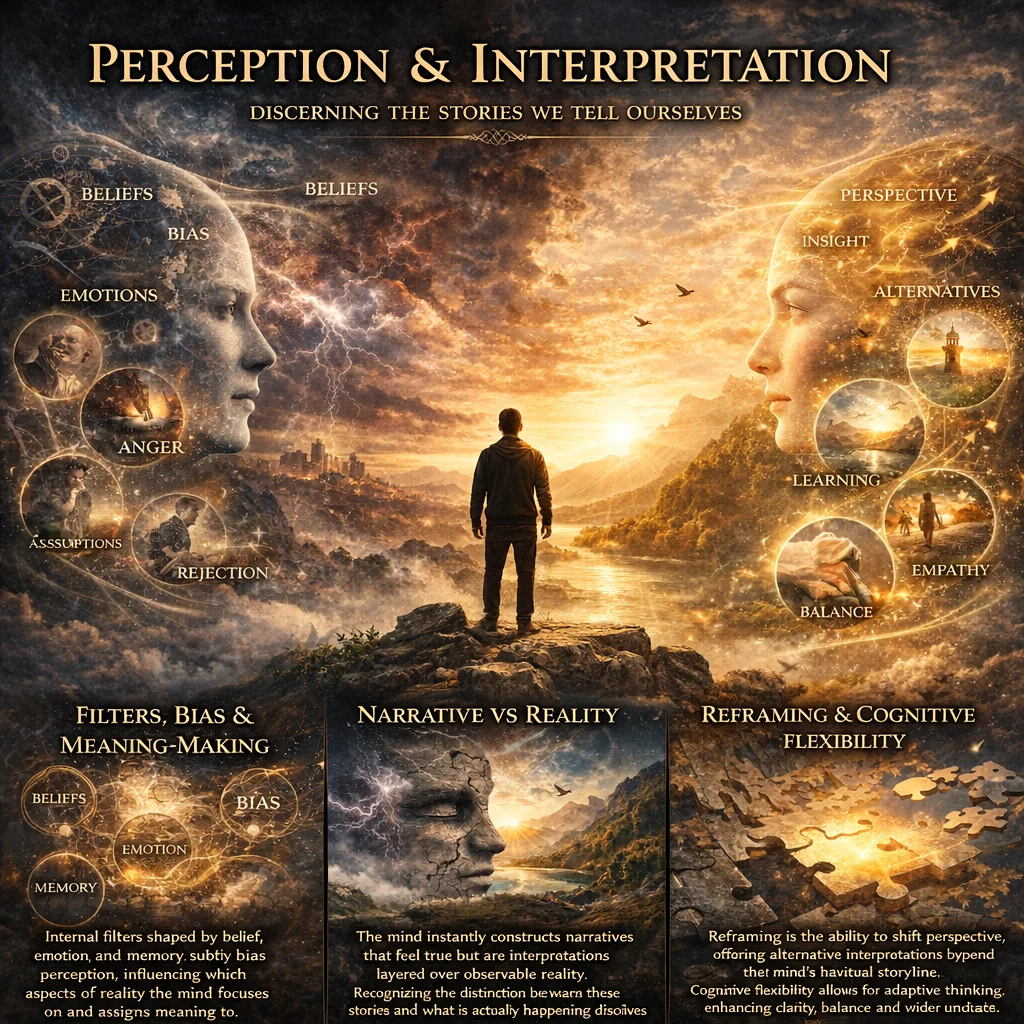
Perception is not a direct reflection of reality—it is a constructed experience shaped by internal filters, past conditioning, and current emotional states. The mind continuously sorts incoming information, selecting what to notice, what to ignore, and how to interpret what is seen. These filters include personal history, cultural influence, beliefs, and biases, all of which influence meaning-making. Two people can experience the same event and arrive at completely different interpretations, not because reality changed, but because their internal frameworks differ. Much of this process happens automatically, creating the illusion that our perception is objective when it is, in fact, highly subjective.
Interpretation is where perception becomes narrative. The mind assigns meaning to what is perceived, often instantly, forming conclusions that feel definitive but are rarely questioned. These narratives—“this means something is wrong,” “this always happens to me,” “this confirms what I already believe”—can reinforce existing patterns and limit new possibilities. Over time, the distinction between narrative and reality becomes blurred, and the story we tell ourselves begins to feel like truth. Reframing and cognitive flexibility introduce a different approach: the ability to question interpretation, consider alternative perspectives, and loosen rigid conclusions. This does not deny reality—it expands it. As flexibility increases, perception becomes less reactive and more accurate, allowing for greater clarity, adaptability, and coherence.
3. Perception & Interpretation
Filters, Bias, and Meaning-Making
Perception is shaped by a set of internal filters that operate automatically—drawing from past experiences, learned beliefs, cultural conditioning, and emotional memory. These filters determine what we notice and what we overlook, creating a selective version of reality. Bias plays a central role in this process. The mind tends to confirm what it already believes, reinforcing familiar interpretations while dismissing information that contradicts them. This is not a flaw so much as a function of efficiency—the brain simplifies complexity by organizing experience into recognizable patterns.
Meaning-making is the next layer, where raw perception is interpreted and assigned significance. An event in itself is neutral, but the meaning we attach to it gives it emotional weight and direction. Over time, repeated interpretations form predictable patterns, shaping expectations and influencing behavior. When brought into awareness, these filters and biases can be examined rather than blindly followed. This creates an opportunity to refine perception—reducing distortion and allowing for a more accurate and balanced understanding of experience.
Narrative vs Reality
The mind is constantly constructing narratives—stories that explain what is happening, why it is happening, and what it means. These narratives are often formed instantly, based on incomplete information, yet they carry a sense of certainty. The challenge is that these internal stories are frequently mistaken for reality itself. A thought becomes a conclusion, and a conclusion becomes a belief. Over time, this process creates a self-reinforcing loop where the narrative shapes perception, and perception continues to validate the narrative.
Distinguishing between narrative and reality is a critical step in developing clarity. Reality consists of observable facts—what is directly present—while narrative is the interpretation layered on top. For example, an interaction may simply occur, but the mind adds meaning such as judgment, rejection, or intent. When this distinction becomes visible, the intensity of experience often decreases, as the story loses its automatic authority. This creates space to question assumptions and respond more thoughtfully, rather than reacting to interpretations that may not be accurate.
Reframing & Cognitive Flexibility
Reframing is the ability to consciously reinterpret a situation by shifting perspective. It does not involve denying or minimizing experience, but rather expanding the range of possible meanings. Cognitive flexibility supports this process by allowing the mind to move beyond rigid interpretations and consider alternative viewpoints. Instead of defaulting to a single explanation, the mind becomes open to multiple possibilities, reducing the tendency to lock into fixed conclusions.
As cognitive flexibility develops, perception becomes less reactive and more adaptive. Situations that once triggered automatic responses can be approached with curiosity rather than certainty. This shift increases resilience, as the individual is no longer bound to a single interpretation of events. Over time, reframing becomes a natural extension of awareness—allowing experience to be processed with greater balance, clarity, and coherence. This is where perception evolves from a fixed lens into a dynamic tool for understanding and navigating reality.
4. Mental Conditioning & Deprogramming
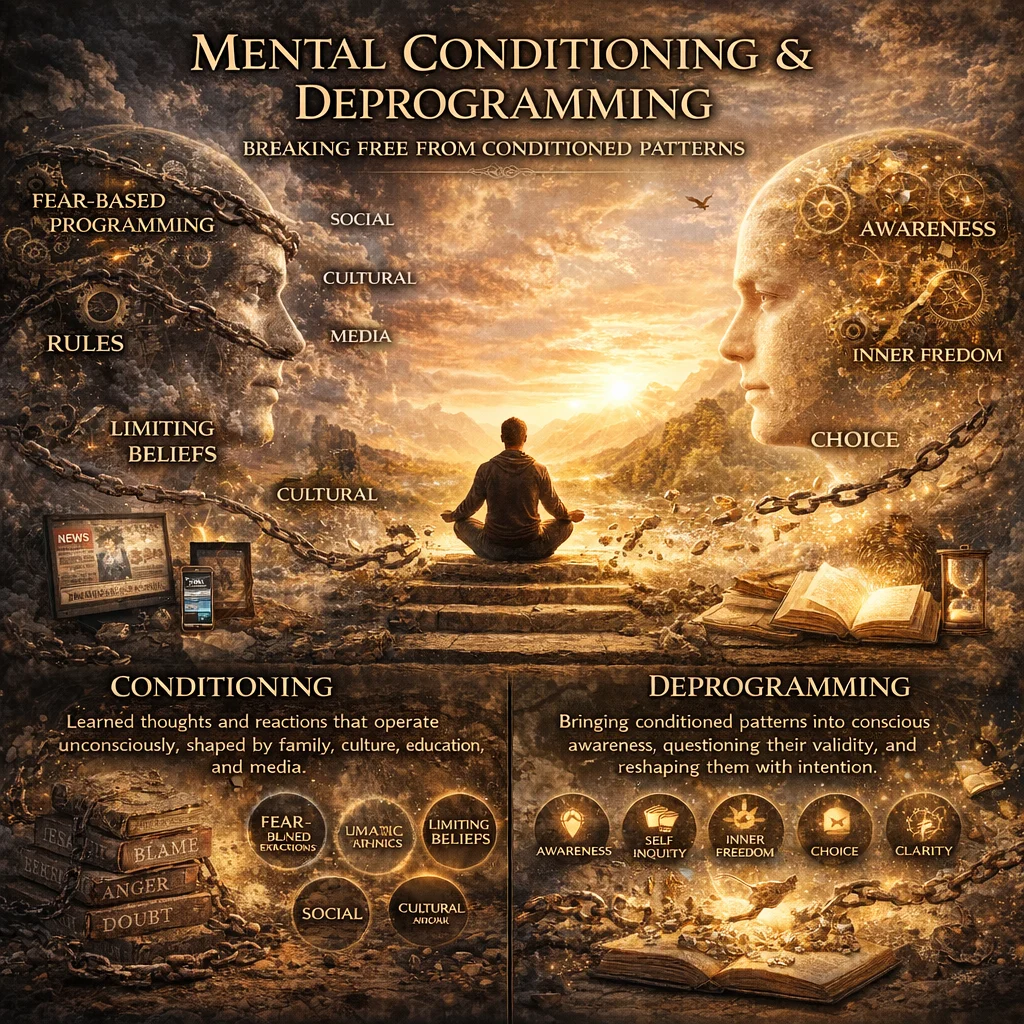
Mental conditioning refers to the process by which thoughts, beliefs, and behavioral patterns are shaped over time through repeated exposure to external influences and internal experiences. From early development onward, the mind absorbs input from family, education, culture, and media, forming implicit rules about how the world works and how one should respond to it. These imprints become embedded as automatic responses—guiding perception, reinforcing emotional reactions, and shaping identity without conscious choice. Because much of this conditioning is normalized and shared collectively, it often goes unquestioned, operating as a default framework for interpreting reality.
Deprogramming is the process of bringing these conditioned patterns into awareness and consciously examining their validity. It involves recognizing that many thoughts and reactions are not inherently true or self-generated, but learned and reinforced over time. Social, cultural, and media imprints can subtly influence priorities, fears, and expectations, while fear-based programming tends to narrow perception and amplify reactivity. By observing these influences without immediate identification, space is created to question, release, and reframe them. Rewriting internal scripts is not about forcefully replacing thoughts, but about gradually aligning them with clarity, coherence, and lived experience. As conditioning loosens, the mind becomes less reactive and more intentional, allowing for a more grounded and self-directed way of thinking.
4. Mental Conditioning & Deprogramming
Social, Cultural & Media Imprints
From an early age, the mind absorbs patterns from its environment—family dynamics, cultural norms, education systems, and media narratives. These influences form the baseline assumptions about how life works, what is valued, and what is considered possible or acceptable. Much of this conditioning happens passively, through repetition and exposure, rather than conscious agreement. Over time, these imprints become internalized as “normal,” shaping perception and behavior without being recognized as learned constructs.
Media, in particular, plays a powerful role by continuously reinforcing certain narratives, emotional tones, and priorities. Whether through news cycles, entertainment, or digital platforms, repeated messaging can influence attention, amplify specific viewpoints, and subtly guide belief formation. The result is often a convergence of external influence and internal identity, where individuals unknowingly adopt perspectives that may not fully align with their direct experience. Awareness of these imprints allows for discernment—creating the ability to question, filter, and consciously choose what to retain and what to release.
Fear-Based Programming
Fear-based programming develops when the mind repeatedly associates certain situations, ideas, or outcomes with threat or danger. This can originate from personal experiences, but it is often reinforced by external messaging that emphasizes risk, scarcity, or uncertainty. When fear becomes a dominant organizing principle, it narrows perception and accelerates reactivity. The nervous system shifts toward protection, prioritizing survival responses over clarity and balanced reasoning. Over time, this creates habitual patterns of anticipation—expecting negative outcomes even in neutral situations.
These patterns can become self-reinforcing. The more attention is directed toward fear-based interpretations, the more they are validated and strengthened. This does not mean fear is unnecessary—it serves a protective function—but when it becomes the default lens, it distorts perception and limits flexibility. Recognizing fear-based programming involves noticing when reactions are disproportionate to the present moment or driven by imagined outcomes. With awareness, it becomes possible to pause, regulate, and re-evaluate, allowing perception to expand beyond automatic threat responses.
Rewriting Internal Scripts
Internal scripts are the recurring narratives and assumptions that guide thought and behavior. These scripts often take the form of identity statements, expectations, or conclusions drawn from past experiences—such as “this is how things always go” or “this is who I am.” Once established, they tend to repeat automatically, influencing decisions and reinforcing familiar patterns. Because they feel consistent and predictable, they are rarely questioned, even when they no longer serve growth or alignment.
Rewriting these scripts begins with awareness—identifying the language and patterns that are operating beneath the surface. Rather than forcefully replacing thoughts, the process involves gently interrupting repetition and introducing alternative perspectives that are more aligned with present reality. This shift is gradual and reinforced through consistency, attention, and experience. As new patterns take hold, the internal narrative becomes less restrictive and more adaptable. Over time, this creates a sense of agency, where thoughts are no longer inherited or automatic, but consciously shaped and aligned with clarity and coherence.
5. Focus, Intention & Direction
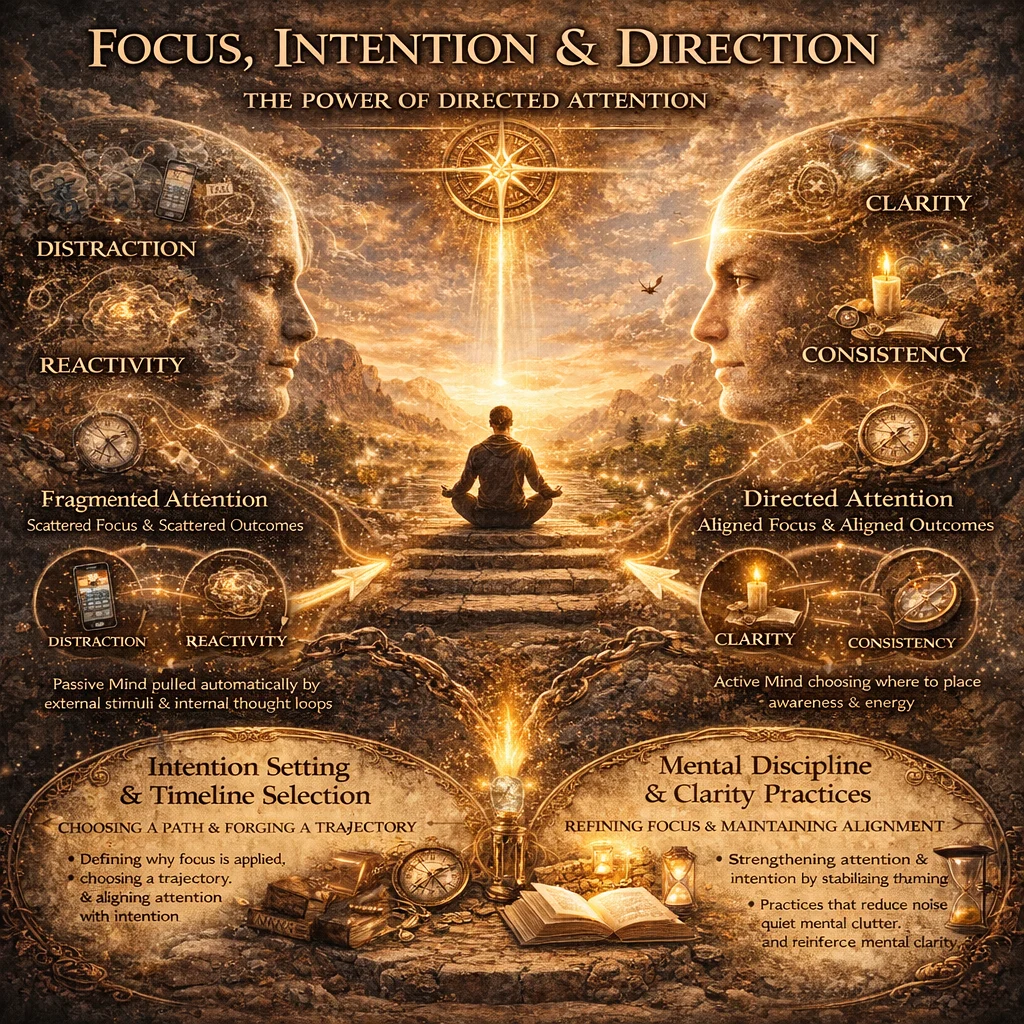
Focus, intention, and direction form the active layer of the mind—where awareness becomes applied. If awareness is the ability to observe, then focus is the ability to choose where that awareness is placed. Most people operate with fragmented attention, pulled in multiple directions by external stimuli and internal thought loops. This creates scattered energy and inconsistent outcomes. When focus becomes intentional, the mind begins to organize itself more coherently. What was once reactive becomes directed, and experience starts to reflect that shift. This is where the mind transitions from passive interpretation to active participation.
Intention provides the underlying orientation for that focus. It is not just what we think about, but why we are directing attention in a particular way. Intention shapes trajectory—it influences decisions, perception, and behavior over time. Without intention, focus can still exist, but it lacks coherence and direction. Together, focus and intention establish a pathway, allowing the mind to move from scattered engagement to aligned action. Mental discipline and clarity practices support this process by stabilizing attention, reducing noise, and reinforcing consistency. Over time, this creates a feedback loop where clarity strengthens focus, focus strengthens intention, and intention shapes a more aligned and coherent experience of reality.
5. Focus, Intention & Direction
The Power of Directed Attention
Directed attention is the ability to consciously choose where your mental energy is placed, rather than allowing it to be pulled automatically by distraction, emotion, or habit. In most cases, attention is reactive—drawn toward whatever is loudest, most urgent, or emotionally charged. This creates fragmentation, where focus is scattered and inconsistent. When attention becomes directed, it shifts from passive to intentional, allowing the mind to stabilize and organize around what truly matters.
This shift has a compounding effect. What you consistently give attention to becomes more defined in your perception and more reinforced in your experience. Over time, directed attention begins to reshape thought patterns, emotional responses, and behavioral outcomes. It is not about forcing concentration, but about recognizing that attention is a resource. When it is applied with clarity and consistency, it becomes a powerful mechanism for creating alignment between what you think, what you feel, and how you act.
Intention Setting & Timeline Selection
Intention provides direction to attention—it defines why focus is being applied and what it is oriented toward. Without intention, attention may still be present, but it lacks coherence and long-term trajectory. Intention setting is the process of consciously choosing a direction based on clarity rather than reaction. It establishes an internal reference point that guides decisions, perception, and behavior over time. This is less about rigid goals and more about alignment—choosing how you want to show up and what you are moving toward.
Timeline selection builds on this by recognizing that different choices and patterns lead to different outcomes. Each moment presents multiple potential pathways, shaped by where attention is placed and what intention is held. When intention is clear, it naturally influences which “path” is reinforced through thought and action. This does not require control over every variable, but it does require consistency. Over time, aligned intention and focused attention begin to converge, creating a more coherent and stable trajectory that reflects conscious choice rather than unconscious repetition.
Mental Discipline & Clarity Practices
Mental discipline is the ability to maintain stability of attention and intention over time, especially in the presence of distraction or emotional fluctuation. It is not rigid control, but consistent alignment—returning attention to what matters, again and again. Without discipline, even clear intentions can dissolve into reactive patterns. With discipline, the mind becomes less influenced by external noise and internal volatility, allowing for greater clarity and steadiness in decision-making.
Clarity practices support this process by reducing mental clutter and strengthening awareness. These may include stillness, breathwork, reflective observation, or structured focus exercises—anything that stabilizes attention and quiets unnecessary activity. Over time, these practices create a baseline of mental coherence, where thoughts are less scattered and more intentional. The result is a mind that is not only aware, but capable of sustaining direction—allowing focus, intention, and action to move in alignment.

6. Coherence of Mind
Coherence of mind is the state in which thoughts, attention, and awareness operate in alignment rather than fragmentation. In an incoherent state, the mind is pulled in multiple directions—reacting to external inputs, cycling through repetitive thought patterns, and shifting constantly between past and future. This creates internal noise, instability, and a lack of clarity. Coherence, by contrast, is experienced as steadiness. Attention is grounded, thoughts are less intrusive, and awareness is able to remain present without being continuously disrupted. The mind becomes organized rather than scattered, allowing perception to be more accurate and less distorted.
This coherence is not achieved through control, but through reduction of unnecessary activity and refinement of attention. As mental stillness develops and identification with thought decreases, the mind naturally begins to synchronize. Discernment strengthens, making it easier to distinguish between meaningful insight and reactive noise. Over time, this creates a stable internal environment where clarity can emerge consistently. In this state, the mind no longer drives reactivity or confusion—it becomes a supportive system that aligns with the body and spirit, allowing the entire system to function with greater balance, coherence, and intentional direction.
6. Coherence of Mind
Mental Stillness & Presence
Mental stillness is not the absence of thought, but the absence of unnecessary movement within the mind. It is a state where thoughts no longer dominate attention or pull awareness in multiple directions. Instead of constant internal commentary, there is space—allowing perception to become clearer and more direct. Presence emerges naturally from this stillness. Rather than being caught in past narratives or future projections, attention rests in the immediacy of the present moment, where experience is less filtered and more accurate.
This state cannot be forced. Attempts to control or suppress thought often create more activity rather than less. Stillness develops through allowing—observing thoughts without engagement, letting them arise and pass without reinforcement. Over time, as identification with thought decreases, the mind begins to settle on its own. Presence stabilizes, and awareness becomes less reactive and more grounded. This creates the foundation for coherence, where the mind is no longer fragmented, but unified in its attention.
Signal vs Noise Discernment
In a world of constant input—information, opinions, stimuli—the ability to distinguish between signal and noise becomes essential. Noise consists of reactive thought patterns, external distractions, and low-quality inputs that fragment attention and distort perception. Signal, by contrast, represents clarity, relevance, and insight—information or awareness that aligns with truth and supports coherent understanding. Without discernment, the mind treats all input as equally important, leading to overwhelm and confusion.
Discernment develops through awareness and refinement of attention. As mental stillness increases, it becomes easier to recognize what carries substance and what is simply repetition or distraction. This is not about rejecting information, but about filtering it more effectively. Over time, the mind becomes more selective, prioritizing clarity over volume. This shift reduces internal noise and allows meaningful signals to stand out, supporting more accurate perception and intentional decision-making.
Establishing Inner Clarity
Inner clarity is the result of a coherent mind—one that is not overwhelmed by conflicting thoughts, reactive patterns, or external noise. It is experienced as a sense of steadiness and understanding, where decisions and perceptions arise from alignment rather than confusion. Clarity does not require having all the answers; it comes from reducing distortion and seeing what is present without unnecessary interpretation. When the mind is clear, it becomes easier to navigate complexity without becoming lost in it.
Establishing this clarity is an ongoing process, supported by awareness, regulation, and consistent refinement of thought patterns. As mental noise decreases and discernment strengthens, clarity becomes more stable and accessible. This creates a reliable internal reference point—allowing you to respond rather than react, and to move through situations with greater confidence and coherence. From this foundation, the mind supports, rather than disrupts, the connection between body and spirit.
SECTION II — BODY
Regulation • Sensation • Nervous System
This section grounds healing in the physical and biological system—where most people are actually dysregulated.
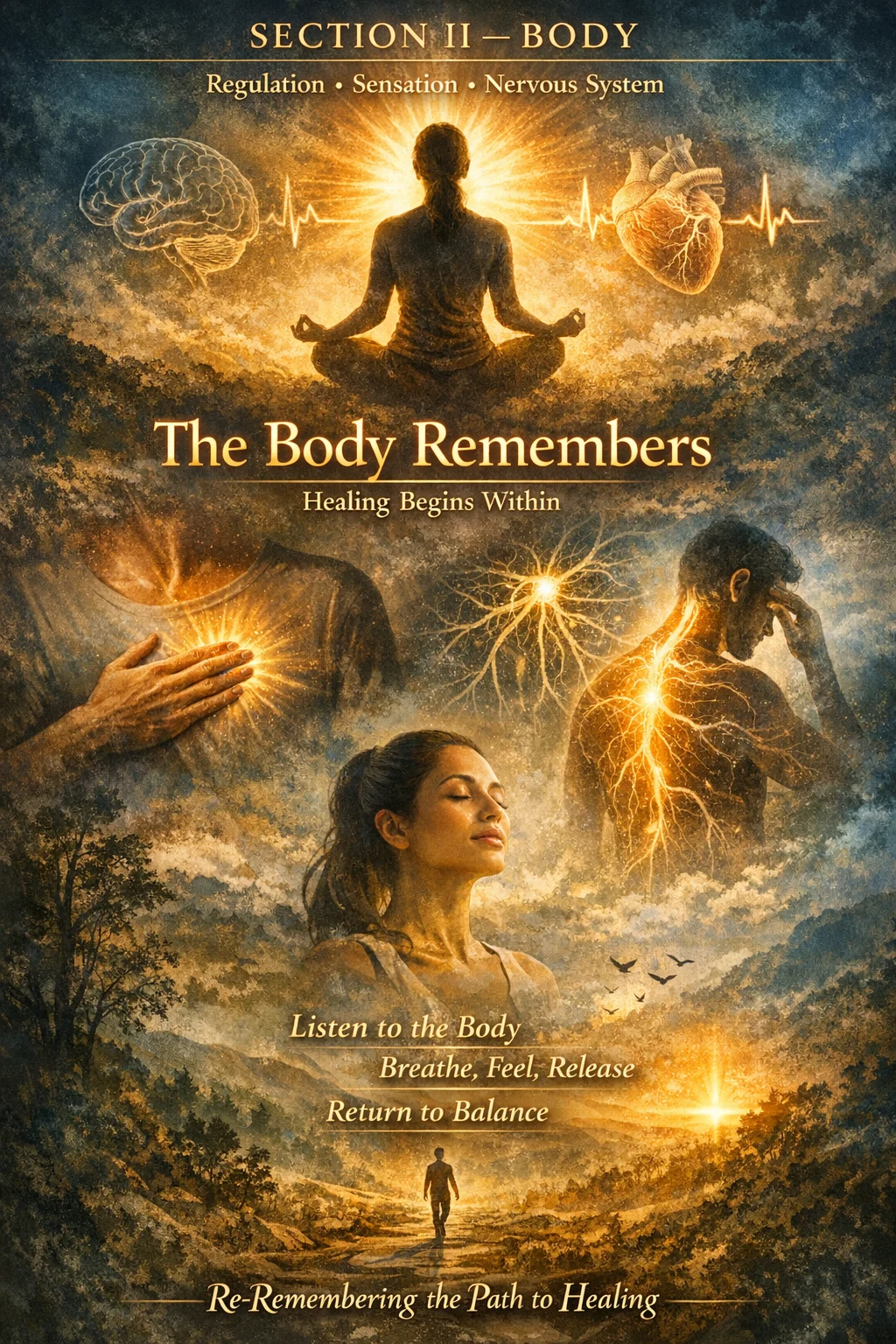
The body is not separate from the healing process—it is the foundation of it. While the mind interprets and the spirit orients, the body holds and expresses the actual lived experience. Most individuals attempt to resolve challenges at the level of thought, while the underlying dysregulation remains in the nervous system. The body continuously responds to internal and external stimuli, adjusting heart rate, breath, muscle tension, and hormonal activity in real time. When this system is overwhelmed or chronically activated, it creates a baseline of stress that shapes perception, emotion, and behavior. Healing, therefore, must include regulation—bringing the body back into a state of balance where it can function as it was designed.
The body operates as an intelligent system, constantly processing information beyond conscious awareness. It stores memory not just as mental recall, but as sensation, posture, and physiological response. Experiences that are not fully processed—especially those tied to strong emotion—can remain embedded as patterns within the nervous system. These stored imprints influence how the body reacts to present situations, often triggering responses that feel disproportionate or automatic. Understanding this shifts the perspective: the body is not malfunctioning, it is remembering. What appears as anxiety, tension, or discomfort is often the body attempting to resolve or signal something that has not yet been integrated.
Reconnecting with the body requires developing awareness of sensation and learning to listen without immediately reacting or suppressing. The body-mind connection becomes clear as physical states influence thoughts, and thoughts influence physical states in a continuous feedback loop. As regulation improves—through breath, presence, and conscious attention—the system begins to stabilize. This creates the conditions for deeper healing, where stored patterns can gradually release and the body can return to its natural state of coherence. In this state, the body is no longer a source of tension or confusion, but a guide—providing real-time feedback that supports clarity, alignment, and integration across mind, body, and spirit.
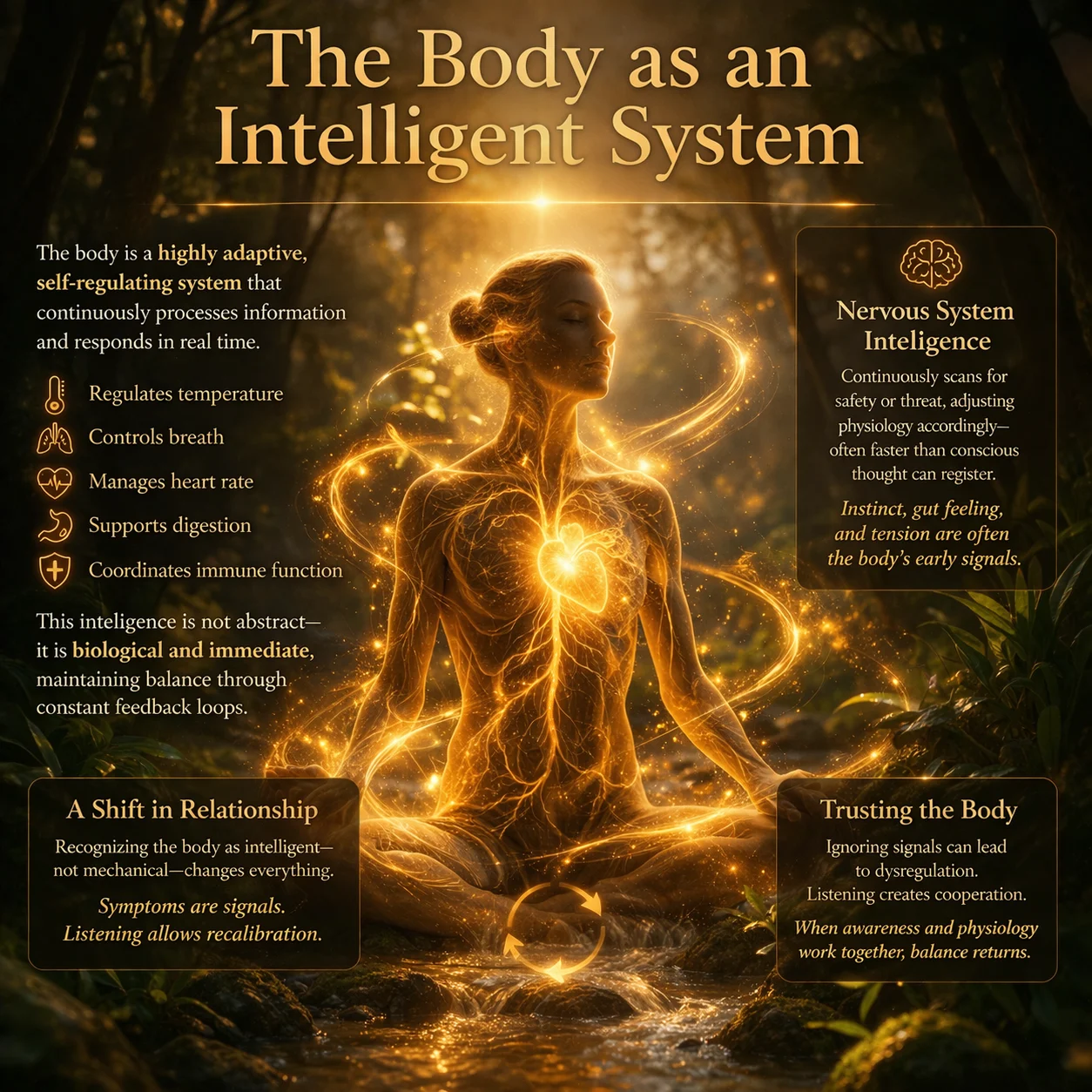
The Body as an Intelligent System
The body is a highly adaptive, self-regulating system that continuously processes information and responds in real time. It regulates temperature, breath, heart rate, digestion, and immune function without conscious effort, maintaining balance through constant feedback loops. This intelligence is not abstract—it is biological and immediate. The nervous system scans for safety or threat, adjusting physiology accordingly, often faster than conscious thought can register. What we experience as instinct, gut feeling, or tension is often the body communicating information before the mind has interpreted it.
When we begin to recognize the body as intelligent rather than mechanical, our relationship with it shifts. Symptoms are no longer seen as random or inconvenient, but as signals. Fatigue, tightness, restlessness, or calm are forms of communication. Ignoring or overriding these signals can lead to deeper dysregulation, while listening to them allows the system to recalibrate. Trusting the body’s intelligence creates a more cooperative dynamic—where awareness and physiology begin to work together rather than in opposition.
1. The Body as an Intelligent System
The Body’s Innate Wisdom
Innate wisdom refers to the body’s natural capacity to heal, restore, and return to balance when given the right conditions. Just as the body heals a wound or fights off illness, it also has mechanisms for processing stress and restoring equilibrium. This wisdom operates through rhythm—cycles of activation and rest, tension and release. When these cycles are uninterrupted, the body can move through experiences and return to baseline without long-term disruption.
However, modern life often interferes with this process. Chronic stress, overstimulation, and lack of recovery can keep the system in a prolonged state of activation, preventing the body from completing its natural cycles. Over time, this suppresses the expression of its innate wisdom. Reconnecting with this intelligence involves creating space—through rest, breath, and awareness—for the body to do what it already knows how to do. Healing, in this sense, is less about adding something new and more about removing interference so the body can return to its natural state of balance.
Stored Memory & Cellular Imprints
The body stores memory not only in the brain, but throughout the entire system as patterns of sensation and response. Experiences—especially those associated with strong emotion—can become encoded in the nervous system as tension, posture, or habitual reactions. These are often referred to as imprints: residual patterns that influence how the body responds to present situations. A current event may trigger a reaction that feels immediate, but the intensity often reflects past experiences that have not been fully processed.
These stored imprints are not conscious memories, but embodied ones. They can show up as recurring physical sensations, emotional responses, or automatic behaviors that seem disconnected from the current moment. Healing involves bringing awareness to these patterns without forcing them to change. As the body is given space to feel and process what has been held, these imprints can gradually release. This is not about revisiting the past intellectually, but allowing the body to complete what was previously unresolved.
The Body-Mind Connection
The body and mind are not separate systems—they are continuously influencing each other in a dynamic feedback loop. Thoughts can trigger physiological responses, such as increased heart rate or muscle tension, while physical states can shape thought patterns and emotional tone. For example, a dysregulated nervous system can make neutral situations feel threatening, while a regulated state supports clarity and balanced perception. This interaction happens constantly, often without conscious awareness.
Understanding this connection shifts the approach to healing. Instead of trying to resolve everything through thought alone, attention is also given to the state of the body. Regulating the nervous system—through breath, posture, movement, and awareness—can directly influence mental clarity and emotional stability. As the body becomes more balanced, the mind naturally follows. This integration creates a more coherent system, where both body and mind support each other, rather than operating in conflict.
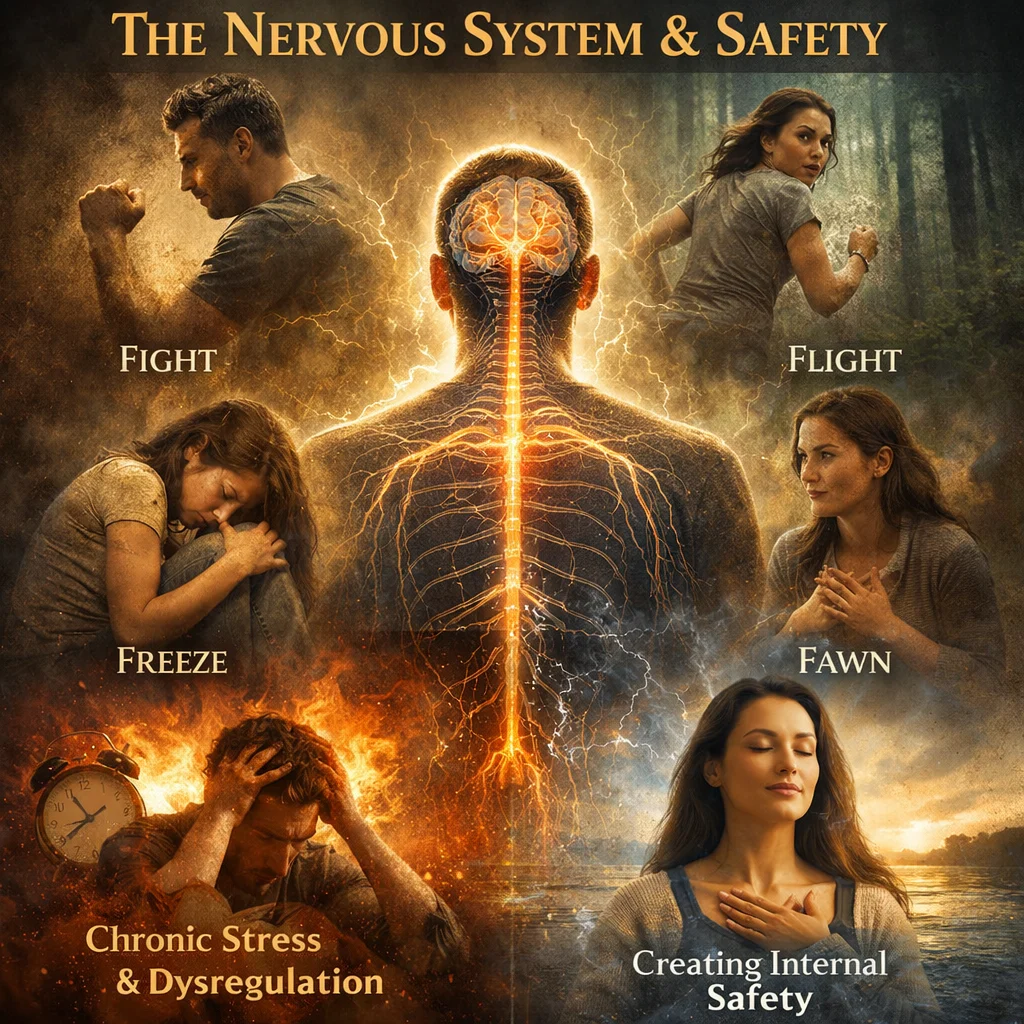
2. The Nervous System & Safety
The nervous system is the body’s primary system for detecting and responding to safety or threat. It operates largely outside of conscious awareness, continuously scanning the environment and internal state to determine how to respond. When a sense of safety is present, the body moves into a regulated state—breathing is steady, muscles are relaxed, and the mind is more clear and receptive. When a threat is perceived, the system shifts into protective responses such as fight, flight, freeze, or fawn. These are not conscious choices, but automatic survival mechanisms designed to keep the body safe. While essential in moments of real danger, these responses can become chronic when the system perceives ongoing stress, even in the absence of immediate threat.
Chronic stress and dysregulation occur when the nervous system remains activated for extended periods, preventing the body from returning to a balanced baseline. This can lead to persistent tension, anxiety, fatigue, and difficulty thinking clearly. Creating internal safety becomes the key to restoring regulation. This is not about convincing the mind that everything is safe, but about signaling to the body—through breath, presence, and consistent supportive practices—that it can begin to settle. As the nervous system experiences repeated moments of safety, it gradually recalibrates. Over time, this builds resilience, allowing the body to respond to challenges without becoming overwhelmed, and creating a stable foundation for healing, clarity, and integration.
2. The Nervous System & Safety
Fight / Flight / Freeze / Fawn
These four responses are the nervous system’s primary survival strategies, activated automatically when a threat is perceived. Fight mobilizes energy to confront danger, flight directs energy toward escape, freeze immobilizes the body when action feels impossible, and fawn seeks safety through appeasement or compliance. These responses are not conscious decisions—they are deeply wired biological reactions designed to protect the organism. In moments of real danger, they are efficient and necessary, allowing the body to respond faster than conscious thought.
However, these responses can become patterned when the nervous system begins to perceive threat in situations that are not immediately dangerous. Over time, individuals may default to one dominant response—becoming reactive, avoidant, shut down, or overly accommodating. Recognizing these patterns is the first step toward change. When brought into awareness, these responses can be observed rather than automatically enacted, allowing space for regulation and more intentional ways of responding.
Chronic Stress & Dysregulation
Chronic stress occurs when the nervous system remains in a prolonged state of activation without adequate recovery. Instead of cycling naturally between activation and rest, the body becomes stuck in patterns of heightened alertness or shutdown. This dysregulation can manifest as anxiety, irritability, fatigue, difficulty concentrating, or a constant sense of unease. The system is no longer responding to immediate conditions—it is operating from accumulated stress that has not been fully processed.
Over time, this state begins to affect both physical and mental health. Hormonal imbalances, disrupted sleep, and weakened immune function can emerge alongside emotional instability and mental fatigue. Dysregulation narrows perception, making it harder to feel grounded or present. Understanding this shifts the focus away from “fixing thoughts” and toward supporting the nervous system itself. As regulation improves, many symptoms naturally begin to resolve because the system is no longer operating in a constant state of imbalance.
Creating Internal Safety
Internal safety is the condition in which the nervous system no longer perceives immediate threat, allowing the body to move into a state of regulation and repair. This state cannot be forced through logic alone—it must be experienced physiologically. Practices such as slow, steady breathing, grounding attention in the body, and creating consistent rhythms of rest and activity help signal to the system that it is safe to settle. Over time, these signals accumulate, gradually shifting the baseline from tension to stability.
Creating internal safety also involves developing a relationship with one’s own experience that is less reactive and more supportive. Instead of resisting or suppressing sensations, there is a willingness to feel and observe them without escalation. This builds trust within the system. As the body learns that it can move through sensations without becoming overwhelmed, it begins to relax its protective patterns. This is where deeper healing becomes possible—because safety is no longer dependent on external conditions, but is cultivated from within.
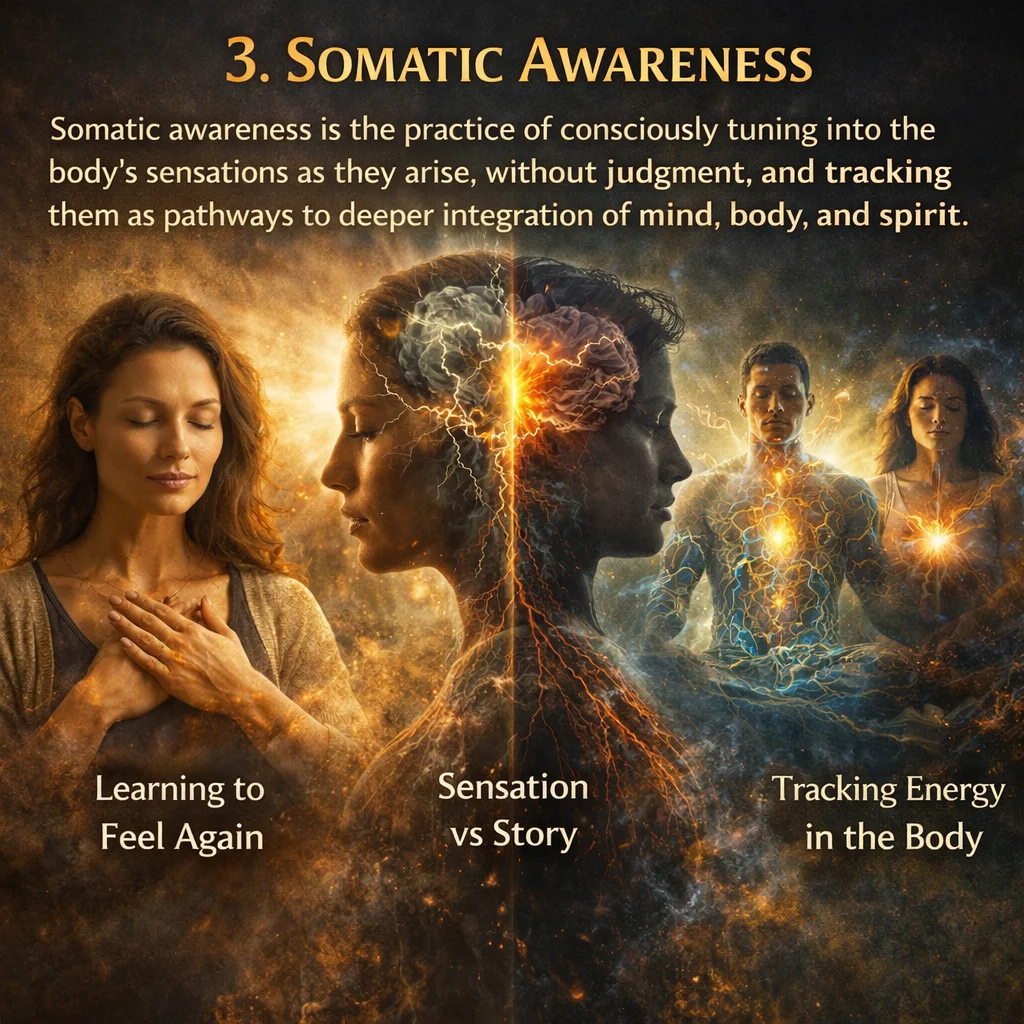
3. Somatic Awareness
Somatic awareness is the practice of turning attention inward to directly experience the body—its sensations, signals, and subtle shifts—without immediately interpreting or reacting. Most people live primarily in thought, analyzing experience rather than feeling it. Somatic awareness reverses that pattern, bringing attention back to the body as the primary source of real-time information. It creates a bridge between mind and body, allowing awareness to move from abstraction into direct experience. This shift is foundational for healing, because the body is where stress, emotion, and memory are actually held.
As somatic awareness develops, the body becomes less of a background system and more of an active guide. Sensations that were once ignored or suppressed begin to surface—not as problems, but as signals. Instead of trying to “figure out” every experience mentally, there is a growing capacity to feel and stay present with what is arising. This builds regulation, because the nervous system is no longer being bypassed. Over time, this practice restores connection, allowing the body to release stored tension and return to a more natural state of balance and coherence.
3. Somatic Awareness
Learning to Feel Again
Learning to feel again is the process of reconnecting with sensations that have been numbed, avoided, or overridden over time. Many people unconsciously disconnect from the body as a way to cope with stress, discomfort, or overwhelming emotion. This creates a sense of distance—not only from physical sensation, but from emotional experience as well. Re-engaging with feeling is not about intensifying emotion, but about gently rebuilding the capacity to stay present with what is already there.
This process requires patience and safety. Sensations may initially feel unfamiliar or even uncomfortable, but as awareness stabilizes, the experience becomes more manageable. Feeling, in this context, is not something to be feared—it is a natural function of the body moving energy and information. As the ability to feel increases, so does the ability to process and release. What was once avoided begins to move, and the body gradually shifts from holding to flowing.
Sensation vs Story
One of the most important distinctions in somatic awareness is the difference between sensation and story. Sensation is the direct, physical experience in the body—tightness, warmth, pressure, movement. Story is the mental interpretation layered on top—what we think it means, why it’s happening, or what should be done about it. Most people immediately move from sensation into story, often amplifying the experience through analysis, judgment, or assumption.
By learning to stay with sensation without immediately attaching a narrative, a new level of clarity emerges. The intensity of experience often decreases when it is not being continuously reinforced by thought. This creates space between what is felt and what is believed about it. Over time, this separation allows for more accurate perception and reduces reactivity. The body can complete its natural processes without interference, and the mind becomes less dominant in shaping every experience.
Tracking Energy in the Body
Tracking energy in the body involves following the movement of sensation as it changes over time. Rather than holding attention in one fixed place or trying to control what is happening, awareness moves with the experience—observing how sensations expand, contract, shift, or dissipate. This process reveals that sensations are not static; they are dynamic and constantly evolving. What feels intense in one moment may soften or transform when given space and attention.
This practice builds trust in the body’s natural ability to process and release. Instead of resisting or suppressing sensation, there is a willingness to stay present as it moves. Over time, this reduces fear around bodily experience and increases confidence in one’s capacity to remain grounded. Tracking energy is not about directing outcomes, but about allowing the body’s intelligence to unfold. As this becomes more familiar, the system begins to regulate more efficiently, supporting deeper integration and a more coherent connection between mind, body, and spirit.
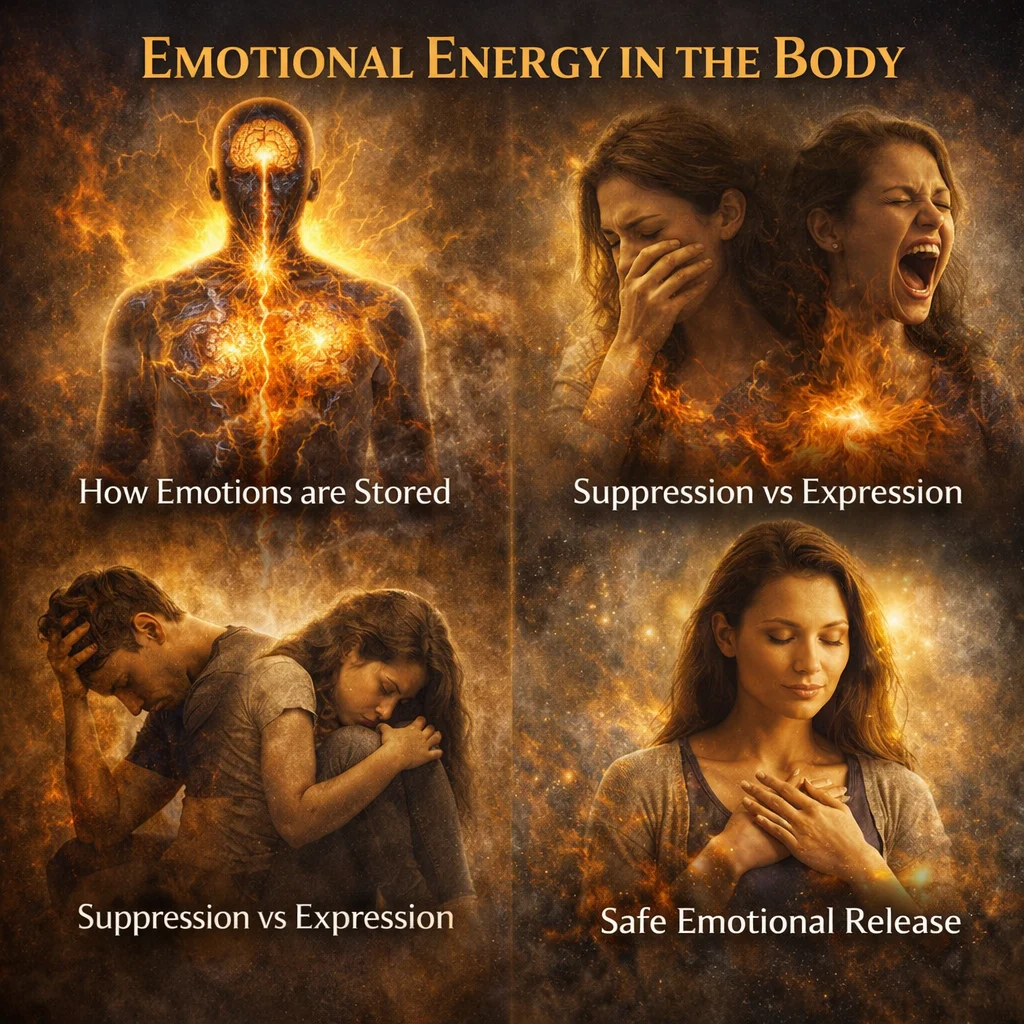
4. Emotional Energy in the Body
Emotions are not just psychological experiences—they are physiological events that move through the body as energy. Every emotional state has a corresponding physical signature: changes in breath, heart rate, muscle tension, and internal sensation. When emotions are allowed to move naturally, they rise, peak, and resolve, completing a cycle within the nervous system. However, when they are resisted, suppressed, or prolonged, they can become stored as tension or patterning within the body. This is why emotional experiences often linger physically, showing up as tightness, heaviness, or discomfort long after the original event has passed.
Understanding emotions as energy shifts the approach to healing. Instead of trying to control or eliminate them, the focus becomes allowing them to move safely through the system. The body is not overwhelmed by emotion itself—it is overwhelmed by the interruption of its natural process. When emotions are acknowledged and felt without resistance or over-identification, they begin to resolve on their own. This restores flow within the system, reducing accumulation and supporting greater emotional stability and coherence.
4. Emotional Energy in the Body
How Emotions are Stored
Emotions become stored when the body is unable to fully process them at the time they occur. This can happen due to intensity, lack of safety, or learned patterns of suppression. Instead of completing their natural cycle, the emotional response is interrupted and held within the nervous system. These stored experiences are not retained as clear memories, but as sensations, tension patterns, or reactive tendencies that can be triggered later by similar situations.
Over time, these stored emotions create layers of accumulated energy within the body. A present moment reaction may feel disproportionate because it is not only about the current experience, but also about unresolved past responses. Recognizing this changes the perspective from “something is wrong” to “something is being held.” As awareness is brought to these patterns, the body is given the opportunity to process what was previously incomplete, allowing stored emotional energy to gradually release.
Suppression vs Expression
Suppression occurs when emotions are pushed down, ignored, or avoided rather than experienced. This is often learned as a protective strategy—either to maintain control, avoid discomfort, or meet external expectations. While suppression may provide short-term relief, it prevents the natural resolution of emotional energy. The emotion does not disappear; it remains active beneath the surface, often influencing behavior, mood, and physical state in subtle but persistent ways.
Expression, on the other hand, allows emotion to move outward or be felt consciously. However, expression does not mean uncontrolled release or reaction. Healthy expression is regulated—it involves feeling the emotion fully without becoming overwhelmed or acting impulsively. The balance between suppression and expression is awareness: the ability to feel without either avoiding or amplifying. This creates a pathway for emotions to move through the system without becoming stored or disruptive.
Safe Emotional Release
Safe emotional release is the process of allowing stored emotional energy to move through the body in a way that is contained and regulated. This does not require dramatic expression; it often occurs through subtle shifts such as changes in breath, physical sensation, or the gradual softening of tension. The key is creating an internal environment where the body feels safe enough to let go. Without safety, the system will continue to hold and protect.
This process is supported by presence and patience. Rather than forcing release, awareness is placed on the sensations associated with the emotion, allowing them to unfold naturally. Over time, the body begins to trust that it can process and release without being overwhelmed. This builds resilience and reduces the accumulation of unresolved emotional energy. As release becomes more consistent, the system moves toward greater balance, where emotions are experienced, processed, and integrated rather than stored.
5. Regulation & Stabilization Practices
Regulation and stabilization practices are the bridge between awareness and embodied change. It’s one thing to understand the mind and nervous system—but without consistent practices, the system will continue to default to old patterns. Regulation is the process of bringing the body and nervous system back into balance, while stabilization is what makes that balance sustainable over time. Together, they create a reliable internal foundation where clarity, presence, and resilience can emerge more naturally.
These practices are not about control or perfection—they are about consistency and relationship. The body responds to repetition. Small, steady inputs signal safety, build trust, and gradually recalibrate the nervous system. Over time, this reduces reactivity, increases capacity, and allows the system to remain grounded even in the presence of stress. Regulation becomes less something you “do” and more a state you return to.
5. Regulation & Stabilization Practices
Breathwork & Transformational Breathing
Breath is one of the most direct ways to influence the nervous system. Unlike most bodily functions, it operates both automatically and consciously, making it a powerful bridge between mind and body. When the breath is shallow or erratic, it signals stress to the system. When it is slow, deep, and rhythmic, it signals safety. Breathwork uses this connection intentionally—shifting physiological state through conscious breathing patterns.
Transformational breathing goes a step further by using continuous, connected breath to move energy through the body. This can bring awareness to stored tension, emotional patterns, or areas of contraction. Rather than forcing release, the breath creates conditions where the body can naturally open and reorganize. Over time, consistent breathwork increases capacity, supports emotional processing, and helps establish a more regulated baseline.
Grounding Techniques
Grounding techniques bring attention out of the mind and back into the body and present moment. When the nervous system is activated, attention often becomes scattered—focused on past events, future concerns, or internal narratives. Grounding interrupts this pattern by anchoring awareness in direct sensory experience: the feeling of the feet on the ground, the rhythm of the breath, or the contact of the body with its environment.
This shift stabilizes the system by reducing mental overwhelm and reorienting awareness to what is actually happening in the present. Grounding is not about escaping thought, but about balancing it with physical awareness. Over time, it strengthens the connection between mind and body, making it easier to return to a regulated state. The more familiar grounding becomes, the more quickly the system can recover from activation.
Daily Regulation Protocols
Daily regulation protocols are structured, repeatable practices that support nervous system stability over time. Rather than relying on occasional interventions, these protocols create a consistent rhythm that the body can adapt to and trust. This might include morning breathwork, periods of stillness, movement, time in nature, or intentional pauses throughout the day to check in with the body.
The key is not complexity, but consistency. When practiced regularly, these small actions accumulate, gradually shifting the baseline of the nervous system from dysregulation to stability. Over time, regulation becomes more automatic, requiring less effort to maintain. This creates a resilient foundation where the body remains more balanced, the mind more clear, and the connection between both more coherent—supporting long-term healing and integration.
6. Physical Alignment & Energy Flow
Physical alignment and energy flow refer to how the body organizes itself structurally and energetically in space. The body is not static—it is constantly adjusting through posture, movement, and internal signaling. When alignment is balanced, energy moves efficiently, breath is unrestricted, and the nervous system remains more regulated. When alignment is compromised—through chronic tension, poor posture, or stress patterns—energy flow becomes restricted, leading to fatigue, discomfort, and reduced clarity. The way the body is held physically directly influences how energy circulates and how the system feels and functions.
Restoring alignment is not about rigid posture or forcing the body into ideal positions. It is about awareness and responsiveness—allowing the body to reorganize naturally as tension is released and movement becomes more fluid. As energy begins to flow more freely, the system returns to a more coherent state. This supports not only physical ease, but also mental clarity and emotional stability, reinforcing the connection between body, mind, and overall well-being.
6. Physical Alignment & Energy Flow
Posture, Movement & Flow
Posture reflects the current state of the nervous system and accumulated patterns within the body. It is not just how we sit or stand, but how we hold ourselves moment to moment. Chronic stress, emotional holding, and habitual movement patterns can create misalignment—tight shoulders, restricted breathing, or collapsed positioning. These patterns often develop unconsciously and become normalized over time, limiting both physical comfort and energetic flow.
Movement is the body’s way of restoring balance. When the body is allowed to move freely—through stretching, walking, or intentional practices—it begins to unwind these patterns. Flow emerges when movement is not forced, but responsive, allowing energy to circulate without obstruction. Over time, posture improves naturally as the body releases unnecessary tension and reorganizes into a more balanced and efficient state.
Tension Release & Relaxation
Tension is the body’s way of holding unresolved stress or protecting against perceived threat. While short-term tension can be useful, chronic tension becomes restrictive, limiting movement, breath, and energy flow. Many individuals carry persistent tightness in areas such as the neck, shoulders, jaw, or lower back, often without realizing how much effort is being used to maintain it. This constant holding creates fatigue and prevents the body from fully resting.
Relaxation is not simply the absence of activity—it is an active process of letting go. As awareness is brought to areas of tension, the body can begin to release gradually. This may occur through breath, gentle movement, or simply allowing attention to rest on the sensation without resistance. Over time, the body learns that it does not need to maintain constant contraction, and a new baseline of ease begins to develop. This supports both physical comfort and overall system regulation.
Restoring Natural Rhythms
The body operates through natural rhythms—cycles of activity and rest, inhalation and exhalation, tension and release. Modern lifestyles often disrupt these rhythms, leading to imbalance and fatigue. Irregular sleep patterns, constant stimulation, and lack of recovery time can prevent the body from resetting, keeping the system in a state of low-level activation. When rhythms are disrupted, both physical and mental coherence are affected.
Restoring these rhythms involves reintroducing consistency and balance into daily life. This includes honoring rest, creating space for recovery, and aligning with natural cycles such as sleep and movement. As these rhythms stabilize, the body begins to function more efficiently, and energy becomes more sustainable. Over time, this creates a sense of flow—where effort is reduced, and the system operates with greater ease, coherence, and resilience.
SECTION III — SPIRIT
Connection • Meaning • Higher Awareness
This is where everything integrates—beyond mind and body into coherence and purpose.
This section represents the point of integration—where the work of the mind and body begins to unify into a deeper sense of coherence and purpose. While the mind brings awareness and the body brings regulation, the spirit introduces meaning. It is not something separate or abstract, but an aspect of experience that becomes accessible when noise, conditioning, and fragmentation begin to settle. In this space, there is less effort and more recognition—a sense that clarity is not being created, but uncovered.
The spiritual dimension of healing is not about adopting beliefs, but about reconnecting to what feels inherently true beneath layers of conditioning. It is experienced as alignment, presence, and a quiet sense of knowing that does not rely on external validation. As this connection strengthens, life is no longer navigated solely through reaction or analysis, but through a deeper orientation that integrates thought, sensation, and awareness into a coherent whole.
1. Reconnecting to Self
Reconnecting to self is the process of returning to an internal reference point that exists beyond learned identity and external influence. Over time, many individuals become oriented outward—shaped by expectations, roles, and conditioned beliefs about who they are supposed to be. This creates distance from an underlying sense of self that is more stable, intuitive, and less defined by circumstance. Reconnection begins when attention shifts inward, not to analyze, but to notice what remains when external layers are set aside.
This is not a process of becoming something new, but of recognizing what has always been present. As noise decreases—both mental and emotional—there is a growing sense of familiarity with this deeper self. It is often experienced as steadiness, clarity, and a lack of internal conflict. From this place, decisions feel less forced, and alignment becomes more natural. The path is not about constructing identity, but about uncovering it.
1. Reconnecting to Self
The True Self vs Conditioned Identity
The conditioned identity is built over time through experience, environment, and repetition. It includes beliefs, roles, and narratives that define how we see ourselves and how we believe we must operate in the world. While necessary for navigating life, this identity is often mistaken for the entirety of who we are. It can become rigid, limiting growth and reinforcing patterns that no longer serve.
The true self, by contrast, is not constructed—it is recognized. It exists beneath these layers as a consistent presence that is not dependent on external validation or changing conditions. When awareness deepens, the distinction between these two becomes clearer. Identity shifts from something fixed and defended to something observed and flexible. This creates freedom, allowing the individual to engage with life without being confined by previously assumed definitions of self.
Inner Knowing & Intuition
Inner knowing is a form of clarity that arises without the need for extended analysis or external confirmation. It is often subtle, experienced as a quiet sense of direction or recognition rather than a loud or forceful signal. Intuition operates beneath the level of conscious thought, integrating information from the body, mind, and environment into a cohesive insight. Unlike reactive thinking, it is steady and does not carry urgency or pressure.
Developing trust in this inner knowing requires reducing reliance on constant external input and allowing space for internal signals to be noticed. This often involves slowing down, creating stillness, and becoming more attuned to subtle shifts in perception and sensation. Over time, intuition becomes more accessible and reliable—not as something mystical, but as a natural function of a coherent system. It reflects alignment between different levels of awareness.
Remembering vs Learning
Much of what is described as spiritual growth is framed as learning—acquiring new knowledge, practices, or beliefs. While learning has value, this perspective can create the sense that something essential is missing or needs to be added. Remembering offers a different orientation. It suggests that what is being sought is not new, but already present—obscured by layers of conditioning, distraction, and fragmentation.
Remembering is less about effort and more about removal—letting go of what is not aligned so that what is inherent can become visible again. This process often feels familiar rather than novel, as if reconnecting with something long known but forgotten. As this shift occurs, the search for external answers begins to soften. There is less striving and more recognition, allowing the experience of self, meaning, and connection to emerge naturally from within.
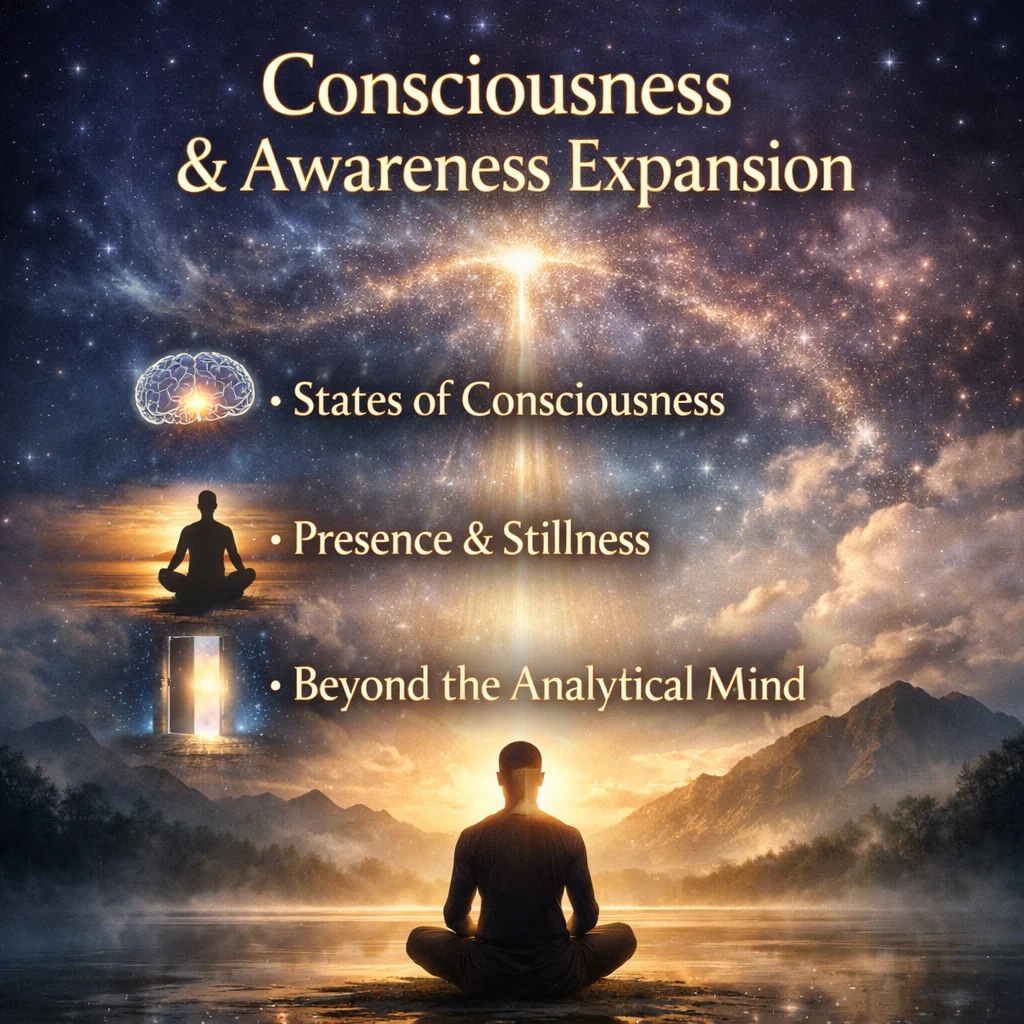
2. Consciousness & Awareness Expansion
Consciousness and awareness expansion refer to the natural broadening of perception that occurs as the mind quiets and identification with thought begins to loosen. Most people operate within a narrow band of awareness—filtered through habitual thinking, emotional reactivity, and conditioned interpretation. As regulation increases and attention stabilizes, awareness is no longer confined to constant mental activity. It begins to open, becoming more spacious, less reactive, and more attuned to subtle aspects of experience. This expansion is not something that needs to be forced or achieved—it emerges as the system becomes more coherent.
As awareness expands, there is a shift from doing to being. Experience is no longer processed solely through analysis or judgment, but through direct perception. This creates a sense of depth and presence that is not dependent on external conditions. The mind becomes a tool rather than the center of experience, and consciousness itself becomes more apparent as the field in which all thoughts, sensations, and perceptions arise. This is where clarity deepens—not through more information, but through less interference.
2. Consciousness & Awareness Expansion
States of Consciousness
States of consciousness refer to the different modes through which awareness can be experienced. These range from highly active, thought-driven states to more still, expansive, and present states. Most individuals spend the majority of their time in a thinking-dominant state, where attention is absorbed in analysis, planning, or reacting. While functional, this state can limit perception by keeping awareness tightly focused within mental activity.
As awareness develops, other states become more accessible—states characterized by calm, clarity, and reduced internal noise. These are not altered or unusual states, but natural modes of being that become available when the system is less reactive. Moving between states becomes more fluid, and there is less attachment to any single mode of experience. This flexibility allows for greater adaptability, as awareness can meet each moment without being confined to habitual patterns of thinking.
Presence & Stillness
Presence is the experience of being fully engaged with the current moment, without distraction from past or future thinking. Stillness is the quality of the mind when unnecessary movement subsides—when thoughts are no longer pulling attention in multiple directions. Together, they create a state where awareness is stable, grounded, and clear. In this state, perception becomes more direct, and experience is less filtered by interpretation or reaction.
Stillness does not require the absence of thought, but rather a shift in relationship to it. Thoughts may still arise, but they do not dominate attention. Presence is what remains when attention is not scattered. As this becomes more consistent, the nervous system stabilizes, and the sense of internal effort begins to decrease. This creates a natural ease, where awareness can rest without needing constant stimulation or engagement.
Beyond the Analytical Mind
The analytical mind is designed to solve problems, categorize information, and create structure. While essential, it is limited to processing what is already known or previously experienced. When relied upon exclusively, it can create over-analysis, indecision, or a constant need to “figure things out.” This keeps awareness confined within mental activity, preventing access to deeper forms of insight.
Moving beyond the analytical mind does not mean abandoning it—it means no longer being limited by it. As awareness expands, there is access to a more intuitive and integrative form of knowing that does not rely solely on logic or step-by-step reasoning. This often appears as clarity that arises without effort, or understanding that feels immediate rather than constructed. In this space, the mind becomes one part of a larger system of awareness, allowing perception to be more complete, balanced, and aligned.
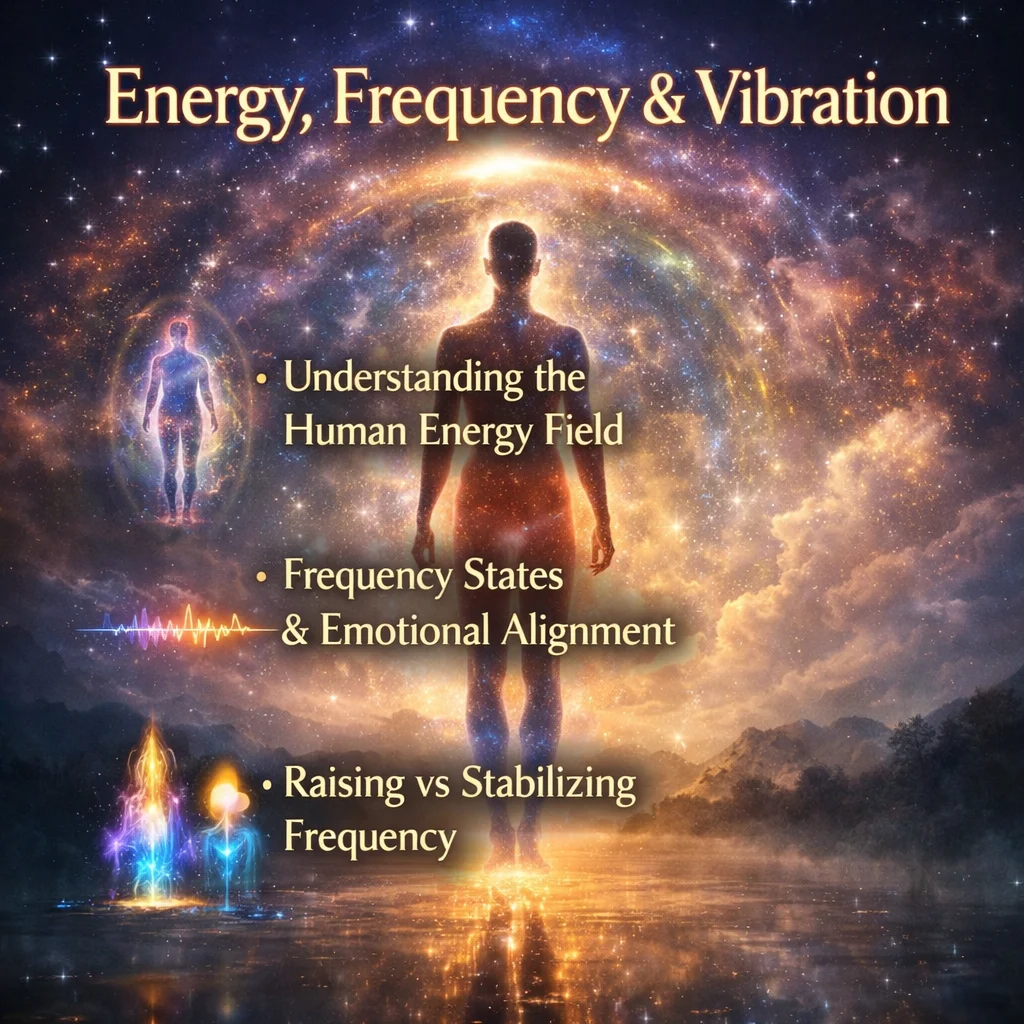
3. Energy, Frequency & Vibration
Energy, frequency, and vibration describe the underlying dynamics of how the human system functions beyond purely physical processes. Every thought, emotion, and physiological state carries a measurable energetic quality that influences how we feel, perceive, and respond. The body is not only biochemical—it is also electrical and energetic, constantly transmitting and receiving signals. These signals form patterns that can either support coherence and stability or contribute to fragmentation and stress. Understanding this framework shifts healing from something mechanical to something integrative, where physical, mental, and emotional states are recognized as interconnected expressions of the same system.
As awareness develops, it becomes possible to sense these shifts more directly. Higher-frequency states—such as calm, clarity, and openness—tend to feel expansive and stable, while lower-frequency states—such as fear, contraction, or overwhelm—feel dense and restrictive. The goal is not to judge or avoid certain states, but to understand how they function and how they move. Regulation plays a key role here: rather than constantly trying to elevate experience, the focus becomes stabilizing the system so that it can naturally shift toward coherence over time.
3. Energy, Frequency & Vibration
Understanding the Human Energy Field
The human energy field can be understood as the subtle extension of the body’s electrical and physiological activity. It reflects the overall state of the system—integrating signals from the nervous system, heart, brain, and emotional processes. While often described in abstract terms, this field is experienced practically through sensation, presence, and the way one’s state influences both internal experience and interactions with others. It is dynamic, continuously shifting based on thought patterns, emotional states, and environmental input.
As awareness of this field increases, there is a greater sensitivity to changes in energy—both within oneself and in surrounding environments. This is not about developing something new, but about noticing what is already occurring. The field becomes more coherent as the system stabilizes, meaning that signals are more organized and less chaotic. This coherence supports clarity, reduces reactivity, and enhances the ability to remain grounded even in changing conditions.
Frequency States & Emotional Alignment
Frequency states refer to the quality of energy associated with different emotional and mental conditions. Each state carries a distinct pattern—calm and presence feel steady and open, while stress and fear feel tight and contracted. Emotional alignment occurs when there is consistency between internal state, thought, and behavior. When misalignment exists—such as thinking one thing while feeling another—it creates internal friction and instability.
Bringing awareness to these states allows for greater regulation. Instead of reacting to emotions as fixed or overwhelming, they can be experienced as shifting frequencies that move through the system. Alignment is not about forcing a particular emotion, but about allowing the system to settle into states that are less fragmented and more coherent. As this happens, emotional experience becomes less volatile and more integrated, supporting a steadier baseline of well-being.
Raising vs Stabilizing Frequency
There is often an emphasis on “raising frequency,” which is commonly interpreted as moving toward more positive or elevated states. While this can be beneficial, it can also create imbalance if it bypasses underlying dysregulation. Attempting to force higher states without addressing the foundation can lead to suppression or instability, where the system fluctuates rather than stabilizes.
Stabilizing frequency, by contrast, focuses on creating consistency and coherence within the system. This involves regulation, grounding, and allowing states to settle naturally rather than pushing them upward. As stability increases, the system naturally begins to shift toward more coherent and expansive states without force. In this way, elevation becomes a byproduct of balance, not a goal in itself. This approach supports sustainable change, where the system is not only capable of reaching higher states, but of maintaining them with ease.
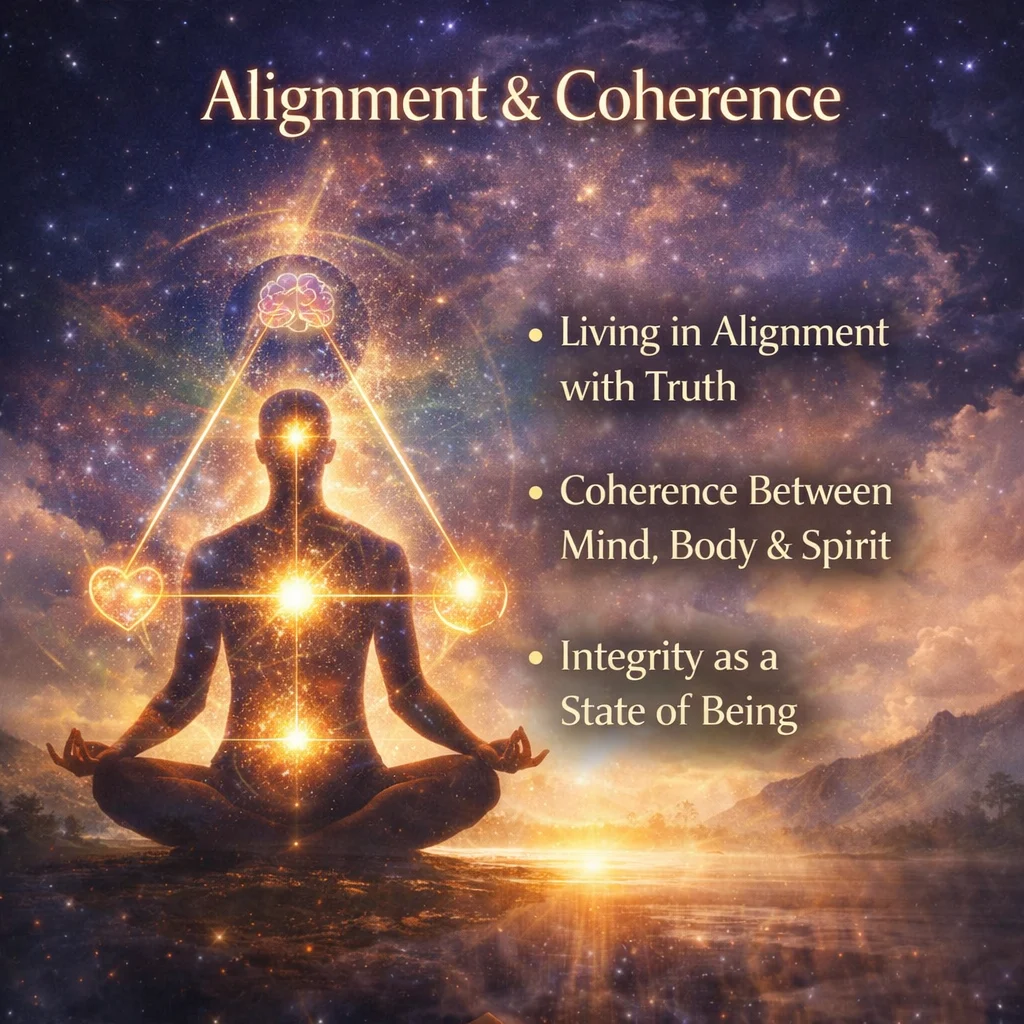
4. Alignment & Coherence
Alignment and coherence represent the state where all aspects of the system—mind, body, and spirit—are working in harmony rather than conflict. When alignment is present, thoughts, emotions, and actions reflect the same underlying truth, creating a sense of stability and ease. When misalignment exists, there is internal friction—thinking one thing, feeling another, and acting in a way that does not fully reflect either. This fragmentation is often experienced as stress, confusion, or lack of direction. Coherence, by contrast, is not something forced; it emerges naturally when distortion, conditioning, and reactivity begin to settle.
Living in coherence simplifies experience. Decision-making becomes clearer, energy is not wasted on internal contradiction, and there is a greater sense of consistency in how one shows up. This does not mean life becomes static or perfect, but that responses are grounded and intentional rather than reactive. Alignment becomes less about external validation and more about internal consistency—an ongoing process of noticing where things are out of sync and allowing them to recalibrate.
4. Alignment & Coherence
Living in Alignment with Truth
Living in alignment with truth means orienting life around what is genuinely known and experienced, rather than what is assumed, conditioned, or externally imposed. This requires discernment—the ability to distinguish between internal clarity and inherited belief. Truth in this context is not rigid or fixed; it is experiential. It is recognized through a sense of resonance, coherence, and absence of internal conflict.
As alignment with truth deepens, there is less need to force decisions or justify actions. Choices become more straightforward because they are not filtered through layers of confusion or contradiction. This often leads to simplification—letting go of what does not align and reinforcing what does. Over time, this creates a stable internal reference point, where direction arises naturally rather than being constantly sought.
Coherence Between Mind, Body & Spirit
Coherence between mind, body, and spirit occurs when these three dimensions are no longer operating independently or in conflict. The mind provides clarity and direction, the body provides real-time feedback and regulation, and the spirit provides meaning and orientation. When these are aligned, there is a sense of integration—each part supporting the others rather than competing for control.
Incoherence often shows up as disconnect: the mind overrides the body, the body reacts without awareness, or meaning feels absent despite external success. Restoring coherence involves listening to all levels simultaneously and allowing them to inform each other. As this integration develops, experience becomes more unified. There is less internal noise and more continuity, creating a stable foundation for both action and reflection.
Integrity as a State of Being
Integrity is often understood as behavior—acting in accordance with values—but at a deeper level, it is a state of being. It reflects internal alignment, where there is consistency between what is felt, understood, and expressed. When integrity is present, actions are not forced or performative; they arise naturally from a coherent internal state.
This state reduces internal conflict because there is no need to maintain separate versions of self for different situations. There is a simplicity and authenticity that comes from being aligned rather than fragmented. Over time, integrity becomes less about effort and more about embodiment. It is not something to achieve occasionally, but something that stabilizes as alignment and coherence deepen—creating a way of being that is both grounded and consistent across all areas of life.
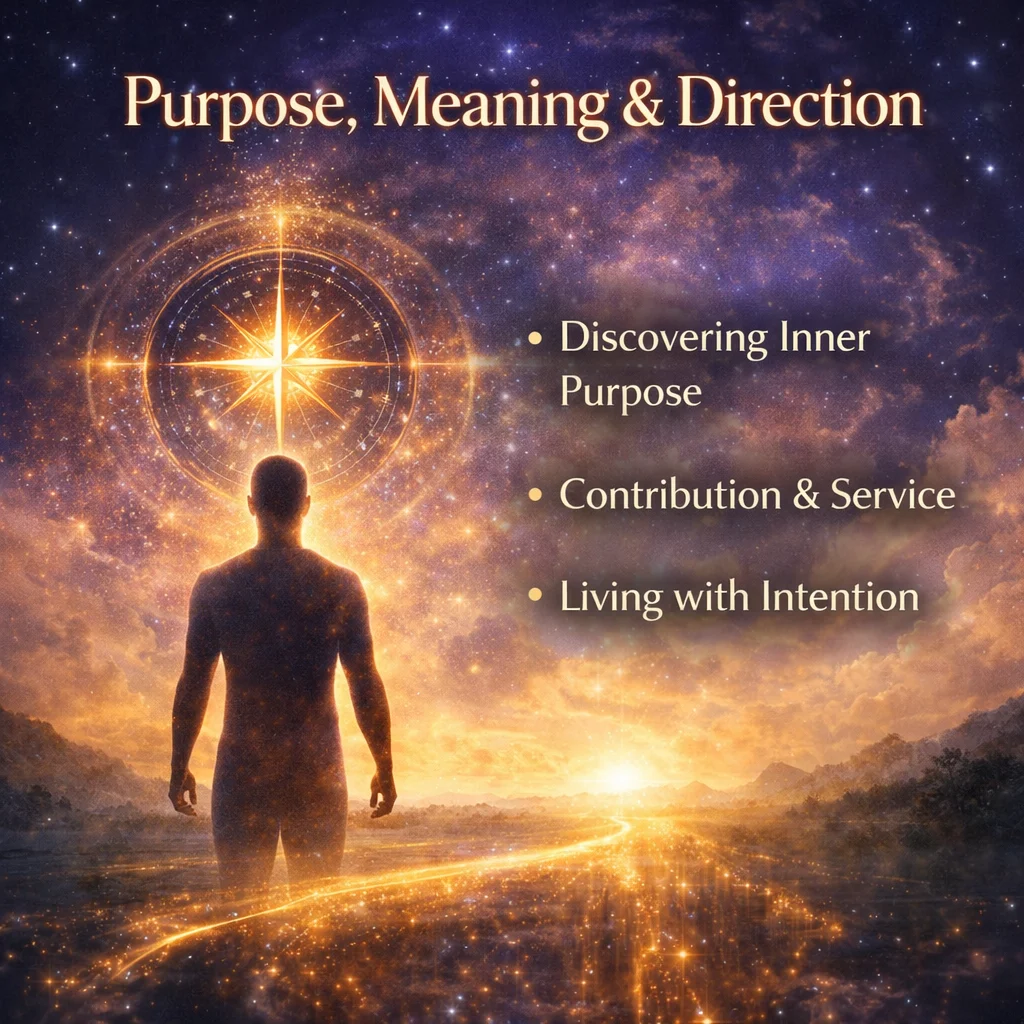
5. Purpose, Meaning & Direction
Purpose, meaning, and direction emerge naturally when the system is aligned and coherent. They are not something that can be forced or intellectually constructed—they are recognized through clarity, connection, and lived experience. When the mind is less reactive and the body is more regulated, there is space to sense what feels true and meaningful. Purpose is not necessarily a fixed role or singular mission; it is an ongoing orientation—how you engage with life, how you make decisions, and how you express what is aligned within you.
Meaning develops through participation. It is not found by searching externally, but by engaging with life in a way that reflects internal coherence. Direction then becomes clearer—not as a rigid plan, but as a natural unfolding. When purpose, meaning, and direction are aligned, there is less confusion and more consistency. Actions feel connected to something deeper, creating a sense of fulfillment that is not dependent on external outcomes but on internal alignment.
5. Purpose, Meaning & Direction
Discovering Inner Purpose
Discovering inner purpose is less about defining a specific path and more about recognizing what consistently feels aligned and true. It often begins with noticing patterns—what draws your attention, what sustains your energy, and what feels meaningful over time. These signals are subtle, but they provide direction when observed consistently. Purpose is not something you invent; it is something you uncover through awareness and engagement.
As this process deepens, external expectations begin to lose influence. Instead of asking “What should I do?” the question becomes “What feels aligned?” This shift creates a more authentic relationship with action and decision-making. Purpose becomes less about achievement and more about expression—how you naturally contribute and participate in the world from a place of clarity and coherence.
Contribution & Service
Contribution and service are natural extensions of alignment. When the system is coherent, there is an inherent movement toward sharing, supporting, or creating in ways that extend beyond the individual. This is not driven by obligation, but by a sense of connection—recognizing that personal alignment often benefits the broader environment. Contribution does not need to be large or visible; it is expressed through consistent, intentional actions that reflect clarity and integrity.
Service, in this context, is not self-sacrifice, but alignment in action. It arises when what you offer is consistent with who you are. This creates sustainability—because the act of contributing does not deplete, it reinforces coherence. Over time, this builds a sense of meaning that is grounded in participation rather than external validation. The focus shifts from “What do I get?” to “What am I expressing and contributing?”
Living with Intention
Living with intention is the practice of aligning daily actions with a deeper sense of purpose and clarity. It involves bringing awareness into decision-making—choosing how to respond, where to direct energy, and what to prioritize. Without intention, actions are often reactive, shaped by habit or external pressure. With intention, there is direction, even in small moments.
This does not require constant effort or rigid control. Intention becomes more natural as awareness stabilizes. Over time, it creates consistency between thought, feeling, and action. Life becomes less about reacting to circumstances and more about engaging with them consciously. This leads to a sense of direction that is steady and adaptable—where each step reflects alignment rather than uncertainty.
6. Integration & Embodiment
Integration and embodiment are where the entire process becomes real and sustainable. It’s not enough to understand concepts or have moments of clarity—what matters is how consistently those insights are lived. Integration is the process of taking awareness, regulation, and alignment and applying them within everyday situations. Embodiment is when those practices are no longer something you “do,” but something you naturally are. This is where change stabilizes, because it is no longer dependent on effort or ideal conditions.
True integration happens in ordinary moments—how you respond to stress, how you make decisions, how you relate to others, and how you navigate challenges. It is less about peak experiences and more about consistency. As awareness is brought into daily life repeatedly, patterns begin to shift at a foundational level. Over time, this creates a new baseline where clarity, regulation, and alignment are no longer temporary states, but ongoing traits of how you operate.
6. Integration & Embodiment
Bringing Awareness into Daily Life
Bringing awareness into daily life means applying presence beyond structured practices and into real-world situations. It is easy to feel clear in moments of stillness, but the deeper work is maintaining that awareness during interaction, stress, and unpredictability. This involves noticing thoughts, emotions, and reactions as they arise in real time, rather than only reflecting on them afterward.
As this becomes more consistent, awareness begins to guide behavior naturally. Small moments—pausing before reacting, noticing tension in the body, redirecting attention—create meaningful shifts. Over time, these moments accumulate, allowing awareness to remain active throughout the day. Life itself becomes the practice, rather than something separate from it.
Consistency Over Intensity
Many people approach growth through intensity—seeking breakthrough moments, deep experiences, or rapid change. While these can be impactful, they are often temporary if not supported by consistency. Lasting transformation comes from repeated, steady application rather than occasional intensity. Small, consistent actions create stability within the system, allowing change to integrate gradually.
Consistency builds trust—both within the mind and the body. The nervous system responds to repetition, not force. When practices are applied regularly, even in simple ways, they begin to shape a new baseline. This reduces the need for constant effort, as the system starts to operate differently on its own. Over time, consistency becomes more valuable than intensity, because it creates sustainable change.
Becoming the Work
Becoming the work is the point where the separation between practice and identity dissolves. Instead of “doing” awareness, regulation, or alignment, these qualities become integrated into how you naturally think, feel, and act. There is less effort involved because the system is no longer working against itself. What once required intention becomes intuitive.
This is not a final state, but an ongoing process of refinement. Growth continues, but from a different place—one of stability rather than struggle. There is a sense of coherence where actions reflect understanding without needing constant reinforcement. At this stage, the work is no longer something external to pursue—it is embodied, expressed through daily life, and continuously evolving through lived experience.
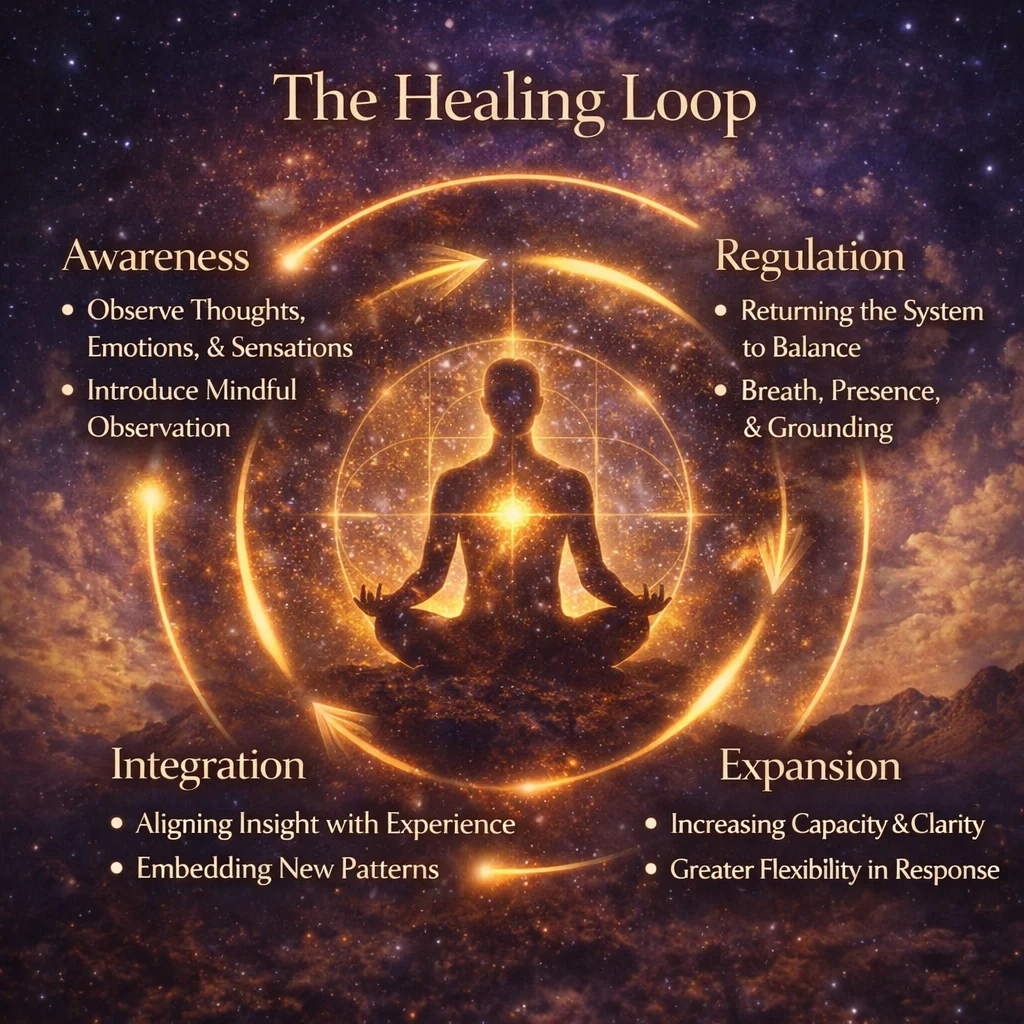
SECTION IV — INTEGRATION (BRIDGE SECTION)
Where It All Comes Together
This is where your framework becomes practical and lived.
This section represents the transition from understanding to lived experience—where the concepts of mind, body, and spirit are no longer explored separately, but function as a unified system. It is the bridge between insight and application. Up to this point, each layer has been developed individually: awareness in the mind, regulation in the body, and meaning in the spirit. Here, those elements begin to operate together in real time. The focus shifts from learning and practicing to living and embodying.
Integration is where healing becomes practical. It shows up in how you respond to stress, how you navigate relationships, how you make decisions, and how consistently you return to alignment. This is not about perfection, but about continuity—developing the ability to recognize when you are out of alignment and gently return. Over time, this creates a stable internal system that can adapt, recalibrate, and grow without losing coherence. The work becomes self-sustaining, because each part supports the others.
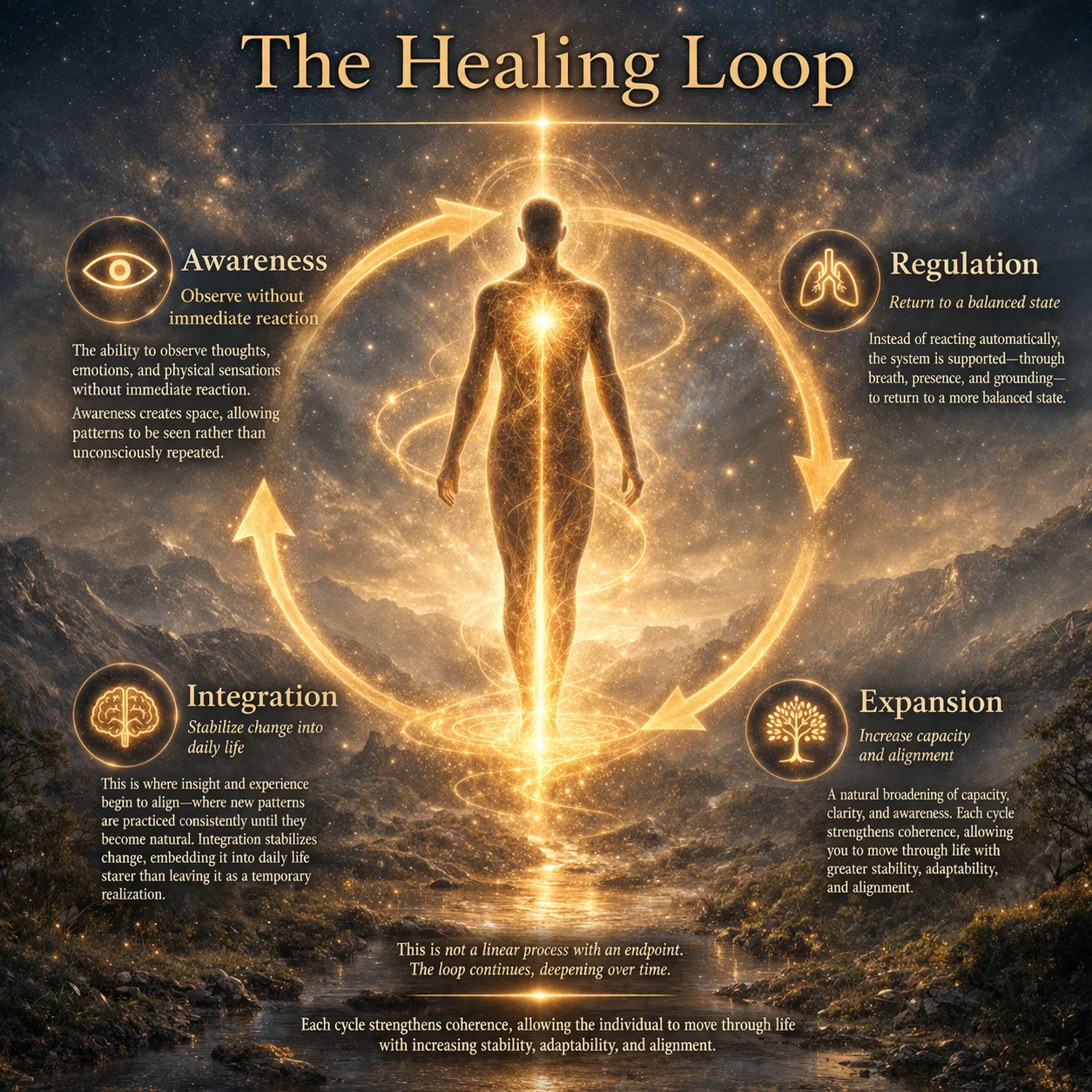
1. The Healing Loop
- Awareness → Regulation → Integration → Expansion
The Healing Loop is a continuous, self-reinforcing cycle that describes how lasting transformation occurs. It begins with awareness—the ability to observe thoughts, emotions, and physical sensations without immediate reaction. Awareness creates space, allowing patterns to be seen rather than unconsciously repeated. From this space, the next step becomes possible: regulation. Instead of reacting automatically, the system is supported—through breath, presence, and grounding—to return to a more balanced state.
Once regulation is established, integration can occur. This is where insight and experience begin to align—where new patterns are practiced consistently until they become natural. Integration stabilizes change, embedding it into daily life rather than leaving it as a temporary realization. From this foundation, the system moves into expansion—a natural broadening of capacity, clarity, and awareness. Importantly, this is not a linear process with an endpoint. The loop continues, deepening over time. Each cycle strengthens coherence, allowing the individual to move through life with increasing stability, adaptability, and alignment.
1. The Healing Loop
Awareness
Awareness is the entry point of the healing process. It is the ability to observe thoughts, emotions, and physical sensations without immediately reacting to them. Most patterns operate automatically—triggered and repeated without being seen. Awareness interrupts this cycle by introducing space. In that space, what was previously unconscious becomes visible. This alone begins to shift experience, because patterns lose some of their power once they are recognized.
As awareness deepens, observation becomes more consistent and less effortful. Instead of only noticing after a reaction has occurred, you begin to recognize patterns in real time. This creates choice. Awareness does not require control or judgment—it simply reveals what is happening. Over time, this clarity becomes the foundation for all change, because you cannot shift what you cannot see.
Regulation
Regulation is the process of bringing the nervous system back into balance after activation. Once awareness reveals a pattern or response, regulation allows the system to settle rather than escalate. This may involve breath, grounding, or simply allowing sensations to move without resistance. Regulation is not about suppressing experience, but about supporting the body so it can return to a stable state.
As regulation becomes more familiar, the system recovers more quickly from stress. Reactions become less intense, and the baseline of the body shifts toward steadiness. This creates a sense of safety within the system, which is essential for deeper healing. Without regulation, awareness alone can feel overwhelming. With it, the body learns that it can experience activation without becoming stuck in it.
Integration
Integration is where awareness and regulation begin to translate into lasting change. It is the process of applying what has been observed and stabilized into daily life. Instead of repeating old patterns, new responses are practiced consistently until they become natural. Integration is not a single event—it is a gradual embedding of new ways of thinking, feeling, and responding.
Over time, integration reduces the gap between insight and action. What once required conscious effort becomes more automatic. The system begins to reorganize itself around coherence rather than reactivity. This is where transformation becomes stable, because it is no longer dependent on temporary awareness, but is reflected in consistent behavior and experience.
Expansion
Expansion is the natural result of sustained awareness, regulation, and integration. As the system becomes more coherent, capacity increases—there is more space for experience without overwhelm, more clarity in perception, and greater flexibility in response. Expansion is not something forced; it emerges as limitations created by unconscious patterns begin to dissolve.
With expansion comes a broader sense of perspective and possibility. Situations that once felt restrictive are approached with more openness and less reactivity. Awareness becomes more stable, and the system is able to hold greater complexity without losing balance. This creates an ongoing cycle of growth, where each stage of the loop reinforces the next, allowing for continuous development and deeper alignment over time.

2. Daily Coherence Practices
Mind • Body • Spirit Alignment Routines
Morning & Evening Protocols
Daily coherence practices are the bridge between understanding and embodiment. While insight can create moments of clarity, it is consistency that stabilizes change. Coherence is not something achieved once—it is something maintained through repeated alignment of mind, body, and spirit. These practices create structure within the day, allowing awareness, regulation, and intention to become integrated into how you live, rather than something you only access occasionally.
At its core, daily coherence is about rhythm. The nervous system, the mind, and the body respond to patterns. When supportive routines are repeated—especially at the beginning and end of the day—they begin to establish a baseline of stability. This reduces reactivity, increases clarity, and strengthens the connection between internal state and external action. Over time, these small, consistent practices compound into a more coherent and resilient system.
2. DAILY COHERENCE PRACTICES
Mind • Body • Spirit Alignment Routines
Alignment routines bring all three dimensions into relationship with each other. The mind is oriented through awareness and intention, the body is supported through regulation and sensation, and the spirit is engaged through meaning and presence. When these are practiced together, they reinforce coherence across the entire system. Without this integration, development can become imbalanced—clear thinking without regulation, or physical grounding without direction.
A simple alignment routine might include a moment of stillness (mind), conscious breathing or movement (body), and a clear intention or reflection (spirit). The power is not in complexity, but in consistency. Over time, these routines begin to synchronize internal systems, creating a stable foundation that carries into the rest of the day. Alignment becomes less of an effort and more of a natural state the system returns to.
Morning & Evening Protocols
Morning and evening protocols serve as anchors for the nervous system and the mind. The morning sets the tone for direction—how attention will be used, what intention is held, and how the system will engage with the day. Without this, attention is often pulled immediately into external demands, creating reactivity before clarity is established. A grounded start allows for a more intentional trajectory, where focus and awareness are directed rather than scattered.
The evening, by contrast, is a time of integration and reset. It allows the system to process the day, release accumulated tension, and return to a regulated state before rest. Without this transition, stress can carry forward, reinforcing cycles of dysregulation. Simple practices such as reflection, breathwork, or stillness help the system settle and integrate experience. Over time, these bookends create a daily cycle of coherence—where each day begins with intention and ends with integration, reinforcing stability, clarity, and alignment.
3. Navigating Disruption & Setbacks
Disruption and setbacks are not interruptions to the healing process—they are part of it. As deeper layers of conditioning, stored emotion, and unresolved patterns surface, there will be periods where clarity feels lost or stability seems to regress. This is not failure; it is exposure. What was previously hidden is becoming visible, giving you the opportunity to meet it with awareness rather than avoidance. Progress in this work is not linear—it moves in cycles, often revisiting similar themes at deeper levels.
Learning to navigate these moments is what stabilizes long-term coherence. Instead of interpreting disruption as something going wrong, it can be recognized as part of integration. The key is not to eliminate discomfort, but to remain present within it without losing orientation. Over time, this builds resilience—the ability to experience intensity without becoming overwhelmed, and to return to alignment more quickly after being pulled out of it.
3. Navigating Disruption & Setbacks
Regression Cycles
Regression cycles occur when old patterns, thoughts, or emotional responses resurface after periods of clarity or progress. This can feel discouraging, as if the work has been undone. In reality, these cycles often indicate that the system is revisiting patterns at a deeper level, where they can be more fully processed and integrated. What appears as regression is often refinement.
As awareness develops, these cycles become easier to recognize and navigate. Instead of being pulled fully back into old patterns, there is a part of you that remains aware of what is happening. This creates space to respond differently. Over time, the duration and intensity of these cycles tend to decrease, and the return to coherence becomes faster and more stable.
Emotional Waves & Triggers
Emotional waves are natural fluctuations in the body’s energetic and nervous system states. They often arise in response to triggers—external events or internal thoughts that activate stored patterns. These responses can feel immediate and intense, but they are not random. They are the body and mind reacting based on past experiences that have not been fully processed.
Working with emotional waves involves allowing them to move without immediate suppression or reaction. Instead of trying to control or avoid them, the focus shifts to observation and regulation. Triggers become signals rather than problems—indicators of where attention and care are needed. Over time, this changes the relationship to emotion from something overwhelming to something informative and manageable.
Staying Centered During Chaos
Staying centered during chaos is the ability to maintain a degree of internal stability even when external conditions are uncertain or intense. This does not mean being unaffected, but rather not being completely destabilized. Centering comes from the practices developed earlier—awareness, regulation, and alignment—which create an internal reference point that remains steady even as circumstances shift.
This capacity is built through repetition. Each time you return to presence in the middle of difficulty, the system learns that stability is possible even under pressure. Over time, this becomes more natural, and reactivity decreases. The external environment may remain unpredictable, but the internal response becomes more grounded, allowing for clearer perception, more intentional action, and a sustained sense of coherence.

4. Building a Coherent Life
Building a coherent life is where internal alignment begins to shape external reality. It’s not enough to cultivate awareness, regulation, and clarity internally—your environment, relationships, and daily structures must support and reflect that coherence. Without this alignment, even strong internal work can be disrupted by chaotic surroundings, conflicting inputs, or draining interactions. A coherent life is intentionally designed to reduce friction, reinforce stability, and support continued growth.
This process is not about control or perfection—it’s about conscious selection. What you surround yourself with, who you engage with, and what you expose your mind and body to all influence your internal state. When these external elements are aligned with your values and direction, they begin to reinforce coherence rather than challenge it. Over time, your life becomes an extension of your inner work—a system that supports clarity, stability, and intentional living.
4. Building a Coherent Life
Environment & Relationships
Your environment and relationships play a significant role in shaping your nervous system and mental state. Physical spaces can either promote calm and clarity or contribute to stress and distraction. Similarly, relationships can either support growth and alignment or reinforce old patterns and reactivity. Much of this influence operates subtly, but consistently, affecting how you think, feel, and respond over time.
Creating coherence in this area involves becoming more intentional about what you allow into your space and who you engage with regularly. This doesn’t necessarily mean removing everything that is challenging, but it does mean recognizing what is supportive versus what is draining. As awareness increases, there is a natural shift toward environments and relationships that reflect stability, respect, and alignment.
Information Diet & Boundaries
The information you consume directly affects your mental and emotional state. In a constant stream of media, news, and digital input, the mind can easily become overloaded, reactive, or fragmented. An unfiltered information diet introduces noise—competing narratives, emotional triggers, and unnecessary stimulation—that disrupt coherence and clarity.
Establishing boundaries around information is essential. This includes being selective about sources, limiting exposure to high-stimulation content, and creating space for mental stillness. Boundaries are not restrictive—they are protective. They preserve attention and energy, allowing you to remain centered rather than pulled into constant reactivity. Over time, a refined information diet supports clearer thinking, better discernment, and a more stable internal state.
Creating Supportive Structures
Supportive structures are the systems and routines that help maintain coherence over time. These include daily practices, schedules, physical organization, and habits that reinforce alignment. Without structure, even clear intention can become inconsistent, as the mind and body revert to familiar patterns under stress or distraction.
Well-designed structures reduce decision fatigue and create stability. They provide a framework that supports consistency without requiring constant effort. This might include set times for reflection, movement, or rest, as well as organized spaces that reduce overwhelm. Over time, these structures become automatic supports, allowing you to maintain coherence even during periods of stress or change. The goal is not rigidity, but reliability—a system that holds you steady as you continue to grow and evolve
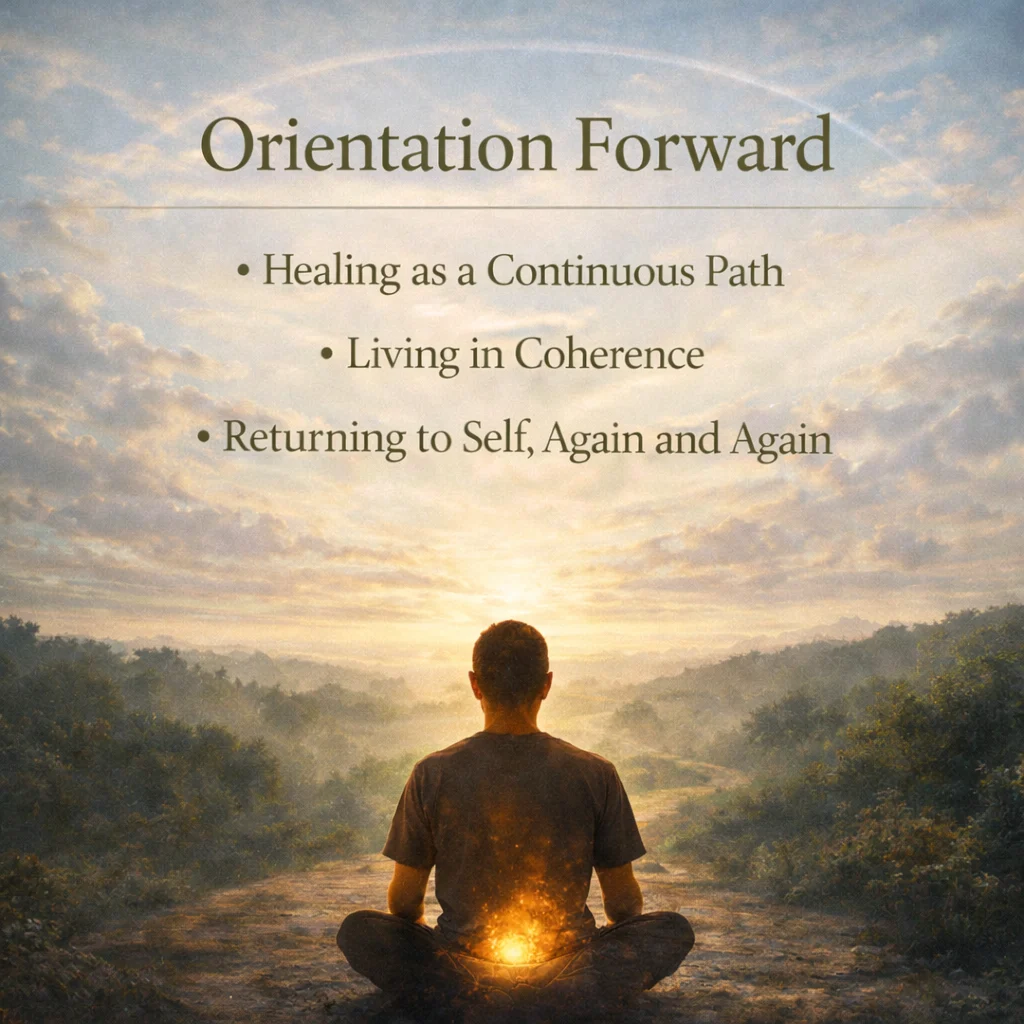
Closing Section — Orientation Forward
This closing section is not an endpoint—it is a reorientation. Healing is not something completed once and then left behind; it is an ongoing relationship with awareness, regulation, and alignment. What has been built throughout this framework is not a rigid system, but a living process—one that adapts, deepens, and refines over time. Orientation forward means carrying this understanding into daily life, not as effort, but as a steady return point.
As complexity increases—externally and internally—the value of coherence becomes more apparent. The ability to remain grounded, to observe without immediate reaction, and to realign without resistance becomes a stabilizing force. This is where the work becomes sustainable. You are no longer chasing clarity—you are returning to it. The path becomes less about searching and more about remembering, less about achieving and more about maintaining connection.
Closing Section — Orientation Forward
Healing as a Continuous Path
Healing is not linear, nor does it follow a fixed timeline. It unfolds in cycles—periods of clarity followed by moments of contraction, integration, and expansion. Each phase serves a purpose, revealing different layers of pattern, conditioning, and stored experience. What once felt resolved may reappear, not as regression, but as an opportunity to engage it with greater awareness and capacity.
Understanding healing as continuous removes the pressure to “arrive.” Instead of striving for a final state, the focus shifts to staying present within the process. This creates a more sustainable approach, where growth is measured not by perfection, but by the ability to remain aware and responsive through change. Over time, this perspective transforms healing from a task into a way of being.
Living in Coherence
Living in coherence means aligning thought, emotion, and action so they are not in conflict with each other. It is experienced as internal consistency—a sense that what you think, feel, and do are moving in the same direction. This does not eliminate challenge, but it reduces internal friction, allowing energy to be used more efficiently and intentionally.
Coherence is maintained through practice, not force. It is supported by the daily application of awareness, regulation, and intentional alignment. As this becomes more stable, decision-making becomes clearer, relationships become more authentic, and external actions reflect internal truth. Life begins to feel less reactive and more directed, not because control has increased, but because alignment has deepened.
Returning to Self, Again and Again
The essence of this work is return. No matter how far attention drifts, how intense experience becomes, or how strong old patterns appear, there is always the ability to come back—to awareness, to the body, to presence. This return is not failure; it is the practice itself. Each time you notice and realign, the pathway strengthens.
Over time, this returning becomes more immediate and less effortful. The gap between disconnection and reconnection shortens. What once required conscious effort becomes a natural reflex. This is where stability emerges—not from never losing alignment, but from consistently finding your way back. In this rhythm of departure and return, coherence is not something you hold onto, but something you continually rediscover.

Closing Summary — Returning to Coherence
This framework is not a set of ideas to understand—it is a system to live. Across mind, body, and spirit, the central movement has been the same: from fragmentation to coherence, from reactivity to awareness, from disconnection to alignment. Each section has revealed a different layer of the process, but all point to a single principle—healing occurs when the system is brought back into relationship with itself. Not through force, but through observation, regulation, and consistent integration.
What becomes clear over time is that nothing within you is working against you. Thought patterns, emotional responses, and physical sensations are not problems to eliminate, but signals to understand. As awareness deepens and regulation stabilizes, these signals begin to organize rather than overwhelm. The mind becomes clearer, the body more responsive, and the connection to self more accessible. This is where coherence emerges—not as a concept, but as a lived experience.
Ultimately, the path is one of return. Not to a past version of yourself, but to a more present and integrated state of being. There will be cycles, disruptions, and moments of disconnection—but each offers another opportunity to come back. And in that return, again and again, the system strengthens. What begins as practice becomes natural, and what once required effort becomes your baseline. This is the path forward: not chasing healing, but living in alignment with it.