



Help Us Bypass Censorship. Share This.
Sign up to receive Our Weekly Briefing Newsletter
Begin your journey with weekly insights designed to expand awareness and ground you in truth. Our free tier gives you a powerful introduction without any commitment.
Introduction to the Anunnaki and Flood Myths
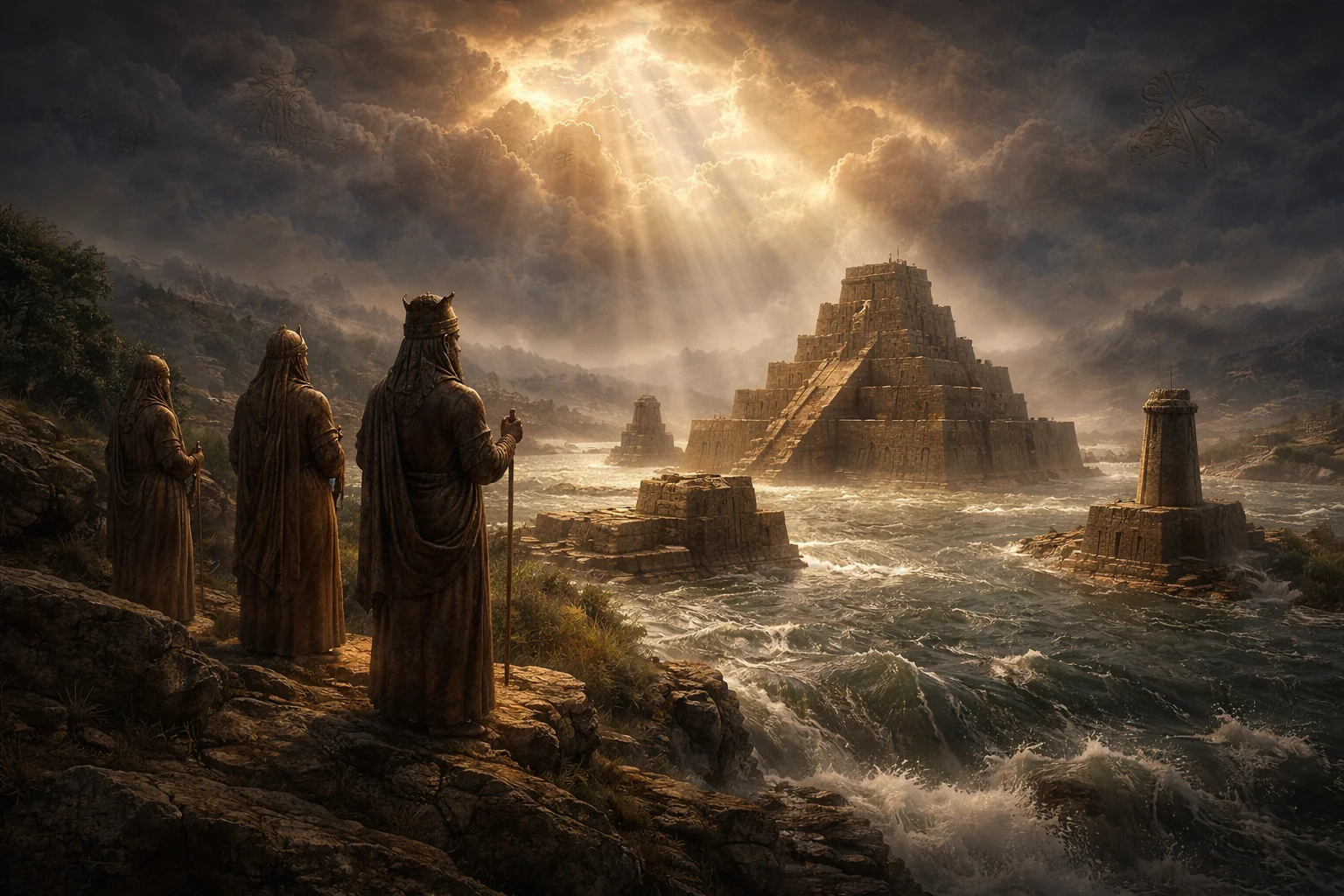
The Anunnaki are a group of deities originating from ancient Mesopotamian mythology, particularly from Sumerian, Akkadian, Assyrian, and Babylonian cultures. They are often depicted as powerful gods who played a central role in the creation stories and governance of the earth and humanity according to these ancient traditions. The narratives surrounding the Anunnaki involve divine interventions, creation myths, and accounts of world-shaping events that ancient cultures used to explain humanity’s origins, moral order, and relationship to cosmic forces.
Flood myths hold significant importance across cultures worldwide, serving as symbolic narratives that explore destruction, renewal, and moral reckoning. These stories often describe great floods sent by divine or cosmic forces to reset the world, cleanse corruption, or restore balance. One of the most well-known examples appears in the Epic of Gilgamesh, which shares striking parallels with later flood accounts such as the biblical story of Noah. Rather than functioning solely as historical records, these narratives reveal how ancient societies processed catastrophe, continuity, and survival through myth.
For a deep dive into the Anunnaki and related ancient mythologies, rise in alternative interpretations, and their connection to historical events, visit Great Awakening Report on the Anunnaki and Ancient Texts. This resource provides a comprehensive introduction and explores the broader cultural impact of flood myths as preserved through ancient Mesopotamian stories.
Origins and Evolution of Anunnaki Mythology
The origins and evolution of Anunnaki mythology trace back to ancient Mesopotamian civilizations, particularly the Sumerians, Akkadians, Babylonians, and Assyrians. The Anunnaki were described as a group of deities in these cultures’ mythological texts, often considered to be the offspring of the sky god Anu. These deities were believed to have played a crucial role in the creation and governance of the world and human affairs.
Historical records, including cuneiform tablets and artifacts, depict the Anunnaki as symbolic embodiments of authority, natural order, and divine law within Mesopotamian cosmology. Over millennia, the narrative of the Anunnaki evolved, merging cosmological concepts with societal values and reflecting the changing dynamics of ancient Near Eastern civilizations.
The role of the Anunnaki in mythology expanded beyond their divine status, with some interpretations associating them with themes of creation, judgment, and the imparting of knowledge to humankind. This evolution showcases the complex layering of mythologies where ancient texts provide insights into the religious and cultural framework of early societies and their understanding of the cosmos.
For a detailed exploration of ancient mythologies and their impact on modern interpretations, consider reading further on related topics in our series of analysis of ancient civilizations and mythological influences at Great Awakening Report.
Global Flood Myths: A Comparative Overview
Across diverse cultures, global flood myths share remarkable similarities, revealing a widespread narrative motif of a catastrophic deluge that reshapes the world and humanity’s fate. Prominent examples include the Mesopotamian Epic of Gilgamesh, the Biblical story of Noah’s Ark, Hindu texts recounting Manu’s survival of a great flood, and the flood myths among indigenous peoples such as the Native American and Australian Aboriginal traditions.
Common elements in these myths are the divine or supernatural cause of the flood, the destruction or near-destruction of the existing world or civilization, and the survival of a chosen individual or family who preserves life, often by building a vessel or seeking refuge on elevated terrain. These stories frequently serve as moral or spiritual lessons about human frailty, divine judgment, renewal, and the importance of obedience or righteousness.
Despite these thematic overlaps, cultural variations exist, reflecting unique religious, social, and environmental contexts. For example, while the Biblical narrative emphasizes covenant and obedience to God, Hindu accounts often frame the flood within cyclical time and cosmic order. In some indigenous myths, floods may also symbolize transformation and connection with ancestral spirits rather than punishment.
The recurrence of flood myths across distant cultures suggests either deep archetypal resonance within the human psyche or the preservation of shared memories of ancient environmental catastrophes—or a complex interplay of both. These narratives reflect humanity’s enduring effort to understand forces beyond individual control, encoding disaster and survival into stories that could be transmitted across generations. Whether rooted in experience, symbolism, or both, flood myths reveal a universal attempt to give meaning to upheaval and renewal.
For a deeper exploration into ancient global narratives and spiritual awakenings connected to such myths, you may find the insights shared in our Great Awakening Report Series especially enlightening.
Symbolism Behind Flood Stories
Flood myths often symbolize profound universal themes such as rebirth and purification, which resonate deeply across diverse cultures. These stories typically depict a cataclysmic flood that wipes away the corrupted world, allowing for a fresh start or a renewed creation. The flood serves as a metaphor for cleansing—washing away sin, chaos, or moral decay—and thus enabling spiritual or societal renewal.
For example, in many traditions, the flood represents a divine act to purge the earth from human wickedness, symbolizing purification on a global scale. Following the devastation, survivors or deities often renew life, which underscores the theme of rebirth. This cyclical concept reflects human hopes for restoration after disaster and the possibility of new beginnings.
Across cultures, from the Mesopotamian Epic of Gilgamesh to the biblical story of Noah’s Ark, and similar narratives in Hindu and Indigenous mythologies, these themes exhibit a shared symbolic language. The flood embodies both destruction and creation, serving as a powerful allegory for transformation and the human condition’s resilience.
Understanding these symbolic themes provides insight into humanity’s collective psyche and spiritual aspirations, illustrating how ancient myths continue to influence contemporary perspectives on life’s challenges and renewal.
For further exploration on universal spiritual themes and awakening, consider reading related articles such as The Spiritual Tools of a Truth Seeker and The Awakening Journey.
Linking the Anunnaki to Flood Myths: Evidence and Hypotheses
The connection between the Anunnaki and various flood myths has been a subject of intrigue among researchers exploring ancient texts and mythologies. Several theories propose that the Anunnaki, a group of deities from ancient Mesopotamian cultures, are linked to the narratives of great floods found in multiple civilizations. These flood legends, such as the story of Noah’s Ark in the Bible or the Epic of Gilgamesh, share remarkable similarities in describing a catastrophic deluge that reshaped humanity.
One hypothesis suggests that narratives involving the Anunnaki may reflect cultural memory of catastrophic flooding events interpreted through mythological language. In this view, the gods’ actions symbolize humanity’s attempt to explain overwhelming natural forces rather than literal intervention by advanced beings. Such interpretations emphasize storytelling as a means of preserving memory and meaning rather than providing direct historical accounts. The fact that Mesopotamian flood myths predate later Biblical versions supports the possibility that these stories encode early experiences of environmental upheaval rather than record literal divine or external intervention.
Archaeological findings and translations of Sumerian tablets describe divine councils, judgments, and resets of order, which later interpretations sometimes frame as evidence of external intervention. However, within their original cultural context, these accounts functioned as symbolic explanations for social collapse, environmental disruption, and moral renewal. While modern theories occasionally reinterpret these narratives through technological or extraterrestrial lenses, such readings extend beyond what the texts explicitly support.
While definitive evidence linking the Anunnaki to flood myths remains elusive, the consistency of flood narratives across civilizations underscores a possible shared origin tied to human experiences with natural disasters and mythic storytelling involving these enigmatic figures.
For more detailed exploration on the Anunnaki and ancient myths, see our article Who Are the Anunnaki? Exploring Ancient Texts and Modern Interpretations.
Shared Memory or Shared Symbolism?
The similarities observed in flood myths across different cultures have sparked a longstanding debate: do they arise from a shared collective memory of historical events, or from common symbolic storytelling practices? Proponents of the shared memory hypothesis argue that recurring flood narratives may reflect ancestral recollections of real cataclysmic floods experienced by early human societies. These could represent collective historical memories passed down through generations, encoded in myth to preserve significant events.
On the other hand, the shared symbolism perspective suggests that floods serve as universal metaphors for renewal, destruction, and rebirth—a common symbolic vocabulary used by disparate cultures to explain existential themes. Flood myths may thus arise independently as archetypal stories constructed to convey moral, spiritual, or cosmological lessons without needing to reference actual shared events.
Modern scholarship increasingly views flood myths as layered narratives shaped by both lived experience and symbolic meaning. Environmental disruptions may have seeded early stories, while mythic structures transformed those memories into enduring frameworks for understanding loss, survival, and renewal. This blending of memory and symbolism helps explain why flood myths persist across cultures and eras, adapting to the needs of each society while retaining their core resonance. Rather than pointing to a single shared event, the widespread recurrence of flood motifs reflects humanity’s deep-rooted storytelling conventions for processing catastrophe, continuity, and transformation.
For more on interpreting symbolic narratives and uncovering historical layers in ancient stories, see related discussions on mythological symbolism and collective consciousness in The Awakening Journey.
Cultural Impact and Modern Interpretations
Ancient flood myths and the concept of the Anunnaki have profoundly influenced modern culture, literature, and popular media by providing a rich source of symbolism and narrative that resonates with contemporary spiritual and speculative interests. These myths often serve as allegories for catastrophic events, divine intervention, and human origins, themes that continue to captivate audiences and inspire creative reinterpretations.
In contemporary literature and media, the Anunnaki are often reimagined as ancient extraterrestrial beings—a reinterpretation shaped by modern fascination with space, technology, and cosmic intelligence. This shift reflects an evolution in symbolic language, where divine authority is translated into technological power and celestial origin. Such narratives reveal far more about modern cultural imagination than about the intentions or worldview of the original mythmakers.
The enduring appeal of these myths lies in their ability to connect ancient wisdom with contemporary questions about humanity’s place in the cosmos and the nature of reality. They foster a cultural dialogue that bridges history, mythology, and speculative futures, often encouraging a reevaluation of historical narratives and inspiring spiritual exploration.
For a deeper understanding of these themes within the context of global awakening and spiritual transformation, see the detailed analysis on spiritual awakening and ancient influences on contemporary consciousness at Great Awakening Report.
Conclusion: Understanding the Legacy of Ancient Flood Stories
Ancient flood stories endure because they speak to universal human experiences of loss, survival, and renewal. Whether interpreted as symbolic teachings, cultural memory, or layered myth, these narratives preserve humanity’s response to forces beyond its control. The Anunnaki and the flood myths associated with them remind us that myth is not a primitive attempt at science, but a sophisticated language of meaning—one that continues to evolve as humanity seeks to understand its past, its place in nature, and its responsibility for the future.
Their continued study sheds light on ancient civilizations while inspiring contemporary discussions about ecological awareness and human responsibility. For insights on related ancient themes and transformative human experiences, explore further articles such as The Awakening Journey and Special Report: Awakening the Sleeping Giant.
Sign up to receive Our Weekly Briefing Newsletter
Begin your journey with weekly insights designed to expand awareness and ground you in truth. Our free tier gives you a powerful introduction without any commitment.
STOP DROWNING IN THE NOISE. START SEEING THE TRUTH. Join over 99,000 truth seekers. Get the essential intelligence, alternative news, and disclosure updates that the mainstream media won’t touch.
Latest Reports
 Monthly ReportConscious Practices · October 2026 EditionOctober 5, 2026
 Weekly ReportAwakening The Sleeping Giant · October 5th EditionOctober 5, 2026
 Weekly ReportAwakening The Sleeping Giant · September 28th EditionSeptember 28, 2026
 Weekly ReportAwakening The Sleeping Giant · September 21st EditionSeptember 21, 2026View all weekly reports
Special Reports
 Special ReportTHE AWAKENING JOURNEY: Hero’s Journey Part II · Week 1October 3, 2026
 Special ReportGlobal Everything Collapse · Economic Chaos · Part IOctober 1, 2026
 Special ReportCreating A Conscious Culture · Part ISeptember 3, 2026
 Special ReportThe Great Healing: Detox, Defense & Sovereignty In an Engineered World · Part ISeptember 1, 2026View all special reports
Help Us Bypass Censorship. Share This.
Join the Discussion
Related Posts

Have questions?
At Great Awakening Report, we are dedicated to supporting your journey toward truth and enlightenment through our specialized Coaching and Consulting services.
Coaching Services: Our coaching programs are designed to guide you through personal awakening and transformation. We offer personalized sessions that focus on expanding consciousness, uncovering hidden truths, and fostering spiritual growth. Our experienced coaches provide the tools and insights necessary to navigate your path with clarity and confidence.
Consulting Services: For organizations and individuals seeking deeper understanding and strategic guidance, our consulting services offer expert analysis and solutions. We delve into areas such as global transitions, alternative news insights, and consciousness studies to provide comprehensive strategies tailored to your unique objectives.
Embark on a transformative journey with our Coaching and Consulting services, and unlock your highest potential. To learn more and schedule a session, visit our Coaching and Consulting pages.
Thank you
Thank you to our subscribers and readers for your continued support and dedication to truth and awakening. Your encouragement, engagement, and belief in our mission make everything we do possible. Together, we are expanding awareness and helping illuminate the path forward.
If you would like to further support the Great Awakening team and our ongoing efforts to share insight, knowledge, and truth, you can DONATE HERE.
With deep gratitude,
– Great Awakening Team
About the Author: Great Awakening Team

We are a community. We are cultural creatives and like minded people seeking the truth and focusing on disclosure, awakening and consciousness. Our focus is real news as researchers, reporters and truth seekers. We are here to teach, to spread the word, to serve and to help. We are a collective, a movement, free from all programing, not closed minded and not discriminatory. We are not political. We are not religious but we are spiritual. We study, research, and report on a wide range of subjects and topics, from the current geopolitical climate to health and wellness, from earth’s history to spiritual practices. We are forward thinkers and visionaries, we are guides for the transition as we usher in The Great Awakening.
THIS WEBSITE DOES NOT PROVIDE MEDICAL ADVICE: The information, including but not limited to text, graphics, images, and other material contained on this website, are for informational purposes only. No material on this site is intended to be a substitute for professional medical advice, diagnosis, or treatment. Always seek the advice of your physician or other qualified health care provider with any questions you may have regarding a medical condition or treatment and before undertaking a new health care regimen, and never disregard professional medical advice or delay in seeking it because of something you have read on this website.
DISCLAIMER: All statements, claims, views and opinions that appear anywhere on this site, whether stated as theories or absolute facts, are always presented by The Great Awakening Report (GAR) as unverified—and should be personally fact checked and discerned by you, the reader.Any opinions or statements herein presented are not necessarily promoted, endorsed, or agreed to by GAR, those who work with GAR, or those who read or subscribe to GAR.Any belief or conclusion gleaned from content on this site is solely the responsibility of you the reader to substantiate.Any actions taken by those who read material on this site are solely the responsibility of the acting party.You are encouraged to think for yourself and do your own research.Nothing on this site is meant to be believed without question or personal appraisal.
COPYRIGHT DISCLAIMER: Citation of articles and authors in this report does not imply ownership. Works and images presented here fall under Fair Use Section 107 and are used for commentary on globally significant newsworthy events. Under Section 107 of the Copyright Act 1976, allowance is made for fair use for purposes such as criticism, comment, news reporting, teaching, scholarship, and research.
COMMUNITY GUIDELINES DISCLAIMER: The points of view and purpose of this video is not to bully or harass anybody, but rather share that opinion and thoughts with other like-minded individuals curious about the subject.