





Published Date: April 13th, 2026
WEEKLY REPORT
TRUTH///AWAKENING///DISCLOSURE
AWAKENING THE SLEEPING GIANT SERIES
Global Pressure Expands: Pakistan Peace Talks Collapse, Straight Hormuz US Block-Aid, Ukraine War Escalates
Distribution Stress • Infrastructure Exposure • Threshold Testing • Energy Flow Disruption • Cyber Positioning • Market Sensitivity • Coordinated Containment
“When pressure begins moving through energy, infrastructure, and digital systems at once, stability is no longer measured by control—but by resilience. What endures is not what appears strongest, but what adapts under sustained strain.”

UPDATED SIGNAL BRIEF
Week Ending April 13th, 2026
Diplomatic Breakdown • Energy Risk Escalation • Strategic Repositioning
Primary Global Signal
Diplomacy Fails as Strategic Tensions Re-Escalate
This week marked a major geopolitical shift as diplomatic efforts to stabilize the Middle East failed to produce resolution.
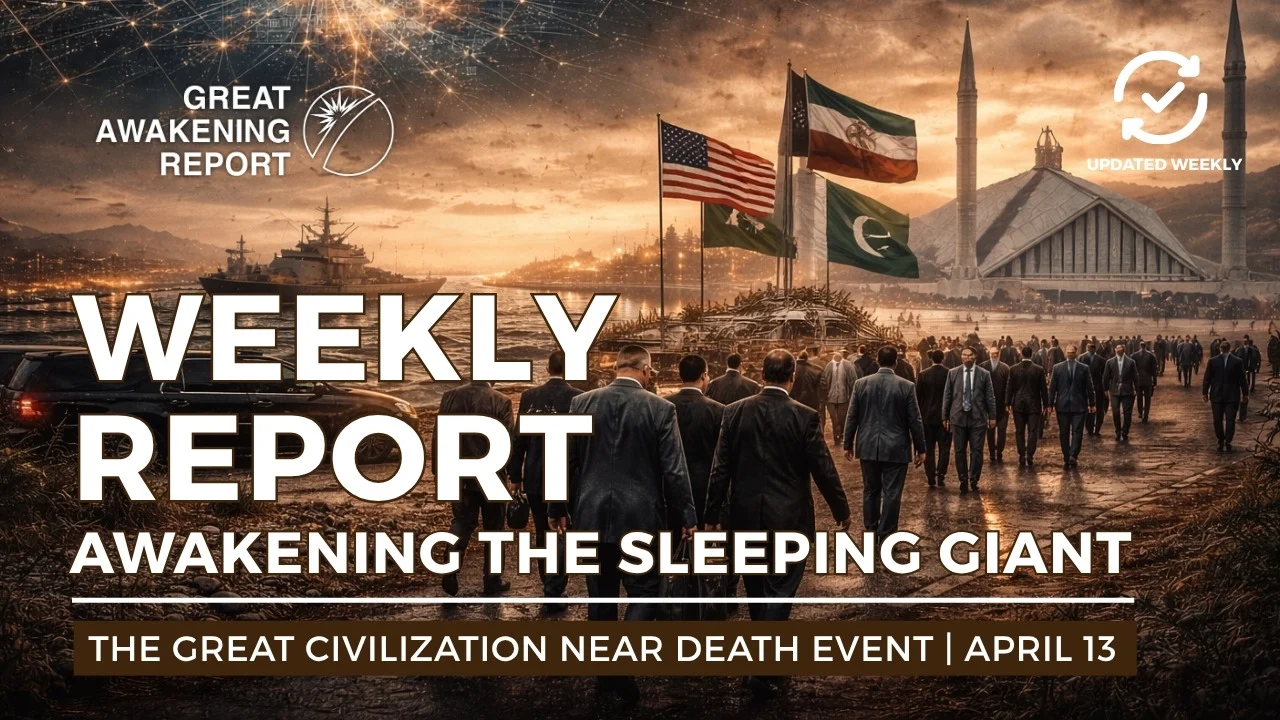
After more than 20 hours of negotiations in Islamabad, Pakistan-mediated peace talks between the U.S. and Iran ended without agreement, leaving the temporary ceasefire framework fragile and regional tensions elevated.
The system is no longer operating under assumptions of near-term de-escalation.
It is repositioning for prolonged instability.
This is not immediate escalation.This is diplomacy losing control of the pressure cycle.
Event 1: Pakistan Peace Talks Collapse
Diplomatic Off-Ramp Removed
The most significant development this week was the breakdown of the Islamabad peace negotiations.
Pakistan’s mediation effort had been viewed as the strongest available off-ramp to prevent renewed regional escalation. Its failure removes the clearest diplomatic pathway for short-term stabilization.
With no agreement reached:
Both sides remain entrenchedMilitary posturing is increasingFuture escalation risk has materially risen
Key Signals:
- U.S.–Iran negotiations ended without agreement after marathon talks in Islamabad
- Core disputes over nuclear conditions and Hormuz access remain unresolved
- Temporary ceasefire framework now under elevated strain
- Diplomatic credibility weakened moving into next week
Pattern:
Negotiation has shifted from solution pathway → delay mechanism
Event 2: Strait of Hormuz Risk Re-Emerges
Chokepoint Tensions Return to Forefront
Following failed talks, strategic attention has immediately returned to the Strait of Hormuz.
President Trump stated the U.S. Navy would begin blockading/interdicting traffic linked to Iranian toll collection, while Iran warned military vessels approaching the strait would face response.
While the waterway remains open at present, the threat posture surrounding one of the world’s most critical energy chokepoints has sharply increased.
Key Signals:
- Hormuz blockade rhetoric returned immediately after failed talks
- Naval force posture increasing in Gulf waters
- Shipping insurers/freight markets watching escalation closely
- Energy traders repricing disruption probability
Pattern:
Strategic pressure has moved from battlefield → economic chokepoint leverage
Event 3: Markets Reprice for Extended Instability
Capital Moves Into Defensive Positioning
Financial markets spent this week adjusting to the realization that conflict resolution may not be imminent.
Rather than panic selling, markets displayed measured defensive repositioning:
Gold remains elevatedOil volatility persistsEquities show selective weaknessCapital continues rotating toward defensive sectors
Reuters noted Gulf equities weakened after the failed talks, reflecting renewed concern over ceasefire durability.
This is not panic.
This is strategic repricing.
Key Signals:
- Gold maintains strength near highs
- Energy markets remain structurally bid
- Defensive capital rotation continues
- Investor sentiment increasingly cautious but orderly
Pattern:
Markets are transitioning from hopeful stabilization → expectation management
Systemic Convergence
Three Systems Now Tightening Together
This week confirmed a stronger convergence between:
Diplomatic System → Negotiation failureMilitary System → Strategic posture escalationFinancial System → Defensive repricing
These systems are no longer reacting separately.
They are now feeding each other.
Weekly Synopsis
The past 7 days marked the failure of the clearest available de-escalation pathway.
Diplomacy has stalledStrategic chokepoint risk has returnedMarkets are repositioning around sustained uncertainty
The system remains operational—but under tightening pressure.
This is not the break.
This is the compression phase before the next directional move.
“When diplomacy fails, chokepoints tighten, and markets reposition simultaneously, instability becomes less about sudden shocks—and more about sustained pressure shaping every next move.”

ORIENTATION BRIEF — WEEK OF APRIL 13th, 2026
Forward Outlook | Diplomatic Breakdown • Chokepoint Risk • Conditional Stability
The system remains under sustained operational pressure.
Last week confirmed that global stress is no longer isolated to singular events—it is now moving across interconnected systems in real time.
The failed Pakistan peace talks, renewed Strait of Hormuz tensions, and continued defensive market positioning all suggest that pressure is no longer episodic.
It is becoming structural.
Despite this, core systems remain functional. Markets are stable, institutions remain coordinated, and escalation is still being managed.
The key question for the coming week:
Can stability hold as diplomatic pressure gives way to strategic positioning?
Primary Watch Zone
Diplomatic Breakdown Replaces De-Escalation Narrative
The collapse of Pakistan-mediated peace talks removed the clearest diplomatic off-ramp available.
The focus now shifts from negotiation to posture.
Key Indicators:
- Any renewed military signaling from Iran, Israel, or U.S. forces
- Breakdown of ceasefire language or diplomatic rhetoric
- Proxy escalations across regional theaters
- New sanctions or ultimatums from Western allies
Watch for posture shifts—not headline statements.
Critical Systems Monitor
Strait of Hormuz Returns as Pressure Point
Energy remains the central leverage mechanism.
With talks failing, strategic focus has returned to the Strait of Hormuz and surrounding Gulf shipping lanes.
Key Indicators:
- Naval movement and maritime advisories
- Tanker rerouting or insurance spikes
- Shipping disruptions through Gulf corridors
- Escalation in blockade/interdiction rhetoric
If Hormuz destabilizes → global pressure accelerates quickly.
Market Behavior
Stability Holds—But Remains Conditional
Markets continue adjusting cautiously rather than reacting emotionally.
Gold, oil, and defensive sectors remain elevated while broader equities show selective weakness.
Key Indicators:
- Oil breakout above resistance levels
- Continued hard asset strength
- Defensive sector rotation
- Liquidity response to escalation headlines
Confidence remains—but tolerance for disruption is narrowing.
Institutional Posture
Active Management Remains Elevated
Governments are still operating in stabilization mode.
Military, diplomatic, and economic coordination remain elevated behind the scenes.
Key Indicators:
- Strategic reserve or emergency energy signaling
- Naval deployments / defense coordination
- Infrastructure and contingency planning measures
- Messaging shifts toward “continuity” / “resilience”
Focus on operational actions—not public messaging.
Systemic Alignment
Pressure Is Now Interacting Across Core Systems
Current convergence remains centered on:
- Diplomatic Breakdown → Rising uncertainty
- Energy Chokepoints → Elevated leverage risk
- Financial Markets → Defensive repositioning
- Military Posture → Controlled escalation readiness
Each remains manageable independently.
Together, they continue tightening systemic margins.
Orientation Guidance
The system remains stable—but increasingly sensitive.
Pressure is no longer building.It is circulating through the framework.
Stay focused on:
- Diplomatic posture shifts
- Hormuz / maritime developments
- Energy price and shipping behavior
- Market reaction to sustained instability
Avoid narrative noise. Watch system behavior.
The next major shift will likely not begin with sudden escalation—but with a disruption that proves difficult to contain.
A Call to Patriots
Let this moment be remembered as a time of clarity, not chaos—when citizens chose discernment over outrage and responsibility over fear. The republic is not reclaimed through force or noise, but through truth, accountability, and lawful restoration.
Patriots are defined by their ability to remain coherent under pressure, to reject deception, and to stand firm as systems are rebuilt. This is not a call to conflict, but to orientation, integrity, and justice allowed to function.
History will remember who stayed steady when it mattered most.