








Help Us Bypass Censorship. Share This.
Sign up to receive Our Weekly Briefing Newsletter
Begin your journey with weekly insights designed to expand awareness and ground you in truth. Our free tier gives you a powerful introduction without any commitment.
“Every civilization passes through the same stages: from bondage to spiritual faith, from spiritual faith to courage, from courage to liberty, from liberty to abundance, from abundance to complacency, from complacency to apathy, from apathy to dependence, and from dependence back into bondage.” — Alexander Fraser Tytler
Editor’s Corner
For much of modern history, people were taught to view civilization as a continuously advancing system moving steadily toward greater stability, prosperity, technological progress, and institutional sophistication. Economic growth expanded globally, supply chains interconnected continents, information moved instantly across borders, and centralized institutions increasingly shaped nearly every aspect of modern life. The assumption beneath this model was simple: the systems governing society would continue evolving upward indefinitely. The Great Restructuring now underway is breaking that assumption.
But today, that assumption is beginning to fracture.
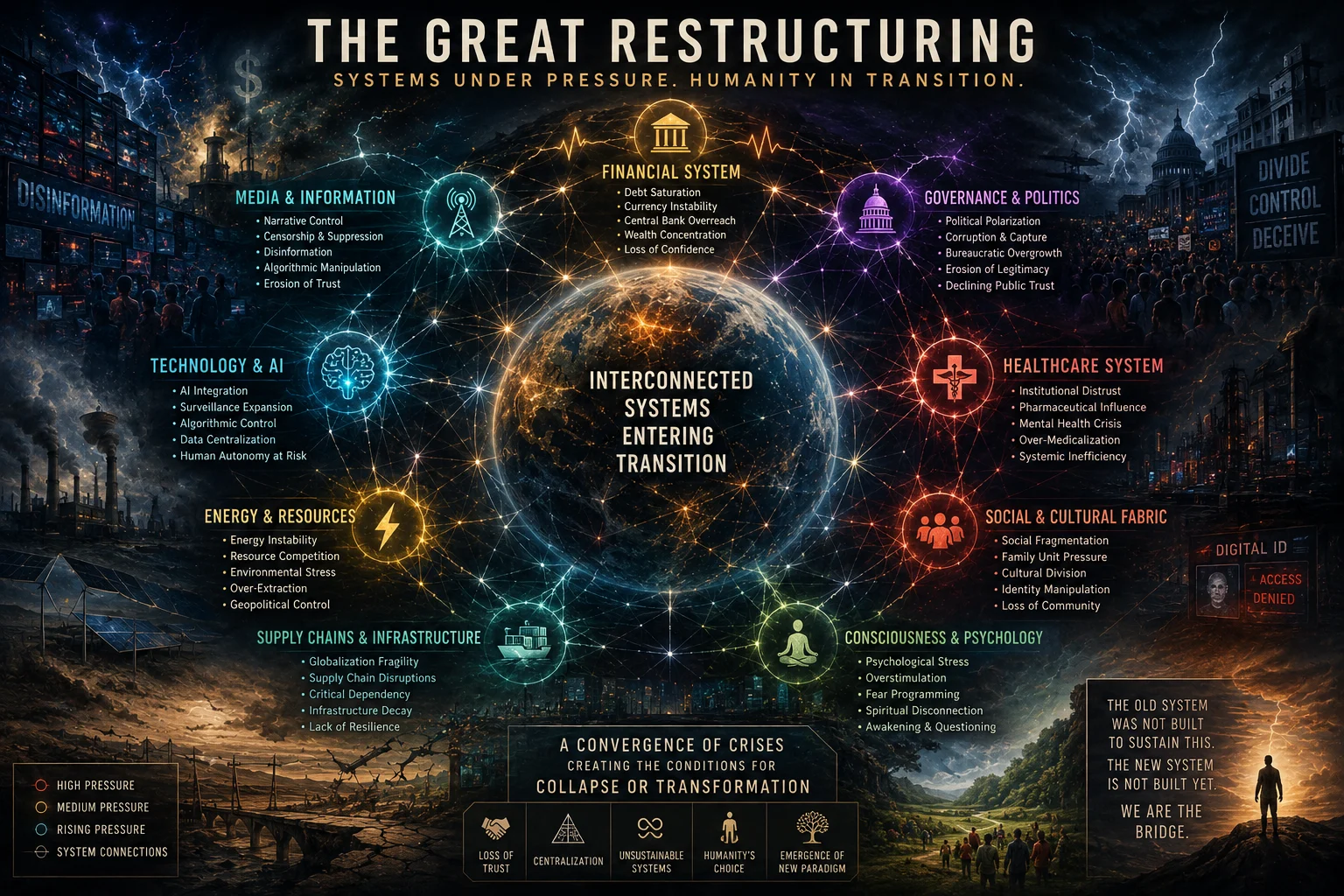
Across nearly every major sector of civilization, pressure is building simultaneously. Financial instability, geopolitical tension, institutional distrust, technological disruption, psychological exhaustion, social fragmentation, supply chain vulnerability, and accelerating information warfare are no longer isolated events unfolding independently from one another. Increasingly, they appear interconnected — symptoms of a much deeper structural transition now emerging beneath the surface of the modern world.
Many people still interpret this instability as a temporary crisis cycle that will eventually return society back to “normal.” But what if the systems entering stress were never designed to sustain the level of complexity, debt expansion, centralization, technological acceleration, and psychological pressure now converging all at once? What if the instability itself is not random collapse, but the early-stage restructuring of an aging global operating system reaching the limits of its architecture?
This Great Restructuring may be the deeper reality many people are beginning to sense intuitively beneath the surface noise.
The old system is not simply weakening because of isolated mistakes.
It is experiencing structural exhaustion.
The End of the Old Operating System
For decades, industrial civilization expanded through debt creation, centralized institutional control, technological acceleration, resource extraction, globalized supply chains, and perpetual economic growth models. During expansion phases, these systems generated extraordinary productivity, convenience, and interconnectedness across the world. But over time, the same structures also accumulated hidden fragilities beneath the surface — unsustainable debt burdens, centralized dependency chains, concentrated power structures, institutional corruption, psychological manipulation systems, environmental stress, bureaucratic bloat, and declining public trust.
What makes the Great Restructuring feel fundamentally different from previous cycles is that humanity is no longer experiencing one isolated crisis at a time. Multiple systems are now entering transition simultaneously. Financial systems, geopolitical alliances, media ecosystems, energy infrastructure, technological governance, healthcare institutions, information networks, and social cohesion are all experiencing pressure at the same moment. Even consciousness itself appears to be shifting as populations increasingly question inherited assumptions about reality, authority, and the direction of civilization.
This convergence creates the feeling that something larger is unfolding beneath individual headlines and isolated events. People sense instability accelerating not because one system is failing independently, but because the architecture connecting many systems together is entering stress simultaneously.
And at the center of much of the Great Restructuring lies the modern financial system itself.
The Debt Saturation Trap
The modern economic system became increasingly dependent on perpetual debt expansion to maintain growth. Governments, corporations, and populations were incentivized to operate inside leverage structures where future productivity was continuously borrowed against the present. For years, low interest rates, monetary expansion, and liquidity interventions temporarily masked deeper structural weakness while creating the illusion of long-term stability.
But debt saturation eventually creates a dangerous threshold.
Systems built upon continuous expansion eventually require exponentially larger interventions simply to maintain the appearance of normalcy. Central banks increasingly operate in permanent crisis-management mode. Sovereign debt burdens continue rising globally. Currency competition intensifies. Liquidity injections become normalized. Asset bubbles distort real economic value while middle-class stability weakens beneath inflation, housing pressure, and declining purchasing power.
The deeper issue is not simply inflation or recession.
The deeper issue is confidence.
Modern financial systems ultimately depend upon collective trust. Once populations begin questioning the long-term stability, transparency, or fairness of those systems, fragility accelerates rapidly beneath the surface. This is why governments and institutions increasingly focus not only on economic management, but on narrative management, behavioral influence, and psychological stabilization itself.
Psychological stability has quietly become economically strategic.
At the same time, nations around the world are repositioning toward resource security, energy independence, regional manufacturing, gold accumulation, digital currency systems, and strategic economic sovereignty. The world is beginning to move away from assumptions of permanent globalization toward a far more fragmented and uncertain geopolitical landscape.
Why Institutional Trust Is Breaking Down
Beyond economics, another major shift is accelerating simultaneously beneath the surface of modern civilization: the gradual erosion of institutional trust.
For decades, large institutions functioned as psychological anchors for society. Governments, healthcare systems, educational structures, media organizations, financial institutions, corporations, and international alliances provided populations with a sense of continuity, coordination, and stability even when those systems operated imperfectly. Most people rarely questioned the deeper architecture of institutional authority because there remained a broad collective assumption that these systems were fundamentally competent, transparent, and capable of maintaining social order over the long term.
But in recent years, that confidence has begun weakening across multiple sectors at the same time.
Political polarization, financial instability, media manipulation concerns, public health controversies, censorship debates, corporate consolidation, ideological fragmentation, and repeated institutional contradictions have gradually altered the psychological relationship many populations now have with authority itself. Increasingly, people no longer view institutions as permanently stable structures operating above society. Instead, many are beginning to see them as competing systems influenced by political pressure, financial incentives, narrative management, bureaucratic self-preservation, and concentrated power dynamics.
This shift may ultimately become one of the defining psychological transitions of the Great Restructuring.
The issue is not necessarily that every institution is collapsing simultaneously. The deeper issue is that public confidence in centralized authority structures is weakening across multiple domains at once. Institutions historically functioned because populations collectively believed they were capable of maintaining order, legitimacy, and long-term stability. Once that belief begins eroding beneath a certain threshold, institutional fragility accelerates regardless of official messaging, public relations campaigns, or attempts to restore confidence externally.
In many ways, people are no longer simply questioning isolated events.
They are beginning to question the systems interpreting those events themselves.
This subtle psychological shift changes everything because once populations begin reassessing the credibility of institutions collectively, they also begin searching for alternatives outside those systems. Independent media networks, decentralized communities, alternative education models, parallel communication platforms, localized support systems, and sovereignty-based structures are increasingly gaining traction as trust weakens in traditional centralized frameworks.
This search for alternatives is quietly becoming one of the driving forces behind the next phase of the Great Restructuring now unfolding across the world.
The Rise of Technocratic Systems
As institutional complexity continues increasing across modern civilization, many governing systems are quietly moving toward greater automation, predictive analytics, centralized data integration, biometric infrastructure, algorithmic behavioral modeling, and AI-assisted governance frameworks. Supporters argue these technologies may improve coordination, efficiency, security, and large-scale management within increasingly complex societies. Critics warn they may also expand surveillance capabilities, reduce personal autonomy, centralize behavioral influence, and create unprecedented forms of population monitoring and social control.
Regardless of perspective, one reality is becoming increasingly difficult to ignore:
Artificial intelligence is no longer a future technology waiting decades to arrive.
It is already integrating rapidly into finance, communication systems, military operations, healthcare infrastructure, hiring systems, media ecosystems, predictive policing, surveillance networks, consumer behavior modeling, and public information visibility itself. Increasingly, AI systems influence what populations see, what information trends, how narratives spread, how financial systems operate, how behaviors are monitored, and how decisions are shaped at scale.
Much of this integration is occurring quietly beneath everyday life. Algorithms already influence social visibility, recommendation systems, behavioral prediction, purchasing behavior, advertising, hiring decisions, news distribution, digital censorship, financial risk analysis, and public attention itself. Most people interact with forms of AI daily without fully recognizing how deeply those systems are already shaping perception, behavior, and information flow beneath the surface.
This is where the conversation becomes far more significant than technology alone.
The defining challenge moving forward may not simply be technological advancement itself, but whether humanity develops enough consciousness, ethics, discernment, emotional maturity, and wisdom to responsibly manage technologies more powerful than the psychological maturity of the systems deploying them. Because throughout history, technological power has often advanced faster than human consciousness evolves alongside it.
Technology alone cannot create stability.
The consciousness directing technology ultimately determines whether systems evolve toward empowerment or control, decentralization or consolidation, transparency or manipulation. In many ways, the future of civilization may depend less upon artificial intelligence itself and more upon the level of awareness humanity brings into the systems increasingly integrating it into every aspect of modern life.
The Fragmentation of Globalization
At the same time, the vulnerabilities exposed by globalization are accelerating another major transition:
fragmentation.
For decades, modern civilization optimized efficiency over resilience. Production became concentrated geographically while nations grew increasingly dependent upon fragile international logistics systems operating under assumptions of long-term geopolitical stability, uninterrupted supply chains, cheap energy, and continuous economic integration. During periods of expansion, globalization created extraordinary interconnectedness, lowered production costs, accelerated technological growth, and reshaped the modern world economy.
But over time, the same systems that created efficiency also accumulated hidden fragility beneath the surface.
The pandemic era, energy instability, cyber threats, maritime disruptions, geopolitical fragmentation, resource competition, and regional conflicts exposed how vulnerable hyper-centralized supply systems had quietly become. Nations that once assumed permanent access to global production networks suddenly faced shortages in medicine, semiconductors, energy infrastructure, agricultural inputs, manufacturing materials, and strategic resources. What appeared highly efficient during stable periods increasingly revealed itself to be dangerously dependent during periods of disruption.
As a result, governments and corporations around the world are now quietly repositioning toward regional manufacturing, resource security, strategic redundancy, localized production, energy independence, agricultural resilience, and parallel logistics infrastructure capable of operating under more fragmented geopolitical conditions.
The world is slowly transitioning away from assumptions of permanent hyper-globalization toward a far more regionalized and strategically competitive landscape.
This transition may become one of the defining geopolitical and economic shifts of the Great Restructuring because it represents more than simple supply chain restructuring. It reflects a deeper recognition that resilience, redundancy, and sovereignty may become increasingly important within a world entering greater instability, technological competition, resource pressure, and geopolitical fragmentation simultaneously.
But beneath these structural changes, something even deeper is beginning to emerge.
As centralized systems weaken and globalization becomes more unstable, individuals and communities themselves are also beginning to search for alternatives outside traditional institutional structures entirely.
The Emergence of Parallel Systems
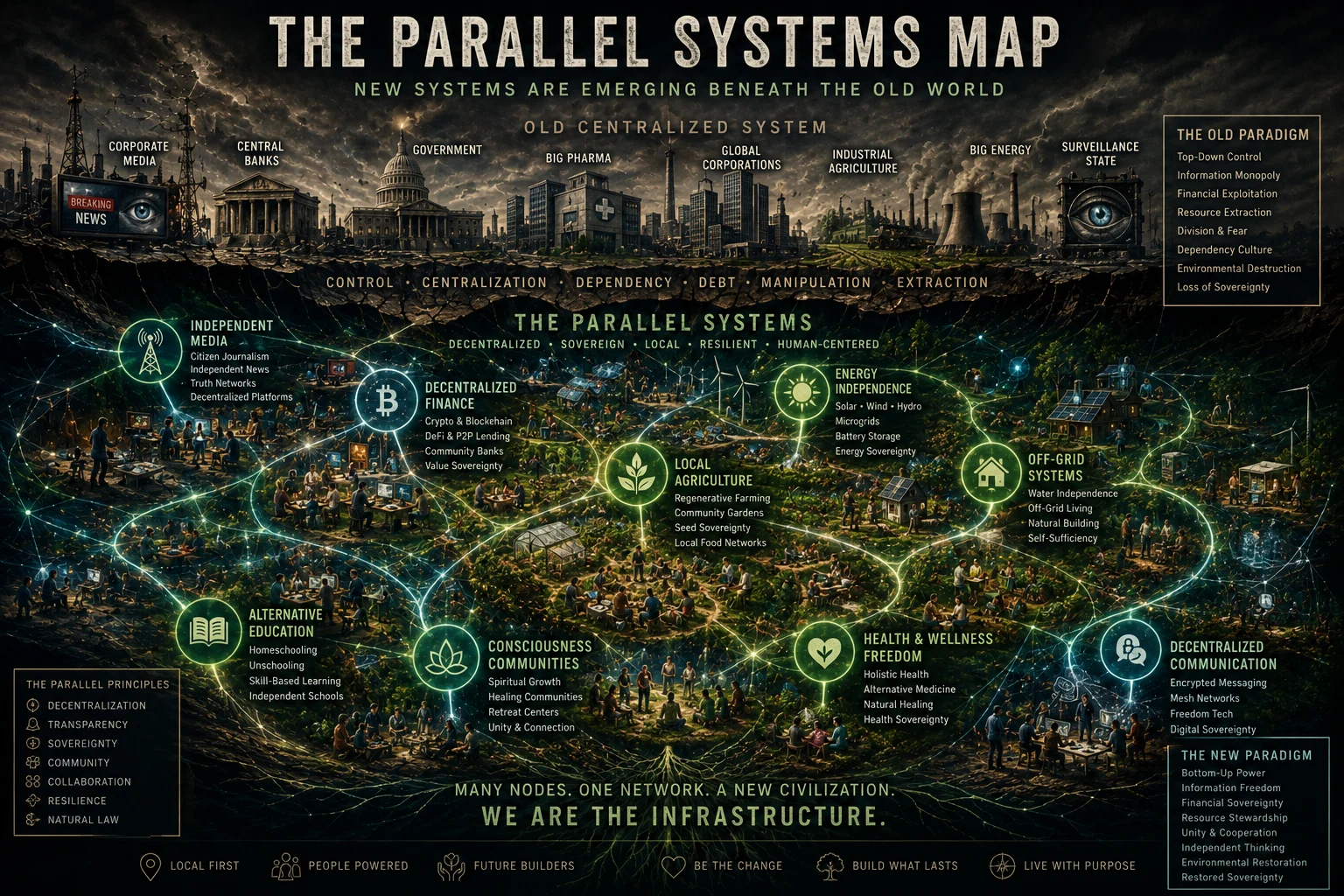
As trust continues weakening across centralized institutions, individuals and communities are increasingly beginning to build alternatives outside traditional systems entirely. What once existed only at the fringe is now slowly moving into broader public awareness as populations search for structures that feel more resilient, transparent, localized, adaptive, and human-centered during a period of accelerating instability.
Parallel systems are already emerging across multiple sectors of society.
Independent media networks continue expanding as trust erodes in corporate information ecosystems. Alternative education models are growing outside traditional institutional frameworks. Decentralized finance systems, local agriculture initiatives, holistic health communities, cooperative economic structures, private communication platforms, off-grid technologies, decentralized energy systems, and consciousness-based communities are all quietly developing beneath the surface of the old centralized model.
Most of these systems remain early-stage, fragmented, imperfect, and relatively small compared to the scale of existing institutions. But historically, entirely new civilizational models almost always begin quietly at the edges before gradually scaling during periods of institutional transition. What initially appears marginal often becomes increasingly significant once legacy systems lose coherence, flexibility, or public trust.
In many ways, humanity now appears to be entering one of those transitional periods: the Great Restructuring.
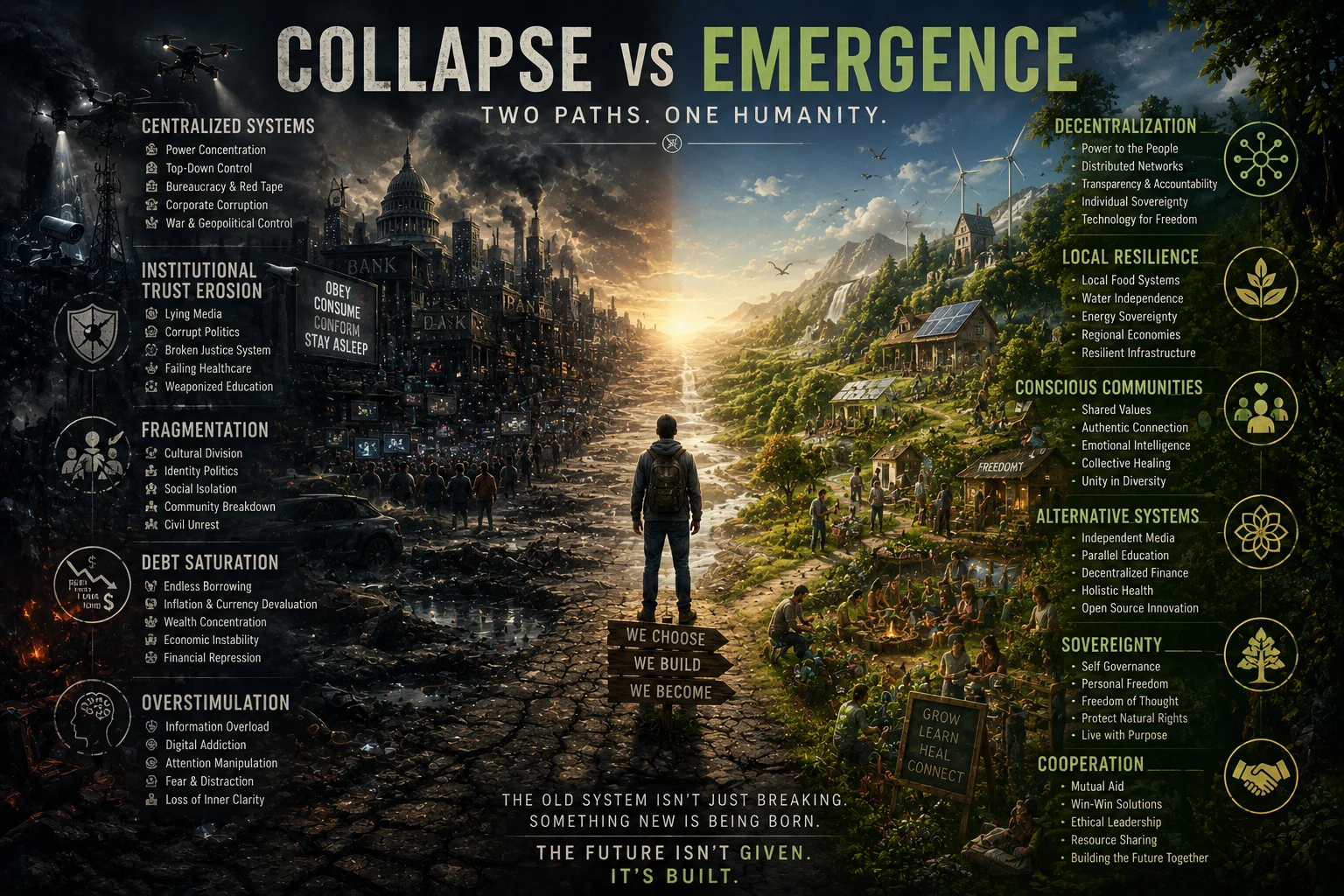
This is where collapse and emergence begin overlapping simultaneously.
The old system weakens while the new system remains incomplete.
That in-between phase is psychologically difficult for many people because the familiar structures of the old world no longer feel stable, yet the emerging systems replacing them have not fully matured or consolidated into recognizable forms. People instinctively search for certainty during periods of instability, but transitional eras rarely provide clarity immediately. Instead, they often feel disorienting, fragmented, emotionally exhausting, and unpredictable while multiple systems reorganize beneath the surface at the same time.
Many individuals still unconsciously associate collapse exclusively with permanent destruction. But throughout history, periods of civilizational stress have also created the conditions for decentralization, innovation, restructuring, adaptation, and consciousness evolution simultaneously. Old systems rarely disappear overnight. More often, they slowly lose legitimacy while new systems gradually emerge in parallel beneath them.
This does not mean the Great Restructuring will be easy.
The next several years of the Great Restructuring may involve extraordinary volatility across multiple domains simultaneously. Financial instability, geopolitical realignment, technological disruption, resource competition, information warfare, social fragmentation, psychological exhaustion, and accelerating institutional distrust may continue intensifying as the restructuring process unfolds globally.
And beneath all of this, another major dynamic is accelerating quietly in the background:
Exposure.
Pressure is increasingly revealing what systems were previously able to hide. Corruption, manipulation, institutional weakness, hidden incentives, financial distortion, narrative management, and structural fragility are surfacing across governments, corporations, media systems, intelligence networks, healthcare institutions, and global power structures simultaneously. Whether through independent journalism, decentralization, technological transparency, whistleblowers, leaked information, or mass public awakening, systems built upon secrecy are becoming increasingly difficult to maintain in the information age.
This is why so many contradictions, disclosures, scandals, and institutional failures appear to be surfacing all at once.
Pressure reveals what systems were hiding.
And in many ways, exposure itself becomes part of the Great Restructuring.
The Age of Exposure
One of the defining characteristics of this era is the acceleration of exposure itself.
Corruption hidden beneath old institutional structures is increasingly surfacing across governments, corporations, intelligence systems, financial institutions, media ecosystems, and global power networks. Whether through whistleblowers, independent journalism, decentralization, technological transparency, leaked information, or mass public awakening, systems built upon secrecy are becoming increasingly difficult to maintain in the information age.
Pressure reveals what systems were previously hiding.
This is why so many scandals, contradictions, disclosures, institutional failures, and credibility collapses appear to be surfacing simultaneously across multiple sectors. Exposure itself is becoming part of the Great Restructuring because systems cannot evolve while foundational deception remains indefinitely protected beneath the surface.
In many ways, all systems eventually reveal their true nature under pressure.
And modern civilization is entering one of the most psychologically pressurized periods in recent history.
The Consciousness Factor in the Great Restructuring
Beneath all of these structural shifts, another transition is accelerating quietly:
consciousness itself.
People around the world are increasingly questioning inherited narratives more deeply. Emotional sensitivity appears heightened. Interest in spirituality, nervous system regulation, discernment, sovereignty, healing, human potential, and consciousness exploration continues expanding globally. Increasingly, individuals are searching not only for material survival, but for meaning, coherence, authenticity, and psychological alignment during a time of extraordinary instability.
This may ultimately become the defining difference between collapse and emergence.
Civilizations do not evolve solely through technology.
They evolve through consciousness.
The systems emerging in the future will likely reflect the psychological and spiritual maturity of the populations creating them. If humanity remains trapped inside fear, manipulation, greed, division, and unconscious behavior, technological advancement alone will not create stability. But if awareness, discernment, ethical responsibility, emotional regulation, cooperation, and conscious participation continue expanding, entirely new civilizational models may emerge from the restructuring now unfolding across the world.
The Great Restructuring is not simply economic.
It is psychological.
Technological.
Geopolitical.
Spiritual.
Civilizational.
And what comes next may not be determined solely by governments, institutions, or technological systems.
It may ultimately be shaped by the level of consciousness humanity brings into the rebuilding process itself.
Sign up to receive Our Weekly Briefing Newsletter
Begin your journey with weekly insights designed to expand awareness and ground you in truth. Our free tier gives you a powerful introduction without any commitment.
STOP DROWNING IN THE NOISE. START SEEING THE TRUTH. Join over 99,000 truth seekers. Get the essential intelligence, alternative news, and disclosure updates that the mainstream media won’t touch.
Latest Reports
 Weekly ReportAwakening The Sleeping Giant · October 12th EditionOctober 12, 2026
 Monthly ReportConscious Practices · October 2026 EditionOctober 5, 2026
 Weekly ReportAwakening The Sleeping Giant · October 5th EditionOctober 5, 2026
 Weekly ReportAwakening The Sleeping Giant · September 28th EditionSeptember 28, 2026View all weekly reports
Special Reports
 Special ReportTHE AWAKENING JOURNEY: Hero’s Journey Part II · Week 1October 3, 2026
 Special ReportGlobal Everything Collapse · Economic Chaos · Part IOctober 1, 2026
 Special ReportCreating A Conscious Culture · Part ISeptember 3, 2026
 Special ReportThe Great Healing: Detox, Defense & Sovereignty In an Engineered World · Part ISeptember 1, 2026View all special reports
Help Us Bypass Censorship. Share This.
Join the Discussion
Related Posts


Have questions?
At Great Awakening Report, we are dedicated to supporting your journey toward truth and enlightenment through our specialized Coaching and Consulting services.
Coaching Services: Our coaching programs are designed to guide you through personal awakening and transformation. We offer personalized sessions that focus on expanding consciousness, uncovering hidden truths, and fostering spiritual growth. Our experienced coaches provide the tools and insights necessary to navigate your path with clarity and confidence.
Consulting Services: For organizations and individuals seeking deeper understanding and strategic guidance, our consulting services offer expert analysis and solutions. We delve into areas such as global transitions, alternative news insights, and consciousness studies to provide comprehensive strategies tailored to your unique objectives.
Embark on a transformative journey with our Coaching and Consulting services, and unlock your highest potential. To learn more and schedule a session, visit our Coaching and Consulting pages.
Thank you
Thank you to our subscribers and readers for your continued support and dedication to truth and awakening. Your encouragement, engagement, and belief in our mission make everything we do possible. Together, we are expanding awareness and helping illuminate the path forward.
If you would like to further support the Great Awakening team and our ongoing efforts to share insight, knowledge, and truth, you can DONATE HERE.
With deep gratitude,
– Great Awakening Team
About the Author: Great Awakening Team

We are a community. We are cultural creatives and like minded people seeking the truth and focusing on disclosure, awakening and consciousness. Our focus is real news as researchers, reporters and truth seekers. We are here to teach, to spread the word, to serve and to help. We are a collective, a movement, free from all programing, not closed minded and not discriminatory. We are not political. We are not religious but we are spiritual. We study, research, and report on a wide range of subjects and topics, from the current geopolitical climate to health and wellness, from earth’s history to spiritual practices. We are forward thinkers and visionaries, we are guides for the transition as we usher in The Great Awakening.
THIS WEBSITE DOES NOT PROVIDE MEDICAL ADVICE: The information, including but not limited to text, graphics, images, and other material contained on this website, are for informational purposes only. No material on this site is intended to be a substitute for professional medical advice, diagnosis, or treatment. Always seek the advice of your physician or other qualified health care provider with any questions you may have regarding a medical condition or treatment and before undertaking a new health care regimen, and never disregard professional medical advice or delay in seeking it because of something you have read on this website.
DISCLAIMER: All statements, claims, views and opinions that appear anywhere on this site, whether stated as theories or absolute facts, are always presented by The Great Awakening Report (GAR) as unverified—and should be personally fact checked and discerned by you, the reader.Any opinions or statements herein presented are not necessarily promoted, endorsed, or agreed to by GAR, those who work with GAR, or those who read or subscribe to GAR.Any belief or conclusion gleaned from content on this site is solely the responsibility of you the reader to substantiate.Any actions taken by those who read material on this site are solely the responsibility of the acting party.You are encouraged to think for yourself and do your own research.Nothing on this site is meant to be believed without question or personal appraisal.
COPYRIGHT DISCLAIMER: Citation of articles and authors in this report does not imply ownership. Works and images presented here fall under Fair Use Section 107 and are used for commentary on globally significant newsworthy events. Under Section 107 of the Copyright Act 1976, allowance is made for fair use for purposes such as criticism, comment, news reporting, teaching, scholarship, and research.
COMMUNITY GUIDELINES DISCLAIMER: The points of view and purpose of this video is not to bully or harass anybody, but rather share that opinion and thoughts with other like-minded individuals curious about the subject.