
Help Us Bypass Censorship. Share This.
Sign up to receive Our Weekly Briefing Newsletter
Begin your journey with weekly insights designed to expand awareness and ground you in truth. Our free tier gives you a powerful introduction without any commitment.
“Empires do not collapse the day they run out of silver — they collapse the day trust runs out.”
The Roman Monetary Foundation
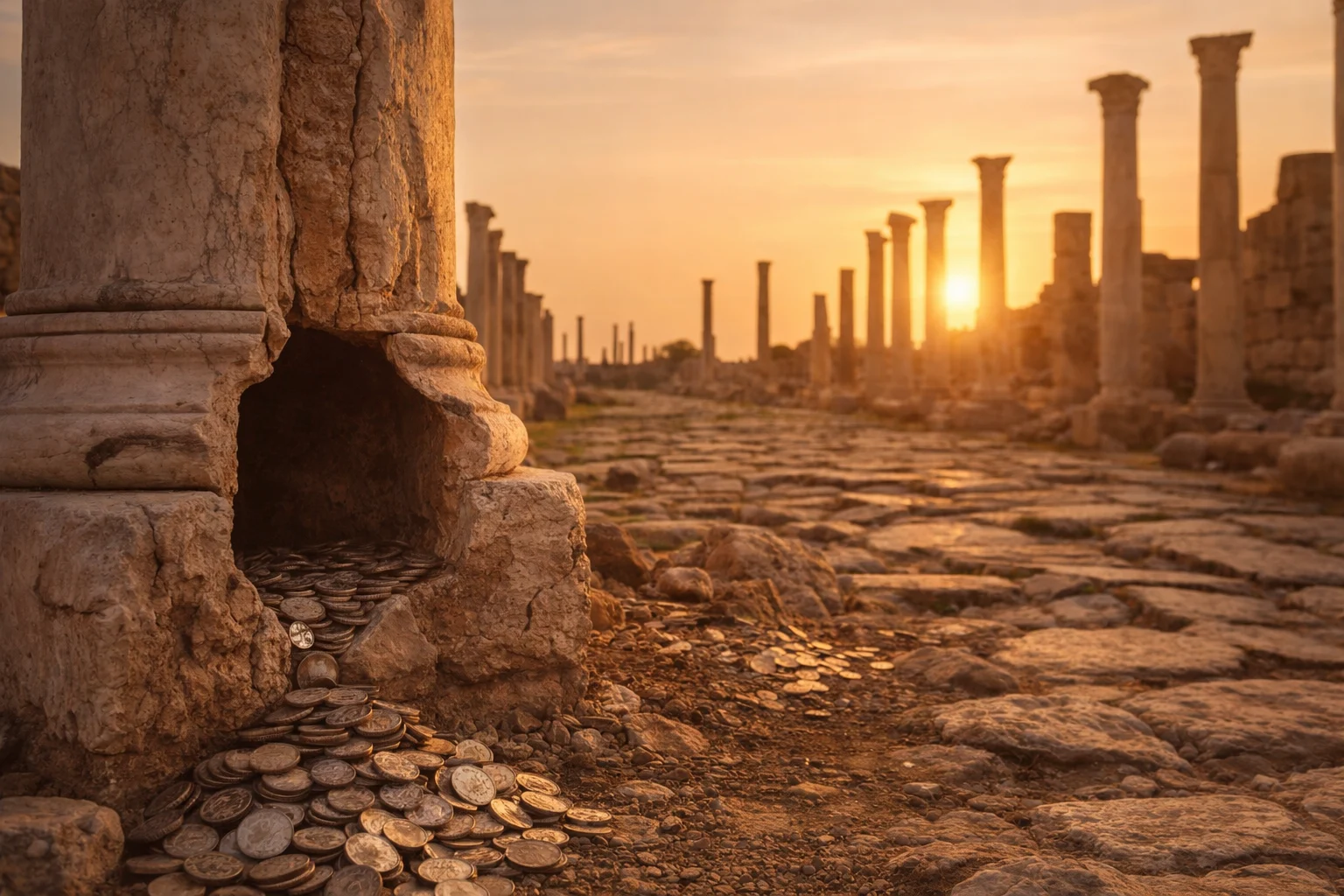
For centuries, Rome’s currency system was one of the structural pillars of the empire. A standardized silver coin — the denarius — allowed trade to flow across vast territories, from Britannia to North Africa to the Middle East. Taxes were collected in coin, soldiers were paid in coin, infrastructure was funded in coin. Trust in Roman money meant trust in Rome itself.
In the early empire, the denarius contained nearly pure silver. Its intrinsic metal value largely matched its face value. This alignment between substance and representation sustained commercial stability and public confidence.
But that alignment did not last.
What Is Currency Debasement?
Currency debasement occurs when a governing authority reduces the precious metal content of its coins while maintaining the same face value. It creates the illusion of stability while quietly expanding the money supply.
In Rome’s case, debasement meant gradually reducing the silver content of the denarius by alloying it with base metals such as copper. More coins could then be minted from the same amount of silver. In the short term, this helped fund military campaigns and state expenditures. In the long term, it eroded trust and fueled inflation.
Debasement is not simply a technical adjustment. It is a hidden transfer of wealth. As silver content declines, purchasing power declines — and citizens pay the difference.
Understanding the historical mechanisms of currency debasement in the Roman Empire illuminates how monetary manipulation impacts economies, a lesson relevant to discussions of modern fiscal policies and economic health. For further insights into economic and historical analysis, see related content on economic awakenings at Great Awakening Report.
The Timeline of Rome’s Monetary Decline
The history of Roman currency debasement is marked by distinct events tied closely to the actions of various emperors, each altering the silver content of coins to address imperial financial needs. Below is a chronological overview highlighting the key debasement events and the emperors responsible:
- Nero (54–68 AD): Nero initiated one of the first significant reductions, lowering silver purity from approximately 98% to about 93%. This followed heavy expenditures on military campaigns and the reconstruction of Rome after the Great Fire of 64 AD. Though modest at first, this marked a turning point.
- Domitian (81–96 AD): Continued the debasement trend, progressively lowering the silver content further as the empire faced ongoing military expenses.
- Septimius Severus (193–211 AD): Facing civil war and military pressures, Severus dramatically increased soldiers’ pay. To finance it, he reduced the silver content of the denarius to roughly 50%. This was no longer subtle monetary adjustment — it was systemic dilution.
- Caracalla (211–217 AD): Caracalla introduced the antoninianus, a coin nominally worth two denarii but containing significantly less than double the silver. It was presented as expansion; in reality, it was accelerated debasement.
- Crisis of the Third Century (235–284 AD): During this period of political instability, rapid imperial turnover, invasions, and economic contraction, debasement intensified. Under emperors such as Gallienus, silver content in coinage fell to near trace levels — in some cases below 5%. Coins were effectively bronze with a thin silver wash. Trust deteriorated rapidly. Merchants began demanding payment in gold. Barter returned in many regions. Tax collection weakened. Prices soared.
- Aurelian (270–275 AD): Aurelian attempted reform by introducing higher-quality coinage and marking purity levels. These reforms offered temporary stabilization but did not fully restore confidence.
- Diocletian (284–305 AD): Diocletian implemented sweeping reforms, including the famous Edict on Maximum Prices (301 AD), an attempt to cap inflation by decree. It failed. Price controls cannot repair currency credibility once trust has eroded.
These episodes of debasement reflect the Roman Empire’s response to fiscal emergencies and military pressures, influencing economic stability and the confidence of its populace in the monetary system. Understanding these events provides insight into historical monetary policy challenges still relevant today. For a broader contextual understanding of economic pressures and financial system responses in history, see related discussions in our analysis of global economic collapse and currency destabilization.
Economic and Social Impact of Currency Debasement
As silver content declined, inflation accelerated. Wages failed to keep pace. Savings lost value. Contracts became unreliable. Trade grew more complex and cautious.
The impact was not abstract:
- Soldiers demanded more stable forms of payment.
- Provincial economies reverted to barter.
- Black markets expanded.
- Economic stratification widened.
- Public confidence in imperial administration weakened.
Debasement did not singlehandedly cause Rome’s fall. But it revealed and accelerated structural decay already underway.
A currency functions on trust. When intrinsic value collapses, so does confidence. When confidence collapses, social cohesion follows.
These effects of currency debasement in antiquity serve as early examples of how monetary policy can directly influence inflation, market confidence, and social well-being—lessons still relevant in modern economic systems. For further insights on economic transformations and policy impacts, see related discussions on economic crises and societal shifts at Great Awakening Report.
Debasement as a Symptom of Rome’s Decline
Rome’s monetary decline reflected deeper strains:
- Military overstretch
- Expanding bureaucracy
- Political instability
- Administrative corruption
- External invasions
Debasement was both a response to these pressures and a catalyst that intensified them. It allowed the empire to postpone hard structural reform — but only temporarily.
Eventually, illusion collided with reality.
Lessons from Rome’s Monetary Collapse for Modern Economies
Modern monetary systems differ fundamentally from Rome’s silver-based economy. Today’s currencies are not tied directly to precious metals. However, one principle remains constant across civilizations:
Currency stability depends on public trust.
When governments expand money supply faster than productive output, confidence becomes fragile. When citizens begin seeking tangible stores of value, it signals psychological stress within the system.
Rome’s experience demonstrates that monetary manipulation can delay fiscal reckoning — but cannot prevent it indefinitely.
History does not repeat in identical form. But structural dynamics rhyme
When the representation of value drifts too far from underlying substance, correction eventually follows.
Furthermore, Rome’s collapse underscores the necessity for transparency and fiscal discipline in managing national debt and expenditures to avoid undermining economic stability. Ultimately, history teaches that unchecked currency debasement can accelerate the decline of even the most powerful civilizations, a warning relevant to today’s global monetary frameworks. For a deeper dive into these connections, consult our analysis at Great Awakening Report.
Sources
Sign up to receive Our Weekly Briefing Newsletter
Begin your journey with weekly insights designed to expand awareness and ground you in truth. Our free tier gives you a powerful introduction without any commitment.





Help Us Bypass Censorship. Share This.
Have questions?
At Great Awakening Report, we are dedicated to supporting your journey toward truth and enlightenment through our specialized Coaching and Consulting services.
Coaching Services: Our coaching programs are designed to guide you through personal awakening and transformation. We offer personalized sessions that focus on expanding consciousness, uncovering hidden truths, and fostering spiritual growth. Our experienced coaches provide the tools and insights necessary to navigate your path with clarity and confidence.
Consulting Services: For organizations and individuals seeking deeper understanding and strategic guidance, our consulting services offer expert analysis and solutions. We delve into areas such as global transitions, alternative news insights, and consciousness studies to provide comprehensive strategies tailored to your unique objectives.
Embark on a transformative journey with our Coaching and Consulting services, and unlock your highest potential. To learn more and schedule a session, visit our Coaching and Consulting pages.
Thank you
Thank you to our subscribers and readers for your continued support and dedication to truth and awakening. Your encouragement, engagement, and belief in our mission make everything we do possible. Together, we are expanding awareness and helping illuminate the path forward.
If you would like to further support the Great Awakening team and our ongoing efforts to share insight, knowledge, and truth, you can DONATE HERE.
With deep gratitude,
– Great Awakening Team
About the Author: Great Awakening Team

DISCLAIMER: All statements, claims, views and opinions that appear anywhere on this site, whether stated as theories or absolute facts, are always presented by The Great Awakening Report (GAR) as unverified—and should be personally fact checked and discerned by you, the reader.Any opinions or statements herein presented are not necessarily promoted, endorsed, or agreed to by GAR, those who work with GAR, or those who read or subscribe to GAR.Any belief or conclusion gleaned from content on this site is solely the responsibility of you the reader to substantiate.Any actions taken by those who read material on this site are solely the responsibility of the acting party.You are encouraged to think for yourself and do your own research.Nothing on this site is meant to be believed without question or personal appraisal.
COPYRIGHT DISCLAIMER: Citation of articles and authors in this report does not imply ownership. Works and images presented here fall under Fair Use Section 107 and are used for commentary on globally significant newsworthy events. Under Section 107 of the Copyright Act 1976, allowance is made for fair use for purposes such as criticism, comment, news reporting, teaching, scholarship, and research.
COMMUNITY GUIDELINES DISCLAIMER: The points of view and purpose of this video is not to bully or harass anybody, but rather share that opinion and thoughts with other like-minded individuals curious about the subject.