
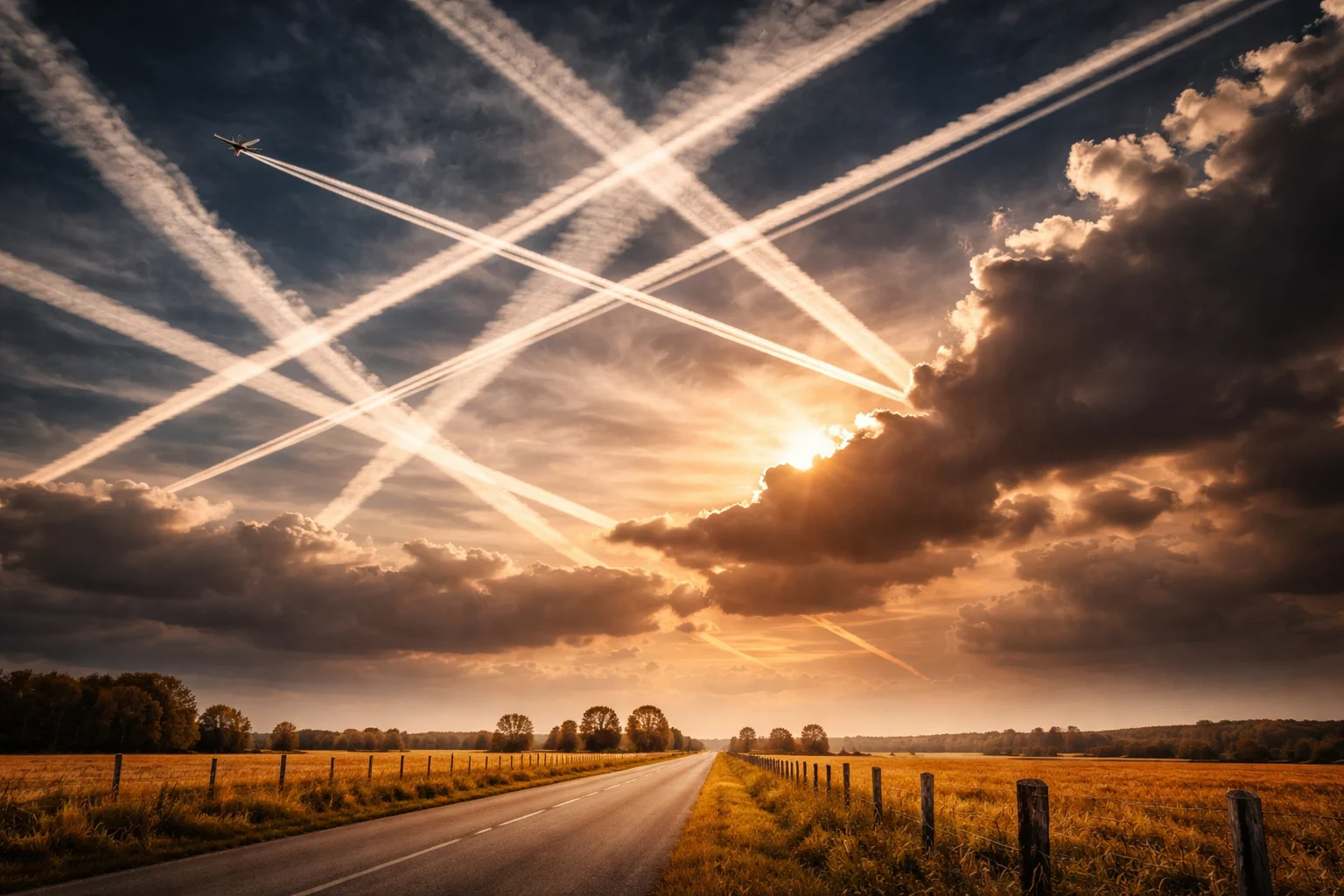
Help Us Bypass Censorship. Share This.
Sign up to receive Our Weekly Briefing Newsletter
Begin your journey with weekly insights designed to expand awareness and ground you in truth. Our free tier gives you a powerful introduction without any commitment.
“Our technology has exceeded our humanity.” – Albert Einstein
Introduction to cloud seeding—What it is, Simplified
For years, most people were taught to think of weather as something purely natural — a system beyond human influence, governed only by atmosphere, pressure, wind, and seasonal cycles. But that is no longer the full story.
Cloud seeding is real. It has been used for decades. It is not science fiction, and it is not a fringe theory. It is a documented form of weather modification in which governments, utilities, agricultural interests, and other institutional actors attempt to influence precipitation by intervening directly in cloud systems.
The public is often told this is limited, modest, and benevolent — a tool for helping drought-stricken regions, improving snowpack, reducing hail damage, or supporting water supply. And in official language, that is often how it is framed.
But that framing leaves out the deeper issue.
Because once humans begin intervening in atmospheric systems — even under the banner of “enhancement” or “management” — we are no longer talking about weather as a purely natural phenomenon. We are talking about engineered influence over shared environmental systems, often with little public awareness, minimal transparency, and almost no meaningful consent.
That is where the real conversation begins.
What Cloud Seeding Actually Is
At its core, cloud seeding is a method of trying to influence how and when clouds release moisture.
It does not typically create clouds out of a blue sky. Instead, it targets clouds that already contain moisture and attempts to alter their internal behavior so that rain or snow becomes more likely.
This is usually done by introducing tiny particles into a cloud — often substances such as silver iodide, salts, or other aerosolized materials — that act as nuclei around which water droplets or ice crystals can form. Depending on the cloud type and atmospheric conditions, this can increase the chances of precipitation.
In simple terms: Cloud seeding is an attempt to nudge the weather in a preferred direction.
That alone should matter more than it does. Because even if the intervention is limited, the principle is enormous: Human institutions are deliberately modifying atmospheric behavior.
And they have been for a long time.
How It’s Done
Cloud seeding programs generally use one of two broad approaches.
1. Cold Cloud Seeding (Glaciogenic Seeding)
This method typically uses substances like silver iodide to encourage ice crystal formation inside supercooled clouds. The idea is to help droplets freeze, grow, and eventually fall as snow or rain.
2. Warm Cloud Seeding (Hygroscopic Seeding)
This method uses salt-based or similar particles to encourage smaller water droplets to combine into larger ones, increasing the chance that they become heavy enough to fall as rain.
These materials can be dispersed by:
- aircraft
- flares
- ground-based generators
- and in some modern programs, drones or automated dispersal systems
The technology is becoming more targeted, more data-driven, and more operationally sophisticated.
That matters. Because what was once experimental is increasingly becoming routine infrastructure.
Why the “It’s Just Harmless Rain Enhancement” Narrative Falls Short
This is where the mainstream explanation often becomes too simplistic.
Official descriptions tend to frame cloud seeding as if it is a modest agricultural or water-management tool — almost like irrigation in the sky.
But that language minimizes what is actually happening.
Cloud seeding is not passive. It is not natural. And it is not inconsequential.
It is a form of atmospheric intervention.
And once that is normalized, a much larger set of questions comes into view:
- Who decides when and where weather should be altered?
- Who benefits from enhanced rainfall or redirected snowpack?
- What happens downwind?
- What are the ecological and chemical consequences of repeated dispersal?
- How much of this is actually disclosed to the public in real time?
These are not fringe questions. They are the obvious questions.
And yet they are rarely centered in the public conversation.
The Deeper Issue: Control Over Shared Systems
The most important part of this story is not whether cloud seeding can “fully control” weather in a Hollywood sense.
It’s that humans are increasingly attempting to influence complex natural systems for strategic outcomes.
That includes:
- water access
- agriculture
- energy reliability
- drought response
- snowpack management
- and potentially geopolitical or economic leverage
The modern operating mindset is no longer: “How do we adapt to nature?”
It is increasingly: “How do we engineer nature to fit institutional objectives?”
That is a very different worldview. And it carries consequences.
A Brief History of Weather Manipulation
Cloud seeding is not new.
Its roots go back to the 1940s, when early experiments showed that certain materials could alter precipitation processes inside clouds. From there, weather modification research expanded into military, agricultural, and scientific domains.
This is not speculation. This is documented history.
The U.S. and other nations have spent decades exploring whether weather systems could be manipulated for tactical, agricultural, or resource-management purposes. Historical projects and military-era interest in environmental modification are part of the public record.
That alone should permanently end the lazy dismissal that “weather manipulation” is somehow imaginary.
The more serious question is not whether it exists. The more serious question is: How normalized has it become — and how much of it is occurring without meaningful public awareness?
The Environmental and Ethical Concerns
This is where the issue becomes especially important.
Even official and academic discussions acknowledge that cloud seeding raises real environmental, legal, and ethical questions. Your source material rightly points to concerns around localized concentrations of silver iodide and the difficulty of measuring impacts across wider regions.
That should not be brushed aside.
Because once substances are repeatedly introduced into atmospheric systems, the burden should not be on the public to prove harm after the fact.
The burden should be on the operators to prove:
- necessity
- safety
- transparency
- and accountability
And in practice, that standard often feels far too loose.
Beyond chemistry, there is also the ethical issue of shared atmospheric ownership.
Weather does not stop at county lines.
Cloud systems do not respect private interests.
And rainfall redirected or enhanced in one place may have consequences elsewhere.
So even if cloud seeding is pitched as “localized intervention,” the moral and ecological implications are not always localized at all.
Why Public Trust Is So Low
Part of the reason this issue is so combustible is because the public has been repeatedly trained to distrust institutions that alter the environment while insisting everything is under control.
People have watched years of denial, ridicule, semantic games, and selective disclosure around a range of environmental and public health topics.
So when officials say:
“Yes, weather modification exists, but it’s limited, harmless, and only for good purposes”
…many people no longer hear reassurance.
They hear a familiar script. And frankly, they should be cautious.
Because history has shown again and again that “for the public good” can become a cover phrase for experimentation, strategic leverage, or policy agendas that the public never meaningfully agreed to.
That doesn’t mean every cloud seeding program is part of some grand centralized plot.
But it does mean the public is justified in asking much harder questions than they’ve been encouraged to ask.
What This Means Going Forward
The future of cloud seeding is likely to involve more—not less—intervention.
As drought, food instability, water scarcity, insurance pressures, and climate narratives intensify, institutional appetite for weather intervention will likely grow.
And that means this conversation is only getting started.
The key issue is not whether humans can influence weather patterns.
We already can.
The key issue is whether that power will be exercised:
- transparently
- ethically
- responsibly
- and with full public awareness
Or whether it will continue expanding under bureaucratic language, technical jargon, and selective disclosure.
That is the line people should be watching.
Final Thought
Cloud seeding is often sold to the public as a practical and benevolent tool — a way to improve rainfall, support agriculture, replenish water supplies, or reduce the impact of harsh weather conditions. Framed this way, it sounds limited, reasonable, and even helpful. Just another scientific adjustment in service of the common good.
But that framing obscures the deeper reality.
Cloud seeding is not simply a weather-management tool. It is a form of atmospheric intervention — a deliberate attempt to influence natural systems that affect entire regions, ecosystems, and communities. And once humans begin inserting themselves into something as complex and interconnected as the sky, the issue is no longer just scientific. It becomes ethical, political, and civilizational.
Because history has shown that whenever institutions gain the power to alter foundational systems — whether related to health, food, finance, energy, or the environment — that power rarely remains neutral for long.
So the central question is not merely whether weather can be influenced through targeted intervention. We already know it can. The real question is who gets to decide when nature should be manipulated, for whose benefit, and under what level of scrutiny.
That is the part the public should be paying closest attention to.
Sign up to receive Our Weekly Briefing Newsletter
Begin your journey with weekly insights designed to expand awareness and ground you in truth. Our free tier gives you a powerful introduction without any commitment.

Help Us Bypass Censorship. Share This.
Have questions?
At Great Awakening Report, we are dedicated to supporting your journey toward truth and enlightenment through our specialized Coaching and Consulting services.
Coaching Services: Our coaching programs are designed to guide you through personal awakening and transformation. We offer personalized sessions that focus on expanding consciousness, uncovering hidden truths, and fostering spiritual growth. Our experienced coaches provide the tools and insights necessary to navigate your path with clarity and confidence.
Consulting Services: For organizations and individuals seeking deeper understanding and strategic guidance, our consulting services offer expert analysis and solutions. We delve into areas such as global transitions, alternative news insights, and consciousness studies to provide comprehensive strategies tailored to your unique objectives.
Embark on a transformative journey with our Coaching and Consulting services, and unlock your highest potential. To learn more and schedule a session, visit our Coaching and Consulting pages.
Thank you
Thank you to our subscribers and readers for your continued support and dedication to truth and awakening. Your encouragement, engagement, and belief in our mission make everything we do possible. Together, we are expanding awareness and helping illuminate the path forward.
If you would like to further support the Great Awakening team and our ongoing efforts to share insight, knowledge, and truth, you can DONATE HERE.
With deep gratitude,
– Great Awakening Team
About the Author: Great Awakening Team

DISCLAIMER: All statements, claims, views and opinions that appear anywhere on this site, whether stated as theories or absolute facts, are always presented by The Great Awakening Report (GAR) as unverified—and should be personally fact checked and discerned by you, the reader.Any opinions or statements herein presented are not necessarily promoted, endorsed, or agreed to by GAR, those who work with GAR, or those who read or subscribe to GAR.Any belief or conclusion gleaned from content on this site is solely the responsibility of you the reader to substantiate.Any actions taken by those who read material on this site are solely the responsibility of the acting party.You are encouraged to think for yourself and do your own research.Nothing on this site is meant to be believed without question or personal appraisal.
COPYRIGHT DISCLAIMER: Citation of articles and authors in this report does not imply ownership. Works and images presented here fall under Fair Use Section 107 and are used for commentary on globally significant newsworthy events. Under Section 107 of the Copyright Act 1976, allowance is made for fair use for purposes such as criticism, comment, news reporting, teaching, scholarship, and research.
COMMUNITY GUIDELINES DISCLAIMER: The points of view and purpose of this video is not to bully or harass anybody, but rather share that opinion and thoughts with other like-minded individuals curious about the subject.