
Help Us Bypass Censorship. Share This.
Sign up to receive Our Weekly Briefing Newsletter

Begin your journey with weekly insights designed to expand awareness and ground you in truth. Our free tier gives you a powerful introduction without any commitment.

REMOTE VIEWING • PSYCHOKINESIS • TELEPATHY • CONSCIOUSNESS RESEARCH • PROJECT STARGATE

“The strategic potential of ESP is as profound as that of any new discovery in science.” — Roger A. Beaumont, “On the Strategic Potential of ESP,” 1982

WHEN THE HUMAN MIND BECAME AN INTELLIGENCE QUESTION

Imagine an intelligence technology that requires no satellite orbiting overhead, no listening device hidden inside an embassy, no aircraft crossing hostile airspace and no human agent penetrating an enemy organization. There is nothing to intercept, nothing to shoot down and nothing to detect. There is only the human mind. Today, that premise sounds like science fiction, but during the Cold War, elements of the American intelligence and defense establishment considered it important enough to investigate. The broader idea would eventually become associated with psionics—an umbrella term encompassing proposed abilities such as telepathy, extrasensory perception, precognition, psychokinesis, anomalous cognition and, most famously, remote viewing. Psionics was never one clearly defined scientific discipline; the term emerged largely from mid-20th-century science fiction, combining psi with the technological language of electronics. Yet behind the futuristic terminology was an ancient question humanity had been asking for centuries: Are the known physical senses the absolute boundaries of human perception?

For intelligence agencies in the early 1970s, that philosophical question acquired strategic urgency as reports circulated that the Soviet Union and other Eastern Bloc countries were investigating parapsychology and so-called psychotronic phenomena. Whether Soviet capabilities were real was almost secondary; if there were even a possibility that unusual human perception could be developed into an intelligence capability, ignoring it carried its own risk. In 1972, the CIA began supporting remote-viewing research at Stanford Research Institute—SRI—in California, where scientists Harold “Hal” Puthoff and Russell Targ worked with individuals including artist and researcher Ingo Swann to explore whether someone could describe a distant or inaccessible location without receiving ordinary sensory information about it. What followed was not a weekend experiment, but a strange, disputed and remarkably persistent chapter of American intelligence history that continued in various forms for more than two decades. And because thousands of pages were eventually declassified, we no longer have to rely entirely upon rumors about what happened.

We can read the files ourselves.

INSIDE THE REMOTE-VIEWING ROOM
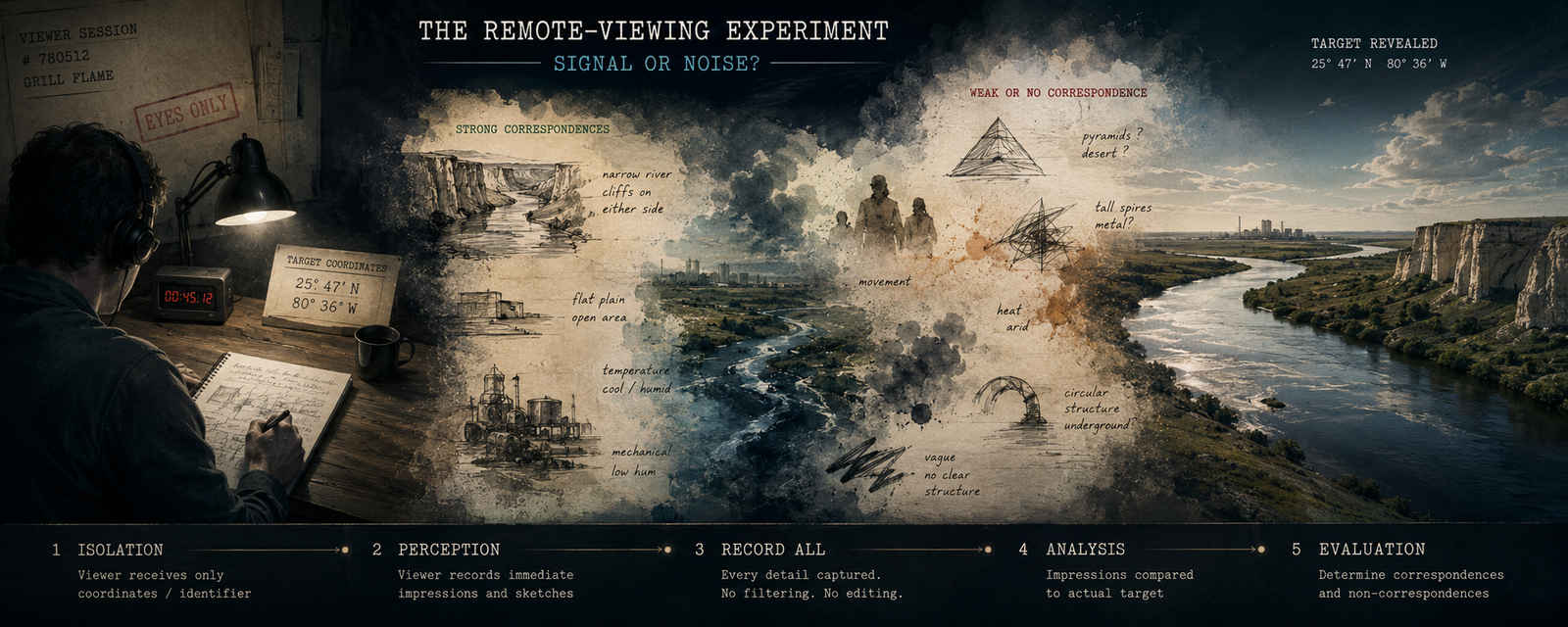
The basic idea behind remote viewing was almost unnervingly simple. Remove ordinary access to information about a target, give the participant as little identifying information as possible—sometimes coordinates or another abstract identifier—and ask what they perceive. Then record everything: shapes, textures, temperatures, buildings, landscapes, water, machinery, movement, people, sounds and impressions. Participants were encouraged to sketch whatever appeared, and only afterward would those impressions be compared with the actual target. SRI researchers described remote viewing as an apparent ability to obtain information about locations blocked from ordinary perception, reporting that certain subjects sometimes produced descriptions that corresponded surprisingly well with geographical or technical targets, although the interpretation and reproducibility of those results would become fiercely disputed.

This is where the declassified record becomes considerably more interesting than the mythology surrounding it, because the archive contains actual session transcripts, drawings, target coordinates and evaluation reports—including successes and failures. One released GRILL FLAME session involved coordinates initially believed to correspond to Offutt Air Force Base in Nebraska, but the coordinates were wrong and actually pointed farther north near Pisgah, Iowa. The remote viewer described a narrow, winding body of water crossing a flat plain with cliffs on either side. When analysts checked the coordinates, they found the location near the Soldier River, where a flat river plain is bordered in places by substantial cliffs. More intriguing still, the viewer apparently did not describe Offutt Air Force Base—the location the interviewer believed was being targeted—but instead described features associated with the location indicated by the mistaken coordinates. It is the kind of result that makes someone stop reading for a moment.

But turn deeper into the archive and another session tells a very different story. A 1978 GRILL FLAME training report concluded that the viewer’s impressions showed “absolutely no target correlation.” That contrast may be the most important thing to understand about the entire STARGATE story. The files do not show psychic super-agents effortlessly spying through walls, but neither do they show intelligence agencies conducting a handful of absurd experiments, finding nothing and immediately walking away. Instead, they reveal something far messier: apparent hits, unmistakable misses, ambiguous results and enough unexplained material to keep the investigation alive for years. And gradually, what had begun as an unusual research experiment started moving toward something much more consequential: the possibility that remote viewing might actually be used for intelligence. Could remote viewing actually be used?

FROM EXPERIMENT TO INTELLIGENCE OPERATION

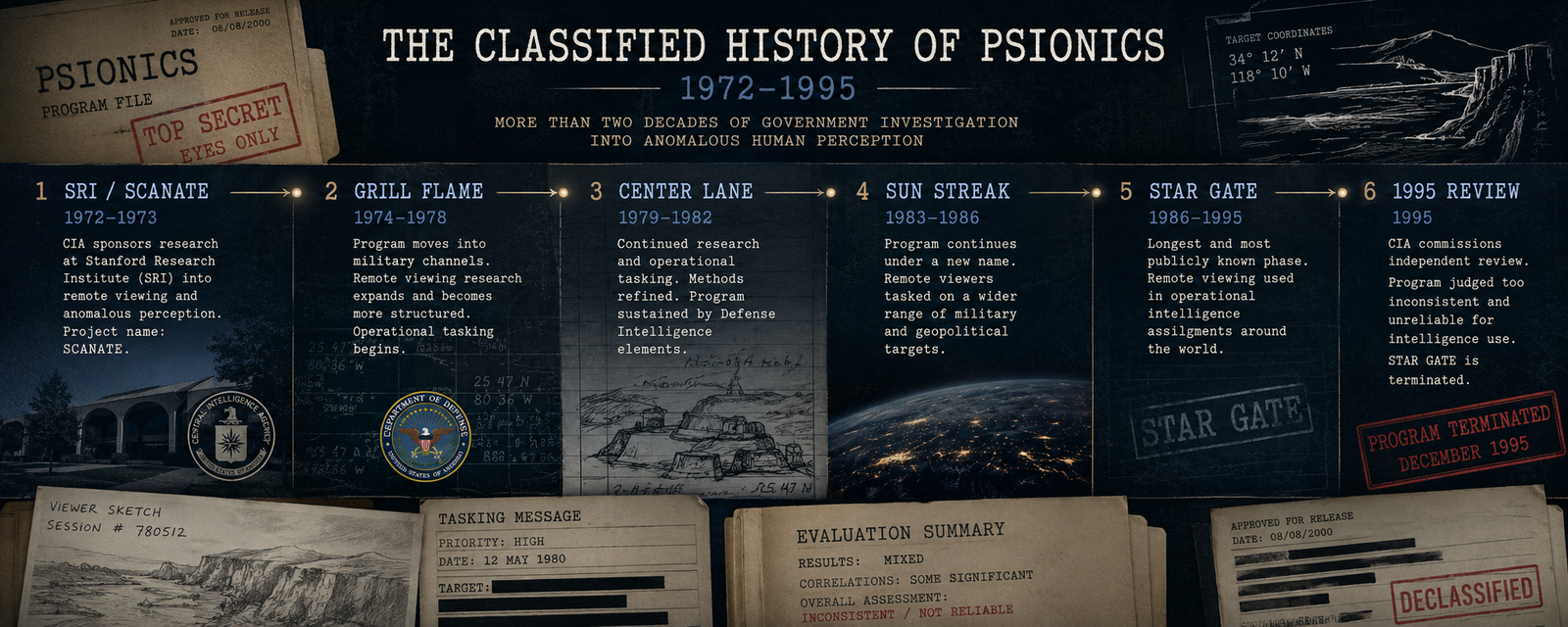
The names changed repeatedly—SCANATE, GRILL FLAME, CENTER LANE, SUN STREAK and eventually STAR GATE—as different agencies, sponsors and researchers became involved and methods evolved. What remained was the underlying question: could anomalous human perception provide information unavailable through conventional intelligence? Eventually, the government moved beyond controlled experiments and tried to find out under real-world conditions. Remote viewers were tasked against structures, geographical locations, military facilities and other targets while attempts were made to prevent ordinary access to the information they were being asked to perceive.

Some of those sessions were far removed from laboratory exercises. Declassified GRILL FLAME records show remote-viewing work conducted in connection with the Iranian hostage crisis, including a 1980 session performed in response to a Pentagon request for information relevant to the hostages. The viewer’s impressions were delivered as raw intelligence for the requesting organization to interpret. Consider what that means: someone inside the national-security apparatus had reached the point where an alleged psychic phenomenon was no longer simply an interesting laboratory anomaly. They were willing to ask whether it could contribute to an actual intelligence problem. By the 1980s, the implications were being discussed more broadly. A 1982 paper preserved in the CIA archive, On the Strategic Potential of ESP, examined the possible military importance of extrasensory perception, including the prospect of communication that might resist conventional interception or jamming. The fundamental question—whether ESP actually worked—remained unresolved, but if it could be demonstrated and harnessed, the strategic implications were potentially enormous.

The logic isn’t difficult to understand. Satellites have trajectories, aircraft leave signatures, radio communications can be intercepted and human agents can be discovered. But what would an adversary defend against if the collection platform were consciousness itself? That possibility helps explain why something most Americans associated with psychics and paranormal entertainment attracted sustained attention from organizations responsible for national security. It also pushed the investigation beyond remote viewing, because if information could somehow enter human awareness without passing through conventional sensory channels, the next question was unavoidable—and considerably larger: What exactly is consciousness capable of interacting with?

THE FRONTIER BEYOND REMOTE VIEWING

This is where the word psionics becomes useful—and dangerous. It captures a much larger family of proposed phenomena, but it can also blur the line between what government documents actually establish and what later speculation claims they establish. Remote viewing concerns acquiring information about a distant or inaccessible target. Telepathy proposes information transfer between minds, precognition proposes awareness of events before they occur, and psychokinesis—or PK—goes further still by proposing that mental intention might somehow influence matter or physical systems. These are not interchangeable claims, and STARGATE did not prove them.

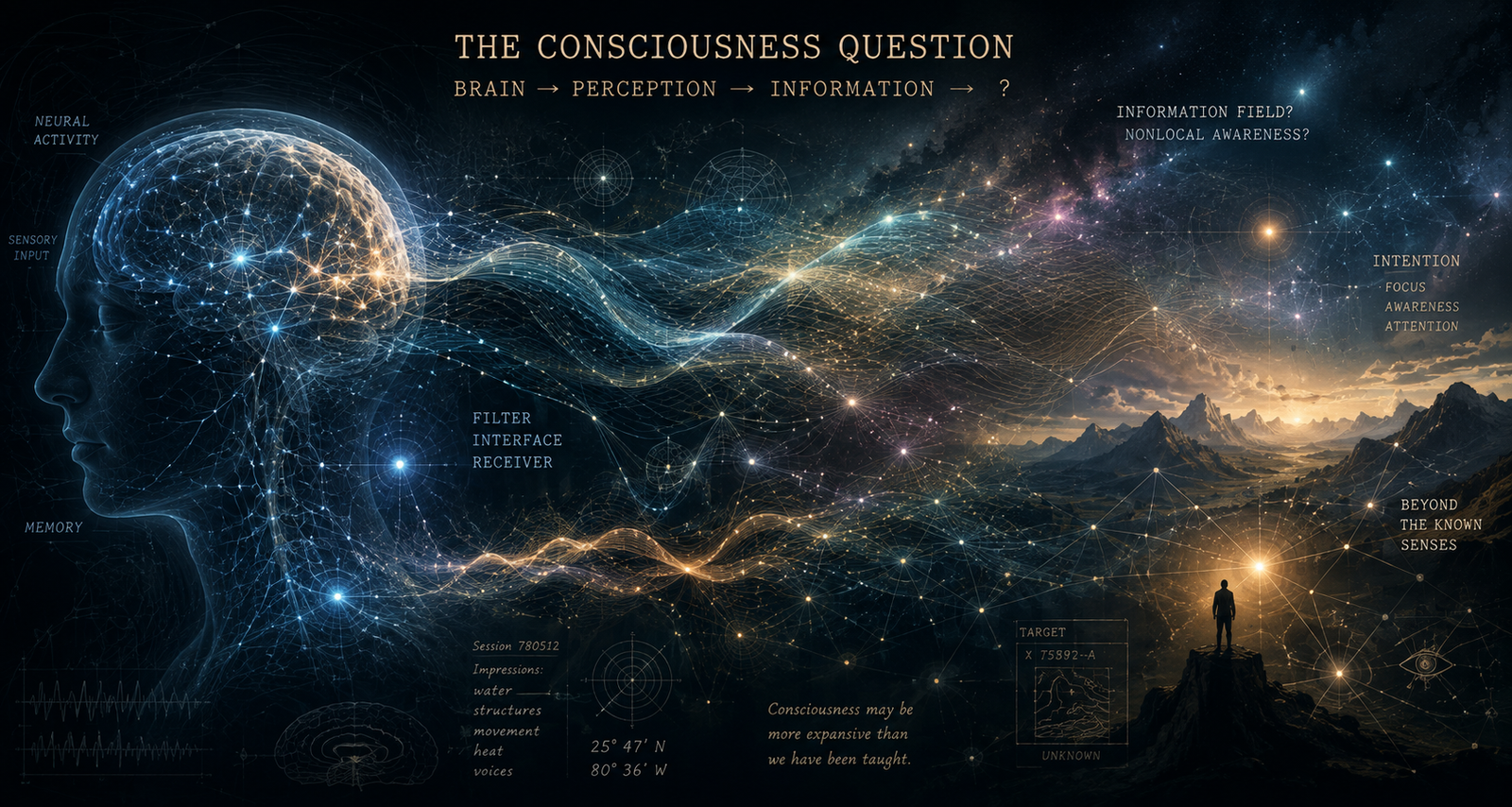
But once researchers began seriously asking whether consciousness could obtain information outside ordinary sensory pathways, the implications inevitably pushed toward a much larger mystery. We generally experience consciousness as though it exists somewhere inside us: the brain receives sensory information, processes it, integrates memory and emotion, and produces the continuous experience we call reality. That remains the dominant neuroscientific framework, yet consciousness itself remains deeply mysterious. We can increasingly map neural activity associated with perception, memory, decision-making and altered states, but explaining why physical activity in the brain produces subjective experience—or whether our current models capture the entirety of consciousness—remains far more difficult.

Psionics introduces a more radical possibility: perhaps consciousness is not entirely confined to the conventional information channels we currently understand. That possibility has inspired theories in which the brain functions not solely as the generator of consciousness, but perhaps partly as a receiver, filter or interface with a larger informational environment. Those ideas remain hypotheses, and the declassified STARGATE files do not prove them. But they help explain why these experiments became so philosophically explosive.

If even a small portion of the remote-viewing research represented genuine information acquisition beyond the conventional senses, then the important discovery would not simply be a new method of espionage. It would suggest that our model of human perception is incomplete. And that is a much larger proposition than anything contained in an intelligence report.

THE EXPERIMENT THAT WOULDN’T QUITE DIE

By the 1990s, however, fascination was no longer enough. After years of research and operational tasking, the program faced the question every intelligence capability eventually faces: Does it work reliably enough to matter? That is a much tougher standard than occasionally producing an extraordinary result. An intelligence officer cannot plan an operation around a phenomenon that works brilliantly one day, vaguely the next and not at all the day after that. Whatever information remote viewing produced had to be sufficiently specific, reproducible and reliable to influence real decisions.

In the mid-1990s, the program returned to CIA oversight and an external assessment was commissioned. The resulting debate became almost a miniature version of the controversy surrounding remote viewing itself. Statistician Jessica Utts concluded that portions of the experimental evidence showed statistically significant anomalous effects deserving scientific consideration, while psychologist Ray Hyman disputed whether those statistical findings justified concluding that a paranormal mechanism had been demonstrated. The operational question was even less forgiving. The CIA’s retrospective account says the assessment found enough accurate remote-viewing experiences to challenge a simple explanation of randomness, but the phenomenon remained too inconsistent, unreliable and sporadic to function as a dependable intelligence capability. The program was not restored.

That conclusion deserves to be taken seriously, but so does the peculiar history that preceded it. If there had been absolutely nothing of interest, why did the research survive across multiple programs, organizations and decades? Conversely, if remote viewing had developed into a dependable intelligence capability, why was it ultimately abandoned? Perhaps the answer lies somewhere inside that uncomfortable middle ground where science often becomes most interesting. Something may have been happening, but nobody learned how to make it happen reliably enough.

That distinction changes the question. Instead of asking simply, Is remote viewing real?, perhaps the more interesting question is whether anomalous human cognition—if it exists—is highly sensitive to conditions we don’t yet understand. The participant, the environment, expectation, emotional state, attention, intention and even the relationship between observer and experiment may all matter. And remarkably, decades after STARGATE ended, those same questions have begun appearing again in an entirely different setting, as the investigation of consciousness has moved beyond government laboratories and into the hands of independent researchers and people experimenting with intention, meditation and alleged psionic contact.

THE EXPERIMENT THAT WOULDN’T QUITE DIE

By the time the Cold War entered its final years, remote viewing had survived far longer than anyone might have expected from an intelligence program built around such an unconventional premise. It had moved from SRI into military programs, changed names repeatedly, attracted supporters and skeptics, and eventually been asked to do something far more difficult than produce interesting laboratory results: it had been asked to provide intelligence.That changed the standard completely. An unusual experimental result might be scientifically intriguing, but an intelligence capability has to be useful. If military planners are trying to locate a hostage, understand a weapons facility or determine what is happening somewhere they cannot physically reach, a vague impression that occasionally resembles the target isn’t enough. The information has to arrive with sufficient accuracy, specificity and consistency to help someone make a decision.

And that was where remote viewing began to struggle. The problem was not that nothing interesting had ever happened; some experimental results had been provocative enough to keep researchers returning to the subject for years. The problem was that whatever was occurring seemed extraordinarily difficult to summon on demand. One viewer might produce an unexpectedly accurate description of a target and then fail badly on another. A session might contain several striking correspondences surrounded by impressions that meant nothing. Even when something appeared anomalous, analysts still had to determine whether the information was specific enough to be useful rather than simply interesting after the fact. By 1995, after more than two decades of investigation, the question could no longer be avoided: Had the government discovered an extraordinary but unreliable human ability—or spent years trying to extract a signal from statistical noise?

The CIA commissioned an external assessment, and even then the answer refused to become simple. Statistician Jessica Utts examined portions of the experimental database and argued that the results contained statistically significant effects that could not easily be dismissed as chance, while psychologist Ray Hyman remained unconvinced that the evidence established a genuine paranormal phenomenon. The operational assessment was more decisive. Whatever anomalies might exist in the experimental record, remote viewing had not demonstrated the reliability, specificity and consistency necessary to function as a dependable intelligence tool. The program was terminated, but even its ending left an unresolved question behind. The official conclusion was not that intelligence agencies had uncovered a secret corps of psychic spies. They hadn’t. Nor did the historical record reduce neatly to more than twenty years of people imagining things in dark rooms.

Something had kept the investigation alive. Researchers had seen enough unusual results to continue asking questions, while intelligence officers had seen enough inconsistency to conclude that they could not rely upon them. That uncomfortable middle ground may be the most fascinating part of the entire story. Perhaps the failure of STARGATE was not necessarily proof that nothing anomalous had occurred, but evidence of a different problem: if anomalous cognition exists, no one had learned how to make it reliably appear on command. And when the government finally walked away, the question didn’t disappear with the program. It simply left the laboratory.

WHEN THE EXPERIMENT LEFT THE LABORATORY

In the decades after STARGATE ended, the investigation of consciousness began migrating into very different territory. Meditation communities, independent researchers, experiencers and eventually people interested in the UAP phenomenon began experimenting with a remarkably familiar idea: that focused human consciousness might somehow interact with information—or perhaps even phenomena—beyond the reach of the ordinary senses. Today, some of those practices are described as CE5, human-initiated contact or psionic contact. The language is different and the setting is different—there are no intelligence officers behind one-way glass or classified target envelopes waiting to be opened—but the underlying question bears an unmistakable resemblance to the one explored at SRI half a century ago: Can intention change what the observer is able to perceive?

People participating in these experiments commonly meditate, focus their attention, establish an intention and then observe the night sky, sometimes reporting unusual lights, objects or apparent responses they believe are connected to the exercise. None of this establishes that consciousness can summon a UAP, communicate with a nonhuman intelligence or influence something in the sky. Aircraft, satellites, meteors, atmospheric effects, camera artifacts and ordinary pattern recognition all have to remain on the table. What makes some contemporary experiments interesting is that the participants themselves wrestle with these possibilities. In one field account, participants attempting psionic contact near an ancient site debated in real time whether unusual lights around a mesa might be satellites, meteors, headlights, animals or camera problems. Some observations remained unexplained to them, but uncertainty remained part of the experience rather than something conveniently removed from it.

Another account turns the investigation inward. Instead of concentrating only on what might be happening in the sky, the experimenter questions why he wants contact in the first place. Is he searching for evidence, spiritual reassurance or recognition? Could grief, religious conditioning, ego or the desire to capture extraordinary proof influence what he perceives? He even confronts the possibility that UFO belief could become a substitute religion after leaving organized religion. Suddenly the modern psionics story becomes considerably more interesting than people standing beneath the stars attempting to summon UFOs, because we have arrived at the observer problem. If someone expects an anomalous event, does expectation make that person more perceptive—or simply more likely to interpret something ordinary as extraordinary? If meditation changes consciousness, is it facilitating an interaction or merely changing attention and perception? And if an unusual light appears immediately after an intention is directed toward the sky, has consciousness influenced an external event—or has the mind connected two unrelated events because their timing feels meaningful?

Those questions are not reasons to abandon the investigation; they are reasons to make it better. Record the sky independently. Track satellites and aircraft. Blind observers whenever possible. Compare contact sessions with control sessions and decide beforehand what qualifies as an anomalous event. Then see what remains. In a strange way, this brings the story directly back to STARGATE. Intelligence agencies eventually discovered that the real difficulty was not producing extraordinary anecdotes, but separating a potentially meaningful signal from expectation, ambiguity, coincidence and noise. Half a century later, anyone seriously investigating modern psionics faces exactly the same challenge—and the deeper we travel into this history, the more important it becomes to distinguish what the evidence actually shows from what we would like it to mean.

WHAT THE FILES ACTUALLY TELL US

That distinction may be the most important discipline in the entire psionics investigation, because the declassified record is extraordinary enough without embellishment. The CIA and Department of Defense really did investigate remote viewing and anomalous cognition. Scientists and intelligence personnel conducted experiments in which remote viewers were given targets and asked to describe information they could not conventionally access. The programs survived under a succession of names for more than two decades, and eventually remote viewers were assigned operational intelligence problems. Those facts are no longer rumors. They are history.

The history becomes more complicated when we ask what those experiments actually demonstrated. Some sessions produced striking correspondences, some experimental datasets were interpreted by researchers as statistically significant, and some of the people closest to the work remained convinced they had observed something conventional models of perception could not adequately explain. Other sessions failed completely. Descriptions could be vague, interpretation could occur after a target was revealed, and results were inconsistent. When the government eventually asked whether remote viewing could produce sufficiently reliable intelligence to justify continued operational use, the answer was no. What remains is an unusual historical record that neither believers nor skeptics can completely simplify without discarding inconvenient pieces of the story.

Over the years, however, something much larger grew around that record. Stories of telepathic communication with nonhuman intelligence, psychokinetic weapons, consciousness-controlled craft, dimensional access, reality manipulation and secret technologies supposedly derived from psychic research became intertwined with the mythology surrounding STARGATE. The released documents do not establish those claims, but that does not mean every unexplained possibility surrounding consciousness should therefore be declared impossible. It means we have reached an important boundary—the point where documented evidence ends and speculation begins. Preserving that boundary makes the documented story more powerful, not less.

We don’t need secret psychic weapons or dimensional portals to make STARGATE extraordinary. The historical reality is already remarkable: for more than two decades, elements of the American national-security establishment seriously investigated whether human consciousness could acquire information beyond the conventional senses. They never demonstrated a reliable operational technology, but they left behind unusual results, scientific disagreement and unresolved questions that prevented the subject from completely disappearing. Perhaps that is why the story still matters. STARGATE began as an intelligence problem. It ended as a consciousness problem. What are the actual limits of human perception? That question is much harder to terminate than a government program, and it carries us beyond what the CIA believed in 1972 toward something modern science still does not fully understand: What if we have barely begun to understand what the human mind is capable of?

“The day science begins to study non-physical phenomena, it will make more progress in one decade than in all the previous centuries of its existence.” — commonly attributed to Nikola Tesla

GAR NOTE: Project STARGATE and its predecessor programs are documented parts of U.S. intelligence history. Their existence establishes that anomalous cognition and remote viewing were investigated; it does not establish telepathy, psychokinesis, UAP contact or other proposed psionic phenomena as scientific fact. GAR distinguishes documented government programs, disputed experimental results and later speculative interpretations throughout this report.

Sign up to receive Our Weekly Briefing Newsletter

Begin your journey with weekly insights designed to expand awareness and ground you in truth. Our free tier gives you a powerful introduction without any commitment.


STOP DROWNING IN THE NOISE. START SEEING THE TRUTH. Join over 99,000 truth seekers. Get the essential intelligence, alternative news, and disclosure updates that the mainstream media won’t touch.

Recently published Reports

🔔 SPECIAL REPORTS

Help Us Bypass Censorship. Share This.

Have questions?

At Great Awakening Report, we are dedicated to supporting your journey toward truth and enlightenment through our specialized Coaching and Consulting services.​

Coaching Services: Our coaching programs are designed to guide you through personal awakening and transformation. We offer personalized sessions that focus on expanding consciousness, uncovering hidden truths, and fostering spiritual growth. Our experienced coaches provide the tools and insights necessary to navigate your path with clarity and confidence.​

Consulting Services: For organizations and individuals seeking deeper understanding and strategic guidance, our consulting services offer expert analysis and solutions. We delve into areas such as global transitions, alternative news insights, and consciousness studies to provide comprehensive strategies tailored to your unique objectives.​

Embark on a transformative journey with our Coaching and Consulting services, and unlock your highest potential. To learn more and schedule a session, visit our Coaching and Consulting pages.​

Thank you

Thank you to our subscribers and readers for your continued support and dedication to truth and awakening. Your encouragement, engagement, and belief in our mission make everything we do possible. Together, we are expanding awareness and helping illuminate the path forward.

If you would like to further support the Great Awakening team and our ongoing efforts to share insight, knowledge, and truth, you can DONATE HERE.

With deep gratitude,

– Great Awakening Team

About the Author: Great Awakening Team

Great Awakening Team

DISCLAIMER: All statements, claims, views and opinions that appear anywhere on this site, whether stated as theories or absolute facts, are always presented by The Great Awakening Report (GAR) as unverified—and should be personally fact checked and discerned by you, the reader.Any opinions or statements herein presented are not necessarily promoted, endorsed, or agreed to by GAR, those who work with GAR, or those who read or subscribe to GAR.Any belief or conclusion gleaned from content on this site is solely the responsibility of you the reader to substantiate.Any actions taken by those who read material on this site are solely the responsibility of the acting party.You are encouraged to think for yourself and do your own research.Nothing on this site is meant to be believed without question or personal appraisal.

COPYRIGHT DISCLAIMER: Citation of articles and authors in this report does not imply ownership. Works and images presented here fall under Fair Use Section 107 and are used for commentary on globally significant newsworthy events. Under Section 107 of the Copyright Act 1976, allowance is made for fair use for purposes such as criticism, comment, news reporting, teaching, scholarship, and research.

COMMUNITY GUIDELINES DISCLAIMER: The points of view and purpose of this video is not to bully or harass anybody, but rather share that opinion and thoughts with other like-minded individuals curious about the subject.