








Help Us Bypass Censorship. Share This.
Sign up to receive Our Weekly Briefing Newsletter
Begin your journey with weekly insights designed to expand awareness and ground you in truth. Our free tier gives you a powerful introduction without any commitment.
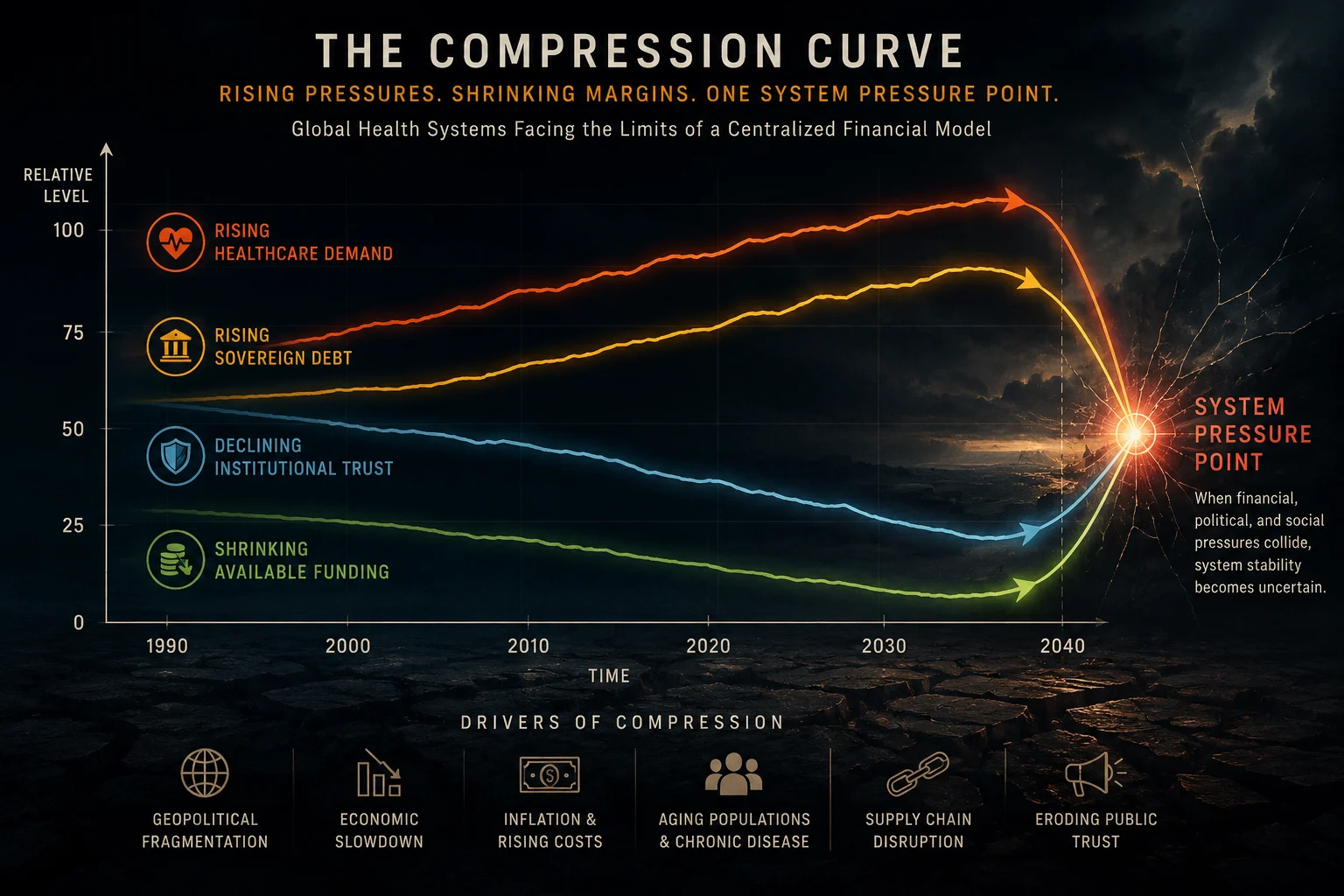
For decades, modern healthcare systems expanded under the assumption that funding, coordination, and institutional stability would continue indefinitely. Today, rising debt, geopolitical fragmentation, and declining public trust are beginning to test that assumption.
Modern healthcare feels permanent to most people. Hospitals operate around the clock, vaccines arrive on schedule, emergency systems mobilize when crises emerge, and international agencies coordinate responses across continents. The entire structure feels vast, stable, and untouchable — a system so deeply embedded into modern civilization that few people ever stop to question how financially dependent and structurally fragile it may actually be beneath the surface.
Yet beneath the appearance of stability, the financial architecture supporting global healthcare is beginning to strain under mounting pressure. Rising sovereign debt, inflation, geopolitical instability, supply chain disruptions, donor fatigue, and declining institutional trust are all converging at the same moment global health demands continue expanding. From pandemic preparedness and vaccine distribution to chronic disease management and humanitarian response, the scale of modern healthcare coordination now requires enormous and continuous financial support that many governments and institutions are increasingly struggling to sustain.
For decades, the dominant assumption was that global systems would simply continue expanding. Economic growth would persist, funding streams would remain stable, technological advancement would improve efficiency, and international coordination would gradually solve many of the world’s most pressing health challenges. But the world entering the late 2020s looks very different from the world these systems were originally built for. Governments are now carrying historic levels of debt, inflation continues placing pressure on public budgets, geopolitical conflicts are redirecting national priorities, and public trust in centralized institutions has weakened significantly following years of political division, pandemic controversy, and growing skepticism toward large-scale governance structures.
Increasingly, one uncomfortable question is beginning to emerge beneath the surface of the healthcare conversation itself:
What happens when centralized systems built for perpetual expansion begin running out of money?
Viewed in isolation, this may appear to be a healthcare funding issue. But when viewed collectively alongside growing pressures in banking, energy, media, transportation, and global supply chains, a much larger pattern begins to appear. The growing strain surrounding global health financing may actually be reflecting something far deeper: the mounting pressure now building across many of the large centralized systems that have defined modern civilization for decades.
The End of Unlimited Expansion?
For much of the modern era, globalization created the conditions for rapid institutional expansion across nearly every major sector of society. Healthcare systems became increasingly interconnected, pharmaceutical supply chains stretched across continents, international health agencies expanded their reach, and public health initiatives evolved into highly coordinated global operations requiring continuous collaboration between governments, nonprofits, corporations, and financial institutions. The scale of this infrastructure would have been unimaginable only a few generations ago.
At the center of this expansion was a largely unquestioned belief that growth itself would continue indefinitely. Population growth, economic expansion, technological innovation, and international cooperation were expected to steadily increase over time, creating the financial and logistical foundation necessary to support ever-larger healthcare systems. In many ways, this model succeeded in dramatically expanding medical access, emergency response capabilities, disease surveillance, and global coordination during health crises.
But systems built during periods of accelerating expansion often struggle when the surrounding environment begins changing faster than the systems themselves can adapt.
Today, governments around the world are facing rising debt obligations, weakening currencies, inflationary pressure, slowing economic growth, and increasing geopolitical fragmentation. Resources that once flowed steadily into healthcare infrastructure are now being divided across multiple competing priorities including military spending, energy security, migration management, infrastructure repair, and domestic economic stabilization. At the same time, aging populations, chronic disease rates, mental health challenges, and future pandemic preparedness are all increasing demands on healthcare systems simultaneously.
The result is a growing imbalance that few institutions openly discuss. Global healthcare systems are being asked to expand their responsibilities precisely when the financial and political stability supporting those systems is becoming harder to maintain. According to multiple projections, the global health financing gap could reach hundreds of billions of dollars annually by the end of the decade, placing enormous pressure on international agencies and lower-income nations that depend heavily on external funding to maintain healthcare infrastructure and public health programs.
What makes this moment especially significant is that the pressure no longer appears temporary. Increasingly, it feels structural.
The issue is no longer simply whether funding shortages can be resolved through larger donations, emergency aid packages, or temporary policy adjustments. The deeper issue emerging beneath the surface is whether the current model itself — large-scale centralized healthcare coordination dependent upon continuous expansion and increasing financial flows — remains sustainable in an era defined by fragmentation, instability, and mounting systemic pressure.
The Fragility of Centralized Systems
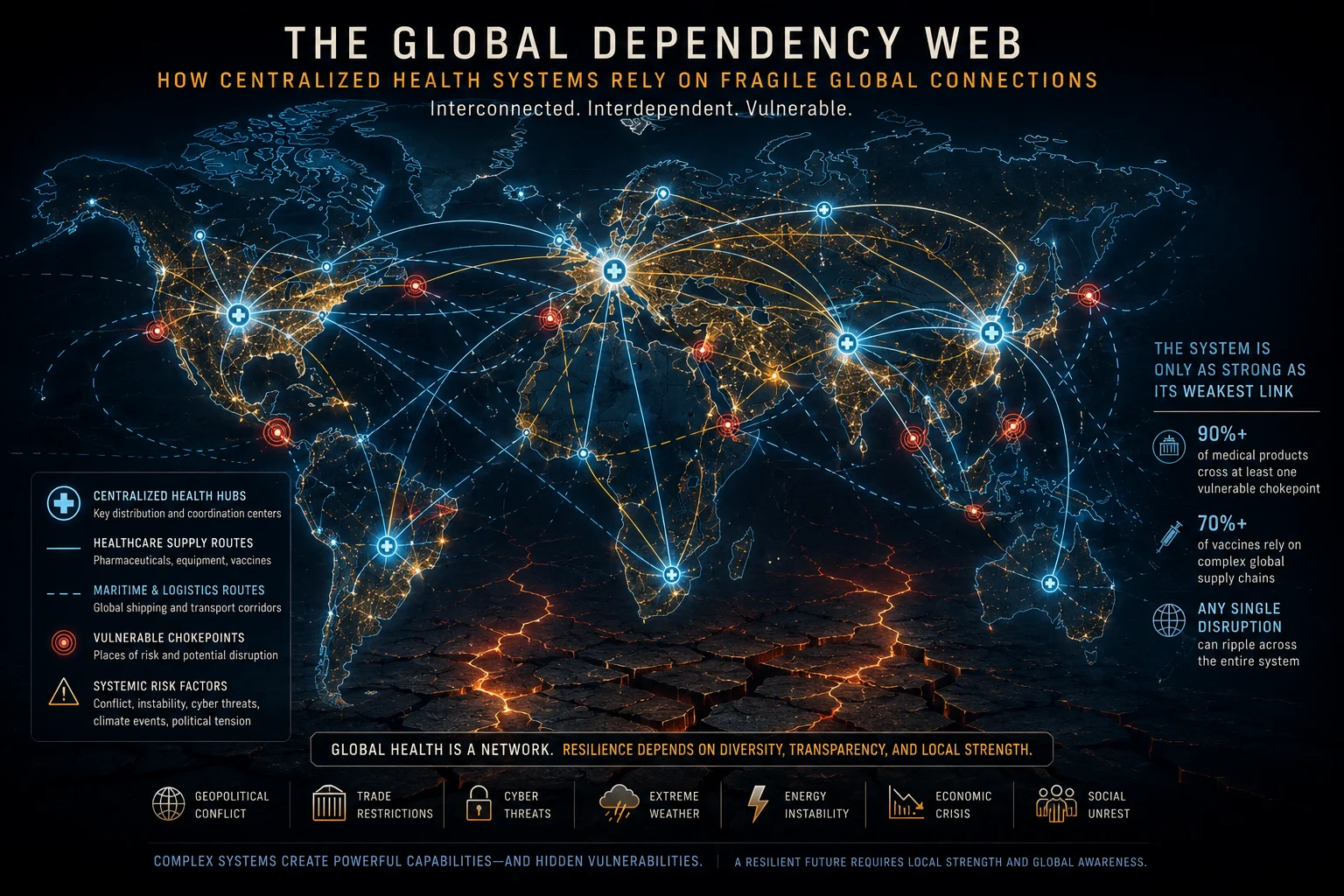
One of the most important lessons exposed in recent years is how dependent modern healthcare infrastructure has become on centralized coordination and highly interconnected global systems. While this structure allowed institutions to scale rapidly and improve efficiency across enormous populations, it also introduced vulnerabilities that remained largely invisible until multiple stress points began occurring simultaneously.
A disruption in one region can now affect pharmaceutical supply chains globally. A funding shortage inside one institution can ripple outward across multiple nations at once. Political disagreements between governments can slow the movement of medicine, emergency resources, and coordinated response efforts across entire regions. Systems designed for maximum efficiency often perform exceptionally well under stable conditions, but they can become increasingly fragile during periods of sustained disruption.
The COVID era brought many of these vulnerabilities into public view. Shortages, logistical bottlenecks, conflicting institutional guidance, staffing strain, delayed treatments, and fractured communication systems exposed how quickly interconnected healthcare networks could become destabilized under pressure. While centralized coordination allowed rapid mobilization in certain areas, it also revealed how dependent modern healthcare had become on uninterrupted institutional functionality operating at global scale.
This does not necessarily point toward malicious intent or deliberate failure. In many ways, it reflects the natural consequence of systems becoming so large, interconnected, and financially dependent that resilience gradually gives way to complexity and dependency. The larger systems become, the more difficult they often are to adapt quickly during periods of uncertainty.
What makes this pattern increasingly difficult to ignore is that healthcare is not the only sector experiencing these pressures. Similar signs of strain are appearing across banking systems, energy grids, transportation infrastructure, food distribution networks, housing markets, and media institutions. Individually, each issue may appear manageable. But collectively, they suggest something larger may be unfolding beneath the surface of modern civilization itself.
The pattern emerging is not necessarily collapse.
It is compression.
Systems built during decades of globalization and expansion are now colliding with financial limitations, political fragmentation, declining trust, resource constraints, and increasing global complexity all at the same time.
Can Technology Save the System?
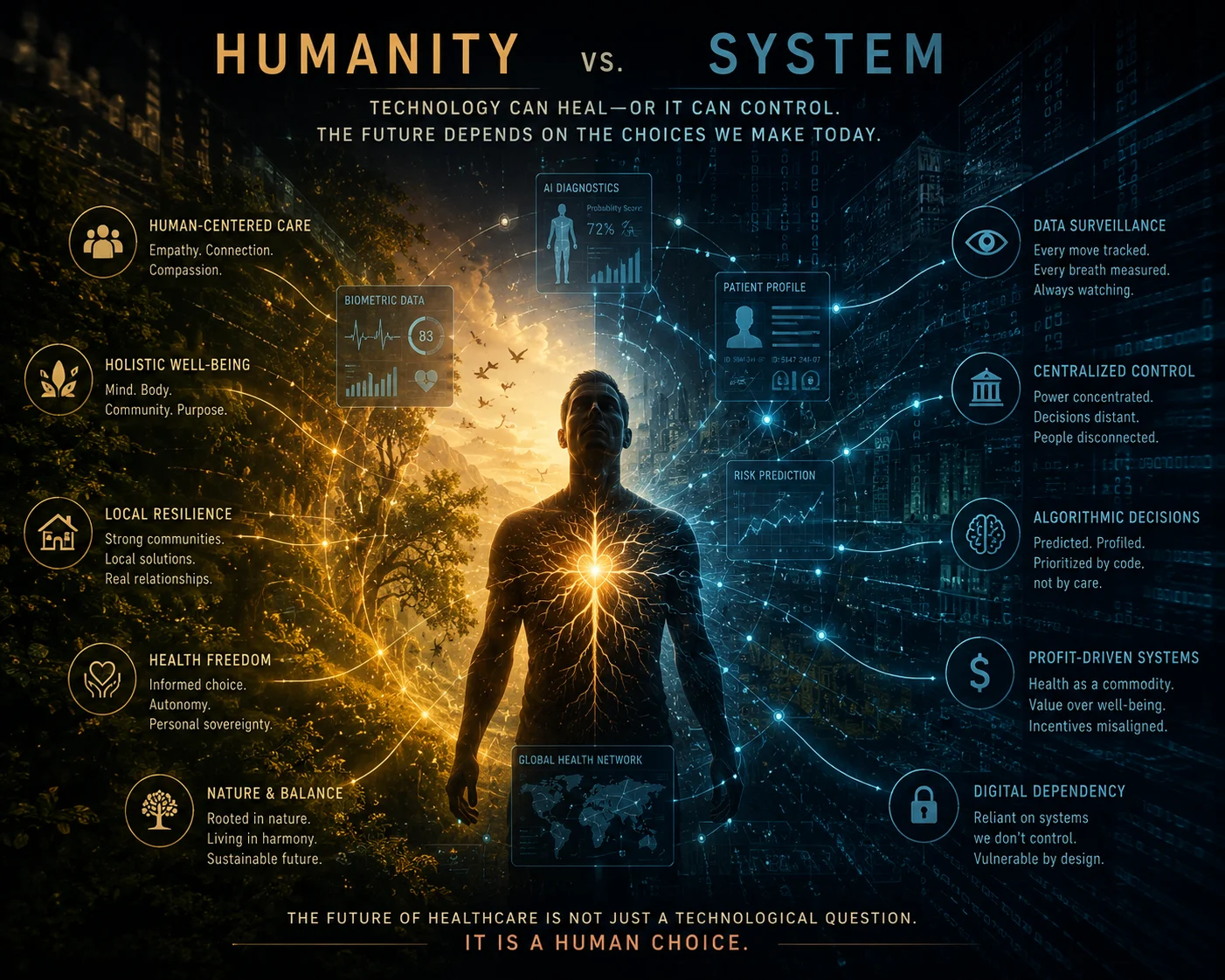
As financial pressure intensifies across global healthcare systems, technology is increasingly being presented as the solution capable of stabilizing strained institutions while expanding efficiency at scale. Artificial intelligence, predictive analytics, digital health records, biometric monitoring, telemedicine, automated diagnostics, and data-driven healthcare management are all being integrated at accelerating speed. Supporters argue these technologies can reduce operational inefficiencies, lower costs, improve accessibility, and help institutions manage rising healthcare demands more effectively.
And in many ways, they may.
Technology has the potential to improve communication, expand remote healthcare access, streamline diagnostics, and optimize resource allocation in ways that were impossible only a decade ago. In lower-resource regions especially, digital healthcare tools may help bridge gaps that traditional infrastructure alone has struggled to address.
But alongside these advancements, a deeper layer of questions is also beginning to emerge.
Who ultimately controls the data flowing through increasingly digitized healthcare systems? Does artificial intelligence primarily improve patient outcomes, or does it optimize institutional efficiency and financial management? Does greater technological integration create resilience, or does it deepen dependency on centralized digital infrastructure that itself remains vulnerable to disruption, cyberattacks, surveillance concerns, and corporate consolidation?
In many ways, the healthcare conversation mirrors a much broader societal transition now unfolding across nearly every major industry. As institutions encounter mounting financial pressure, automation and AI are increasingly being introduced as stabilizing mechanisms designed to preserve functionality within systems that are becoming more difficult and expensive to maintain through traditional means alone.
Yet technology may ultimately extend the lifespan of strained systems without fully resolving the deeper structural issues creating instability in the first place.
The future of healthcare may depend not only on innovation itself, but on whether technology remains aligned with human well-being rather than becoming another mechanism for scaling centralized control, data consolidation, and institutional dependency more efficiently.
The Search for a New Model
The deeper issue emerging beneath the global health funding crisis is not simply financial.
It is structural.
Systems built during an era of globalization, economic expansion, institutional consolidation, and centralized coordination are now colliding with a world entering fragmentation, instability, and accelerating complexity. This does not mean global healthcare systems suddenly disappear, nor does it mean centralized institutions no longer serve important functions. But it may mean the current model becomes increasingly difficult to sustain in its present form as financial pressure, public distrust, political division, and technological disruption continue intensifying simultaneously.
Around the world, alternative approaches are already beginning to emerge alongside traditional healthcare structures. Localized healthcare networks, preventative wellness models, functional and integrative medicine, decentralized health communities, technology-assisted remote care, and resilience-focused community initiatives are all gaining attention as people increasingly search for systems that feel more adaptive, transparent, accessible, and human-centered.
Some of these approaches will succeed.
Some will fail.
Some may ultimately become integrated into future healthcare models that combine centralized infrastructure with more localized and preventative forms of care.
But the direction itself signals something important.
People are beginning to recognize that resilience may not come solely from making existing systems larger, faster, or more centralized. Increasingly, resilience may depend upon adaptability, decentralization, local support structures, transparency, and reducing dependency on fragile global systems operating under continuous financial and political strain.
In many ways, the growing global health funding crisis reflects a much larger transition now unfolding across modern civilization itself. Systems that once appeared permanent are increasingly encountering the limits of debt expansion, institutional complexity, political fragmentation, and declining public confidence. Healthcare simply happens to be one of the clearest areas where these pressures are becoming impossible to ignore.
Conclusion: Beyond Healthcare
The global health funding crisis is ultimately about far more than budgets, institutions, or temporary financing shortages.
It is a reflection of a much larger transition now unfolding across the modern world.
Systems built for endless expansion are beginning to collide with financial strain, geopolitical instability, institutional distrust, demographic pressure, and increasing global complexity. Healthcare merely provides one of the clearest windows into those deeper structural tensions now emerging simultaneously across society.
The deeper question is no longer whether centralized systems can continue expanding indefinitely.
The deeper question is whether humanity can build systems resilient enough to serve people during an era where certainty itself is beginning to fracture.
Because when systems become too large, too dependent, and too financially strained, the greatest risk is not merely institutional instability.
It is the growing distance between human needs and the systems designed to support them.
Sign up to receive Our Weekly Briefing Newsletter
Begin your journey with weekly insights designed to expand awareness and ground you in truth. Our free tier gives you a powerful introduction without any commitment.
STOP DROWNING IN THE NOISE. START SEEING THE TRUTH. Join over 99,000 truth seekers. Get the essential intelligence, alternative news, and disclosure updates that the mainstream media won’t touch.
Latest Reports
 Monthly ReportConscious Practices · October 2026 EditionOctober 5, 2026
 Weekly ReportAwakening The Sleeping Giant · October 5th EditionOctober 5, 2026
 Weekly ReportAwakening The Sleeping Giant · September 28th EditionSeptember 28, 2026
 Weekly ReportAwakening The Sleeping Giant · September 21st EditionSeptember 21, 2026View all weekly reports
Special Reports
 Special ReportTHE AWAKENING JOURNEY: Hero’s Journey Part II · Week 1October 3, 2026
 Special ReportGlobal Everything Collapse · Economic Chaos · Part IOctober 1, 2026
 Special ReportCreating A Conscious Culture · Part ISeptember 3, 2026
 Special ReportThe Great Healing: Detox, Defense & Sovereignty In an Engineered World · Part ISeptember 1, 2026View all special reports
Help Us Bypass Censorship. Share This.
Join the Discussion
Related Posts

Have questions?
At Great Awakening Report, we are dedicated to supporting your journey toward truth and enlightenment through our specialized Coaching and Consulting services.
Coaching Services: Our coaching programs are designed to guide you through personal awakening and transformation. We offer personalized sessions that focus on expanding consciousness, uncovering hidden truths, and fostering spiritual growth. Our experienced coaches provide the tools and insights necessary to navigate your path with clarity and confidence.
Consulting Services: For organizations and individuals seeking deeper understanding and strategic guidance, our consulting services offer expert analysis and solutions. We delve into areas such as global transitions, alternative news insights, and consciousness studies to provide comprehensive strategies tailored to your unique objectives.
Embark on a transformative journey with our Coaching and Consulting services, and unlock your highest potential. To learn more and schedule a session, visit our Coaching and Consulting pages.
Thank you
Thank you to our subscribers and readers for your continued support and dedication to truth and awakening. Your encouragement, engagement, and belief in our mission make everything we do possible. Together, we are expanding awareness and helping illuminate the path forward.
If you would like to further support the Great Awakening team and our ongoing efforts to share insight, knowledge, and truth, you can DONATE HERE.
With deep gratitude,
– Great Awakening Team
About the Author: Great Awakening Team

We are a community. We are cultural creatives and like minded people seeking the truth and focusing on disclosure, awakening and consciousness. Our focus is real news as researchers, reporters and truth seekers. We are here to teach, to spread the word, to serve and to help. We are a collective, a movement, free from all programing, not closed minded and not discriminatory. We are not political. We are not religious but we are spiritual. We study, research, and report on a wide range of subjects and topics, from the current geopolitical climate to health and wellness, from earth’s history to spiritual practices. We are forward thinkers and visionaries, we are guides for the transition as we usher in The Great Awakening.
THIS WEBSITE DOES NOT PROVIDE MEDICAL ADVICE: The information, including but not limited to text, graphics, images, and other material contained on this website, are for informational purposes only. No material on this site is intended to be a substitute for professional medical advice, diagnosis, or treatment. Always seek the advice of your physician or other qualified health care provider with any questions you may have regarding a medical condition or treatment and before undertaking a new health care regimen, and never disregard professional medical advice or delay in seeking it because of something you have read on this website.
DISCLAIMER: All statements, claims, views and opinions that appear anywhere on this site, whether stated as theories or absolute facts, are always presented by The Great Awakening Report (GAR) as unverified—and should be personally fact checked and discerned by you, the reader.Any opinions or statements herein presented are not necessarily promoted, endorsed, or agreed to by GAR, those who work with GAR, or those who read or subscribe to GAR.Any belief or conclusion gleaned from content on this site is solely the responsibility of you the reader to substantiate.Any actions taken by those who read material on this site are solely the responsibility of the acting party.You are encouraged to think for yourself and do your own research.Nothing on this site is meant to be believed without question or personal appraisal.
COPYRIGHT DISCLAIMER: Citation of articles and authors in this report does not imply ownership. Works and images presented here fall under Fair Use Section 107 and are used for commentary on globally significant newsworthy events. Under Section 107 of the Copyright Act 1976, allowance is made for fair use for purposes such as criticism, comment, news reporting, teaching, scholarship, and research.
COMMUNITY GUIDELINES DISCLAIMER: The points of view and purpose of this video is not to bully or harass anybody, but rather share that opinion and thoughts with other like-minded individuals curious about the subject.