














Help Us Bypass Censorship. Share This.
Sign up to receive Our Weekly Briefing Newsletter
Begin your journey with weekly insights designed to expand awareness and ground you in truth. Our free tier gives you a powerful introduction without any commitment.
“A liquidity freeze isn’t the end of the system. It’s the moment the system inhales.”
Introduction: Why Liquidity Matters More Than You Think
A bank liquidity freeze doesn’t mean banks run out of money.
It means they temporarily lose access to cash flow.
Liquidity is what allows banks to process withdrawals, clear payments, issue loans, and meet daily operational demands. When liquidity tightens — even if assets still exist on paper — the system slows down. In moments of stress, that slowdown can cascade.
A liquidity freeze typically emerges during financial strain: when confidence drops, interbank lending dries up, or funding sources contract. To prevent panic and bank runs, regulators and central banks may step in to temporarily restrict outflows while emergency support mechanisms activate.
These events are rare — but not theoretical.
Understanding what one would actually look like removes speculation and replaces it with clarity.
For a deeper dive into economic instability and systemic risks, see our related analysis on financial system breakdowns and global risk factors at the Great Awakening Report.
The Mechanics of a 72-Hour Freeze
A 72-hour liquidity freeze is not chaos. It is coordinated containment.
The goal is to pause acceleration — not to dismantle the system.
During such a window, banks and regulators would likely implement:
- Withdrawal and Transfer Limits:Customers may face caps on ATM withdrawals, delays on large transfers, or temporary restrictions on high-volume payment processing. The objective is simple: slow capital flight.
- Interbank Lending Pauses: Banks may restrict lending to one another to prevent liquidity stress from spreading across institutions.
- Central Bank Emergency Facilities: Central banks could activate emergency lending programs, asset purchase mechanisms, or liquidity lines to reinforce reserves.
- Suspension of Non-Essential Outflows: Dividend payments, stock buybacks, and certain discretionary asset transactions may pause to conserve balance sheet stability.
- Regulatory Oversight and Coordination: Authorities monitor the system in real time, assessing systemic risk and calibrating interventions.
Seventy-two hours may not sound long — but in financial markets, it can be enough time to stabilize liquidity channels and prevent contagion.
The objective is psychological containment as much as financial containment.
For in-depth coverage of economic and financial system shifts, see The Great Awakening Report and related analyses on financial crises and systemic controls.
What Customers and Businesses Would Experience
For individuals, the experience would feel inconvenient — possibly unsettling — but not necessarily catastrophic.
You might see:
- Daily withdrawal limits
- Delays in large transfers
- Slower payment processing
- Temporary interruptions in certain banking services
For most households, short-term impact would depend on liquidity preparedness.
Businesses, however, would feel pressure faster.
Payroll cycles. Supplier payments. Vendor settlements. Inventory purchasing. Cash flow timing matters. A short liquidity interruption can create operational strain, particularly for small and mid-sized enterprises operating with tighter margins.
The real risk isn’t three days. It’s confidence erosion. If trust falters, behavior shifts. That’s when stress compounds.
For more insights on economic challenges and systemic impacts, see the Great Economic Awakening: Reclaiming Sovereignty in a System Built on Debt and explore business continuity strategies in The Future of Corporate Wellness series.
Regulatory Framework Behind It
Liquidity freezes do not occur in a vacuum.
Central banks and regulators operate within established frameworks designed specifically to prevent systemic collapse.
In the United States, the Federal Reserve, FDIC, and OCC possess tools to intervene during liquidity crises. These include emergency lending authorities, resolution mechanisms, and coordination protocols across institutions.
Globally, Basel III liquidity coverage ratios require banks to maintain high-quality liquid assets capable of covering short-term stress scenarios.
Stress testing, contingency planning, and capital buffers exist precisely because liquidity freezes have happened before.
The 72-hour window is not improvisation. It’s pre-modeled containment.
For further insights into financial regulatory themes within broader systemic contexts, see related analyses on economic collapse risks and institutional trust erosion at Great Awakening Report here and here.
Historical Precedents
History shows how quickly liquidity can evaporate.
The 1930s Bank Runs: Widespread withdrawals during the Great Depression led to systemic collapse and ultimately the creation of federal deposit insurance.
The 2007–2008 Financial Crisis: Interbank lending froze as institutions questioned one another’s solvency. Central banks responded with unprecedented liquidity injections.
The 1997 Asian Financial Crisis: Rapid capital flight destabilized banking systems, triggering currency devaluations and emergency interventions.
Each case reinforced the same lesson:
Liquidity is confidence.
When confidence disappears, cash disappears faster.
Preparing Without Panicking
Preparation does not require fear. It requires prudence.
For Individuals:
- Maintain an emergency reserve covering short-term expenses
- Diversify across institutions if appropriate
- Understand your bank’s policies during crisis conditions
- Avoid overleveraging
For Businesses:
- Monitor cash flow timing carefully
- Maintain working capital buffers
- Diversify credit relationships
- Develop contingency payment strategies
Liquidity freezes are designed to be temporary.
But resilience reduces stress.
For an in-depth understanding of economic system stresses and strategies for resilience, see our related coverage on The Great Economic Awakening, and insights into financial collapse signs.
Sign up to receive Our Weekly Briefing Newsletter
Begin your journey with weekly insights designed to expand awareness and ground you in truth. Our free tier gives you a powerful introduction without any commitment.
STOP DROWNING IN THE NOISE. START SEEING THE TRUTH. Join over 99,000 truth seekers. Get the essential intelligence, alternative news, and disclosure updates that the mainstream media won’t touch.
Latest Reports
 Monthly ReportConscious Practices · October 2026 EditionOctober 5, 2026
 Weekly ReportAwakening The Sleeping Giant · October 5th EditionOctober 5, 2026
 Weekly ReportAwakening The Sleeping Giant · September 28th EditionSeptember 28, 2026
 Weekly ReportAwakening The Sleeping Giant · September 21st EditionSeptember 21, 2026View all weekly reports
Special Reports
 Special ReportTHE AWAKENING JOURNEY: Hero’s Journey Part II · Week 1October 3, 2026
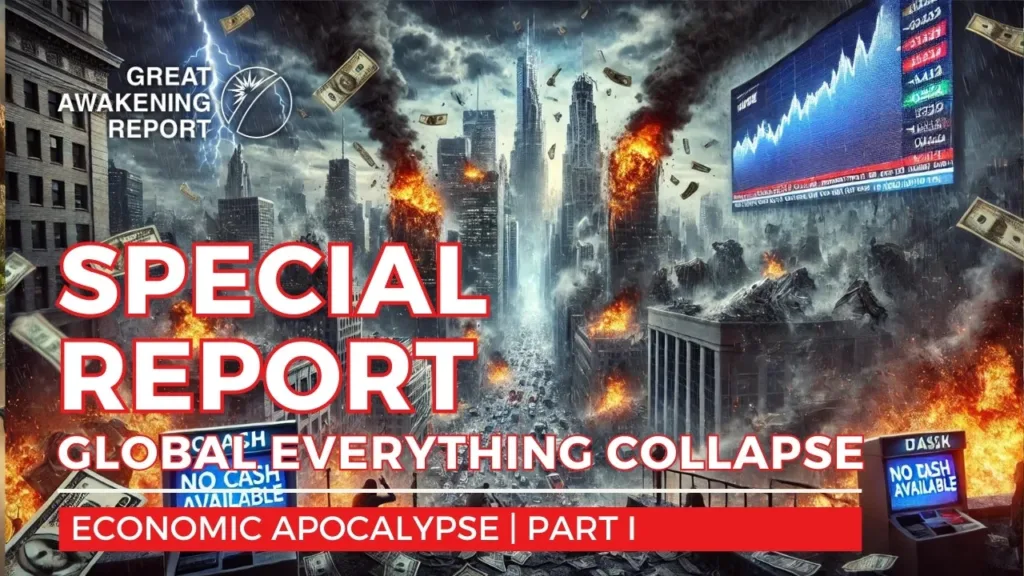
 Special ReportGlobal Everything Collapse · Economic Chaos · Part IOctober 1, 2026
 Special ReportCreating A Conscious Culture · Part ISeptember 3, 2026
 Special ReportThe Great Healing: Detox, Defense & Sovereignty In an Engineered World · Part ISeptember 1, 2026View all special reports
Help Us Bypass Censorship. Share This.
Join the Discussion
Related Posts



Have questions?
At Great Awakening Report, we are dedicated to supporting your journey toward truth and enlightenment through our specialized Coaching and Consulting services.
Coaching Services: Our coaching programs are designed to guide you through personal awakening and transformation. We offer personalized sessions that focus on expanding consciousness, uncovering hidden truths, and fostering spiritual growth. Our experienced coaches provide the tools and insights necessary to navigate your path with clarity and confidence.
Consulting Services: For organizations and individuals seeking deeper understanding and strategic guidance, our consulting services offer expert analysis and solutions. We delve into areas such as global transitions, alternative news insights, and consciousness studies to provide comprehensive strategies tailored to your unique objectives.
Embark on a transformative journey with our Coaching and Consulting services, and unlock your highest potential. To learn more and schedule a session, visit our Coaching and Consulting pages.
Thank you
Thank you to our subscribers and readers for your continued support and dedication to truth and awakening. Your encouragement, engagement, and belief in our mission make everything we do possible. Together, we are expanding awareness and helping illuminate the path forward.
If you would like to further support the Great Awakening team and our ongoing efforts to share insight, knowledge, and truth, you can DONATE HERE.
With deep gratitude,
– Great Awakening Team
About the Author: Great Awakening Team

We are a community. We are cultural creatives and like minded people seeking the truth and focusing on disclosure, awakening and consciousness. Our focus is real news as researchers, reporters and truth seekers. We are here to teach, to spread the word, to serve and to help. We are a collective, a movement, free from all programing, not closed minded and not discriminatory. We are not political. We are not religious but we are spiritual. We study, research, and report on a wide range of subjects and topics, from the current geopolitical climate to health and wellness, from earth’s history to spiritual practices. We are forward thinkers and visionaries, we are guides for the transition as we usher in The Great Awakening.
THIS WEBSITE DOES NOT PROVIDE MEDICAL ADVICE: The information, including but not limited to text, graphics, images, and other material contained on this website, are for informational purposes only. No material on this site is intended to be a substitute for professional medical advice, diagnosis, or treatment. Always seek the advice of your physician or other qualified health care provider with any questions you may have regarding a medical condition or treatment and before undertaking a new health care regimen, and never disregard professional medical advice or delay in seeking it because of something you have read on this website.
DISCLAIMER: All statements, claims, views and opinions that appear anywhere on this site, whether stated as theories or absolute facts, are always presented by The Great Awakening Report (GAR) as unverified—and should be personally fact checked and discerned by you, the reader.Any opinions or statements herein presented are not necessarily promoted, endorsed, or agreed to by GAR, those who work with GAR, or those who read or subscribe to GAR.Any belief or conclusion gleaned from content on this site is solely the responsibility of you the reader to substantiate.Any actions taken by those who read material on this site are solely the responsibility of the acting party.You are encouraged to think for yourself and do your own research.Nothing on this site is meant to be believed without question or personal appraisal.
COPYRIGHT DISCLAIMER: Citation of articles and authors in this report does not imply ownership. Works and images presented here fall under Fair Use Section 107 and are used for commentary on globally significant newsworthy events. Under Section 107 of the Copyright Act 1976, allowance is made for fair use for purposes such as criticism, comment, news reporting, teaching, scholarship, and research.
COMMUNITY GUIDELINES DISCLAIMER: The points of view and purpose of this video is not to bully or harass anybody, but rather share that opinion and thoughts with other like-minded individuals curious about the subject.