
Help Us Bypass Censorship. Share This.
Sign up to receive Our Weekly Briefing Newsletter
Begin your journey with weekly insights designed to expand awareness and ground you in truth. Our free tier gives you a powerful introduction without any commitment.
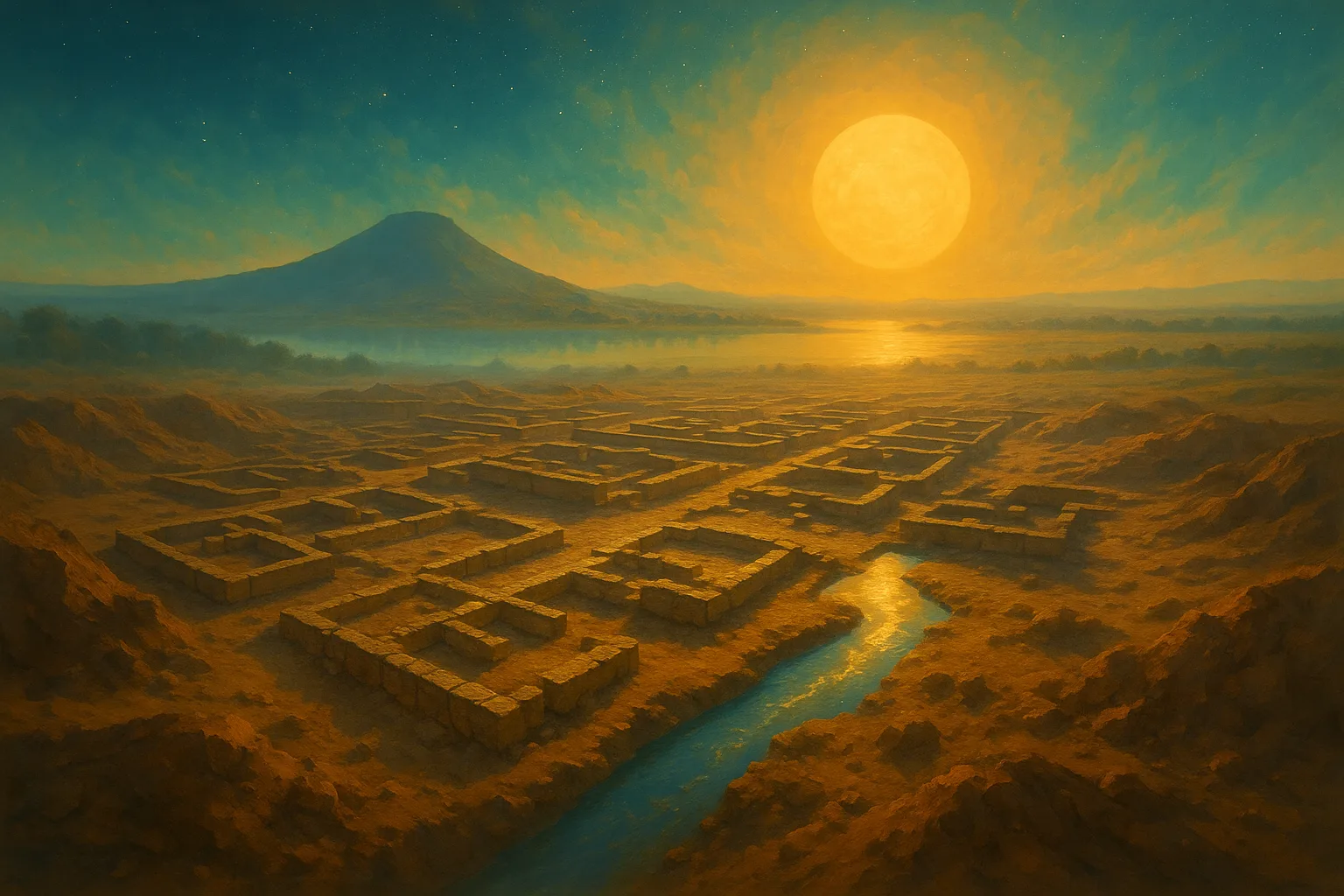
For centuries, the ancient city of Gabii lay silent beneath fields of volcanic soil east of Rome — a ghost woven into the landscape, whispered in the pages of Livy and Dionysius but forgotten by time. Once a rival city-state with a powerful civic identity and sacred topography, Gabii flourished long before Rome rose to dominate the region. Yet while Rome grew into the Republic and Empire, Gabii slipped into obscurity, its lakes drained, its sanctuaries buried, its civic memory reduced to myth.
Over the last decade, however, something extraordinary has happened: the ground has given way. Excavations have revealed an urban world shaped entirely around water — engineered, channeled, sanctified, and controlled with remarkable sophistication. Beneath layers of ash and soil, archaeologists are uncovering an ancient civic sanctuary built upon one of the most elaborate water systems in pre-Republican Italy.
This is the story of Gabii’s Lost Waters — and how their rediscovery is rewriting early Roman history.
A City Older Than Rome: The Forgotten Power of Gabii
Long before Rome claimed the Tiber Valley, Gabii stood as one of the most influential settlements in Latium. Positioned between two volcanic lakes — Lake Regillus to the east and the now-vanished Lake Gabinus to the west — Gabii thrived on a landscape shaped by fire and water. It was a natural crossroads between the eastern highlands and the emerging Latin cities near the coast.
Ancient sources describe Gabii as:
- A fortified stronghold
- A religious center of early Italic rites
- A rival or uneasy partner to early Rome
- A city tied to kingship, treaties, and priestly authority
Its alliance treaty with Rome, the Foedus Gabinum, was one of the oldest diplomatic compacts in Italian history — predating the Republic and associated with the semi-mythic Tarquin kings. The fact that Rome recognized Gabii’s sovereignty suggests it was not a backwater but a peer.
Yet despite its prominence in early literature, Gabii became a shadow — a name without a city, a story without ruins.
Until now.
Gabii Beneath the Soil: How a Volcanic Landscape Concealed a Civilization
The land east of Rome is not like the limestone hills that shape the city itself. Gabii sits on a plateau formed by long-dormant volcanoes and carved by seasonal water flow. For centuries, this terrain has been both fertile and treacherous. The same geological forces that created Gabii’s lakes also contributed to its burial.
When the city was abandoned between the 3rd and 1st centuries BCE, its buildings collapsed inward. Without maintenance, canals clogged, reservoirs filled with silt, and the once-lush lake retreating from the city slowly dried.
Over time, three forces sealed Gabii from memory:
- Volcanic ash and alluvial soil blanketed the abandoned plateau.
- A falling water table erased the city’s aquatic boundaries.
- Agricultural activity leveled surface traces of ancient structures.
Unlike Pompeii, where catastrophe preserved a moment in time, Gabii quietly dissolved into the land — absorbed layer by layer into the volcanic plain.
By the Middle Ages, it had become an invisible city.
By the Renaissance, even travelers who sought its ruins found almost nothing.
By the modern era, it was assumed lost.
That assumption is now being overturned.
Breaking the Surface: The Gabii Project and a New Archaeological Dawn
In 2009, a group of archaeologists from the University of Michigan launched the Gabii Project, one of the most ambitious excavations in Italy. Unlike earlier digs that focused on temples or monumental ruins, the team used digital mapping, geomagnetic surveys, and soil-penetrating radar to identify structures hidden beneath the surface.
What they found astonished them.
Beneath a flat field lay an entire urban grid, perfectly preserved:
- Streets aligned with the cardinal directions
- Insulae (urban blocks) shaped around water channels
- Subterranean reservoirs carved directly into bedrock
- Hydraulic installations integrated into domestic life
- A monumental civic building unlike anything in early Rome
For the first time, Gabii emerged not as a legend but as a planned water city, engineered centuries before Roman urban design reached similar levels of sophistication.
But the greatest surprise came next.
The Heart of the City: Rediscovering the Civic Sanctuary
In 2013, excavators uncovered the cornerstone of Gabii’s identity:
A vast civic sanctuary constructed around a complex system of water basins, channels, and ritual spaces.
The structure, now believed to be a hybrid civic-religious complex, contained:
- A large central courtyard paved with stone
- Hidden water channels feeding ritual basins
- Subterranean chambers likely used for civic rites
- Evidence of hydraulic control systems
- Steps leading down into a water-fed podium space
This was no ordinary temple.
It was an engineered environment — a hydro-architectural sanctuary.
Researchers believe it served multiple functions:
- Civic assemblies related to the governance of the city
- Ritual washings or purifications for political and religious elites
- Gathering pools that symbolized civic unity
- Priestly divination possibly tied to water omens or reflection rituals
The sanctuary’s location in the city center, its monumental scale, and its water infrastructure all point to one conclusion:
Gabii’s public life was inseparable from water.
Water was not merely a resource — it was a political symbol, a ritual medium, and a communal identity.
Engineering the Lakes: Gabii’s Water Mastery and the Vanished Basin
If Gabii was built around water, how exactly did it harness it?
Excavations reveal engineering that rivals the most advanced Etruscan and early Roman systems:
- Bedrock-cut cisterns with plastered interiors
- Overflow channels feeding downhill storage basins
- Subterranean conduits directing water to the sanctuary
- A system of retention pools that managed seasonal run-off
- Stone-lined drains running beneath entire streets
Archaeologists believe Gabii’s engineers sculpted their city between two lakes, using them to regulate water flow. One of these lakes — Lake Regillus — is known from ancient sources. The other, smaller lake — Lake Gabinus — has vanished entirely.
The disappearance of Lake Gabinus likely contributed to the city’s collapse:
- Without the lake, water levels dropped
- Ritual significance diminished
- Agricultural terraces dried
- Civic prestige eroded
By the late Republic, Gabii could no longer sustain the civic and ritual identity tied to its water. Rome, rising rapidly, absorbed its territory and institutions.
The waters dried.
The sanctuary emptied.
The city dissolved into soil.
What the Lost Waters Reveal: A New Understanding of Early Rome
The rediscovery of Gabii’s water sanctuaries is reshaping scholarly views of early Roman history.
Three major insights are emerging:
1. Rome was not the inevitable center of Latium: Gabii — older, wealthier, and strategically placed — may have been Rome’s peer or superior for centuries. Its urban planning is older and in some ways more advanced.
2. Early Italic religion centered on water far more deeply than believed: Gabii’s civic sanctuary shows that Italic people built civic identity around controlled water spaces — not just temples or altars.
3. Rome inherited and absorbed Gabii’s institutions: The Foedus Gabinum, early Roman priesthoods, and even some civic practices appear rooted in Gabii’s tradition.
As archaeologists uncover more water channels, ritual basins, and civic structures, it becomes clear that Gabii is not a minor footnote — it is a missing chapter in the birth of urban Rome.
The City Rises Again: Why Gabii Matters Today
Gabii is emerging as one of the most important archaeological sites in Italy, not because of a single discovery, but because the entire city has been preserved like a blueprint beneath the earth.
The lost waters of Gabii tell us:
- How ancient societies engineered their environments
- How urban identity was shaped by ritual and resource management
- How early Italic civilization evolved before Rome became dominant
- How cities can vanish not by catastrophe, but by slow environmental change
Most of all, the waters remind us that history is layered — and sometimes the oldest layers are the ones that speak the loudest when brought back into the light.
Gabii is rising again from the soil, block by block, basin by basin, revealing a forgotten world where water was sacred, civic life was ritualized, and engineering was an expression of identity.
The sanctuary of Gabii may have been silent for two millennia, but its lost waters are now flowing again — through the stories, discoveries, and revelations reshaping our understanding of Rome’s earliest world.
Sign up to receive Our Weekly Briefing Newsletter
Begin your journey with weekly insights designed to expand awareness and ground you in truth. Our free tier gives you a powerful introduction without any commitment.






Help Us Bypass Censorship. Share This.
Have questions?
At Great Awakening Report, we are dedicated to supporting your journey toward truth and enlightenment through our specialized Coaching and Consulting services.
Coaching Services: Our coaching programs are designed to guide you through personal awakening and transformation. We offer personalized sessions that focus on expanding consciousness, uncovering hidden truths, and fostering spiritual growth. Our experienced coaches provide the tools and insights necessary to navigate your path with clarity and confidence.
Consulting Services: For organizations and individuals seeking deeper understanding and strategic guidance, our consulting services offer expert analysis and solutions. We delve into areas such as global transitions, alternative news insights, and consciousness studies to provide comprehensive strategies tailored to your unique objectives.
Embark on a transformative journey with our Coaching and Consulting services, and unlock your highest potential. To learn more and schedule a session, visit our Coaching and Consulting pages.
Thank you
Thank you to our subscribers and readers for your continued support and dedication to truth and awakening. Your encouragement, engagement, and belief in our mission make everything we do possible. Together, we are expanding awareness and helping illuminate the path forward.
If you would like to further support the Great Awakening team and our ongoing efforts to share insight, knowledge, and truth, you can DONATE HERE.
With deep gratitude,
– Great Awakening Team
About the Author: Great Awakening Team

DISCLAIMER: All statements, claims, views and opinions that appear anywhere on this site, whether stated as theories or absolute facts, are always presented by The Great Awakening Report (GAR) as unverified—and should be personally fact checked and discerned by you, the reader.Any opinions or statements herein presented are not necessarily promoted, endorsed, or agreed to by GAR, those who work with GAR, or those who read or subscribe to GAR.Any belief or conclusion gleaned from content on this site is solely the responsibility of you the reader to substantiate.Any actions taken by those who read material on this site are solely the responsibility of the acting party.You are encouraged to think for yourself and do your own research.Nothing on this site is meant to be believed without question or personal appraisal.
COPYRIGHT DISCLAIMER: Citation of articles and authors in this report does not imply ownership. Works and images presented here fall under Fair Use Section 107 and are used for commentary on globally significant newsworthy events. Under Section 107 of the Copyright Act 1976, allowance is made for fair use for purposes such as criticism, comment, news reporting, teaching, scholarship, and research.
COMMUNITY GUIDELINES DISCLAIMER: The points of view and purpose of this video is not to bully or harass anybody, but rather share that opinion and thoughts with other like-minded individuals curious about the subject.