



















Help Us Bypass Censorship. Share This.
Sign up to receive Our Weekly Briefing Newsletter
Begin your journey with weekly insights designed to expand awareness and ground you in truth. Our free tier gives you a powerful introduction without any commitment.
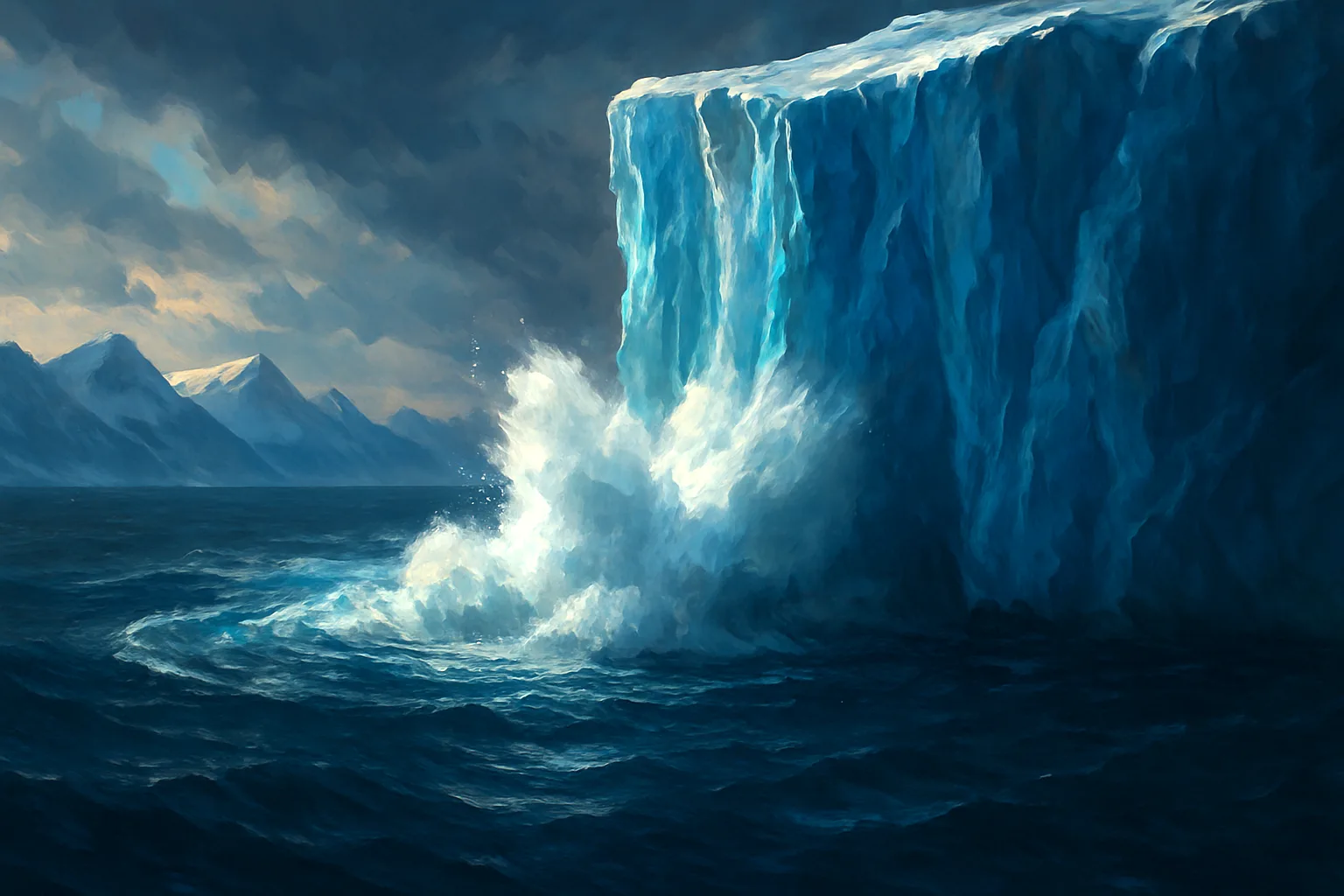
For decades, scientists have warned that Antarctica represents one of the most critical tipping points in Earth’s climate and geophysical systems. But a new wave of research from glaciologists and polar monitoring teams has delivered a stunning and sobering escalation: a key Antarctic glacier is now retreating ten times faster than anything previously recorded in the region’s history.
This revelation—based on high-resolution satellite data, autonomous underwater vehicles, deep-ice radar, and decades of comparative modeling—has set off alarm bells throughout the international scientific community. The rate of change is so extreme that researchers say it eclipses every prior estimate of how fast the continent could destabilize, signaling that parts of the West Antarctic Ice Sheet may be entering an accelerated phase of irreversible retreat.
A Rapid Shift Beneath the Ice
The glacier at the center of the study sits along a vulnerable stretch of West Antarctica, one of the most dynamic and unstable ice sectors on the planet. Using advanced radar capable of penetrating more than a kilometer of ice, scientists have mapped the movement of the grounding line—the critical point where land-based ice begins floating on the ocean. This line is key because once it retreats inland, the entire glacier becomes more prone to accelerated flow, thinning, and eventual collapse.
According to the new research, the grounding line of this glacier has pulled back at a rate ten times faster than historical averages show in the sedimentary and geologic record. That record spans thousands of years. Nothing comparable has been observed in modern scientific monitoring—or inferred from deep-ice history.
The cause? Warm, dense ocean currents circulating beneath the glacier’s floating shelf. These currents, which originate in deeper layers of the Southern Ocean, have pushed farther inland than previously believed, eroding the ice from below. This undercutting initiates a chain reaction: the ice shelf weakens, the glacier speeds up, more ice flows to sea, and the grounding line retreats even more rapidly.
Researchers describe it as “a runaway feedback loop.”
What Makes This Glacier So Important?
In earlier drafts, the argument was that “the system is built for yesterday’s threats.”
But that lets the system off the hook.
A more accurate framing is:
The system is not designed around today’s threats because it is entangled with the very forces that create them.
Not all Antarctic glaciers are created equal. This particular glacier is considered a keystone glacier—meaning its stability helps hold an entire section of the West Antarctic Ice Sheet in place. Once a keystone glacier destabilizes, it can trigger a domino effect across surrounding basins, accelerating retreat among neighboring glaciers and ice shelves.
According to the study:
- The glacier alone holds enough ice to contribute several inches of global sea-level rise.
- If its surrounding basin becomes destabilized, total potential sea-level contribution could measure in the feet, not inches.
- Its rapid retreat suggests that the West Antarctic Ice Sheet may be closer to a tipping cascade than expected.
Several models have warned that once grounding-line retreat begins on reverse-sloping bedrock (where the bed gets deeper inland), collapse can proceed far more rapidly than simple surface melt would suggest.
And based on the new data, that process appears to be well underway.
Why This Time Is Different
Antarctica’s glaciers naturally advance and retreat over long timescales. But this retreat is fundamentally different:
-
It’s far faster than any natural cycle on record.
Geological history shows no precedent for the speed observed today. -
It’s driven primarily by oceanic heat, not atmospheric warming.
This means that even if air temperatures stabilized, heat circulating in the Southern Ocean could continue driving retreat for decades. -
It signals a structural shift in Antarctic dynamics.
Scientists now believe portions of the ice sheet may have crossed internal thresholds that accelerate their own collapse. -
Models hadn’t predicted this pace—meaning risk estimates must be recalculated.
This is perhaps the most concerning aspect: Earth-system models used by governments and risk planners may be too conservative.
The Southern Ocean’s Changing Heat Patterns
One of the biggest revelations from the new research is how wrong earlier models were about heat transport near Antarctica. For years, scientists believed that a stable “cold water shield” protected the base of many ice shelves from the warm deep-water currents circling offshore. But new oceanographic surveys show this cold-water barrier is weakening.
What’s driving this?
- Stronger circumpolar winds pushing warm water toward the continent.
- A shift in ocean stratification—layers of warm and cold water mixing differently than before.
- Increased intrusion of warm modified Circumpolar Deep Water beneath ice shelves.
This warm water is highly efficient at melting ice from below. And because it moves silently and invisibly under the ice, its effects can accelerate long before surface changes are visible.
Consequences for Global Sea Levels
While the glacier’s rapid retreat won’t raise sea levels overnight, the implications are profound. Scientists estimate:
- If the glacier continues retreating at its current pace, it could shift from a “decades-long concern” to a near-term global issue.
- Its basin alone may contribute several inches to global sea levels this century.
- A destabilized West Antarctic Ice Sheet could ultimately add 3 to 10 feet over longer timescales.
For coastal cities—from Miami to New York, from London to Shanghai—these numbers are not abstract. They represent major economic, infrastructural, and humanitarian challenges.
Signals of a Wider Antarctic Trend
This glacier isn’t the only one in retreat. In the last decade:
- The Thwaites Glacier (“Doomsday Glacier”) has shown fractures across its supporting ice shelf.
- Pine Island Glacier has tripled its retreat rate.
- East Antarctic glaciers, once thought stable, are showing early signs of thinning in key sectors.
- The Ross and Filchner-Ronne ice shelves are experiencing subsurface melt zones larger than expected.
Scientists now believe the entire Antarctic system may be synchronizing into phase-wide instability, driven by shifting ocean patterns and increasingly vulnerable ice shelves.
Impact on Global Climate and Ocean Circulation
Rapid Antarctic melt doesn’t just raise sea levels—it can alter global climate behavior itself. Fresh meltwater entering the Southern Ocean affects:
- Thermohaline circulation, which drives global ocean currents.
- Sea-ice formation, changing reflectivity and heat absorption.
- Marine ecosystems, disrupting nutrient cycles and krill populations.
In extreme cases, massive freshwater input could slow major global currents—similar to concerns associated with Greenland’s melting and the Atlantic Meridional Overturning Circulation (AMOC).
What Scientists Are Saying
The tone from the research community is unusually urgent.
Some key sentiments:
- “We are witnessing changes that were once considered impossible this century.”
- “The glacier has entered a phase of retreat that may be irreversible.”
- “Our models underestimated the role of ocean heat. This forces a fundamental re-evaluation.”
- “Western Antarctica’s keystone glaciers are now showing coordinated retreat.”
This isn’t alarmism; it’s the scientific establishment openly acknowledging that Antarctic dynamics are moving faster than expected.
The Path Ahead
While the findings are troubling, they also provide clarity. The scientific community now has sharper data, clearer baselines, and more accurate methods for projecting near-term changes. Upcoming missions—including autonomous submersibles that can navigate beneath ice shelves—will gather critical details about subsurface melt mechanisms.
Governments, coastal planners, and climate risk agencies will need to integrate these updated Antarctic signals into:
- Flood planning
- Infrastructural development
- Insurance risk models
- Long-term geopolitical and economic planning
The pace of Antarctic change is no longer distant or theoretical. It is unfolding now, in real time.
The Bottom Line
The discovery that a major Antarctic glacier is retreating ten times faster than previously recorded marks a turning point in our understanding of Earth’s polar systems. It suggests that the long-feared destabilization of parts of the West Antarctic Ice Sheet may be underway—and accelerating.
Antarctica has always been a sleeping giant in Earth’s climate and ocean systems. This latest research indicates that the giant is not only waking—but moving rapidly.
Humanity’s coastal future, global ocean circulation, and planetary stability are all connected to what unfolds in the ice fields of the far south. And right now, that story is changing with unprecedented speed.
Sign up to receive Our Weekly Briefing Newsletter
Begin your journey with weekly insights designed to expand awareness and ground you in truth. Our free tier gives you a powerful introduction without any commitment.
STOP DROWNING IN THE NOISE. START SEEING THE TRUTH. Join over 99,000 truth seekers. Get the essential intelligence, alternative news, and disclosure updates that the mainstream media won’t touch.
Latest Reports
 Weekly ReportAwakening The Sleeping Giant · September 21st EditionSeptember 21, 2026
 Weekly ReportTruth Seekers Briefing · Master Class Connecting The Dots · September 18th EditionSeptember 18, 2026
 Weekly ReportAwakening The Sleeping Giant · September 14th EditionSeptember 14, 2026
 Monthly ReportSeptember 2026 • Volume IX • Chapter IXSeptember 7, 2026View all weekly reports
Special Reports
 Special ReportCreating A Conscious Culture · Part ISeptember 3, 2026
 Special ReportThe Great Healing: Detox, Defense & Sovereignty In an Engineered World · Part ISeptember 1, 2026
 Special ReportThe Newly Released Fauci DiariesAugust 8, 2026
 Special ReportPersonal Meditation Protocols for Manifestation Series · Part 1August 5, 2026View all special reports
Help Us Bypass Censorship. Share This.
Join the Discussion
Related Posts


Have questions?
At Great Awakening Report, we are dedicated to supporting your journey toward truth and enlightenment through our specialized Coaching and Consulting services.
Coaching Services: Our coaching programs are designed to guide you through personal awakening and transformation. We offer personalized sessions that focus on expanding consciousness, uncovering hidden truths, and fostering spiritual growth. Our experienced coaches provide the tools and insights necessary to navigate your path with clarity and confidence.
Consulting Services: For organizations and individuals seeking deeper understanding and strategic guidance, our consulting services offer expert analysis and solutions. We delve into areas such as global transitions, alternative news insights, and consciousness studies to provide comprehensive strategies tailored to your unique objectives.
Embark on a transformative journey with our Coaching and Consulting services, and unlock your highest potential. To learn more and schedule a session, visit our Coaching and Consulting pages.
Thank you
Thank you to our subscribers and readers for your continued support and dedication to truth and awakening. Your encouragement, engagement, and belief in our mission make everything we do possible. Together, we are expanding awareness and helping illuminate the path forward.
If you would like to further support the Great Awakening team and our ongoing efforts to share insight, knowledge, and truth, you can DONATE HERE.
With deep gratitude,
– Great Awakening Team
About the Author: Great Awakening Team

We are a community. We are cultural creatives and like minded people seeking the truth and focusing on disclosure, awakening and consciousness. Our focus is real news as researchers, reporters and truth seekers. We are here to teach, to spread the word, to serve and to help. We are a collective, a movement, free from all programing, not closed minded and not discriminatory. We are not political. We are not religious but we are spiritual. We study, research, and report on a wide range of subjects and topics, from the current geopolitical climate to health and wellness, from earth’s history to spiritual practices. We are forward thinkers and visionaries, we are guides for the transition as we usher in The Great Awakening.
THIS WEBSITE DOES NOT PROVIDE MEDICAL ADVICE: The information, including but not limited to text, graphics, images, and other material contained on this website, are for informational purposes only. No material on this site is intended to be a substitute for professional medical advice, diagnosis, or treatment. Always seek the advice of your physician or other qualified health care provider with any questions you may have regarding a medical condition or treatment and before undertaking a new health care regimen, and never disregard professional medical advice or delay in seeking it because of something you have read on this website.
DISCLAIMER: All statements, claims, views and opinions that appear anywhere on this site, whether stated as theories or absolute facts, are always presented by The Great Awakening Report (GAR) as unverified—and should be personally fact checked and discerned by you, the reader.Any opinions or statements herein presented are not necessarily promoted, endorsed, or agreed to by GAR, those who work with GAR, or those who read or subscribe to GAR.Any belief or conclusion gleaned from content on this site is solely the responsibility of you the reader to substantiate.Any actions taken by those who read material on this site are solely the responsibility of the acting party.You are encouraged to think for yourself and do your own research.Nothing on this site is meant to be believed without question or personal appraisal.
COPYRIGHT DISCLAIMER: Citation of articles and authors in this report does not imply ownership. Works and images presented here fall under Fair Use Section 107 and are used for commentary on globally significant newsworthy events. Under Section 107 of the Copyright Act 1976, allowance is made for fair use for purposes such as criticism, comment, news reporting, teaching, scholarship, and research.
COMMUNITY GUIDELINES DISCLAIMER: The points of view and purpose of this video is not to bully or harass anybody, but rather share that opinion and thoughts with other like-minded individuals curious about the subject.