





Help Us Bypass Censorship. Share This.
Sign up to receive Our Weekly Briefing Newsletter
Begin your journey with weekly insights designed to expand awareness and ground you in truth. Our free tier gives you a powerful introduction without any commitment.
Introduction — A Crisis That Doesn’t Announce Itself
Antimicrobial resistance is often framed as a looming future threat—something that may arrive if corrective action is not taken. In reality, it is already embedded in modern healthcare systems, advancing quietly and incrementally. Across hospitals, clinics, and long-term care facilities, infections that were once straightforward to treat are increasingly resistant to standard therapies. Treatments still exist, but they require longer courses, stronger drugs, and greater risk. This is not a hypothetical scenario—it is an ongoing structural shift.
At its core, antimicrobial resistance occurs when bacteria, viruses, fungi, and parasites adapt faster than the medications designed to suppress them. This adaptation is a natural biological process. What has changed is the scale and speed at which it now occurs. Industrial medicine, mass antibiotic use, agricultural practices, environmental exposure, and globalized supply chains have created ideal conditions for resistant organisms to emerge and spread. The result is not sudden collapse, but a gradual erosion of reliability.
What makes this crisis particularly destabilizing is its invisibility. There are no dramatic daily case counts, no single outbreak to point to, no clear moment when systems “fail.” Instead, options narrow quietly. Backup treatments become first-line therapies. Side effects increase. Procedures once considered routine carry higher risk. The system adapts—until it can no longer compensate.
Antibiotics underpin nearly every aspect of modern medicine, from surgery and trauma care to cancer treatment and organ transplantation. As resistance grows, the margin of safety across the entire medical ecosystem shrinks. Understanding antimicrobial resistance requires moving beyond institutional warnings and examining how complex systems behave under sustained pressure. Like many modern crises, it advances slowly enough to normalize dysfunction—until the cost becomes unavoidable.
The Rise of Drug-Resistant Pathogens
Drug-resistant organisms—often referred to as “superbugs”—are not rare anomalies. They are the predictable outcome of selective pressure applied at scale. When antimicrobials are used frequently, broadly, and sometimes unnecessarily, organisms that survive treatment gain a survival advantage. Over time, these traits spread.
Hospitals have become key environments where resistant strains concentrate. High antibiotic usage, vulnerable patient populations, invasive procedures, and dense contact networks create ideal conditions for adaptation. Resistant infections often lead to longer hospital stays, higher complication rates, and more aggressive treatment protocols. In many cases, older or more toxic drugs are reintroduced—not because they are optimal, but because few alternatives remain.
Outside clinical settings, resistance develops through environmental exposure as well. Antibiotics used in agriculture, wastewater contamination, and pharmaceutical runoff introduce low-level exposure that encourages gradual adaptation. Resistant organisms do not respect boundaries between hospitals, communities, or nations. Once established, they move easily through food systems, travel networks, and ecosystems.
This is not a failure of medicine—it is a biological response to pressure. The mistake lies in assuming that adaptation would not eventually outpace innovation.
How Resistance Accelerates — A Systemic Problem
Antimicrobial resistance is not driven by a single behavior or sector. It emerges from interacting systems.
In clinical care, antibiotics are often prescribed under uncertainty—used “just in case” or to meet patient expectations. In agriculture, they are deployed to prevent disease and increase yield in high-density environments. In the environment, residues persist and circulate. Each layer reinforces the next.
Modern medicine also depends heavily on speed and scale. Rapid patient turnover, standardized protocols, and efficiency metrics often discourage cautious restraint. Resistance, however, rewards restraint and long-term thinking—an uncomfortable mismatch.
Crucially, resistance does not require misuse to occur. Even appropriate use creates selective pressure. When combined across billions of doses, adaptation becomes inevitable. The question is not how to eliminate resistance entirely, but whether systems can slow it enough to maintain functional margins.
Healthcare Under Strain
Public Awareness Without Panic
Public understanding of antimicrobial resistance often oscillates between alarmism and apathy. Neither is useful.
The goal is not fear, but orientation. Resistance does not mean infections will become untreatable overnight. It means margins are shrinking. It means choices are narrowing. It means tradeoffs are increasing.
Individual behavior matters—completing prescribed courses, avoiding unnecessary antibiotics, supporting preventive care—but the issue cannot be solved at the individual level alone. It is embedded in how modern systems operate.
Awareness becomes meaningful when it informs design, not blame.
A Structural Reckoning
Antimicrobial resistance exposes a deeper truth about modern civilization: biological systems do not scale indefinitely without consequence. Efficiency, speed, and volume produce gains—until adaptation reverses them.
This is not unique to medicine. Similar patterns appear in agriculture, energy systems, finance, and ecology. Systems optimized for short-term output often generate long-term fragility.
In this sense, antimicrobial resistance is not just a medical issue. It is a systems signal—one that reveals the limits of control in complex, living environments.
Seeing the Silent Pandemic Clearly
The antimicrobial resistance crisis is already here—not as a sudden collapse, but as a quiet restructuring of risk.
Treatments still work. Medicine still advances. But the assumptions that once guaranteed reliability are weakening. The margin for error is thinner than it appears.
Understanding this moment does not require panic or ideology. It requires clarity. Resistance is not an anomaly—it is feedback. And feedback, when ignored, eventually becomes constraint.
The question facing modern medicine is not whether it can continue innovating, but whether it can adapt its relationship with biology itself. The answer will shape the future of healthcare—not through dramatic announcements, but through the outcomes we quietly normalize.
Sign up to receive Our Weekly Briefing Newsletter
Begin your journey with weekly insights designed to expand awareness and ground you in truth. Our free tier gives you a powerful introduction without any commitment.
STOP DROWNING IN THE NOISE. START SEEING THE TRUTH. Join over 99,000 truth seekers. Get the essential intelligence, alternative news, and disclosure updates that the mainstream media won’t touch.
Latest Reports
 Weekly ReportTruth Seekers Briefing · Master Class Connecting The Dots · September 18th EditionSeptember 18, 2026
 Weekly ReportAwakening The Sleeping Giant · September 14th EditionSeptember 14, 2026
 Monthly ReportSeptember 2026 • Volume IX • Chapter IXSeptember 7, 2026
 Weekly ReportAwakening The Sleeping Giant · September 7th EditionSeptember 7, 2026View all weekly reports
Special Reports
 Special ReportCreating A Conscious Culture · Part ISeptember 3, 2026
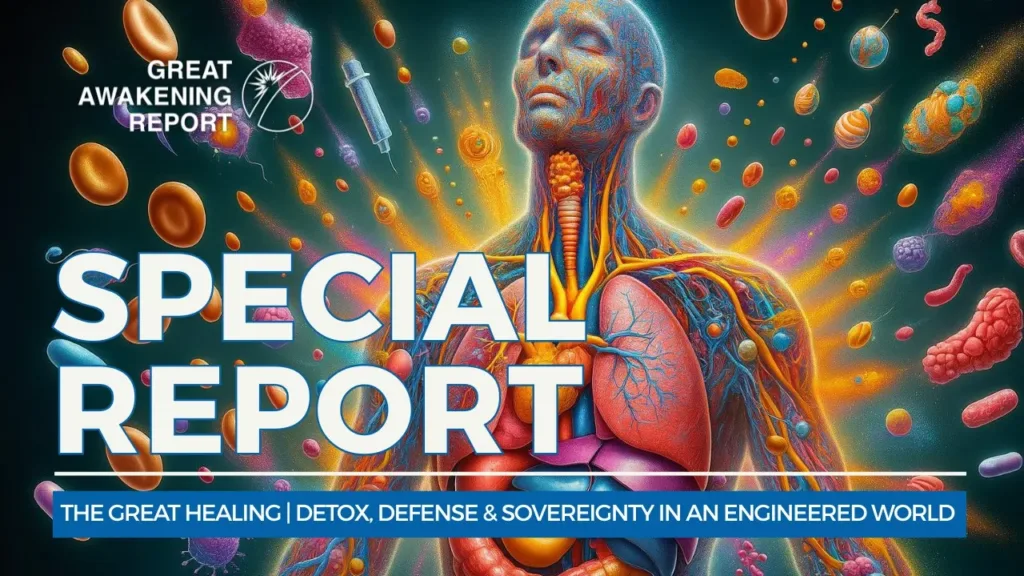
 Special ReportThe Great Healing: Detox, Defense & Sovereignty In an Engineered World · Part ISeptember 1, 2026
 Special ReportThe Newly Released Fauci DiariesAugust 8, 2026
 Special ReportPersonal Meditation Protocols for Manifestation Series · Part 1August 5, 2026View all special reports
Help Us Bypass Censorship. Share This.
Join the Discussion
Related Posts
Have questions?
At Great Awakening Report, we are dedicated to supporting your journey toward truth and enlightenment through our specialized Coaching and Consulting services.
Coaching Services: Our coaching programs are designed to guide you through personal awakening and transformation. We offer personalized sessions that focus on expanding consciousness, uncovering hidden truths, and fostering spiritual growth. Our experienced coaches provide the tools and insights necessary to navigate your path with clarity and confidence.
Consulting Services: For organizations and individuals seeking deeper understanding and strategic guidance, our consulting services offer expert analysis and solutions. We delve into areas such as global transitions, alternative news insights, and consciousness studies to provide comprehensive strategies tailored to your unique objectives.
Embark on a transformative journey with our Coaching and Consulting services, and unlock your highest potential. To learn more and schedule a session, visit our Coaching and Consulting pages.
Thank you
Thank you to our subscribers and readers for your continued support and dedication to truth and awakening. Your encouragement, engagement, and belief in our mission make everything we do possible. Together, we are expanding awareness and helping illuminate the path forward.
If you would like to further support the Great Awakening team and our ongoing efforts to share insight, knowledge, and truth, you can DONATE HERE.
With deep gratitude,
– Great Awakening Team
About the Author: Great Awakening Team

We are a community. We are cultural creatives and like minded people seeking the truth and focusing on disclosure, awakening and consciousness. Our focus is real news as researchers, reporters and truth seekers. We are here to teach, to spread the word, to serve and to help. We are a collective, a movement, free from all programing, not closed minded and not discriminatory. We are not political. We are not religious but we are spiritual. We study, research, and report on a wide range of subjects and topics, from the current geopolitical climate to health and wellness, from earth’s history to spiritual practices. We are forward thinkers and visionaries, we are guides for the transition as we usher in The Great Awakening.
THIS WEBSITE DOES NOT PROVIDE MEDICAL ADVICE: The information, including but not limited to text, graphics, images, and other material contained on this website, are for informational purposes only. No material on this site is intended to be a substitute for professional medical advice, diagnosis, or treatment. Always seek the advice of your physician or other qualified health care provider with any questions you may have regarding a medical condition or treatment and before undertaking a new health care regimen, and never disregard professional medical advice or delay in seeking it because of something you have read on this website.
DISCLAIMER: All statements, claims, views and opinions that appear anywhere on this site, whether stated as theories or absolute facts, are always presented by The Great Awakening Report (GAR) as unverified—and should be personally fact checked and discerned by you, the reader.Any opinions or statements herein presented are not necessarily promoted, endorsed, or agreed to by GAR, those who work with GAR, or those who read or subscribe to GAR.Any belief or conclusion gleaned from content on this site is solely the responsibility of you the reader to substantiate.Any actions taken by those who read material on this site are solely the responsibility of the acting party.You are encouraged to think for yourself and do your own research.Nothing on this site is meant to be believed without question or personal appraisal.
COPYRIGHT DISCLAIMER: Citation of articles and authors in this report does not imply ownership. Works and images presented here fall under Fair Use Section 107 and are used for commentary on globally significant newsworthy events. Under Section 107 of the Copyright Act 1976, allowance is made for fair use for purposes such as criticism, comment, news reporting, teaching, scholarship, and research.
COMMUNITY GUIDELINES DISCLAIMER: The points of view and purpose of this video is not to bully or harass anybody, but rather share that opinion and thoughts with other like-minded individuals curious about the subject.